John 1:43-51 – Follow Me

“Follow Me” by Greg Dampier. Jesus calls Peter and Andrew.

The next day Jesus decided to leave for Galilee. Finding Philip, he said to him, “Follow me.”

Philip, like Andrew and Peter, was from the town of Bethsaida. Philip found Nathanael and told him, “We have found the one Moses wrote about in the Law, and about whom the prophets also wrote—Jesus of Nazareth, the son of Joseph.”

“Nazareth! Can anything good come from there?” Nathanael asked.

“Come and see,” said Philip.

When Jesus saw Nathanael approaching, he said of him, “Here truly is an Israelite in whom there is no deceit.”

“How do you know me?” Nathanael asked.

Jesus answered, “I saw you while you were still under the fig tree before Philip called you.”

Then Nathanael declared, “Rabbi, you are the Son of God; you are the king of Israel.”

Jesus said, “You believe because I told you I saw you under the fig tree. You will see greater things than that.” He then added, “Very truly I tell you, you will see ‘heaven open, and the angels of God ascending and descending on’the Son of Man.” (New International Version)

I am a follower of Jesus. I have been for decades. I found, and continue to find, in Jesus Christ a compelling person full of grace, truth, and love.

But my early life was not characterized with knowing Christ. I certainly learned about Jesus, that this ancient guy lived an altruistic life, got tortured and killed on a cross, and that Christians believe in his resurrection from death. However, back then it was more like some strange history lesson. That information made no difference to me.

That is, until I heard a voice – not an audible one that others could hear. Yet, it was just a real as any daily conversation with another person. I heard the call of Jesus. The Ancient of Days showed up. I know with every epistemic fiber in my being that it wasn’t an undigested bit of beef, a blot of mustard, a crumb of cheese, a fragment of an underdone potato. I am sure beyond sure that there was more of an empty grave than gravy about my experience of the risen Christ.

I experienced the call of Jesus to “follow me.” And that is really, at its simplest, the call which continually goes out to all humanity. It is a gracious and merciful call. It isn’t a summons to experience a cataclysmic event of total belief in one fell swoop. Rather, it’s a call to belief that is much more an unfolding awareness of the deep spirituality and connection with the divine within.

“I am the light of the world. If you follow me, you won’t have to walk in darkness, because you will have the light that leads to life.”

Jesus (John 8:12, NLT)

Important to that faith process is another call to “come and see.” Whereas there are some Christian traditions which focus solely on a singular one-time experience of saving faith in Christ, the Gospel of John displays a drama of faith with multiple layers which people move through.

There is no egalitarian zap in which God grants total and immediate understanding. Instead, faith is an ever-increasing process. It is appropriate and biblical to say that our salvation has happened, is happening, and will happen. We follow, we come and see, and we keep following, keep coming, keep seeing more and more.

Like a muscle, our faith grows, develops, stretches, and strengthens over time. To use another metaphor, we ascend a stairway to heaven, one step at a time, day after day, following Jesus.

Methinks this is likely part of what Jesus was getting at with Nathaniel in today’s Gospel lesson. Nathaniel would have quickly picked up on the reference Jesus was making, way back to the first book of Genesis. The Jewish patriarch, Jacob, had an experience of seeing the angels of God on some celestial stairway, ascending and descending. It was an encounter of God’s presence with Jacob, assuring him of divine intervention into the muck of humanity. (Genesis 28:10-17)

Jesus connected that ancient portrait to himself so that Nathaniel would understand, would believe, that God has again broken into this world with a special divine presence. To look at Jesus and follow him, is to see and follow God.

Christ Jesus is the ultimate example and embodiment of God with us. Throughout John’s Gospel, Jesus presents himself as:

  • Living water – connecting to Jacob’s well (John 4:5-14)
  • The Temple of God – the place where the Lord dwells in all divine fullness (John 2:18-22)
  • Bread from heaven – linking the giving of manna to the Israelites in the desert (Exodus 16:4-7; John 6:1-59)
  • The good shepherd – fulfilling divine Old Testament imperatives of caring for people (Ezekiel 34:11-16; John 10:1-30)

In all these ways, and more, Jesus intentionally connects himself as fulfilling God’s ancient promises to people.

In whichever way we need to hear the call to follow, Jesus accommodates to us. For some, Christ comes knocking on the front door. For others, he enters the side door, or slips into the backdoor of our lives.

And, if we will come and see, Jesus will also accommodate us by being the authority over us, the teacher to us, or the friend beside us. The Lord Jesus shall shepherd us and woo us to the flock for guidance and protection.

However, Jesus comes to you, it most likely will be in ways we aren’t expecting. Surely, nothing good can come from Nazareth! Yet, it did. Can anything good come from Calcutta, India, or Juarez, Mexico, or Hoboken, New Jersey, or Milwaukee, Wisconsin, or even from a small rural area that doesn’t show up on a map? Yes, it can. Because with Jesus, God has entered this world, and, as it turns out, the Lord’s presence is everywhere.

Follow me. Come and see. Two of the simplest exhortations ever uttered. Yet, two of the most gracious phrases ever said, with profound implications for us beyond what we can fathom or imagine.

Guide us waking O Lord, and guard us sleeping; that awake we may watch with Christ and asleep we may rest in peace. May the shape of each day be formed by the pedantic following of my Lord; and may I come and see the wonders you have done, are doing, and will do. Almighty and merciful God – Father, Son and Holy Spirit – bless us and keep us. Amen.

Psalm 71:1-6 – How to Cope with Change and Loss

I run to you, Lord,
for protection.
    Don’t disappoint me.
You do what is right,
    so come to my rescue.
    Listen to my prayer
    and keep me safe.
Be my mighty rock,
    the place
where I can always run
    for protection.
Save me by your command!
    You are my mighty rock
    and my fortress.

Come and save me, Lord God,
    from vicious and cruel
    and brutal enemies!
I depend on you,
    and I have trusted you
    since I was young.
I have relied on you
    from the day I was born.
You brought me safely
through birth,
    and I always praise you. (Contemporary English Version)

No one gets off this planet without experiencing several events of change and loss, resulting in grief and the need to lament. Because of this reality, you would think we all acknowledge this great need of lamenting our significant losses. Yet, we don’t.

Many Christians avoid grief work. The following are just a few of the statements I’ve heard over the decades from parishioners when they experience loss:

  • “Christ is resurrected and alive. There’s victory in Jesus. No need to grieve like unbelievers.”
  • “My loved one is in heaven. No more suffering or pain. It would be selfish of me to be sad.”
  • “It’s a sin to be depressed.”
  • “I can’t let myself cry and fall apart. I need to be strong for my family.”

Those statements are very far from what we find in the biblical psalms and throughout the entirety of Holy Scripture. Consider these realities in the Bible:

  • 62 out of the 150 Psalms in the Old Testament are laments; some are communal, many are individual expressions of grief.
  • God laments. And God grieves with us. (Genesis 6:5-6; Isaiah 53:4; John 11:1-44)
  • An extended time and process of grieving was practiced by biblical characters when loss occurred. It was a normal emotional, spiritual, physical, and relational reaction to that loss. (e.g., Genesis 50:1-3)
  • Lament is an intentional process of letting go of relationships and dreams and discovering how to live into a new identity after the loss or change. There’s even an entire book of the Bible given to lamenting: Lamentations.
  • Everyone’s grief is personal; there is no one size fits all.
  • Avoiding grief, mourning, lament, and loss is totally foreign to the Bible.

Psalms of lament have a characteristic structure, distinct from psalms of praise, trust, or wisdom, like today’s psalm:

  1. Address to God: The address is usually a brief cry for help; and is occasionally expanded to include a statement of praise or a recollection of God’s intervention in the past (Psalm 71:1-3).
  2. Complaint: God is informed about the problem or experience through a range and depth of emotional, relational, and spiritual reactions to change (Psalm 71:4).
  3. Confession of Trust: The psalmist remains confident in God despite the circumstances and begins to see his or her problems differently (Psalm 71:5-8).
  4. Petition: Filled with confidence in God, the psalmist appeals to God for deliverance and intervention.  Petitioning is not bargaining with God or a refusal to accept loss; it is a legitimate seeking of help (Psalm 71:9-13).
  5. Words of Assurance: The psalmist expresses certainty that the petition will be heard by God (Psalm 71:14a).
  6. Vow of Praise: The lament concludes with the psalmist’s vow to testify to what God will do or has done through praise (Psalm 71:14b-24).

The biblical psalms do two wonderful services for us as God’s people: First, a constant stream of reading, quoting, memorizing, and meditating on them actually shapes our faith into a full-orbed, mature, and robust belief. Second, the psalms provide us with a healthy means of expressing the complete range of our human experience. 

So, then, the psalms both reflect our feelings, and, at the same time, form those feelings to know God better, cope with situations, and relate appropriately with others. 

The fourth-century Bishop of Alexandria, Athanasius, had it right about the psalms when he said: 

“Whatever your particular need or trouble, from this same book [the Psalms] you can select a form of words to fit it, so that you not merely hear and pass on, but learn the way to remedy your ill.”

St. Athanasius (297-373 C.E.), Bishop of Alexandria

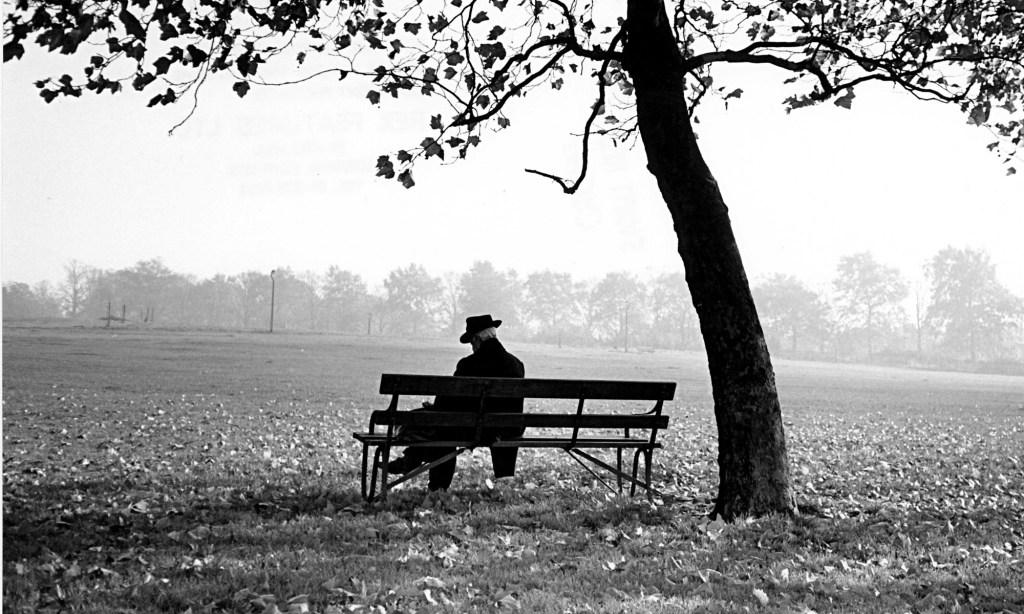
Today’s psalm of lament is the expression of a person getting along in years and discovering all the limitations and weaknesses that go along with aging. It is a plea for help. Whereas in younger days the psalmist had the vigor to engage problems and enemies, now he has the realization that he must increasingly depend upon God (and others).  

Far too many people hitting the aging process do not deal with it well. The change to their bodies, even their minds, is so unwelcome that they do not cope quickly, or, sometimes, at all. They believe it silly to lament such a natural occurrence, even though those physical changes dog them day after day.

Based upon the psalms, I insist that lament is a powerful and necessary form of coming to grips with change. God has not promised us life-long health and constant energy. Rather, the Lord has promised to be with us as our refuge and help through all the vicissitudes of changing health and altered situations. 

Let praying the psalms, then, be a regimen as familiar and daily as your using your pill planner and taking your meds.

Ever-watchful God, you are a rock of refuge, a never changing reality in a world of constant change. You are my hope, Lord, and my faith has been in you all my life. I lament all the difficult changes I encounter. I can never go back to the way things were. So, please open to me a new reality where fresh hope and life can be found, through Jesus Christ my Savior. Amen.

Psalm 145 – Some Solid Robust Theology

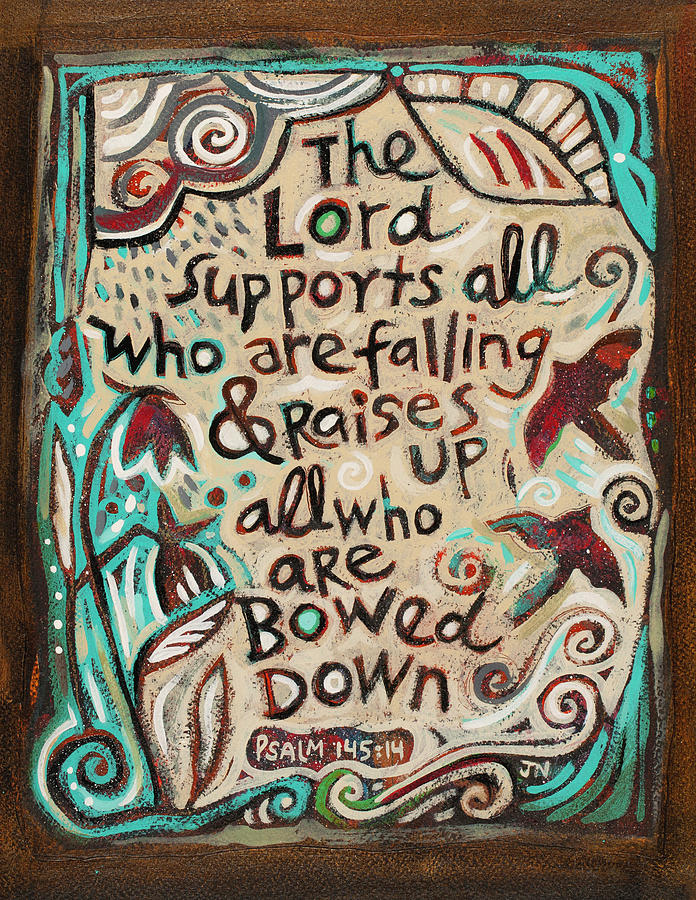
Psalm 145:14 by Jen Norton

I will praise you,
my God and King,
    and always honor your name.
I will praise you each day
    and always honor your name.
You are wonderful, Lord,
    and you deserve all praise,
because you are much greater
    than anyone can understand.

Each generation will announce
to the next
    your wonderful
    and powerful deeds.
I will keep thinking about
your marvelous glory
    and your mighty miracles.
Everyone will talk about
    your fearsome deeds,
    and I will tell all nations
    how great you are.
They will celebrate and sing
    about your matchless mercy
    and your power to save.

You are merciful, Lord!
    You are kind and patient
    and always loving.
You are good to everyone,
    and you take care
    of all your creation.

All creation will thank you,
    and your loyal people
    will praise you.
They will tell about
    your marvelous kingdom
    and your power.
Then everyone will know about
    the mighty things you do
    and your glorious kingdom.
Your kingdom will never end,
    and you will rule forever.

Our Lord, you keep your word
    and do everything you say.
When someone stumbles or falls,
    you give a helping hand.
Everyone depends on you,
and when the time is right,
    you provide them with food.
By your own hand
    you satisfy
    the desires of all who live.

Our Lord, everything you do
    is kind and thoughtful,
    and you are near to everyone
    whose prayers are sincere.
You satisfy the desires
    of all your worshipers,
    and you come to save them
    when they ask for help.
You take care of everyone
who loves you,
    but you destroy the wicked.

I will praise you, Lord,
    and everyone will respect
    your holy name forever. (Contemporary English Version)

These days, everywhere I go there is high anxiety, even downright fear. In my city, the highest murder rate in its history marked the past year. In the hospital for which I am the chaplain, the coronavirus with all its deathly strains is bringing grief and bereavement to many families. Within many churches, their future viability is in question, and parishioners wonder about the future.

When there seems to be no light at the end of the tunnel, with apprehension and stress as the very air we breathe, there is an angle to the whole situation the psalmist wants us to consider. We are to give weight and consideration to some solid robust theology.

Everyone has a theology. All persons have some sort of understanding of a god, G-d, or no god at all. In the hard circumstances of life, it might seem as if our theology isn’t serving us well. We may feel as if G-d is aloof, distant, or just plain disinterested. So, let’s pay attention to the psalmist. Notice his theology….

The Lord saves… is merciful… powerful… kind… patient… loving… and good. G-d keeps divine promises… helps… gives… provides… protects… and is near to those who humbly seek the divine. In short, the Lord cares for all creation and all creatures, including you and me, and tackles injustice like a hefty linebacker on a string-bean running back.

Yes, G-d deserves all praise, glory, and honor because standing behind all the anxiety of the age is a very large deity who acts with good purpose.

Let this psalm (and the entire psalter) buoy you up with good solid theology because the Lord is righteous in all dealings and is present to all who call for help. G-d hears. G-d responds. Perhaps neither according to our idea of timeliness nor to our expectation. Yet, deliverance is at hand, even if it comes in a form different than we were anticipating.

I am taking time to read today’s psalm several times over, to let it awash my soul with significant doses of truth and mercy. There are simply times when all of us need to remember and be reminded that there is a G-d in heaven who is willing and able, as well as a friend close at hand. 

True human satisfaction does not come through personal ingenuity or accumulation of more knowledge or more stuff.  Rather, our deepest desires and needs are fulfilled in the G-d who cares.

Anxiety, stress, fear, and apprehension don’t simply melt away. We, like the psalmist, need to practice the active verbs within the text: I will praise you… I will always honor your name… I will keep thinking about your marvelous glory and miracles… I will tell all nations how great you are… because the Lord saves and satisfies.

May that be your experience today, and every day.

Mighty G-d, you are both far and near, totally above us, yet close at hand.  Preserve me with your mighty power so that I might not fall into sin, nor be overcome by adversity. But in all I do direct me to the fulfilling of your purposes through Jesus Christ, my Lord.  Amen.

Psalm 80:1-7 – Restore Us

Give ear, O Shepherd of Israel,
    you who lead Joseph like a flock!
You who are enthroned upon the cherubim, shine forth
    before Ephraim and Benjamin and Manasseh.
Stir up your might,
    and come to save us!

Restore us, O God;
    let your face shine, that we may be saved.

O Lord God of hosts,
    how long will you be angry with your people’s prayers?
You have fed them with the bread of tears,
    and given them tears to drink in full measure.
You make us the scorn of our neighbors;
    our enemies laugh among themselves.

Restore us, O God of hosts;
    let your face shine, that we may be saved. (New Revised Standard Version)

Restoration is a beautiful thing. I don’t often watch makeover shows on television. But if I’m channel surfing and see an old house, appearing ready for the wrecking ball, getting restored to its original charm and beauty, I’m hooked. We resonate deeply with things being repaired and rejuvenated, as if it is brand new.

For that to occur, someone needs to have a vision to see the old become new. If not, then the drab discouragement of a gray and dreary environment can easily take over. We then forget the original shine of how things once were to the point where we cannot even imagine that it’s worth salvaging. 

In the context of today’s psalm, God’s people once enjoyed the covenant and the promises of God. But over time, the relationship was not maintained and cared for. So, the people gradually slid into disrepair. Centuries of sheer neglect brought a situation where it seemed the only recourse was to raze everything and begin again.

The psalms have been the prayer book of God’s people for over three millennia. Suffering and hard circumstances provide the backdrop for many of them. Sometimes the difficulty is external – another nation oppressing the people. Yet other times, like in today’s psalm, the problem is internal – sheer neglect of God’s commands over time. It went on to the point that God’s longsuffering ran out.

I would much rather enjoy God’s favor than God’s disappointing anger. To begin addressing any sort of spiritual neglect, the work of prayer becomes the tool we need. Restoring broken lives and broken communities to their original beauty starts with prayer and praise, offered daily and often. 

Seven times a day I praise you
    for your righteous laws. (Psalm 119:164, NIV)

What’s more, our tears, which seem, at times, to be our daily bread, are a kind of baptismal offering to God – prayers coming through groans which words cannot express. Even with our prayers, the Lord is gracious to help us with the requests themselves and not just the answers.

And the Holy Spirit helps us in our weakness. For example, we don’t know what God wants us to pray for. But the Holy Spirit prays for us with groanings that cannot be expressed in words. (Romans 8:26, NLT)

God is waiting for us to approach the throne of grace with confidence. And we must keep coming to the Lord, again and again. 

Jesus understands every weakness of ours because he was tempted in every way that we are. But he did not sin! So whenever we are in need, we should come bravely before the throne of our merciful God. There we will be treated with undeserved kindness, and we will find help. (Hebrews 4:15-16, CEV)

Like the continual routine of using the hammer, pounding nail after nail, so we must offer our prayers morning, noon, and night, day after day, crying out to God with the great cry of the church: Restore us, O God; let your face shine, that we may be saved!

May the hope of Advent, the love of God in Christ, and the encouragement of the Holy Spirit restore your soul and enliven your spirit, now and forever. Amen.

O loving and gracious God, bring restoration to my life, to my church, to my family, to my workplace, and to my community.  Things are not as they once were.  Send your Holy Spirit so that we might enjoy seasons of blessing again.  Restore, renew, revive and rejuvenate our disordered churches.  May your face shine upon us once again through the mighty name of Jesus.  Amen.