Psalm 23 – I Have Everything I Need

Psalm 23 by John August Swanson, 2010

The Lord is my shepherd;
    I have everything I need.
He lets me rest in fields of green grass
    and leads me to quiet pools of fresh water.
He gives me new strength.
He guides me in the right paths,
    as he has promised.
Even if I go through the deepest darkness,
    I will not be afraid, Lord,
    for you are with me.
Your shepherd’s rod and staff protect me.

You prepare a banquet for me,
    where all my enemies can see me;
you welcome me as an honored guest
    and fill my cup to the brim.
I know that your goodness and love will be with me all my life;
    and your house will be my home as long as I live. (Good News Translation)

I once had a neighbor named Art. Art was a shepherd. He spent a good chunk of his day, every day, leading his sheep around his five acres of property across the road from me. On occasion, Art would politely ask if some of his sheep could come to my backyard and feed on some of the wild plants that were in abundance. I was amazed how “artfully” he cared for his sheep.

Sheep get a bad rap, in my opinion. I have often heard others refer to them as stupid. Having grown up on a farm, I realize there are animals that are not so bright. Sheep aren’t one of them. Cows, however, are. I think when God created cows the raccoons came along and stole some of their brains. 

There’s a reason sheep possess the reputation of lacking smarts – they are prone to being afraid. Sheep get spooked and upset easily. And, when they are skittish and scared, sheep tend to panic.

More than once I’ve seen a flock of sheep run full-steam head-first into a stone wall. If you don’t know much about sheep and come along and see this, they most certainly appear to be downright stupid. Yet, sheep are really, quite intelligent.  It’s just when fear overcomes them, they can do some nonsensical things.
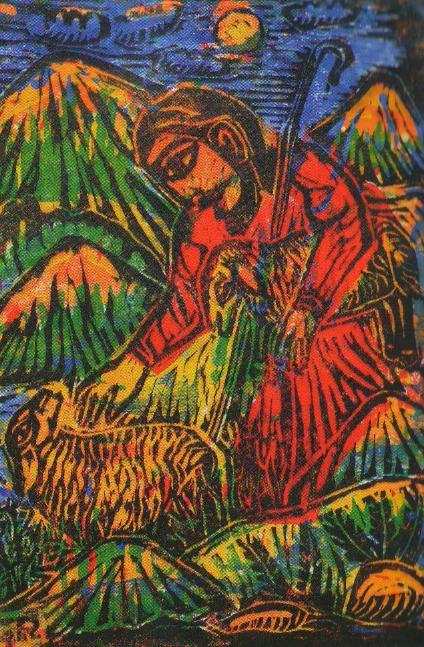
Jesus the Good Shepherd by Solomon Raj

The presence of a faithful shepherd makes all the difference.

Sheep become familiar with their shepherd and learn to depend on them. There were times that Art had to leave the sheep alone and I would do a sort of babysit with them. Around me the sheep were cautious and had their guard up. The presence of anxiety was clear. But when Art showed up, he didn’t have to say a word. I could feel and observe the flock collectively relaxing.

God Pastors

God is the ultimate shepherd of the sheep. Jesus is the Good Shepherd. When we sense the presence of God’s Spirit, there is faith, trust, and confidence. This, then, brings a settled conviction of calm and comfort. Whenever that sense is absent, we do things like buy two pallets of toilet paper and try to bring it home in a compact car. It’s non-sense.

Psalm 23 is a beloved portion of Holy Scripture for a reason; it helps us as sheep to settle down and trust, even in the middle of uncertainty and anxiety. 

God’s presence + God’s provision + God’s protection = God’s providential care. God’s presence is constant, not sporadic; his provision is enough, not stingy; and his protection is total, not partial.

To know and feel God’s presence watching over us and giving generously to us is the very balm we need. It melts our fear in the face of adversity and opposition; it helps us relax in tough economic times; and it inoculates us from believing the sky is falling. 

Our courage and confidence cannot be ginned-up through sheer willpower; it comes as we get to know the great shepherd of the sheep standing there watching over us with compassionate and competent care.

God Provides

God is personal, not generic. God is the great “I AM,” the God who is. The Lord is my shepherd – not was or will be – is. God is not just somebody else’s God and shepherd, but my shepherd. 
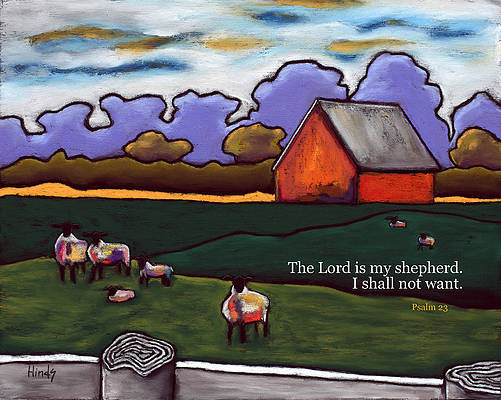
The Lord is My Shepherd by David Hinds

Shepherd is an apt term because a shepherd cares for the sheep – watches over them, is present with them, protects them, and provides whatever they need to both survive and thrive.

God benevolently leads us; and does not act outside of his character and attributes. If we believe this about the great “I AM,” then worry and anxiety begins to diminish. Too many of us suffer from the heebie-jeebies because we don’t see the shepherd standing in the field watching over us.

The answer to our worry is not to keep telling ourselves to stop being anxious. With God on the job as shepherd, I shall not be in want; I have everything I need. 

Troubled times will always be with us, this side of heaven. Fear can grab hold and prevent us from living with settled intentions and reasonable plans toward the future. Every day we see folks running headlong into a stone wall. 

It’s okay to be afraid; it is not okay to let fear rule our lives. The solution is to speak, despite your fear; to act, despite your worry; to live, knowing God has your back.

God Is Present

Within much of Hebrew poetry, the focus of the writing is found smack in the middle. Everything before it builds toward it; everything after it points back. Smack in the middle of Psalm 23 is that God is with us. 

Even though I walk through the valley of the shadow of death, even though it may seem that everything is bleak and that all things are against me – God is with me, which is why I do not succumb to fear. 

We walk through the valley, not around it. God does not cause us to avoid difficult circumstances. Instead, God promises to be with us through them. The way to deliverance is to confront our fears and walk with God, rather than expecting God to take away everything unpleasant that we don’t like.

My neighbor Art had a shepherd’s crook. He mostly used it as a walking stick. Yet, I did see times when he fended-off predators seeking to get to the sheep. More often, Art used his shepherd’s crook as a way of guiding the sheep where they could feed and be protected. 

The discovery of God’s guidance comes from movement and creativity. We aren’t going to experience the leading we want apart from embracing the uncomfortable in the confidence that God provides and protects through the trouble, and not apart from it.
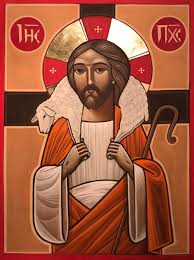
Coptic Church icon of Jesus the Good Shepherd

God Protects

Even with enemies of disease, death, and disorder surrounding us, God’s presence is such that his protection and provision are providentially working to create blessing in the middle of trouble. Whereas fear and panic believe in a culture of scarcity, a culture of abundance discerns that there is plenty for all – and will thus work toward equitable distribution and fostering an egalitarian spirit.

God refreshes, encourages, and restores. There are abundant blessings – even within troubled times. God’s provision is right here, amidst the worst of circumstances. We don’t have to pick a fight with someone in the Costco parking lot, who has what I want, to get the things we need.

It’s easy to believe that God’s goodness and love will follow me when my health is good, my income is solid, and I have plenty of friends around me. It is another thing to have an awareness of that goodness in dark days.  Yet, God’s love and goodness hasn’t sequestered itself.  God providentially uses each life situation and bends it to redemptive purposes.

Experientially knowing God brings contentment and confidence. The radical nature of Psalm 23 is that peace is realized while chaos and uncertainty is all around. Establishing spiritual practices that reinforce our sense of security can aid us through difficulty and hardship.

With a settled conviction that God indeed has our backs and stands as the divine sentinel watching over the beloved sheep, we find the ability to relax and trust that all is well with my soul.

Lord, help me to relax.

Take from me the tension
that makes peace impossible.
Take from me the fears
that do not allow me to venture.
Take from me the worries
that blind my sight.
Take from me the distress
that hides your joy.

Help me to know
that I am with you,
that I am in your care,
that I am in your love,
that you and I are one,

Through the mighty name of Jesus,

In the power of the Holy Spirit. 

Amen.

Psalm 121 – The Divine Helper

I lift up my eyes to the hills—
    from where will my help come?
My help comes from the Lord,
    who made heaven and earth.

He will not let your foot be moved;
    he who keeps you will not slumber.
He who keeps Israel
    will neither slumber nor sleep.

The Lord is your keeper;
    the Lord is your shade at your right hand.
The sun shall not strike you by day,
    nor the moon by night.

The Lord will keep you from all evil;
    he will keep your life.
The Lord will keep
    your going out and your coming in
    from this time on and forevermore. (New Revised Standard Version)

Not a one of us gets off this planet without needing help – a lot of help! Even people who are in helping professions or who identify themselves primarily as helpers need help themselves.

There is no such thing as complete, total, and irrevocable independence. We as humans are hard-wired by our Creator for community. We only find our greatest fulfillment within interdependent relationships, and only discover our highest happiness in a dependent relationship to God.

To need others, and especially God, is not a weakness. It’s a sign of sage awareness and confident strength whenever we assess that help is needed. Only the fool goes it alone, believing they can pull themselves up by their bootstraps. “God helps those who help themselves,” was originated by Ben Franklin, not Holy Scripture.

So, the real question is: To whom and to where do we go for help? Who do we consult? With whom do we collaborate?

The most important step any of us can make is to realize that our own personal resources are inadequate, and that we admit, “I need help with this.” The next most important step is to go to the right source for that help.

The psalmist insists that the Lord is our helper, our keeper. Keeping is a large part of helping. God as our Divine Keeper means that the Lord watches over us, guards our lives, and seeks to preserve us from harm, wrongdoing, injustice, and oppression.

The very identity of God is wrapped up in being a Protector, Guard, and Watchkeeper. The Lord shields and shelters us, much like a mother hen over her chicks. God watches over us, just as a watchman keeps guard over a city at night when the residents are sleeping. And since the Lord is everywhere present, there is a continual divine presence in all of our life journeys. The dangers of both the day and the night are no match for the God who is our Keeper.

The promises of safety in today’s psalm are not meant to suggest that those who walk in the shelter of God will never endure harm or that nothing ill will ever befall them. The Psalter knows all too well that the wicked are everywhere and that they thrive unjustly.

Rather, these divine promises are general promises—they are blessings God does for those who rely on the Lord, call upon God’s name, and seek divine help. We are to have a continual awareness of God’s presence in this world. Although we are not inoculated from pain, God is always with us in our hurt and bewilderment.

It can be hard to ask for help. Our pride, stubbornness, and independence might cause us to experience harm rather than seek assistance.

Be specific about the help needed. The following are some “helpful” ways of approaching God by answering some basic newsgathering type questions. The goal isn’t to convince the Lord to help us, but rather to enable us in connecting with what we truly need and being specific about God’s assistance for us or for others:

Who? 

Who needs help? Clarify if the help is for yourself, another, or a group of people.

When Jesus had entered Capernaum, a centurion came to him, asking for help. “Lord,” he said, “my servant lies at home paralyzed, suffering terribly.”

Jesus said to him, “Shall I come and heal him?”

The centurion replied, “Lord, I do not deserve to have you come under my roof. But just say the word, and my servant will be healed. (Matthew 8:5-8, NIV)

How? 

How will God’s action help? God is an expert listener. Tell the story of what you have tried already and where you fall short.

Jesus asked the boy’s father, “How long has he been like this?”

“From childhood,” he answered. “It has often thrown him into fire or water to kill him. But if you can do anything, take pity on us and help us.”

“‘If you can’?” said Jesus. “Everything is possible for one who believes.”

Immediately the boy’s father exclaimed, “I do believe; help me overcome my unbelief!” (Mark 9:21-24, NIV)

Why? 

Why are you soliciting God’s help? Explain what’s going on and the reasons why you believe the Lord is the One to help. Mention the divine attributes and actions of God, as well as your own personal connection.

Then Asa called to the Lord his God and said, “Lord, there is no one like you to help the powerless against the mighty. Help us, Lord our God, for we rely on you, and in your name we have come against this vast army. Lord, you are our God; do not let mere mortals prevail against you.” (2 Chronicles 14:11, NIV)

Where? 

Where is the help needed? Is it a geographical location, a specific spot in the human body, or a place such as a building or home?

Jesus left the synagogue and went to the home of Simon. Now Simon’s mother-in-law was suffering from a high fever, and they asked Jesus to help her. So, he bent over her and rebuked the fever, and it left her. She got up at once and began to wait on them. (Luke 4:37-39, NIV)

When? 

When do you need help? Immediately? Tomorrow? At a specific time?

O Lord, God of my salvation,
    when, at night, I cry out in your presence,
let my prayer come before you;
    incline your ear to my cry.

For my soul is full of troubles,
    and my life draws near to Sheol. (Psalm 88:1-3, NRSV)

What? 

What, exactly, is the need? Spell out what you want in detail, holding nothing back. Don’t be concerned about the words or saying it right. Speak in your own plain language.

Help, O Lord, for the godly are fast disappearing!
    The faithful have vanished from the earth!
Neighbors lie to each other,
    speaking with flattering lips and deceitful hearts.
May the Lord cut off their flattering lips
    and silence their boastful tongues. (Psalm 12:1-3, NLT)

May you find the help you need today and every day, in Jesus’ name. Amen.

Luke 24:36-40 – Peace Be with You

Jesus Shows Himself to Thomas by Rowan and Irene LeCompte, National Cathedral, Washington, D.C.

While they were still talking about this, Jesus himself stood among them and said to them, “Peace be with you.”

They were startled and frightened, thinking they saw a ghost. He said to them, “Why are you troubled, and why do doubts rise in your minds? Look at my hands and my feet. It is I myself! Touch me and see; a ghost does not have flesh and bones, as you see I have.”

When he had said this, he showed them his hands and feet. (New International Version)

Christ’s disciples were abuzz. Two dudes showed up and told eleven of the original disciples that they had seen and talked to Jesus himself! This was a lot to wrap both their heads and their hearts around. Maybe they dared to hope it was true.

Peter and John encountered an empty tomb. Now these guys from Emmaus are giving this wild testimony of a risen Savior. Into the weird mix of doubt, curiosity, grief, hope, wondering, and outright confusion, Jesus materializes out of the blue and says, “Peace be with you.”

Already feeling unsettled and uncertain, the disciples had anything but a peaceful response to the presence of their Lord. Startled, troubled, and frightened they were, as if somebody had just dropped a skunk into the room.

Why the fear? Why not be overjoyed or overcome with sheer delight at seeing Jesus?

The disciples were caught off guard, as if they had zero expectation of seeing Jesus. Believing him to be dead, they immediately went to thinking this was some ghost. After all, the door was locked. Nobody could have gotten into the room without the disciples knowing it. (John 20:19)

As it turns out, faith and belief are not uniform static terms. There are layers to faith. Yes, the disciples really did believe, and their faith developed over time with Jesus. However, their belief had not yet come to full bloom. So, in this sense, they still possessed a lack of faith and were rebuked by Jesus for it. (Mark 16:14)

A full-orbed belief in the Lord Jesus Christ is more than words, more than making professions, and more than signing-off on a doctrinal statement of faith. Faith is shown for what it is through our actions. (James 1:19- 2:26)

Faith comes to fruition when the head, the heart, and the hands all align together and conspire to proclaim the gospel in thought, word, and deed. If they are misaligned or incongruent with each other, then that faith is inadequate. There is yet another level to the belief which needs to emerge.

Perhaps this is instructive for people today. While maintaining beliefs about the person and work of Jesus, and acknowledging Christ’s death and resurrection, some Christians live as though he had never risen from the grave. If Jesus were to suddenly show up and say, “Peace be with you,” like a startled puppy, they’d likely have an accident on the floor.

As Jesus had done so many times before in his earthly ministry, he invited the disciples to experience him in a real, tangible, visceral way. This is no ghost. This is a Christ who has physical flesh and bones. You can eat with this Jesus, real food and drink. Look at his hands and feet. Touch and feel them if you must. But, by all means, believe!

Jesus came to give them, and us, peace. Peace is more than a greeting, more than the absence of conflict or anxiety. It is to enjoy harmony with self, others, and God. Peace is wholeness and integrity of being, even when all is going to hell around us.

A child is born to us, a son is given to us,
    and authority will be on his shoulders.
    He will be named
    Wonderful Counselor, Mighty God,
    Eternal Father, Prince of Peace.
There will be vast authority and endless peace
    for David’s throne and for his kingdom,
    establishing and sustaining it
    with justice and righteousness
    now and forever. (Isaiah 9:6-7, CEB)

The peace of God is closely associated with the presence of God. And so, conversely, the lack of peace is to experience a sense of divine absence. God’s peace and presence are inseparable. It is, therefore, no surprise that Jesus demonstrated his actual physical presence and spoke to the disciples about peace.

On the evening of that first day of the week, when the disciples were together, with the doors locked in fear of the Jewish leaders, Jesus came and stood among them and said, “Peace be with you!” After he said this, he showed them his hands and side. The disciples were overjoyed when they saw the Lord.

Again, Jesus said, “Peace be with you! As the Father has sent me, I am sending you.” And with that he breathed on them and said, “Receive the Holy Spirit. If you forgive anyone’s sins, their sins are forgiven; if you do not forgive them, they are not forgiven.” (John 20:19-23, NIV)

Chronic spiritual anxiety usually arises from the inability to perceive a generous and hospitable God having our backs and working on our behalf. Knowing God, who is gracious and compassionate, slow to anger and abounding in steadfast love, leads to peace and settled rest. 

May the Lord bless you
    and protect you.
May the Lord smile on you
    and be gracious to you.
May the Lord show you his favor
    and give you his peace. Amen. (Numbers 6:24-26, NLT)

Psalm 31:9-16 – Lord, Have Mercy

Christ in Gethsemane by Michael O’Brien

Have mercy on me, Lord, for I am in distress.
    Tears blur my eyes.
    My body and soul are withering away.
I am dying from grief;
    my years are shortened by sadness.
Sin has drained my strength;
    I am wasting away from within.
I am scorned by all my enemies
    and despised by my neighbors—
    even my friends are afraid to come near me.
When they see me on the street,
    they run the other way.
I am ignored as if I were dead,
    as if I were a broken pot.
I have heard the many rumors about me,
    and I am surrounded by terror.
My enemies conspire against me,
    plotting to take my life.

But I am trusting you, O Lord,
    saying, “You are my God!”
My future is in your hands.
    Rescue me from those who hunt me down relentlessly.
Let your favor shine on your servant.
    In your unfailing love, rescue me. (New Living Translation)

One of my parishioners from years ago had seen hard combat in Italy during World War II. He saw his best friend killed, right next to him. I still remember his story and what he said in conclusion to it, in his own sage way: “In my experience, war is a very poor way of dealing with problems.”

And yet, we sometimes find ourselves embedded in circumstances we neither wanted nor asked for. Just ask the Ukrainians. No one puts their name on a sign-up sheet for suffering. Yet not a one of us can avoid it. 

Pain comes in all kinds of forms. Maybe the worst kind of suffering is the wound inflicted from others looking down at you when you’re already experiencing trouble and damaged emotions. 

Whether it is an ethnic or racial group of people facing ridicule, anger, and even beatings or death; or whether it is refugees trying to survive the ravages of war, the physical effects of pain can oftentimes be secondary to the primary hurt experienced within the spirit. 

“Suffering is part of the human condition, and it comes to us all. The key is how we react to it, either turning away from God in anger and bitterness or growing closer to Him in trust and confidence.”

Billy Graham

The Old Testament character, David, knew first-hand about suffering through hard circumstances. There were times when he felt completely overwhelmed by the evil machinations of people trying to take his life. If we could put ourselves in David’s sandals, we can understand why he was worn-out to the point of not sleeping, not eating well, even with a hint of paranoia. 

David responded to his seemingly impossible situation by entrusting himself to God. He truly believed he was in the Lord’s hands – and that fact was David’s go-to truth. 

Crossing over into the New Testament Gospels, Jesus uttered his last words on the cruel cross from this today’s psalm: “Father, into your hands I commit my spirit” (Luke 23:46). 

The cross was an obvious place of extreme bodily pain. That wretched pain, however, was dwarfed by the great spiritual pain of holding the entire world’s hurts and their curse of separation. The stress of both body and soul must have been crushing for Jesus. 

Yet, there was a strength of assurance, for Jesus, in the eye of that pain – the confidence of knowing he was in good hands, just like David’s confidence a millennium before.

There are times in life when we all struggle with why particular afflictions happen to us, in whatever form they might take in us. 

It is in the situation of being forgotten by others that we are most remembered by God.

It is within the crucible of trouble that God is the expert in deliverance.

It is when others revile us, say terrible things about us, and talk behind our backs that God comes alongside and whispers words of grace and steadfast love to us. 

It is whenever life is downright hard that we see a soft-hearted God standing to help us and hold us. 

While we are feeling our awful suffering, God is carefully crafting within us resilience through the rejection, empathy in our loneliness, purpose because of the trauma, forgiveness out of the shame, courage from having been failed, and self-awareness in the wake of emotional devastation. 

The biblical psalms are the consummate place to go when we are most in need. They provide the means to lift heartfelt prayers whenever our own words fail us. 

The psalms give us structure and meaning when the world around us makes no sense. 

The psalms do not always give us answers to our most vexing questions; they do, however, point us to the God who is attentive to the least, the lost, and the lonely.

Together, as people sharing the human condition of suffering, we cry out, “Lord, have mercy. Christ, have mercy. Lord, have mercy on us and grant us your peace. Amen.”