Access to God (Exodus 24:1-11)

Moses on Mount Sinai, by Jean-Leon Gerome, Moses on Mount Sinai, 1895

Then the Lord said to Moses, “Come up to the Lord, you and Aaron, Nadab and Abihu, and seventy of Israel’s elders, and worship from a distance. Only Moses may come near to the Lord. The others shouldn’t come near, while the people shouldn’t come up with him at all.”

Moses came and told the people all the Lord’s words and all the case laws. All the people answered in unison, “Everything that the Lord has said we will do.” Moses then wrote down all the Lord’s words. He got up early in the morning and built an altar at the foot of the mountain. He set up twelve sacred stone pillars for the twelve tribes of Israel. He appointed certain young Israelite men to offer entirely burned offerings and slaughter oxen as well-being sacrifices to the Lord. Moses took half of the blood and put it in large bowls. The other half of the blood he threw against the altar. Then he took the covenant scroll and read it out loud for the people to hear. They responded, “Everything that the Lord has said we will do, and we will obey.”

Moses then took the blood and threw it over the people. Moses said, “This is the blood of the covenant that the Lord now makes with you on the basis of all these words.”

Then Moses and Aaron, Nadab and Abihu, and seventy elders of Israel went up, and they saw Israel’s God. Under God’s feet there was what looked like a floor of lapis-lazuli tiles, dazzlingly pure like the sky. God didn’t harm the Israelite leaders, though they looked at God, and they ate and drank. (Common English Bible)

Mount Sinai, by Shlomo Katz (1937-1992)

We all know the experience of taking something for granted. Over time, we might fail to appreciate what we truly have and the privilege we enjoy – particularly when it comes to the spiritual life.

In Christianity, believers are invited to come boldly before God in order to receive grace and help in a time of need, because we have been granted access by means of Christ’s blood. (Hebrews 4:16)

What we may, however, lose sight of is that the ability to do this was achieved at a great cost.

For anyone to approach God, there are some things which need to be in place. Getting near to the Lord, without provision for it to happen, is like looking directly into the sun on a cloudless day and expecting to observe it. Some major filtering needs to occur if we’re going to gaze at the sun.

In today’s Old Testament lesson, God makes it possible for the ancient Israelites to come near and enjoy a special relationship with the divine by establishing a covenant. The Lord put everything in place which was needed for an ongoing divine/human connection.

There was a ratification ceremony of this covenant relationship, involving blood, pledges to obey the moral and ethical Law, and a singular devotion and commitment to God alone. It was all topped-off with a meal, eating and drinking in the presence of Yahweh their God. Every ritual was highly symbolic of establishing a tight link between God and God’s covenant people.

Who may ascend the mountain of the Lord?
    Who may stand in his holy place?
The one who has clean hands and a pure heart,
    who does not trust in an idol
    or swear by a false god. (Psalm 24:3-4, NIV)

The trouble is that we cannot make ourselves pure in order to approach a perfectly pure and holy Being. God comes to humanity in waves – over the years, centuries, and millennia – so that we might become ever more close and intimate, as in the original relationship in the Garden.

All of the Law, the sacrifices, and the experiences at the mountain, pointed forward to a much greater fulfillment of the divine/human relationship.

“The days are coming,” declares the Lord,
    “when I will make a new covenant
with the people of Israel
    and with the people of Judah.
It will not be like the covenant
    I made with their ancestors
when I took them by the hand
    to lead them out of Egypt,
because they broke my covenant,
    though I was a husband to them,”
declares the Lord.
“This is the covenant I will make with the people of Israel
    after that time,” declares the Lord.
“I will put my law in their minds
    and write it on their hearts.
I will be their God,
    and they will be my people.
No longer will they teach their neighbor,
    or say to one another, ‘Know the Lord,’
because they will all know me,
    from the least of them to the greatest,”
declares the Lord.
“For I will forgive their wickedness
    and will remember their sins no more.” (Jeremiah 31:31-34, NIV)

This new covenant finds its focus, according to the New Testament, in the person and work of Jesus Christ. Now, the ultimate access and approachability is accomplished by means of the suffering, death, burial, and resurrection of Christ.

Mount Calvary, by William H. Johnson, 1944

Christ did not enter by means of the blood of goats and calves; but he entered the Most Holy Place once for all by his own blood, thus obtaining eternal redemption. The blood of goats and bulls and the ashes of a heifer sprinkled on those who are ceremonially unclean sanctify them so that they are outwardly clean. How much more, then, will the blood of Christ, who through the eternal Spirit offered himself unblemished to God, cleanse our consciences from acts that lead to death, so that we may serve the living God!

For this reason Christ is the mediator of a new covenant, that those who are called may receive the promised eternal inheritance—now that he has died as a ransom to set them free from the sins committed under the first covenant….

When Moses had proclaimed every command of the law to all the people, he took the blood of calves, together with water, scarlet wool and branches of hyssop, and sprinkled the scroll and all the people. He said, “This is the blood of the covenant, which God has commanded you to keep.” In the same way, he sprinkled with the blood both the tabernacle and everything used in its ceremonies. In fact, the law requires that nearly everything be cleansed with blood, and without the shedding of blood there is no forgiveness.

It was necessary, then, for the copies of the heavenly things to be purified with these sacrifices, but the heavenly things themselves with better sacrifices than these. For Christ did not enter a sanctuary made with human hands that was only a copy of the true one; he entered heaven itself, now to appear for us in God’s presence. Nor did he enter heaven to offer himself again and again, the way the high priest enters the Most Holy Place every year with blood that is not his own. Otherwise Christ would have had to suffer many times since the creation of the world. 

But he has appeared once, for all, at the culmination of the ages to do away with sin by the sacrifice of himself. Just as people are destined to die once, and after that to face judgment, so Christ was sacrificed once to take away the sins of many; and he will appear a second time, not to bear sin, but to bring salvation to those who are waiting for him. (Hebrews 9:12-15, 19-28, NIV)

Believers in Jesus remember this covenant each time they gather at the Table, partaking of bread and cup, imbibing deeply of the grace given us.

We have no hoops to jump through; there are no gymnastics we need to perform in order to approach God. The way has been opened. The curtain has been torn. Access to God is available.

I arise early each morning, but it’s not to offer a blood sacrifice. Rather, I have the wonderful privilege of drawing near to God, and offering a sacrifice of praise. Doing this daily routine helps me to remember, and not take for granted, the incredible privilege I have of entering the Lord’s presence.

Gracious and merciful God, forgive me in any way that I have taken you for granted. I thank you for salvation and the spiritual blessings of your presence and power in my life. Help me to always be aware and grateful for Jesus Christ, who with you and the Holy Spirit are one God, now and forever. Amen.

A Prayer of Desperation (Jonah 2:1-10)

From inside the fish, Jonah prayed to the Lord his God:

When I was in trouble, Lord,
I prayed to you,
    and you listened to me.
From deep in the world
    of the dead,
I begged for your help,
    and you answered my prayer.

You threw me down
    to the bottom of the sea.
The water was churning
    all around;
I was completely covered
    by your mighty waves.
I thought I was swept away
    from your sight,
never again to see
    your holy temple.

I was almost drowned
by the swirling waters
    that surrounded me.
Seaweed had wrapped
    around my head.
I had sunk down deep
    below the mountains
    beneath the sea.
I knew that forever,
    I would be a prisoner there.

But you, Lord God,
    rescued me from that pit.
When my life was slipping away,
    I remembered you—
and in your holy temple
    you heard my prayer.

All who worship worthless idols
turn from the God
    who offers them mercy.
But with shouts of praise,
I will offer a sacrifice
    to you, my Lord.
I will keep my promise,
because you are the one
    with power to save.

The Lord commanded the fish to vomit up Jonah on the shore. And it did. (Contemporary English Version)

Desperate (adjective):

  1. reckless or dangerous because of despair, hopelessness, or urgency: a desperate prayer for help
  2. having an urgent need, desire: desperate to stay alive in a watery grave
  3. leaving little or no hope; very serious or dangerous: desperately stuck in the belly of a fish
  4. extremely bad; intolerable or shocking: skin being bleached white inside of a stomach
  5. extreme or excessive: swallowed and puked-out by a fish

Out of all the postures of prayer I have taken in my life, and in every prayer of desperation I’ve ever uttered to God, none of my experiences were ever quite like Jonah’s. Curled up in a fetal position inside the belly of a big fish will tend to bring out a desperate plea for help. And desperate prayers are the sort God wants from us.

I am God Most High!
    The only sacrifice I want
is for you to be thankful
    and to keep your word.
Pray to me in time of trouble.
I will rescue you,
    and you will honor me. (Psalm 50:14-15, CEV)

The Lord says, “If you love me
    and truly know who I am,
I will rescue you
    and keep you safe.
When you are in trouble,
    call out to me.
I will answer and be there
    to protect and honor you.
You will live a long life
    and see my saving power.” (Psalm 91:14-16, CEV)

Anyplace of difficulty, adversity, or overwhelming situation, can be transformed from the acid belly of a fish to a womb of possibility and new life.

In running from God, Jonah chose unwisely, and took the path of separation and death. Being swallowed whole by a great fish, and languishing in such a place of sheer isolation, is also a metaphor mirroring the actual circumstance of Jonah’s great separation from everyone, everything, especially God.

Our own fleeing from what we hate, and searching for safety apart from the Lord, only lands us in a place of horror. Jonah got himself so far from everything that he became entombed in a living death. In truth, God is the only safe and sacred place we have, our only secure refuge. We don’t need to run in order to be protected – not when God has our backs.

The turning point is whenever we come to our senses and make the choice to unmask our actual thoughts, feelings, and intentions before the Lord. The change comes whenever we make an honest cry of desperation in prayer. For prayer is the very breath of life; it is our hope.

What do you do when you are in distress?

Prayer elicits mercy from the heart of God. The value of adopting biblical prayers, like the ones in the psalter and Jonah’s prayer, is that frequent use of praying them fills our minds and hearts with words in times of great distress.

Its when we are in overwhelming need that scriptural prayers and familiar passages reawaken us with fresh hope for deliverance and renewal.

Jonah’s dark watery grave became empty when he decided to voice his desperate prayer to God. It’s one thing to pray because you want something; it’s another thing to pray because your very life is on the line.

Living for God is much more than holding to particular doctrines or making pious statements about God. The spiritual life is one in which we open ourselves to new beginnings and new life – going beyond ourselves and connecting with a transcendent God.

We must abandon ourselves to God. We are in no position to negotiate or make deals with the Lord. There needs to be a radical letting go of hatred and bigotry, injustice and unrighteousness, and especially our bent toward wanting things our way.

It is from the empty places of life that we find possibility. It was from the grave of the fish’s belly that set up Jonah’s experience of being vomited out in a spiritual resurrection.

Jonah was in the stomach of a big fish for three days and nights, just as the Son of Man will be deep in the earth for three days and nights. (Matthew 12:40, CEV)

Abandoning the false self, forsaking the old life, and coming to the end of ourselves, puts us in a position to pray desperate prayers which God delights to answer beyond what we can even ask or think.

Most holy and merciful God, I am in your care. Help me know that I need not face my troubles alone. May you grant me consolation in my sorrow, courage in my fear, and healing in the midst of my suffering. Fill me with the grace to accept whatever lies ahead for me; and strengthen my faith. Thank you that I have a living hope, through Jesus Christ my Lord, who with you and the Holy Spirit are one God, now and forever. Amen.

Assurance for the Next Step in Life (Judges 6:36-40)

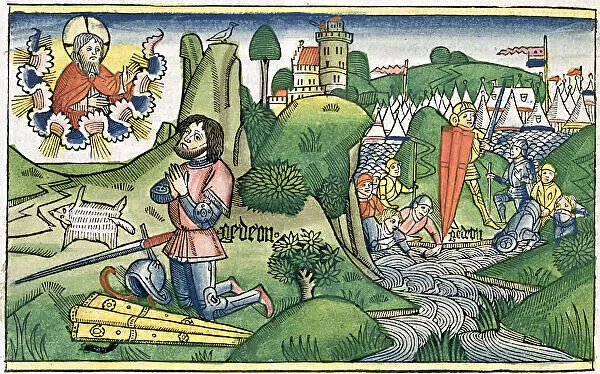
15th century German artist depiction of Gideon putting out the fleece

Gideon prayed to God, “I know that you promised to help me rescue Israel, but I need proof. Tonight I’ll spread a sheep skin on the stone floor of that threshing place over there. If you really will help me rescue Israel, then tomorrow morning let there be dew on the skin, but let the stone floor be dry.”

And that’s just what happened. Early the next morning, Gideon got up and checked the sheep skin. He squeezed out enough water to fill a bowl. But Gideon prayed to God again. “Don’t be angry with me,” Gideon said. “Let me try this just one more time, so I’ll really be sure you’ll help me. Only this time, let the skin be dry and the stone floor be wet.”

That night, God made the stone floor wet with dew, but he kept the sheep skin dry. (Contemporary English Version)

It’s only human to want assurances. And since humanity requires some sort of affirmation that they’re hearing things right, or are on the right track, God graciously accommodates to our need. Much like the disciple of Jesus, Thomas, who desired an assurance that Christ is alive and was victorious over the grave, so Gideon needed clarification that victory was truly at hand.

In both cases of doubting Thomas and anxious Gideon, the Lord does not chide them for needing such assurances. Rather, God immediately responds to their requests. You and I might feel ourselves weak or confused in needing such support, yet God doesn’t feel this way about us.

Sometimes, in our disorientation and our dismay, we try and put feelings aside and stoically attempt to do whatever must be done with complete dispassion and lack of emotion. But that’s to try and be somebody we are not; humans simply aren’t wired that way. There’s no need to try and stir up the courage and confidence on our own.

To navigate this life with any success, we’ll need to pay attention to the inner person, to what’s going on inside us, whenever we are in stressful or confusing times. Then we can connect with the God who mercifully awaits hearing our request. It’s good to be equipped and ready for what’s ahead by having a few convictions….

It’s not the destination that’s important; it’s the journey

Gideon needed to come around to seeing that getting from Point A to Point B as quickly and as efficiently as possible was not the goal. The process of getting from one place to another is the very opportunity needed to connect with the Lord and with others around us. God’s instructions may seem, at times, nonsensical – which is why we often look for assurances that we’ve heard them correctly!

Gideon and the fleece, in the Frauenkirche, Esslingen, Germany

For us modern folk, the Lord doesn’t want us getting lost in the race to become ever more streamlined and productive, only looking at the end goal. If relationships, human connection, justice, love and respect of others is our highest value, then we really need to pay a lot more attention to the process of what we’re doing, and not just the product and outcomes.

Focusing solely on a final outcome turns factory workers into extensions of the machines they are using to churn out a quality product; it turns families at church into giving units with potential to support all the programs and ministries; it turns adversity into an unwanted obstacle to achieving victory; and turns needy people into problems we can fix.

Life is a pilgrimage to walk; it’s not a race to run

At the end of life, folks don’t reminisce about how much they produced, how many places they’ve been, or how much money they made. Instead, they talk about people, both the relationships that were rich and full, as well as the broken or lapsed relationships which cause them regret.

This is why, daily, I purpose to saunter, walk slowly, and observe the people and places around me. This practice allows me to take the time to greet others, connect with some, and even have a sit down conversation with another person – all on the way to doing something else.

Frankly, from a goal-oriented perspective of achievement and accomplishment, this practice does nothing to help whittle down my massive checklist for the day. But I do it, anyway, because human connection our real purpose in life.

Humanity is our business

It doesn’t matter what we do for a living, or where we live. Relationships are the only reality we take with us in the end – both with God and other people.

Dead with ball and chain, the ghost of Jacob Marley responded to Ebenezer Scrooge’s accolade that he was such a good man of business:

“Mankind was my business. The common welfare was my business; charity, mercy, forbearance, benevolence, were all my business. The dealings of my trade were but a drop of water in the comprehensive ocean of my business!” 

Jacob Marley, in Charles Dickens, A Christmas Carol

Marley had discovered this insight too late. 

All of life is a gift given by God, meant for us to be stewards toward the benefit and welfare of humanity. All our abilities, skills, intellectual acumen, possessions, and even the lack thereof – literally everything – is meant to be used in the betterment of our fellow human beings.

We all share the common human condition of needing our stories told and heard by one another, so that we can have some assurance and comfort through what we’re facing.

Will I be there to hear another? Will another be there to hear me? Will I listen to God? Will God listen to me?

Be fully present to others; avoid thinking about the past or focusing on the future

If you think about it, Jesus was perhaps the most productive person to ever walk this earth. In just three short years his ministry completely changed the world and continues to do so. Perhaps our Lord’s “secret” was no secret at all. 

Christ was fully present to the Father, and to the people right in front of him. He was never hurried, and didn’t capitulate to the anxiety of others who wanted him to pick up the pace of being a kickass Messiah.

So, my friends, may you slow down enough to observe, see, hear, smell, and witness the incredible and deep humanity that is present next door to you, down the hall from you, and sitting across the table with you. 

May you experience the wide mercy of God and graciously extend the same love to others. 

May you embrace the process of whatever you are doing to include the space of others and their unique humanity.

For this is how we gain our assurance that God is with us and that we are on the right track for that next step in life.

Jesus Shows Up (John 20:19-31)

Jesus shows himself to Thomas, by Rowan and Irene LeCompte

On the evening of that first day of the week, when the disciples were together, with the doors locked for fear of the Jewish leaders, Jesus came and stood among them and said, “Peace be with you!” After he said this, he showed them his hands and side. The disciples were overjoyed when they saw the Lord.

Again Jesus said, “Peace be with you! As the Father has sent me, I am sending you.” And with that he breathed on them and said, “Receive the Holy Spirit. If you forgive anyone’s sins, their sins are forgiven; if you do not forgive them, they are not forgiven.”

Now Thomas (also known as Didymus), one of the Twelve, was not with the disciples when Jesus came. So the other disciples told him, “We have seen the Lord!”

But he said to them, “Unless I see the nail marks in his hands and put my finger where the nails were, and put my hand into his side, I will not believe.”

A week later his disciples were in the house again, and Thomas was with them. Though the doors were locked, Jesus came and stood among them and said, “Peace be with you!” Then he said to Thomas, “Put your finger here; see my hands. Reach out your hand and put it into my side. Stop doubting and believe.”

Thomas said to him, “My Lord and my God!”

Then Jesus told him, “Because you have seen me, you have believed; blessed are those who have not seen and yet have believed.”

Jesus performed many other signs in the presence of his disciples, which are not recorded in this book. But these are written that you may believe that Jesus is the Messiah, the Son of God, and that by believing you may have life in his name. (New International Version)

When Jesus shows up, there is peace. Wherever Jesus goes, the Spirit of God is there. When Jesus appears, people believe.

The Meeting

After the crucifixion of Christ, the disciples were huddled together, mostly in fear of being found out and put out by the religious authorities. Out of nowhere, Jesus showed up, smack in the middle of the anxious group of men.

Christ in the center makes all the difference. From this central place, Jesus bestowed to the disciples his peace. The very first word the risen Christ spoke to his disciples was neither a command to stop being afraid, nor a rebuke for sitting around and doing nothing, or disappointment that they all ran away in the final hour of need at the crucifixion; instead, the first word of Christ was a gift of peace.

The presence and peace of Christ melted the disciples’ fear. Christ-centered peace is graciously given; so let us gratefully receive it.

The Reality

Jesus showed up, then showed off his hands and his side. He was not fabricated out of the disciples’ imagination; he was not some ghostly apparition. Rather, Christ was standing in the middle of them, very real, very physical, and very alive.

Christ gave his disciples real truth: actual wounded hands and side on a real body. Christ is risen and alive – not just spiritually, but physically. Since the resurrection of Jesus really happened, then nothing else matters; our joy is complete. We have what we need.

The Mission

As Jesus was sent by the Father, so Jesus sent his disciples; and is still sending us out into the world. And as Jesus came not to condemn the world but to save it, so we go out with words of grace and peace. The church exists for the life of the world – to bless it with the presence and peace of Christ.

“Whoever believes in me does not believe in me only, but in the one who sent me. The one who looks at me is seeing the one who sent me. I have come into the world as a light, so that no one who believes in me should stay in darkness.” (John 12:44-46, NIV)

Our spiritual DNA makes us little Christ’s walking around, doing the will of God, for the benefit of a world in darkness. We bear the name of Christ: Christians, proclaiming a message of life, delighting in God and creation; and not destroying the earth and its inhabitants.

The Gift

Right now, we are not alone. The Holy Spirit has been graciously given to us by Jesus. Although our mission is a big one, our resource for accomplishing it is even bigger. Jesus gives the Spirit in the same way he gives himself – as a sheer gift with no strings attached. Just as God breathed life into the very first people on earth, so Jesus breathes on the disciples and gives them new life and a new heart.

I will give you a new heart and put a new spirit in you; I will remove from you your heart of stone and give you a heart of flesh. And I will put my Spirit in you and move you to follow my decrees and be careful to keep my laws… and you will be my people, and I will be your God. (Ezekiel 36:26-28, NIV)

The Privilege

Christ has redeemed us, forgave us of our guilt and shame. Now, we have the privilege of passing the forgiveness to others. The special mission of the Church is giving Jesus to others with grace and peace, so that they may believe he is truly the risen Lord; and so, receive Jesus, the Spirit, forgiveness, and purpose in life, with Christ at the center of all things.

For the one whom God has sent speaks the words of God, for God gives the Spirit without limit. The Father loves the Son and has placed everything in his hands. Whoever believes in the Son has eternal life, but whoever rejects the Son will not see life, for God’s wrath remains on them.” (John 3:34-36, NIV)

The Risen Lord, by He Qi

The Appearance

When Jesus appears, its good if we also show up to see him. It seems Thomas was late for church and missed the beginning of the service. He wasn’t with the other gathered disciples. Nobody knows where he was or what he was doing. But the important thing is that he did eventually show up, because showing up is the beginning of a changed life.

The Witness

After Jesus showed up, the disciples bore witness to what they saw and heard to Thomas. Yet Thomas, bless his doubting heart, wasn’t having it. He’s a realist. He wants proof, some actual physical evidence. Thomas was clearly a tactile learner because he needs some touch to believe any of this crazy talk of his disciple brothers.

Sometimes Thomas gets a bad rap, but he is really our Everyman. Doubt and skepticism are an important part of a full-orbed and honest faith. Jesus gave Thomas some space, time, and respect to begin wrapping his head and heart around this new reality of resurrection. I wonder if we all can do the same with others.

The Middle

A second time, Jesus shows up in the middle of the disciples. The Word became flesh and dwelt among us – and didn’t become a ghost and hang out in secret places. Once again, peace is given by Jesus to his followers.

Both appearances happen on a Sunday (which is why Christians have always worshiped on Sundays); and both meetings are literally Christ-centered (which every Christian meeting is supposed to be). Every Sunday. Christ always in the middle. Keep those two, and keep them together, and you can’t go wrong.

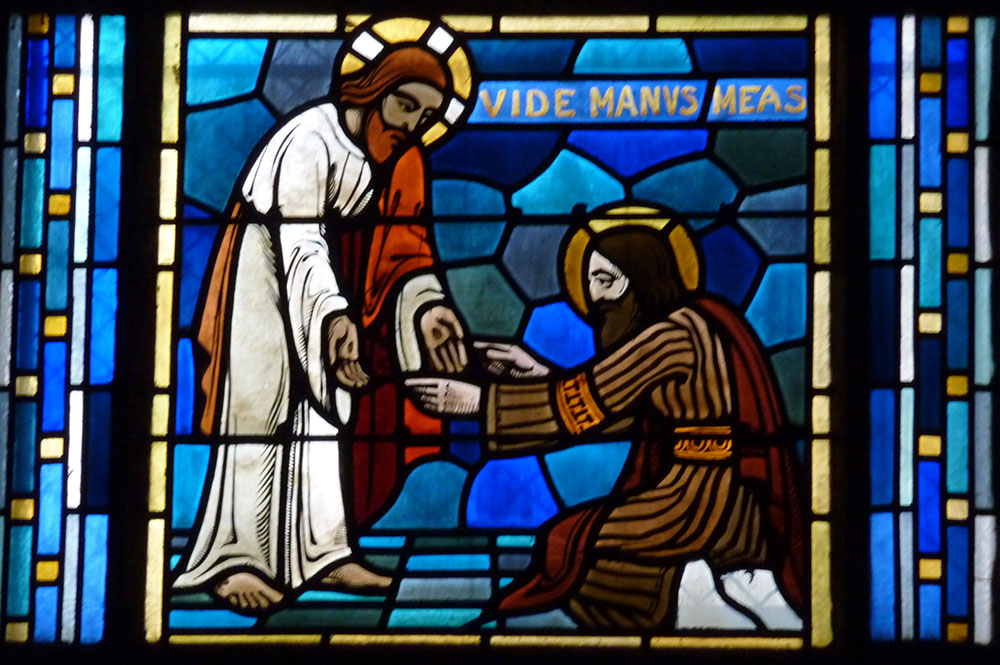
Jesus appears to Thomas with the Latin words, “See my hands,” in Notre-Dame-du-Rosaire Church, Saint-Ouen, France 

The Invitation

There’s no beating around the bush with Jesus. He immediately engaged Thomas and invited him to touch the wounds on his very real body. Christ knew Thomas’ hang-up, and went right to it. Thomas wanted evidence; Jesus offered it. If we get anything out of this encounter, it is that risen Christ honors honest doubt.

The evidence is here. Now believe it, and stop disbelieving. We have documentary evidence of the Old and New Testaments; the Church’s witness in Creeds, Confessions, and contemporary narratives of changed lives; and the internal testimony of the Holy Spirit. Therefore, look into them carefully and draw a sound conclusion.

The Confession

“My Lord and my God!” That’s the confession and the conclusion Thomas drew from the evidence – not only that Jesus is real, alive, existed, a good teacher; or other people’s Lord and God – but that he is my Lord and my God.

Jesus cared enough for Thomas to specifically meet him personally at his point of need. The grace of God keeps coming and never runs out. Jesus is filled up to the full in both grace and truth.

The Believer

Thomas had the physical evidence. But it doesn’t take that to truly believe. God blesses those who’ve never seen nor touched, but still believe. Jesus was thinking of you and me, and not only the people in front of him at the time. The Lord Jesus blesses us with the gift of peace, grace, and faith.

Though you have not seen him, you love him; and even though you do not see him now, you believe in him and are filled with an inexpressible and glorious joy, for you are receiving the end result of your faith, the salvation of your souls. (1 Peter 1:8-9, NIV)

The Conclusion

All this is for our benefit, so that we, too, may believe that Jesus is the Christ, the Son of the living God. Since Jesus is alive, he continues to bless us with his presence, power, and peace.

Jesus is with us:

  • through the Word of God, giving us his peace, showing up and meeting needs people.
  • at the Table in the sacrament of communion, bringing grace and forgiveness
  • in the person of the Holy Spirit, enabling and energizing us for mission and ministry to the world

It’s a life worth living, a Christ-centered life, full of God’s blessing.

O God and Father of our Lord Jesus Christ, in whom we receive the legacy of a living hope, born again not only from his death but also from his resurrection. May we who have received forgiveness of sins, set others free, until we enter the inheritance that is imperishable and unfading, where Christ lives and reigns with you and the Holy Spirit, one God, now and forever. Amen.