Distressed (Psalm 77)

I cry aloud to God;
    I cry aloud, and he hears me.
In times of trouble I pray to the Lord;
    all night long I lift my hands in prayer,
    but I cannot find comfort.
When I think of God, I sigh;
    when I meditate, I feel discouraged.

He keeps me awake all night;
    I am so worried that I cannot speak.
I think of days gone by
    and remember years of long ago.
I spend the night in deep thought;
    I meditate, and this is what I ask myself:
“Will the Lord always reject us?
    Will he never again be pleased with us?
Has he stopped loving us?
    Does his promise no longer stand?
Has God forgotten to be merciful?
    Has anger taken the place of his compassion?”
Then I said, “What hurts me most is this—
    that God is no longer powerful.”

I will remember your great deeds, Lord;
    I will recall the wonders you did in the past.
I will think about all that you have done;
    I will meditate on all your mighty acts.

Everything you do, O God, is holy.
    No god is as great as you.
You are the God who works miracles;
    you showed your might among the nations.
By your power you saved your people,
    the descendants of Jacob and of Joseph.

When the waters saw you, O God, they were afraid,
    and the depths of the sea trembled.
The clouds poured down rain;
    thunder crashed from the sky,
    and lightning flashed in all directions.
The crash of your thunder rolled out,
    and flashes of lightning lit up the world;
    the earth trembled and shook.
You walked through the waves;
    you crossed the deep sea,
    but your footprints could not be seen.
You led your people like a shepherd,
    with Moses and Aaron in charge. (Good News Translation)

Psalm 77, by Jeremy Grant

I Worry

You and I know what it feels like to be in trouble. We understand the sense, at times, of having our prayers bounce off the ceiling, as if our cries are not heard by heaven. Loneliness and discouragement are palpable. Sleep is elusive. Worries and racing thoughts go round and round in our heads, like some sort of demented NASCAR event.

Swirling around us like a black cloud are all the questions asked without any answers:

  • Has God walked off the job? Is the Lord ever coming back? Is God even there? Did the Lord retire from being God?
  • Is God angry at me? What have I done to piss him off? Is the Lord fed up with us?
  • Is the Lord really a God of love? Did grace run out of steam? Does God hate me?

Then, when the questions go unanswered without any replies, we begin to remember the good old days… when God was a mover and shaker in this messed up world… when the Lord delivered the people from Egyptian bondage… when God pulled people out of the worst kind of troubles….

We continue to reminisce, even recalling that the very elements of the earth were moved by the command of an almighty God: setting aside the Red Sea so that the people were delivered from impending doom… congealing the Jordan River so that the people could cross over into the Promised Land… causing clouds to form and belch out buckets of rain to end droughts in the land… and so much more….

Like a concerned and compassionate shepherd, protecting the sheep and caring for them, God had led the people out of slavery and into freedom, speaking to Moses, delivering people, moving mountains…. Yet, here I lay, hearing and experiencing bupkis from God. *Sigh*

So, what’s a spiritually sensitive person to do?

I and Thou

In 1937, the Jewish philosopher, Martin Buber wrote an insightful book entitled “I and Thou.” Buber postulated how people exist in the world and how they actualize that existence. We engage the world through both monologue and dialogue. For Buber, “all real living is meeting.” In other words, to exist, to live, is to encounter another and relate to a “Thou.” We only have meaning in relationships. We only have our being in God.

The psalmist acknowledges there is a “Thou” besides his distressed “I” – that this Thou will hear, make a difference, and open a way of deliverance… even if it might not happen right away. There are four actions the psalmist decides to do in his distress, actions which put him in a vital dialogue with the divine “Thou”… even if it seems like nothing is happening.

I Pray

Prayer, at its heart, is a dialogue with God. From the place of our spiritual poverty and bankruptcy, we beg; and God gives us the kingdom. To be a spiritual beggar, pleading for our needs to be met, knowing we have no way to repay, is a posture which God delights in.

You’re blessed when you’re at the end of your rope. With less of you there is more of God and his rule. (Matthew 5:3, MSG)

I Search

In the I and Thou relationship, the search works both ways.

You have searched me, Lord,
    and you know me.
You know when I sit and when I rise;
    you perceive my thoughts from afar.
You discern my going out and my lying down;
    you are familiar with all my ways….

Search me, God, and know my heart;
    test me and know my anxious thoughts.
See if there is any offensive way in me,
    and lead me in the way everlasting. (Psalm 139:1-2, 23-24, NIV)

I Remember

The psalmist intentionally sought to recall the mighty works of God, especially in delivering the people from slavery and bringing them to the Promised Land. In our forgetfulness, we get lost in our troubles and our perspective becomes skewed. We cannot see beyond the end of our nose. Remembering, however, grants us a fuller picture of what is happening in light of the past. It brings us out of the lonely “I” and into the relationship of “I and Thou.”

Remember those earlier days after you had received the light, when you endured in a great conflict full of suffering. 

Sometimes you were publicly exposed to insult and persecution; at other times you stood side by side with those who were so treated. You suffered along with those in prison and joyfully accepted the confiscation of your property, because you knew that you yourselves had better and lasting possessions. 

So do not throw away your confidence; it will be richly rewarded. You need to persevere so that when you have done the will of God, you will receive what he has promised. (Hebrews 10:32-36, NIV)

I Meditate

Pondering and thinking upon God’s deeds enables praise to arise from us. It fosters the I and Thou relationship, bolstering and buoying our faith through life-events which produce our distress.

I lie awake thinking of you,
    meditating on you through the night.
Because you are my helper,
    I sing for joy in the shadow of your wings. (Psalm 63:6-7, NLT)

Thou Art Worthy

The psalm ends with no resolution to the personal distress of the psalmist. Whether there is a happy ending, or not, isn’t the point. It’s about the process.

The journey of moving through our troubles causes us to learn as much (or more) from God’s absence than of God’s presence. We learn how to pray, search, remember, and meditate because of and despite our troubles. We learn to relate to God and eventually proclaim that Thou art worthy.

Thou art worthy, O Lord, to receive glory and honor and power: for thou hast created all things, and for thy pleasure they are and were created. (Revelation 4:11, KJV)

Amen.

The Model Prayer (Matthew 6:7-15)

The Lord’s Prayer, by He Qi

And when you pray, do not use vain repetitions as the heathen do. For they think that they will be heard for their many words.

“Therefore do not be like them. For your Father knows the things you have need of before you ask Him. In this manner, therefore, pray:

Our Father in heaven,
Hallowed be Your name.
Your kingdom come.
Your will be done
On earth as it is in heaven.
Give us this day our daily bread.
And forgive us our debts,
As we forgive our debtors.
And do not lead us into temptation,
But deliver us from the evil one.
For Yours is the kingdom and the power and the glory forever. Amen.

“For if you forgive men their trespasses, your heavenly Father will also forgive you. But if you do not forgive men their trespasses, neither will your Father forgive your trespasses. (New King James Version)

God knows what we need before we even ask, which means the Creator of the universe has the divine ear inclined to listen to us. The Lord desires, even longs for us to pray to him.

Since this is God’s daily disposition, Jesus communicated for us a model way of prayer which exemplifies the values of Christ’s Beatitudes and reflects the priorities of God’s kingdom.

The Lord’s Prayer is meant to be prayed often, mindfully, and with flavor.

Jesus gave us six petitions to guide us in our prayers: The first three petitions are priorities of God that set the tone for the next three petitions, which are centered in our problems of living in this fallen world.

Addressing God

Jesus gave us instruction of how to address God: “Our Father in heaven.” All the pronouns in the Lord’s Prayer are plural, not singular. We are to be concerned for both our own individual issues, and for the needs of the community, and of the problems of the world.

“Father” is an endearing and relational word. “In heaven” balances the closeness and nearness of our heavenly Father with his sovereign and transcendent nature. Our God is both near and far – a close friend as well as a holy king. So, we address our prayers with a proper understanding of who God is.

First Petition: “Hallowed be your name.”

“Hallow” comes from the root word for holiness; it is to sanctify and set apart. God is concerned that we know the distinction between the Creator is holy, and so, the creatures are also to be holy. 

As He who called you is holy, you also be holy in all your conduct, because it is written, “Be holy, for I am holy.” (1 Peter 1:15-16, NKJV)

Notice the use of the verb: not hallowed “is” your name, but hallowed, or holy “be” your name. Jesus guides us to pray that God’s name would be shown as holy through us by the way we live. The world sees a holy God when God’s people walk in holiness, reflecting the Lord’s benevolent nature. 

Second Petition: “Your kingdom come.”

We live in a fallen world that has come under the domain of dark forces. The unfolding drama of Holy Scripture is that God is on a mission to restore creation to a benevolent rule.

Jesus is the King, we are the subjects, and God’s realm exists wherever his subjects go.  And where his subjects go, they are to pierce the darkness by embodying the good news that King Jesus has overcome the demonic realm and brought us into God’s kingdom. The prayer and proclamation of this good news is of utmost priority to God.

Third Petition: “Your will be done on earth as it is in heaven.”

God’s ethical will has been revealed to us by Jesus in the Sermon on the Mount; the Beatitudes are the cornerstone of his teaching (Matthew 5-7). God’s will is that Christ’s followers be humble; grieve over sin in the world; act with gentleness instead of prideful condescension; hunger for true righteousness instead of legalistic self-righteousness; show mercy; be pure in heart; pursue peace; and, rejoice when persecuted. All of this results in being salt and light in this dark world. (Matthew 5:3-16)

Jesus spells out God’s will in his sermon. Christ’s followers are to:

  1. reconcile with others instead of hold grudges
  2. deal with lust through accountability instead of making excuses for mental adultery
  3. cherish our spouse instead of taking the easy way out when problems arise in marriage
  4. tell the truth at all times instead of shading it
  5. love, not retaliate when personally hurt or insulted.

If God’s will seems an impossible task, that’s because we need divine resources to live a Christian ethic; we need to pray!

The first three petitions are priorities for God. They are asking the same thing – that the full manifestation of God’s reign on earth be realized. 

Therefore, our prayers are not primarily to receive goods and services from God, but for us to render service to God. These prioritized petitions are a desire to see God honored on earth as God is already honored in heaven.

Fourth Petition: “Give us today our daily bread.”

Our bodies enable us to do God’s will, and so we must be concerned for them. Daily, we must have the basic necessities of life to carry out God’s priorities for the church and the world.

In the ancient world, people were paid at the end of each day. Folks also shopped every day at the marketplace for their food because there was no refrigeration. Whenever there was a flood or a drought, it meant much more than high grocery prices; people faced starvation and death.

They needed to trust God for today, and not worry about tomorrow. Even though contemporary people may not always readily perceive their great dependence on God, we still are in divine hands and need faith.

Fifth Petition: “Forgive our debts, as we also have forgiven our debtors.”

Sin is pictured as a debt. If someone has sinned (trespassed) against us, we must forgive them, thus releasing them from their debt. To forgive does not mean to forget. Rather, we do not hold the debt (the sin) over someone’s head for the rest of their life. 

The person who is forgiven by God is a forgiving person. Our own forgiveness implies that we have done the hard work of repentance through identifying our sin and renouncing it. So, if we fail to forgive, it demonstrates a lack of change on our part. We cannot be forgiven if we spurn God’s freely offered grace. 

Forgiveness is important to Jesus. Thus, we are to squarely face our bitterness. Simply sweeping our hurt under the rug and not extending forgiveness only gives the darkness a foothold into our lives – which is why we are to pray the final petition:

Sixth Petition: “And lead us not into temptation but deliver us from evil.”

Just as we must trust God for our physical necessities, we also must trust God for our spiritual needs – which hinge on the issue of forgiveness – our forgiveness from God through Christ, and the forgiveness we extend to others who have hurt or offended us. 

An unforgiving heart is a major temptation to hate, seek revenge, and retaliate. If we have spent days, weeks, months, years, or even decades harboring an unforgiving spirit through anger, bitterness, and avoidance of facing our past trauma, we have embraced the dark side and need deliverance from evil. 

Freedom comes through acknowledging the offense, receiving grace and forgiveness from God, and passing that same forgiveness and grace to those who hurt us. This is not about whether they deserve it or not; it’s a matter of what I need to do.

Conclusion

The truth sets us free; telling our secrets brings freedom. Apart from naming our shame, we will remain bound and in need of liberation. Tell your secrets to God in the prayer closet, and then tell them to a trusted friend(s). We pray, and we act on what God tells us in prayer.  

The Lord’s Prayer is a model prayer. That means we use the six petitions of Jesus to frame our prayers in our own words, as well as say the words in our favorite translation of the Bible.

Praying this prayer daily shapes our everyday lives, serves as a guide for how to live, and provides discernment in making life’s many decisions. So, let us daily and in every way make use of our Lord’s Prayer.

Our Father in heaven, the One who is both near and far,

May your Name be shown as holy through us, your people.

May others submit to your lordship and become holy, too.

Help us to know your will and to do it.

We need you God, so provide our necessities for today.

Forgive us of our great and many sins, just as we forgive those who have sinned egregiously against us.

Lead us in paths of righteousness, which shoo the devil away.

For you are the Ruler, the Mighty One, forever full of glory and grace. Amen!

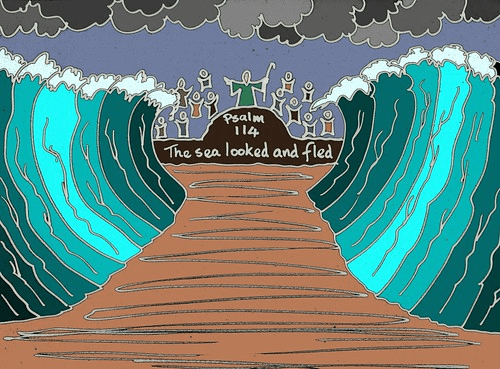
A Mighty Deliverance (Psalm 114)

Psalm 114:3, by Stushie Art

When the people of Israel left Egypt,
    when Jacob’s descendants left that foreign land,
Judah became the Lord’s holy people,
    Israel became his own possession.

The Red Sea looked and ran away;
    the Jordan River stopped flowing.
The mountains skipped like goats;
    the hills jumped around like lambs.

What happened, Sea, to make you run away?
    And you, O Jordan, why did you stop flowing?
You mountains, why did you skip like goats?
    You hills, why did you jump around like lambs?

Tremble, earth, at the Lord’s coming,
    at the presence of the God of Jacob,
who changes rocks into pools of water
    and solid cliffs into flowing springs. (Good News Translation)

I tend to use a lot of metaphors in my conversations with others. I like word pictures, analogies, and illustrations. Maybe that’s one reason I resonate with the Old Testament. The Hebrew mind revels in story, symbol, similitude, and even the occasional sarcasm.

The turn-of-phrase is something which connects well with me – which is why I like today’s psalm. The language is freighted with metonymy (using the name of one object or concept for that of another) and personification (using an animate characteristic for an inanimate object).

This psalm is a poetic response to the Jewish Passover and exodus out of slavery to freedom. It is a brief song of thanksgiving which nicely recounts the Israelite experience from Egypt to the Promised Land. At the behest of a mighty God, the Red Sea parted when the people left Egypt, and the Jordan River stopped its flowing when the people entered the Promised Land.

It’s a whole lot more powerful to say, “When the sea looked at God, it ran away,” than it is to say, “The Red Sea parted.” God is so mighty, so powerful, so large and sovereign that we must use the full extent of language to even begin to describe the wonderful works of the Lord. A big God with awesome capability needs some wordsmithing worthy of divine greatness.

Not only does the sea flee from its place, but the river also turns back, the mountains and hills shake and skip. To try and somehow capture the immensity of God, the psalmist used language which communicates that even inanimate objects come alive and fulfill the Lord’s bidding.

It is one thing to make a flat statement such as, “Put your trust in God,” and it is quite another matter to open up the tool of language and allow it to picture a divine Being so amazing that nothing nor anyone can possibly stand in such a Sovereign’s way. And this very same God works for us, and not against us.

The Lord God almighty, Creator of heaven and earth, has taken this formidable divine power and granted us a pinch of it – because that’s all we really need. Jesus, intimately familiar with his mighty heavenly Father, commented:

If your faith is as big as a mustard seed, you can say to this mulberry tree, “Dig yourself up and plant yourself in the ocean!” And the tree will obey you. (Luke 17:6, ERV)

For assuredly, I say to you, whoever says to this mountain, “Be removed and be cast into the sea,” and does not doubt in his heart, but believes that those things he says will be done, he will have whatever he says. (Mark 11:23, NKJV)

All of creation conspires together to participate in the great liberating and saving acts of God for God’s people. And if that wasn’t enough, we have been given the Holy Spirit to be with us forever – uprooting trees and moving mountains to accomplish the good and loving plan of God here on earth as it is always done in heaven.

Mighty God you invite us to be with you, to have a place near you. Your presence is joy, light, and comfort. Your nearness is holy, awesome, and wonderful. In the play of sunlight through rainbows, in the sounds of music and laughter, in the beauty of creation and the taste of bread and wine, your presence is known. Your saving presence surrounds us, whether we are fearful or joyful, laughing or crying.

You invite us, welcome us, forgive us and renew us with fresh hope and new life. You love us into your presence. We bless and thank you. We praise and adore you. We enjoy being with you, in the name, the spirit, and the presence of Jesus. Amen.

Relying on the Presence (Exodus 13:17-22)

When Pharaoh let the people go, God did not lead them on the road through the Philistine country, though that was shorter. For God said, “If they face war, they might change their minds and return to Egypt.” So God led the people around by the desert road toward the Red Sea. The Israelites went up out of Egypt ready for battle.

Moses took the bones of Joseph with him because Joseph had made the Israelites swear an oath. He had said, “God will surely come to your aid, and then you must carry my bones up with you from this place.”

After leaving Sukkoth they camped at Etham on the edge of the desert. By day the Lord went ahead of them in a pillar of cloud to guide them on their way and by night in a pillar of fire to give them light, so that they could travel by day or night. Neither the pillar of cloud by day nor the pillar of fire by night left its place in front of the people. (New International Version)

From a human perspective, God makes some nonsensical decisions in the Bible such as telling Noah to build a big boat in a place with no water; Abraham to leave everything, and later, to sacrifice his son; Moses to stroll into Egypt and tell Pharaoh to let the people go; and, the people to walk through a body of water without getting wet. Indeed, it’s as if God has an odd predilection for making weird requests of people.

Although today’s Old Testament story gives us a glimpse into God’s thinking, the people were not privy to that information. Yes, God’s people were experiencing an unbelievable exodus out of Egypt. Their wildest dreams could not have imagined such a reality as strolling out of slavery having seen not one but a string of miraculous wonders. Yet, God was not done with the miracle thing.

Although many people would really like to see a miracle happen in their lives, rarely do we think about the circumstances we might need to face for that miracle to occur. God typically asks folks to do some outrageous-sounding things to set up the miracle.

An entire nation left Egypt with celebration only to be told to go in a misdirection toward the Promised Land, as if God were somehow geographically challenged. I can imagine that this decision had Moses raising a Spock-like eyebrow and the Israelites wondering if God was off his celestial rocker.

There is, however, a reason why folks like Noah, Abraham, and Moses obeyed instructions that didn’t make sense to them at the time: The Presence of God.

Pillar of Fire, Pillar of Cloud in the Desert, Congregation Beth Emeth, Herndon, VA

It is the personal Presence and power of God which makes all the difference. For God has not promised to create an existence with a zero factor of hardship. God, instead, has created a world that is full, vibrant, and alive with Presence – and a zero tolerance for bullies like Egypt. The uncertainty, doubt, and mystery of the future is thoroughly mitigated with the effusive Presence.

When sitting with patients in the hospital who struggle with the unknown of why they are there and what will become of them (and their families) the last thing I do is try to fabricate reasons so that it makes sense – because it doesn’t, and I’m not going pretend that it does.

Rather, I remind them of what I know: The Presence of God is here. Although God does not go out of the way to give us an easy life, God does, however, go far out of the way to communicate the glorious divine Presence with us.

God kept constant vigil over the ancient Israelites, powerfully seen with the pillar of cloud by day and pillar of fire by night. Nothing was going to happen to the Jewish people without first passing through the mighty hands of God.

Not only do I know God is with us, but I also know the Lord neither slumbers nor sleeps (Psalm 121). When God keeps vigil, God keeps vigil! No smoke or bathroom breaks with God. God’s vigilance is relentless and wondrous, giving assurance to the godly, and terrifying the ungodly.

Once we are out in the wilderness of uncertainty, there is no turning back. And that’s okay – because the Presence of God patrols the area and divinely guards our every move.

For the Christian, the Presence has found its fulfillment in the person of Jesus. Although Christians everywhere serve a risen and ascended Christ, the Divine Presence remains with glorious constancy through the Holy Spirit, the Paraclete, the One who is consistently alongside us, empowering us and advocating on our behalf.

The beautiful theological truth here is that God is both transcendent (far above us) and immanent (intimately close to us) at the same time, all the time. Armed with such a robust theological understanding, trust and confidence come to us without having to resort to ginning up positive thoughts.

Instructions and commands which seem like nonsense? No problem. The Transcendent and Immanent One has the Presence all around it. In between a rock-and-hard-place (or an Egyptian army and a Red Sea)? Not an issue. I willingly place myself there knowing that with the Presence, the miraculous is about to happen.

We need not buck the difficult circumstances. The Presence has got this.

So, then, let us pray for the Church and for the world, and let us thank God for the great Presence: In the power of the Spirit and in union with Christ, we pray to you, Almighty God, and Father. From the rising of the sun to its setting, we pray to you, ever-vigilant Lord, on behalf of those in despair and darkness, that they may find the hope and light of Christ; those in fear of death, that they may find faith through the resurrection of Jesus; prisoners and captives, widows and orphans, and all those who today need a blessed assurance of the Presence; through Jesus Christ, your Son, our Lord, who with you and the Holy Spirit are one God, now and forever. Amen.