Idolatry Is the Tail Wagging the Dog (Psalm 106:1-6, 19-23)

Praise the Lord!
    O give thanks to the Lord, for he is good,
    for his steadfast love endures forever.
Who can utter the mighty doings of the Lord
    or declare all his praise?
Happy are those who observe justice,
    who do righteousness at all times.

Remember us, O Lord, when you show favor to your people;
    help us when you deliver them,
that we may see the prosperity of your chosen ones,
    that we may rejoice in the gladness of your nation,
    that we may glory in your heritage.

Both we and our ancestors have sinned;
    we have committed iniquity, have done wickedly…

They made a calf at Horeb
    and worshiped a cast image.
They exchanged the glory of God
    for the image of an ox that eats grass.
They forgot God, their Savior,
    who had done great things in Egypt,
wondrous works in the land of Ham,
    and awesome deeds by the Red Sea.
Therefore he said he would destroy them—
    had not Moses, his chosen one,
stood in the breach before him,
    to turn away his wrath from destroying them. (New Revised Standard Version)
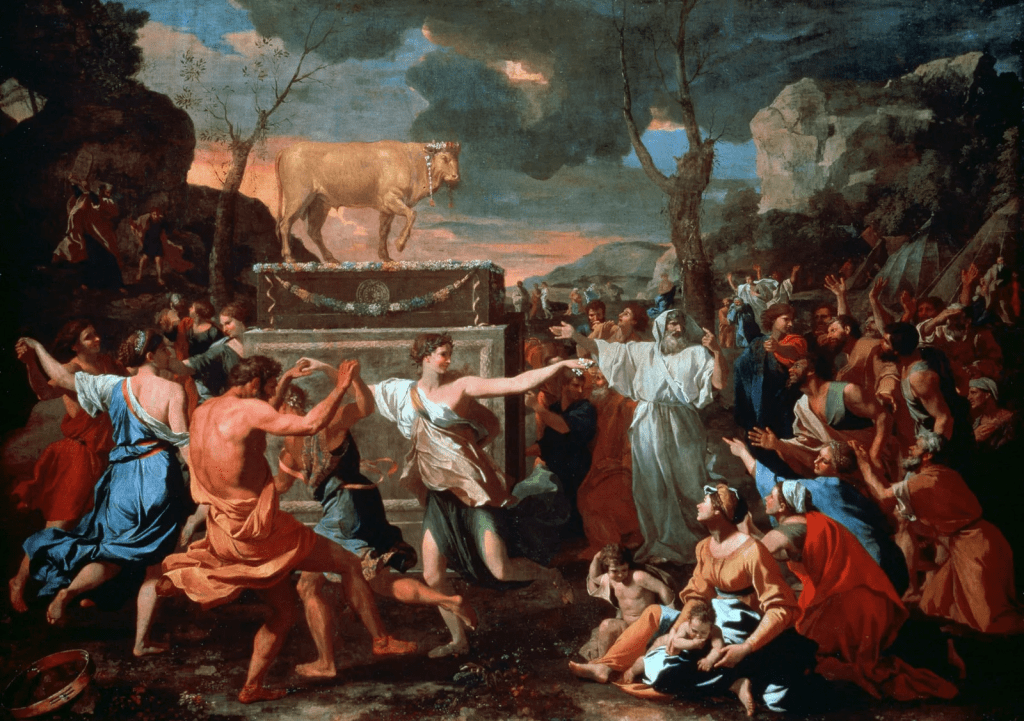
Adoration of the Golden Calf, by Nicolas Poussin (1594-1665)

When it comes to sin, especially the sin of idolatry, it’s imperative that we name it for what it is. It will do no good to fudge on it by saying that so-and-so struggles with it more than me, or that it’s not as bad as assault or murder.

No, we must call sinful idolatry just that, because the problem of idolatry is at the heart of humanity’s spiritual struggle. The first of the Ten Commandments frames it and names it squarely:

“I am the Lord your God who brought you out of slavery; do not worship other gods.” (Exodus 20:2-3, NRSV)

And the second commandment straight up prohibits any manufacturing or worshiping of idols:

“You shall not make for yourself an idol, whether in the form of anything that is in heaven above or that is on the earth beneath or that is in the water under the earth. You shall not bow down to them or serve them….” (Exodus 20:4-5, NRSV)

In the New Testament Gospels, Jesus also drew sharp lines between God and idolatry:

“No one can serve two masters, for a slave will either hate the one and love the other or be devoted to the one and despise the other. You cannot serve God and wealth.” (Matthew 6:24, NRSV)

The early church fathers (and mothers) forsook dependence on anything or anyone other than the one true God. Idolatry is an obsessive and fruitless search to satisfy a legitimate need in an illegitimate manner by giving oneself to someone or something other than the true object of the heart’s longing.

“You have made us for yourself, O Lord, and our heart is restless until it rests in you.”

St. Augustine

None of this means that the material and physical world is somehow bad – that money, possessions, food, books, nature, and other people are objects to avoid – because they are most certainly not! The problem arises whenever we seek to replace God with the things God made, God’s own creation.

By seeking to save our souls and fill the emptiness in our spirits with more and more wealth, or more and better jobs, or more time and expense for reading, or just about any other activity or possession there is, those things which were given for our use and enjoyment and to be stewarded well by us, end up becoming the users and our masters.

Inanimate objects, ideas, and activities begin calling the shots and giving the commands about what we should do and not do. What we own, now owns us. Even the poor can succumb to idolatry through the sin of covetousness by wanting things they do not have in the belief that wealth and possessions will make their lives whole and worthy. But this breaks the tenth commandment:

“You shall not covet your neighbor’s house; you shall not covet your neighbor’s wife, male or female slave, ox, donkey, or anything that belongs to your neighbor.” (Exodus 20:17, NRSV)

Nature and all the earth were formed by the Creator. And, as such, they too, give glory to God and recognize they themselves are not to be worshiped.

The heavens are telling the glory of God,
    and the firmament proclaims his handiwork.
Day to day pours forth speech,
    and night to night declares knowledge. (Psalm 19:1-2, NRSV)

Genuine wealth, prosperity, happiness and peace are found in the Creator of all good things. It is God who will:

  • wipe every tear from our eyes (Isaiah 25:1-9)
  • provide protection and guidance through the hard times of life (Isaiah 54:17)
  • be present with us as we walk through the valley of despair and ascend the mountain of celebration and joy (Psalm 23)

The reason idolatry is so insidious and difficult to name is that our affections are typically on a good thing which God has created and given for us. It’s just that, over time and through an extended process, the tail begins to wag the dog. For example:

  • Humanity serves the Sabbath instead of the Sabbath serving humanity
  • Parishioners venerate a church building instead of the church building being a tool for ministry
  • People are slaves to their hobbies instead of the hobby serving the person
  • Spouses worship one another instead of worshiping the God who brought them together
  • Groups let their traditions hold them with an iron grip, instead of traditions being held loosely by groups

It could (and does) happen to each one of us. And when it does, we need the wisdom and humility to see it for what it has become. Then, confess it as idolatry, and accept the forgiveness which is freely available from the Divine.

Almighty and everlasting God: Not to us, but to your name we give glory, for the sake of your steadfast love and your faithfulness! Yet because of the idolatry in our hearts, we have strayed far from you. We have disobeyed your commandments; we have trusted our own judgement; and we wonder why we feel distant from you. We have worshipped idols of silver and gold—and idols of self and comfort. Forgive us for not loving you as we ought, not obeying you as we were taught, and not trusting that our forgiveness has been bought. Amen.

Encountering God (Exodus 19:9-25)

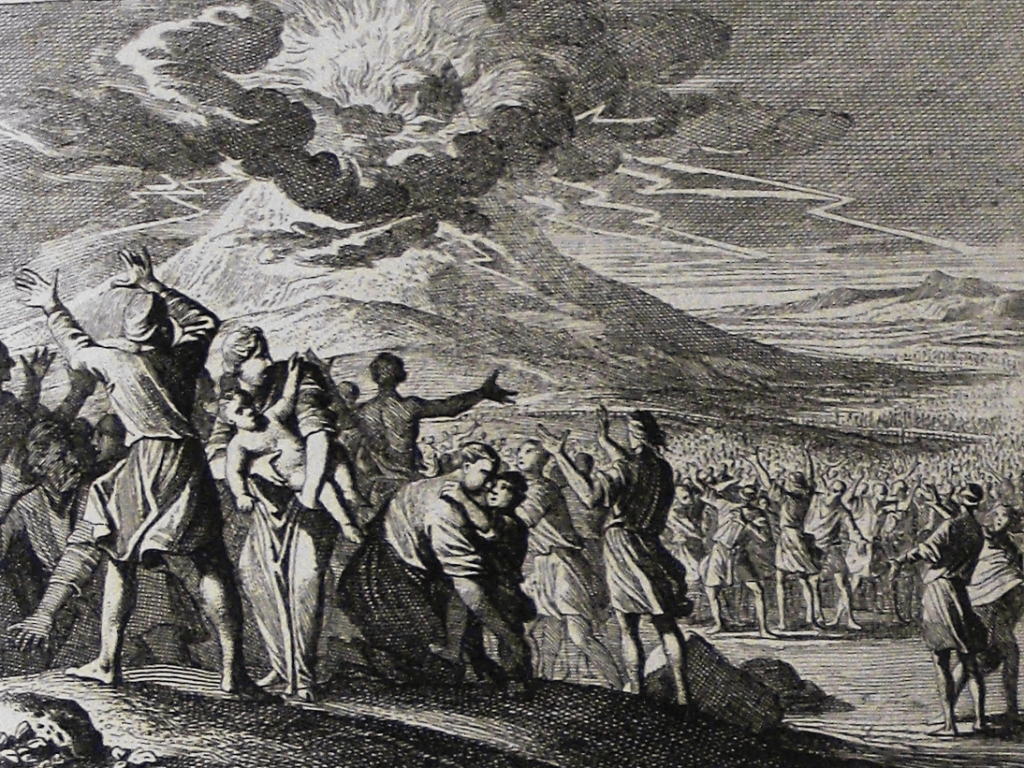
Israel at Mount Sinai, by Jan Luijken (1649–1712)

Then the Lord said to Moses, “I will come to you in a thick cloud, Moses, so the people themselves can hear me when I speak with you. Then they will always trust you.”

Moses told the Lord what the people had said. Then the Lord told Moses, “Go down and prepare the people for my arrival. Consecrate them today and tomorrow, and have them wash their clothing. Be sure they are ready on the third day, for on that day the Lord will come down on Mount Sinai as all the people watch. Mark off a boundary all around the mountain. Warn the people, ‘Be careful! Do not go up on the mountain or even touch its boundaries. Anyone who touches the mountain will certainly be put to death. No hand may touch the person or animal that crosses the boundary; instead, stone them or shoot them with arrows. They must be put to death.’ However, when the ram’s horn sounds a long blast, then the people may go up on the mountain.”

So Moses went down to the people. He consecrated them for worship, and they washed their clothes. He told them, “Get ready for the third day, and until then abstain from having sexual intercourse.”

On the morning of the third day, thunder roared and lightning flashed, and a dense cloud came down on the mountain. There was a long, loud blast from a ram’s horn, and all the people trembled. Moses led them out from the camp to meet with God, and they stood at the foot of the mountain. All of Mount Sinai was covered with smoke because the Lord had descended on it in the form of fire. The smoke billowed into the sky like smoke from a brick kiln, and the whole mountain shook violently. As the blast of the ram’s horn grew louder and louder, Moses spoke, and God thundered his reply. The Lord came down on the top of Mount Sinai and called Moses to the top of the mountain. So Moses climbed the mountain.

Then the Lord told Moses, “Go back down and warn the people not to break through the boundaries to see the Lord, or they will die. Even the priests who regularly come near to the Lord must purify themselves so that the Lord does not break out and destroy them.”

“But Lord,” Moses protested, “the people cannot come up to Mount Sinai. You already warned us. You told me, ‘Mark off a boundary all around the mountain to set it apart as holy.’”

But the Lord said, “Go down and bring Aaron back up with you. In the meantime, do not let the priests or the people break through to approach the Lord, or he will break out and destroy them.”

So Moses went down to the people and told them what the Lord had said. (New Living Translation)

Moses receives the Ten Commandments, by Caspar Luijken (1672-1708)

There’s a lot of drama surrounding today’s Old Testament story. That’s because it’s a big deal when an announcement comes that God is about to show up, speak to the people, and be with them. This is definitely not the stuff of daily mundane life.

The Mount Sinai event is one of the most remembered and talked about events in the Old Testament. This encounter establishes that the presence of the Lord is with Moses, thereby giving him authority over the people. It authenticates the leadership of Moses up to this point – in leading the people out of Egyptian slavery and to the Promised Land.

The presence of God with the people, demonstrated in Moses the leader, assures the Israelites of protection against dangers from other nations and peoples. The divine presence of the Lord will be seen preeminently in the giving of the Law. God’s very Word is encapsulated in the commands and instructions given to Moses on the mountain.

Although the scene on Mount Sinai appears dark, serious, and even scary, it nonetheless is a gift of God’s self-revelation to the people. The Law is a wonderful and gracious provision for Israel. The Lord is providing necessary guidance for living, direction in shaping successful spiritual lives, and the opportunity for obedience to a life-giving system of laws.

If the Israelites hear and obey the Lord, they will be God’s special and treasured people – a nation of priests, a people set apart to be a light for the world.

So, preparations were made for God to enter. The Lord is truly awesome and holy, and so, certain boundaries needed to be established so that the people would be safe and not overcome by such immense light and power. The mountain shakes in anticipation of the divine arrival; the shofar (ram’s horn) is heard, signaling the imminent entrance of God.

The people are assembled by Moses. God descends in the fire, which accompanies the Lord’s presence. Yahweh has come to Israel. The way is now prepared for God’s revelation to be given to Moses in Israel’s hearing. It is an awesome sight and experience.

Perhaps your own days on this earth seem very ho-hum compared to the mountain encounter of Moses and God. You may even feel as if your prayers are puny and don’t get beyond the ceiling of your house. Yet, there is always and continually an opportunity to meet with this very same God, without all the pomp and scariness.

Every single day we have the gracious and wonderful opportunity of opening the book containing a good and merciful God’s self-revelation, and reading gracious words of life to live by. We have guidance for our earthly journey; there is direction for our needy souls.

Your word is a lamp to guide my feet
    and a light for my path. (Psalm 119:105, NLT)

All Scripture is inspired by God and is useful to teach us what is true and to make us realize what is wrong in our lives. It corrects us when we are wrong and teaches us to do what is right. God uses it to prepare and equip his people to do every good work. (2 Timothy 3:16-17, NLT)

Blessed Lord, who caused all Holy Scriptures to be written for our learning: Grant us so to hear them, read, mark, learn and inwardly digest them, so that we may embrace and ever hold fast the blessed hope of everlasting life, which you have given us in our Savior Jesus Christ; who lives and reigns with you and the Holy Spirit, one God, forever and ever. Amen.

Remember and Learn (Psalm 78:1-4, 12-16)

My people, hear my teaching;
    listen to the words of my mouth.
I will open my mouth with a parable;
    I will utter hidden things, things from of old—
things we have heard and known,
    things our ancestors have told us.
We will not hide them from their descendants;
    we will tell the next generation
the praiseworthy deeds of the Lord,
    his power, and the wonders he has done….

He did miracles in the sight of their ancestors
    in the land of Egypt, in the region of Zoan.
He divided the sea and led them through;
    he made the water stand up like a wall.
He guided them with the cloud by day
    and with light from the fire all night.
He split the rocks in the wilderness
    and gave them water as abundant as the seas;
he brought streams out of a rocky crag
    and made water flow down like rivers. (New International Version)

Every day I read in the biblical psalms. There are two reasons I do this. First, the psalms are the church’s prayer book. They are more than reading material; the psalms are designed to be owned by us as prayers. And second, I need their reminders – a lot!

Remembering is a major theme throughout the entirety of Holy Scripture. It’s just part of the human condition, fallen and forgetful as we are, to lose sight of what has taken place in the past. Today’s psalm invites us to seek the Lord through remembering all the good and wonderful works he has done.

For Israel, remembering meant continually having the events of Passover in front of them. God redeemed the ancient Israelites out of Egyptian slavery and into a good Promised Land. They were to never forget God’s miracle through the Red Sea, God’s protection over them from other nations, and God’s provision of food and necessities in the desert.

We are to remember because we are made in God’s image and likeness. God remembers. God has an ongoing reminder in a divine day timer – Fulfill the promises I made and keep the covenant I initiated with the people, even when they’re stinkers and forget who I am and what they are supposed to be about.

As old as God is, there is no danger of the Lord getting some sort of divine dementia. God doesn’t forget. The Lord always keeps promises made to people.

For the Christian, all God’s promises are remembered and fulfilled in the person and work of Jesus Christ. Deliverance from sin, death, and hell; the gift of the Holy Spirit; and ongoing presence and provision are given to us graciously and freely by the God who loves and cares for people.

For Christians, remembering means coming to the Lord’s Table, entering the once for all loving sacrifice of Christ on our behalf.

We remember the past action of the cross – the once for all sacrifice of Jesus for all the world.

We are mindful of Christ’s continuing presence now in the person of the Holy Spirit.

And remembering these things helps us to look forward with confidence when the Lord shall return and we will eat with him at a grand heavenly banquet table.

One of the reasons I write and journal about my life and Scripture is to remember. Sometimes I forget. There are times when I’m overwhelmed with life and it feels as if God has forgotten me. In such times, I look back into my journal and see what God has done.

And I peer into the psalms and see that the Creator God is active in the big, created world, always attentive to working what is just, right, and good – bending twisted circumstances and evil machinations back toward the great arc of love.

Psalm 78 is designed to recall historical events for the theological education of ourselves and the next generation. Through passing on eventful stories from the past to future generations, God’s people continue to remember and realize the incredible action of God in the world.

In recalling stories of care and deliverance, God’s commandments are kept. Putting trust in the powerful and benevolent God of all brings assurance and encouragement.

Using the psalms as a means of recollecting past events is a wise way of edifying God’s people and living into the command of the Law. As the Israelites were about to enter the Promised Land, Moses restated the Law for them, and then said:

These are the commands, decrees and laws the Lord your God directed me to teach you to observe in the land that you are crossing the Jordan to possess, so that you, your children and their children after them may fear the Lord your God as long as you live by keeping all his decrees and commands that I give you, and so that you may enjoy long life. Hear, Israel, and be careful to obey so that it may go well with you and that you may increase greatly in a land flowing with milk and honey, just as the Lord, the God of your ancestors, promised you.

Hear, O Israel: The Lord our God, the Lord is one. Love the Lord your God with all your heart and with all your soul and with all your strength. These commandments that I give you today are to be on your hearts. Impress them on your children. Talk about them when you sit at home and when you walk along the road, when you lie down and when you get up. Tie them as symbols on your hands and bind them on your foreheads. Write them on the doorframes of your houses and on your gates.

When the Lord your God brings you into the land he swore to your fathers, to Abraham, Isaac and Jacob, to give you—a land with large, flourishing cities you did not build, houses filled with all kinds of good things you did not provide, wells you did not dig, and vineyards and olive groves you did not plant—then when you eat and are satisfied, be careful that you do not forget the Lord, who brought you out of Egypt, out of the land of slavery. (Deuteronomy 6:1-12, NIV)

Since psalms are meant to be recited repeatedly throughout one’s spiritual life, doing so inoculates worshipers from faithless rebellion; and it counteracts the temptation toward trusting in idols. It’s a preservative which gives life, purpose, and wholeness.

Regular spiritual consumption of the psalms provides a pattern of instruction which molds and maintains the soul so that, when hard situations arise, the supports are there to hold us up under the adversity.

The life that is truly life – and the life of those who will come after us – happens through intentional remembrance and learning. Today’s psalm is a fitting invitation to set our hope in God, remember God’s wonderful works, and keep God’s commands.

O God and Father of our Lord Jesus Christ:
Give me strength to live another day;
Let me not turn coward before its difficulties or prove recreant to its duties;
Let me not lose faith in other people;
Keep me sweet and sound of heart, in spite of ingratitude, treachery, or meanness;
Preserve me from minding little stings or giving them;
Help me to keep my heart clean, and to live so honestly and fearlessly that no outward failure can dishearten me or take away the joy of conscious integrity;
Open wide the eyes of my soul that I may see good in all things;
Grant me this day some new vision of your truth;
Inspire me with the spirit of joy and gladness;
and make me the cup of strength to suffering souls;
in the name of our Deliverer, Jesus Christ, in the power of the Holy Spirit. Amen.

Be Careful What You Ask For (Numbers 11:18-23, 31-32)

Now tell the people, ‘Purify yourselves for tomorrow; you will have meat to eat. The Lord has heard you whining and saying that you wished you had some meat and that you were better off in Egypt. Now the Lord will give you meat, and you will have to eat it. You will have to eat it not just for one or two days, or five, or ten, or even twenty days, but for a whole month, until it comes out of your ears, until you are sick of it. This will happen because you have rejected the Lord who is here among you and have complained to him that you should never have left Egypt.’”

Moses said to the Lord, “Here I am leading 600,000 people, and you say that you will give them enough meat for a month? Could enough cattle and sheep be killed to satisfy them? Are all the fish in the sea enough for them?”

“Is there a limit to my power?” the Lord answered. “You will soon see whether what I have said will happen or not!”…

Suddenly the Lord sent a wind that brought quails from the sea, flying three feet above the ground. They settled on the camp and all around it for miles and miles in every direction. So all that day, all night, and all the next day, the people worked catching quails; no one gathered less than fifty bushels. They spread them out to dry all around the camp. (Good News Translation)

I can just imaging the dialogue around the campfire at night with some of the ancient Israelites. Out in the middle of nowhere, delivered from Egyptian slavery, but not yet to the Promised Land, they were feeling the awkward space of being in-between those two places:

“Manna, again!? Geez, are we ever going to get anything else to eat?”

“Doesn’t look like it, does it? Every single day we get up, go out on the desert, collect the manna, eat it all day, go to bed, then get up and do it all over again.”

Do you remember back in Egypt, we had garlic and leeks and stew and meat? Oh, glorious meat! Sometimes I think we were better of there. Dang it, I want meat! Don’t you want meat, too!?”

“Yeah, I’m sick of this manna. Hey, there’s Moses. Get us some meat, Moses! Did you bring us out here to bore us to death with manna!? What are you doing about it? Where are you leading us? Where’s the meat?”…

And on and on it goes, the murmuring about food and conditions in the desert.

When life is topsy-turvy and upside-down, it is so amazingly easy to grumble and complain. The ancient Israelites sometimes didn’t have water to drink. They had a limited diet of manna. They were anxious, nervous, and scared, wondering if things would get better, or not. The people were in a life-and-death sort of situation.

How would you respond?

Complaining, unlike our emotions such as fear, is a volitional response. We choose to grumble. The problem with gripes and complaints is that it sets a person down a dark path. The criticisms and grievances begin easily and are seemingly harmless, that is, at first. They are, however, anything but innocuous or innocent.

The murmuring under the breath did not stop with getting meat to eat. If we look ahead in the story of God’s people in the exodus event, the moaning and complaining quickly returned. The people became so disillusioned with their circumstances that they began longing for the “good old days” back in Egypt when they had plenty to eat and drink, forgetting about their cruel bondage in slavery. (Exodus 16:1-3)

The psychological progression continued with beginning to blame their situation on God, as if the Lord were some mean malevolent deity. From that point, it was inevitable that the people would disobey God and eventually succumb to the idolatry of the golden calf. (Exodus 32:1-8)

Despite the grand celebration of leaving Egypt and experiencing a miraculous deliverance through the Red Sea, the people quickly forgot because of their present mundane circumstance of eating manna every day.

If they were spiritually healthy, they would realize that the mighty God who saved them with incredible acts of power would care for them in a desert. Yet, for many, there was no faith to be found in a new situation they had not faced before.

Failure of faith begins neither with ignorance nor an egregious sin. It begins with grumbling and complaining. And if allowed to run amok, complaints will bear the fruit of discouragement, disobedience, and finally, a disavowal of God.

Sometimes, if you want something bad enough, God will give it to you. And you won’t like it. That’s because the heart has already been attuned to grumbling and murmuring. The heart’s hunger will never be satiated; it’s sick. And it can become so sick that a heart transplant is needed – an altogether new heart. Yet God will even help with that:

And I will give you a new heart, and I will put a new spirit in you. I will take out your stony, stubborn heart and give you a tender, responsive heart. And I will put my Spirit in you so that you will follow my decrees and be careful to obey my regulations. (Ezekiel 36:26-27, NLT)

Acceptance means practicing a conscious effort to acknowledge and honor difficult situations and emotions. Fully accepting things as they are, instead of ignoring, avoiding, or wishing the situation were different, can be a critical step in moving through a difficult experience to experiencing more meaning.

Learning to be satisfied and content begins with accepting our current reality and present circumstances. The state of our minds and our hearts will determine whether we will ever be happy or not. When we discover how to synchronize ourselves with the groove of God’s Spirit, then we shall enjoy an abundant life of contentment – no matter the situation.

May we be able to say along with the psalmist:

I will bless the Lord who guides me;
    even at night my heart instructs me.
I know the Lord is always with me.
    I will not be shaken, for he is right beside me.

No wonder my heart is glad, and I rejoice.
    My body rests in safety.
For you will not leave my soul among the dead
    or allow your holy one to rot in the grave.
You will show me the way of life,
    granting me the joy of your presence
    and the pleasures of living with you forever. (Psalm 16:7-11, NLT)