The Hound of Heaven (2 Timothy 2:8-13)

Remember Jesus Christ, who was raised from the dead and descended from David. This is my good news. This is the reason I’m suffering to the point that I’m in prison like a common criminal. But God’s word cannot be imprisoned. This is why I endure everything for the sake of those who are chosen by God so that they too may experience salvation in Christ Jesus with eternal glory. This saying is reliable:

“If we have died together, we will also live together.
        If we endure, we will also rule together.
        If we deny him, he will also deny us.
If we are disloyal, he stays faithful”
    because he can’t be anything else than what he is. (Common English Bible)

C.S. Lewis once described God as the Hound of Heaven. By that phrase he meant that God doggedly pursued him and would not let go. Lewis came into Christian faith, in his own words, “kicking and screaming” as God’s faithful pursuit won out in his life. 

The Apostle Paul reminded his young protégé Timothy of some basic theology to keep him on track and encouraged in a tough ministry. Paul gave Timothy a trustworthy saying that he could easily remember and say to himself day after day, especially when the going got tough: 

If we died with Christ,
    we will live with him.
If we don’t give up,
    we will rule with him.
If we deny
    that we know him,
he will deny
    that he knows us.
If we are not faithful,
    he will still be faithful.
Christ cannot deny
    who he is. (CEV)

The beauty, wonder, and distinction of God is his amazing grace. There is no ambiguity with God. The Lord is not fickle but loves and holds tight even when we are unlovely and practice avoidance. When God pursues, God finds; when God holds on, there is no letting go.

This trustworthy saying of Scripture is a good, short, solid expression of theological truth to memorize, meditate upon, and say to ourselves repeatedly. We belong to Jesus Christ. God is with us. The Hound of Heaven will always sniff us out and bring us to himself.

Lewis likely got his phrase “Hound of Heaven” from an English poem of the same name by Francis Thompson (1859-1907). Thompson was a tortured soul who flirted in and out of depression, opium addiction, and suicidal thoughts for much of his adult life. Yet, he understood, perhaps better than most, that a loving God never stops pursuing a wayward heart. The poem’s beginning and end says this:

I fled Him, down the nights and down the days;
I fled Him, down the arches of the years;
I fled Him, down the labyrinthine ways
Of my own mind; and in the mist of tears
I hid from Him, and under running laughter….

How hast thou merited—
Of all man’s clotted clay the dingiest clot?
Alack, thou knowest not
How little worthy of any love thou art!
Whom wilt thou find to love ignoble thee,
Save Me, save only Me?
All which I took from thee I did but take,
Not for thy harms,
But just that thou might’st seek it in My arms.
All which thy child’s mistake
Fancies as lost, I have stored for thee at home:
Rise, clasp My hand, and come.”
Halts by me that footfall:
Is my gloom, after all,
Shade of His hand, outstretched caressingly?
“Ah, fondest, blindest, weakest,
I am He Whom thou seekest!
Thou dravest love from thee, who dravest Me.

Theology is not an impersonal affair. Personal religion still exists. The individual’s wax and wane between faith and faithlessness shall never negate divine grace.

The Lord of the universe loves you. There is a deep Divine desire to shower grace on you, to shelter and protect you. There is no need to run. Yet, if you do, God remains steadfast in his dogged pursuit. The hunt will continue….

Thank you, O God, for your great faithfulness, even to me. I believe. Help me in my unbelief! I give unceasing praise and undying devotion to you for your grace of being the One who never lets up, through Jesus Christ my Lord. Amen.

God Will Make a Way (Exodus 2:1-10)

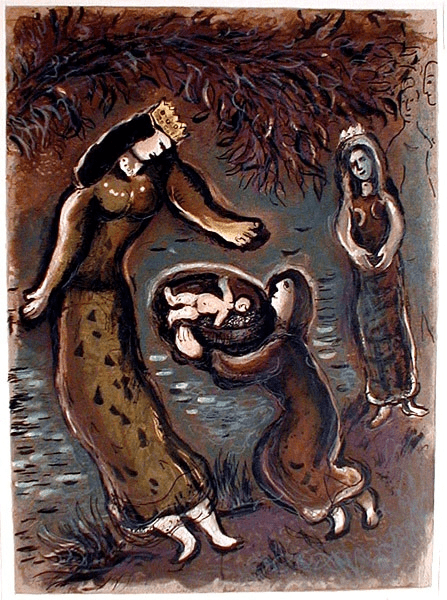
Moses is saved from the water by Pharaoh’s daughter, by Marc Chagall, 1966

Now a man from Levi’s household married a Levite woman. The woman became pregnant and gave birth to a son. She saw that the baby was healthy and beautiful, so she hid him for three months. When she couldn’t hide him any longer, she took a reed basket and sealed it up with black tar. She put the child in the basket and set the basket among the reeds at the riverbank. The baby’s older sister stood watch nearby to see what would happen to him.

Pharaoh’s daughter came down to bathe in the river, while her women servants walked along beside the river. She saw the basket among the reeds, and she sent one of her servants to bring it to her. When she opened it, she saw the child. The boy was crying, and she felt sorry for him. She said, “This must be one of the Hebrews’ children.”

Then the baby’s sister said to Pharaoh’s daughter, “Would you like me to go and find one of the Hebrew women to nurse the child for you?”

Pharaoh’s daughter agreed, “Yes, do that.” So the girl went and called the child’s mother. Pharaoh’s daughter said to her, “Take this child and nurse it for me, and I’ll pay you for your work.” So the woman took the child and nursed it. After the child had grown up, she brought him back to Pharaoh’s daughter, who adopted him as her son. She named him Moses, “because,” she said, “I pulled him out of the water.” (Common English Bible)

A new Pharaoh was enthroned in Egypt. Enough time had gone by that the legacy of Joseph as the administrator in saving many Egyptian people was lost. So, because the Israelites had grown to such large numbers, Pharaoh was afraid.

The politics of fear typically results in somebody getting oppressed. Indeed, fear became the driving force to a series of escalating oppressive policies initiated by Pharaoh, even to the point of planned infanticide. The Jewish midwives were instructed toward this end.

But the midwives did not fear the Egyptian Pharaoh. Instead they had a healthy fear of God (Exodus 1:17, 21). With such rightly ordered fear, the Jewish midwives defied the order of Pharaoh and openly disobeyed the royal command to murder Hebrew boys.

Here then, we have the setting for a special Hebrew baby to be born named Moses. He is the healthy child of two devout Levites. And although God’s name is not referenced in the verses for today, we can nonetheless see the providence and protection of the Lord within the narrative.

Through a complex chain of events, both the birth mother and the royal daughter care for this baby, protecting his life, with a divine provision for the needs of the infant Moses. Most stories in the Old Testament have contrasting characters within them, and today’s is no exception.

Pharaoh was the ruler over all of Egypt, and yet, he feared a loss of power and the status quo because of the Israelites – even though he reigned during a time of political peace, with hegemony reaching into the Middle East. As Pharaoh’s paranoid fear rose, so did God’s response of divine sovereignty over him, by providing protection against his diabolical intentions.

In contrast to Pharaoh, a powerless and non-descript Hebrew couple were married, conceived and bore a family of a daughter and two sons – Moses being the youngest. They had nothing, yet everything; whereas Pharaoh had everything, yet nothing. Thriving and flourishing has to do with a lot more than wealth and material resources.

Maternal care is powerful. And it finds a way to win the day and not only save a baby, but also to ensure that the baby grows, lives, and thrives. No royal edict can defeat the resilient strength of maternal compassion.

Despite Pharaoh’s increasing oppression, the compassion of several women ends up raising the very one who will lead the Israelites into liberation from this oppression.

With the Lord, a way will be found where there is no way. God + nothing = everything.

For us today, there is often a tendency to look back on the good old days when God did great things, and to look ahead when the Lord will return and make all things new and right. Yet we too often neglect to be mindful and live in the present moment, and know the God who is present with us right now.

We may remember the awesome deeds that God once did; and rejoice in biblical stories which demonstrate the Lord’s power, provision, and protection. We may look forward to the fulfillment of God’s promises in the person of Jesus when he returns, and gain hope from that.

Now, in this present evil age, and in this messed up world, we also have the God of the present tense. God will make a way, in this present time, where there seems to be no way. God is doing something new and amazing for us today.

And that way will be clear enough for us to know – and incredible enough for us to not predict or imagine. For God’s watch-care and deliverance can (and does) take many forms. When the Lord fulfills divine plans, it sometimes comes in the most creative and incredible way possible, so that we will have no doubt where it came from.

“God Will Make a Way” by Don Moen

God will make a way, Where there seems to be no way
He works in ways we cannot see, He will make a way for me
He will be my guide, Hold me closely to His side
With love and strength, For each new day
He will make a way He will make a way

By a roadway in the wilderness, He’ll lead me
And rivers in the desert will I see
Heaven and earth will fade
But His Word will still remain
He will do something new today

Encouragement for Today (1 Thessalonians 4:13-18)

Brothers and sisters, we do not want you to be uninformed about those who sleep in death, so that you do not grieve like the rest of mankind, who have no hope. 

For we believe that Jesus died and rose again, and so we believe that God will bring with Jesus those who have fallen asleep in him. According to the Lord’s word, we tell you that we who are still alive, who are left until the coming of the Lord, will certainly not precede those who have fallen asleep. 

For the Lord himself will come down from heaven, with a loud command, with the voice of the archangel and with the trumpet call of God, and the dead in Christ will rise first. After that, we who are still alive and are left will be caught up together with them in the clouds to meet the Lord in the air. And so we will be with the Lord forever. Therefore encourage one another with these words. (New International Version)

Everyone needs encouragement. Everybody wants some good news in their lives. People must not only have food, drink, clothing, and shelter, but also words that they can live by – words that can sustain them and help to make ends meet for their daily lives.

The Thessalonian Christians needed some good words of encouragement. They believed the Lord Jesus was coming soon. Any day now, at any time, Christ will return and take us to be with him forever. And yet, day after day, there was nothing but the anticipation, along with the expectations that weren’t realized.

On top of it all, some of the believing brothers and sisters died. So, what happens to them when they die? Will they somehow be excluded from enjoying Christ’s return? And, by the way, are we missing out on something here? Did Jesus come, and we somehow missed it?

The believers in the Thessalonian Church were left with concerns – not only for those who had died, but for those who were still alive. Perhaps somebody, even themselves, were being excluded from the gracious visitation of God. They were curious, but most of all confused.

Hope needed to be clarified for the Christians. A confident expectation would help sustain them in this life. They can keep laboring in the Lord with faith, have hope for the future, and realize love in both this life and in the life to come.

Christ will descend from the clouds with a cry of command, the sound of a trumpet, and lift the faithful into heaven. In other words, for those people who were living in the Roman Empire, Christ will arrive with the fanfare and pageantry of any Roman Emperor. Peace and security are here – not from Ceasar – but from a Sovereign who is greater than any earthly ruler.

I realize that many believers today see this vision of the coming Christ as a literal description. Maybe it is, and maybe it isn’t. But whatever it is, the Apostle Paul intended to assure the Thessalonian faithful that the promises of God were backed up by a power even greater than that of Rome.

Furthermore, true peace, security, and hope are not found in the Pax Romana of Rome, but in the gracious rule and reign of God. Christ is the Lord; Ceasar is not. The Thessalonians, therefore, were encouraged to let God be the source of their peace. For the One who calls you is faithful.

The encouragement we need is really not so different from what the Thessalonians needed to hear. Two thousand years later, like them, we continue to look for signs that assure us that God has not forgotten us; that we will not be left behind; and that we will not be separated from those who have already died.

As world problems continue, and as time marches on, we may grow weary. We might then place more hope and confidence in the power of a national government that offers us peace and security, as we patiently wait for God. Like the Thessalonians, all we really need is the assurance that God’s power and God’s promise is real.

We might not see Christ coming down from the sky today, or even next week, or next year. But we can still embrace the hope we need in order to get by every single day.

Although an apocalypse is coming, it is actually in the little things of life that helps sustain us till then. An encouraging and timely word from a friend; praying with a fellow believer; giving thanks to God for all things; and living with an awareness of the spiritual throughout the world all these things strengthen us and enable us to see God at work.

Through a consistent walk with God, day after day, the power and presence of God becomes real to us – maybe just as real as a dramatic scene of Christ coming down from the clouds – and offers us hope to face each new day with courage and compassion for a world in desperate need of salvation.

Almighty and all-sufficient God, give me strength to live another day.

Let me not be a coward in difficult circumstances, or to turn tail and run in the face of hard responsibilities.

Help me not lose faith in other people.

Keep my heart tender and wise, in spite of others’ ingratitude, treachery, or meanness.

Preserve me from minding the little stings of life, or of giving them to others.

May my heart be pure; and may I live honestly and fearlessly, so that no outward failure can dishearten me or take away the joy of inward integrity.

Open wide the eyes of my soul that I may see good in all things.

Grant me today some new vision of your truth.

Inspire me with a spirit of joy and gladness.

Make me the cup of strength to suffering souls.

I ask all of this in the name of my Deliverer, Lord, and Friend, Jesus Christ. Amen.

The Redeemed and Responsive Soul (Psalm 107:1-7, 33-37)

O give thanks to the Lord, for he is good,
    for his steadfast love endures forever.
Let the redeemed of the Lord say so,
    those he redeemed from trouble
and gathered in from the lands,
    from the east and from the west,
    from the north and from the south.

Some wandered in desert wastes,
    finding no way to an inhabited town;
hungry and thirsty,
    their soul fainted within them.
Then they cried to the Lord in their trouble,
    and he delivered them from their distress;
he led them by a straight way,
    until they reached an inhabited town…

He turns rivers into a desert,
    springs of water into thirsty ground,
a fruitful land into a salty waste,
    because of the wickedness of its inhabitants.
He turns a desert into pools of water,
    a parched land into springs of water.
And there he lets the hungry live,
    and they establish a town to live in;
they sow fields and plant vineyards
    and get a fruitful yield. (New Revised Standard Version)

The responsive spirit

A soul full of spiritual abundance responds freely and organically to God with offerings of gratitude for divine rescue and redemption.

The spiritually responsive person is at peace, content, and able to love with a sensitivity to God because they have had their needs for safety, satisfaction, and relational connection fulfilled. So, as a result, they are able to:

  • worship joyfully and praise God
  • speak words of thanksgiving
  • be attentive to self-care and personal well-being
  • use their resources wisely, feeling capable and confident of making good decisions that bless both the church and the world
  • know they are secure in the loving hands of God

The reactive spirit

Conversely, a soul that is empty from spiritual deprivation reacts predictably and robotically to others with frustration and fear.

The spiritually reactive person seems perpetually upset and in chronic emotional pain, feeling rattled and worried most of the time. They do not reflexively look to the Lord. Their needs for safety, satisfaction, and relational connection have not been met. So, as a result, they are:

  • hypervigilant, on the lookout for the bad, which they are convinced is coming
  • focused narrowly with tunnel vision, having lost sight of the big picture
  • prone to overgeneralizing their negative experiences as being the only experiences they ever have
  • searching for continual stimulation, just to seem alive and feel something
  • insecure, wanting constant validation from others because they cannot give themselves any encouragement

So, what do you do when always feeling between a rock and a hard place, experiencing racing thoughts, being anxious more than not, feeling like an abandoned town in the Old West with nothing but tumbleweed moving down the street?

A redeemed soul

In your desperation, call out to God. The Lord can:

  • get you out in the nick of time and deliver you soul from trouble so that you can be grateful for divine love
  • put your feet walking on a wonderful road of grace that leads to a good place of transformation
  • meet your needs for freedom, contentment, and loving relational networks, so that your spirit is full of right relationships, purity, mercy, and peace

You can once again, or maybe for the first time, feel like:

  • A flowing river, instead of sunbaked mud
  • A fruitful orchard, instead of dry dead tree
  • A farmer with much grain and many animals, instead of a homeless person sitting on a pile of dung
  • A person loved and valued by God, instead of a waste of space, breathing air that others could have
  • A sheep who knows the shepherd is watching over them, instead of an insect that everyone steps on

Keep in mind, that the experience of blessing, the encounter of abundance, and the feeling of peace, is not like a simple math equation – as if God were a divine genie that you happened to find and got three wishes.

Rather, the fulfilling spiritual life involves a persistent faith, confident hope, and constant love. These come from God, and are accessed through humility. The proud person will not realize a life of faith, hope, and love, because they believe they already know what is best.

The humble admit their ignorance, their failings, their shame, their guilt, and their desperation.

Approaching God with humility doesn’t mean to heap deprecation and curses on oneself. It just means to be honest with where you are spiritually, emotionally, mentally, and physically. And to cry out for help, knowing you have nothing to offer in return.

In God’s economy, the currency is grace – and not some give-and-take, I’ll-scratch-your-back-if-you-scratch-mine sort of mentality. God’s steadfast love endures forever. God’s kingdom spins on the axis of grace.

The Lord is not a reactive God but a responsive God. The Lord responded to Israel’s cry for deliverance not just with food and drink, but with a city. God did not only meet the immediate needs of the ancient Israelites, for whom the psalmist is one, along with the original recipients; the Lord took care of their larger, long term needs. 

The people needed a place where they could settle down, raise their own crops and tend their own livestock, and have a dependable means of making a living. God satisfied this, and more, by giving them a city where they could settle, be safe, secure, and content.

God can do anything, you know—far more than you could ever imagine or guess or request in your wildest dreams. God does it not by pushing us around, but by working within us, the Spirit deeply and gently providing us with our deepest and greatest needs.

Blessed heavenly Father, you have filled the world with divine beauty: Open our eyes to behold your gracious hand in everything you have done, so that, rejoicing in all your creation, we may learn to serve you with gladness; for the sake of him through whom all things were made, your Son Jesus Christ, our Lord, who with you and the Holy Spirit are one God, now and forever. Amen.