Nativity of the Lord (Luke 2:1-20)

Nativity, by He Qi, 1998

In those days a decree went out from Caesar Augustus that all the world should be registered. This was the first registration and was taken while Quirinius was governor of Syria. 

All went to their own towns to be registered. Joseph also went from the town of Nazareth in Galilee to Judea, to the city of David called Bethlehem, because he was descended from the house and family of David. He went to be registered with Mary, to whom he was engaged and who was expecting a child. 

While they were there, the time came for her to deliver her child. And she gave birth to her firstborn son and wrapped him in bands of cloth and laid him in a manger, because there was no place in the guest room.

Now in that same region there were shepherds living in the fields, keeping watch over their flock by night. Then an angel of the Lord stood before them, and the glory of the Lord shone around them, and they were terrified. 

But the angel said to them, “Do not be afraid, for see, I am bringing you good news of great joy for all the people: to you is born this day in the city of David a Savior, who is the Messiah, the Lord. This will be a sign for you: you will find a child wrapped in bands of cloth and lying in a manger.” 

And suddenly there was with the angel a multitude of the heavenly host, praising God and saying,

“Glory to God in the highest heaven,
    and on earth peace among those whom he favors!”

When the angels had left them and gone into heaven, the shepherds said to one another, “Let us go now to Bethlehem and see this thing that has taken place, which the Lord has made known to us.” 

So they went with haste and found Mary and Joseph and the child lying in the manger. When they saw this, they made known what had been told them about this child, and all who heard it were amazed at what the shepherds told them, and Mary treasured all these words and pondered them in her heart. 

The shepherds returned, glorifying and praising God for all they had heard and seen, just as it had been told them. (New Revised Standard Version)
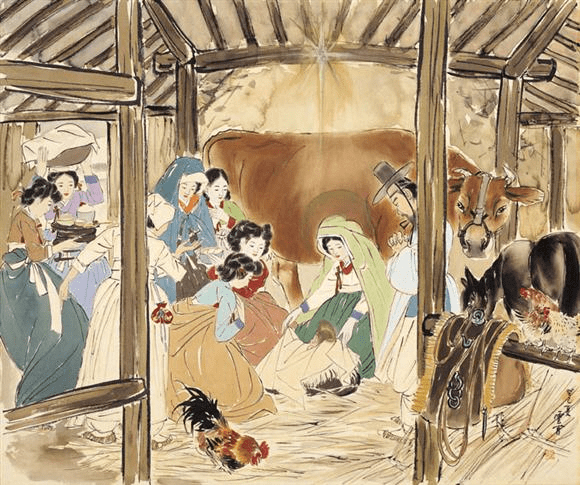
The Birth of Jesus Christ, by Woonbo Kim Ki-chang, 1953

Overwhelmed. That’s the word I imagine the characters in this story had, for various reasons.

To have spiritual or emotional overwhelm is to feel overpowered by several circumstances at once. It’s experiencing a lot of emotions all at the same time.

The sense of overwhelm can come from many different things, including complicated grief, relational distance, and too many responsibilities. Depending upon why we are overwhelmed, it will likely either leave us stuck and chronically tired, or free and forever rejoicing.

A good sense of overwhelm is awe and wonder. A bad sense of overwhelm is despondency and dejection.

Mary probably experienced the full range of overwhelm. An angel showed up and announced to her that she would give birth to a son and name him Jesus, meaning that God will save the people. He will fulfill the promise of being the Son of the ancient King David who has a permanent reign.

In other words, Mary would give birth to the Messiah. That sounds like the very definition of overwhelm, in both its good and bad sense.

Despite the temporal worldly power of the Roman Empire, Mary’s child would have a kingdom without end. And in spite of the Romans, God’s will and purpose would prevail.

And yet, Mary and Joseph were still subject to Roman authority. That meant they needed to be registered, along with everyone else in the Empire, so that the government knew about their tax base, and who was going to pay it.

The decree from Ceasar meant that, even though Mary was quite pregnant, she and Joseph would have to travel to Bethlehem, the family’s ancestral town, in order to be properly registered.

Jesus would not be born in the city of overwhelming power and control in Jerusalem. Rather, Bethlehem, a small non-descript town south of the city, is the place for an overwhelming birth experience to happen.

It’s appropriate that from the beginning, the life and ministry of Jesus would be more about the smaller and less powerful place and people.

And so, the new king, from the line of David, is born in the most humble of circumstances. It is fitting that the humblest of persons were the first to receive the birth news.

Shepherds were literally out on the margins of society. Their typical reputation was not good. They stink. They drink too much. They’re on the lower rung of cultural power.

Yet, a huge angelic delegation was sent from heaven to shepherds to announce the birth. It was an overwhelming experience, no matter how you view it.

Seeing Shepherds, by Daniel Bonnell

Angels showed up, and the shepherds were nearly paralyzed with fear. But their terror turned on a dime to awe, wonder, and joy.

What’s more, the good news shared with the lowliest of persons, is for everyone. All the overwhelm and awe is contained in a savior who has been born, Christ the Lord.

Overwhelming feelings were a regular experience of people in the Gospel of Luke who encountered angels – fear being the initial response. But it’s then followed by an assurance that God is extending grace to them, not judgment. No one need be afraid, because God is with them.

It’s not a new message; but it is a message that is newly focused in this savior of a baby. He is Immanuel, God with us. The presence of God is here, because the attention and love of God are here.

Out of my distress I called on the Lord;
    the Lord answered me and set me in a broad place.
With the Lord on my side I do not fear.
    What can mortals do to me?
The Lord is on my side to help me;
    I shall look in triumph on those who hate me. (Psalm 118:5-7, NRSV)

The real genuine authentic power of the universe is here – not found within political empires or governments, nor with the wealthy and influential – but discovered in the arrival of the actual savior, who holds all power and authority, and wields it according to proper justice and righteousness.

All along, God is the true deliverer who backs up the needy and oppressed. It is demonstrated in the angelic proclamations of good news about this Savior, the Christ, the One anointed and chosen by God, the son of David, the deliverer from ancient enemies.

The angel’s proclamation erupts with the sudden appearance of a multitude of God’s heavenly messengers praising God, declaring God’s glory, favor, and blessing of peace on the earth. The emphasis is upon God’s grace rather than human action.

In response to the announcement they received, the shepherds went to see if what they had heard was true, and indeed, it all was. When they saw the sign for themselves, they could not keep silent about all they had heard and seen.

The shepherds praised God, out of an overwhelming sense of amazement that the Lord had paid attention to them.

Praise is still the reaction in the life of the person touched by all that they have seen and heard.

Creator God, by your greatness you became small; by your power you became powerless; and by your limitlessness you became limited. Through the birth of your son, we can live in the divine light that shines on a world transformed by the limitless power of your love. Amen. Praise the Lord!

Struggling in the Season (Genesis 25:19-28)

Art by Sefira Lightstone

These are the descendants of Isaac, Abraham’s son: Abraham was the father of Isaac, and Isaac was forty years old when he married Rebekah, daughter of Bethuel the Aramean of Paddan-aram, sister of Laban the Aramean. Isaac prayed to the Lord for his wife because she was barren, and the Lord granted his prayer, and his wife Rebekah conceived. The children struggled together within her, and she said, “If it is to be this way, why do I live?” So she went to inquire of the Lord. And the Lord said to her,

“Two nations are in your womb,
    and two peoples born of you shall be divided;
the one shall be stronger than the other;
    the elder shall serve the younger.”

When her time to give birth was at hand, there were twins in her womb. The first came out red, all his body like a hairy mantle, so they named him Esau. Afterward his brother came out, with his hand gripping Esau’s heel, so he was named Jacob. Isaac was sixty years old when she bore them.

When the boys grew up, Esau was a skillful hunter, a man of the field, while Jacob was a quiet man, living in tents. Isaac loved Esau because he was fond of game, but Rebekah loved Jacob. (New Revised Standard Version)

As we near the end of Advent and the anticipation of the Christ child, today’s Old Testament lesson is a reminder to us of a much earlier birth.

The birth of the twins Jacob and Esau from Rebekah and the patriarch Isaac, are part of the promise given to Abraham, which would find its fulfillment centuries later, according to Christians, with the incarnation of Christ.

In this time of year, we may commonly associate the season with an emphasis on peace and unity. Yet, we must bear in mind that the need to emphasize these positive elements arises because enmity and discord exists among us.

In our story for today, we are reminded that God also works within conflict, even family conflict, to further divine purposes and promises. God’s presence exists through times of strife and disagreement, just as much as it does in times of joy of celebration.

The sibling rivalry between Jacob and Esau began within the womb and at their birth. Their adverse relationship and continual competition was something God used, and bent it toward the Lord’s good plans and purposes for people.

Just as Mary and Elizabeth were mothers central to the direction of God’s will accomplished on this earth, so Rebekah is a pivotal character in the early history of the people of Israel, and their covenantal promises.

And similar to Mary and Elizabeth in the New Testament, Rebekah in the Old Testament was given children by means of God’s gracious power. We are meant to see God’s sovereign authority over all things, including control of the future. The text of Scripture values faith, and trusting in divine promises.

The two babies, Esau and Jacob, are more than twins. They each are ancestors of entire nations of people: Esau of Edom, and Jacob of Israel.

Against all odds, Jacob is the one who kept coming out on top of things. His character reveals something of the nation of Israel’s understanding of themselves. Israel is a small, and by all appearances, an insignificant nation; and yet, they become identified as God’s covenant people.

The ways of the Lord are often quite contradictory to societal convention and cultural expectations. The smallest and the youngest, the least and the forgotten, become prominent in God’s economy of things. This is a common pattern throughout Holy Scripture. (e.g. Genesis 17:18-19; 42:6-9; 1 Samuel 16:10-13; 17:33, 50)

Even though the two of them are twins, Esau and Jacob have very different personalities and interests. Esau was an outdoorsman, a hunter, who wasn’t home much. He had an extroverted life which had him interacting with all sorts of different people, especially women from other places. Jacob, however, hung around the home tents, an introvert. He comes across a stereotypical mama’s boy.

Yet, despite Jacob’s continual conniving, and Esau’s constant disdain for his family’s heritage with God, the Lord nevertheless showed generosity to both brothers.

But for a long time, it seemed as if one might kill the other, or both of them may do away with each other. Yet, eventually, there is a reunion between the brothers.

Ultimately, their story as brothers ends without any more sibling rivalry or hatred. Instead, there is reconciliation, blessing, and peace, as they positively accept one another and share in the burial of their father Isaac.

Especially in this time of year, when families gather around tables to eat, watch football games together, and go outside for semi-ceremonial smokes and drinks – and all that goes with being together around family, there is the inevitable conflict.

And when it comes, each individual responds in their typical way of either avoidance, confrontation, or quick-fix resolution. But there is also another way to respond.

Know that struggle, rivalry, emotion, longing, and belonging are all part of our human experience. And God is just as much present within those times, as God is in the blessing before eating, or the spiritual conversation between friends, or the collective sojourn to church on Christmas Eve and/or Christmas Day.

The blessing and abundance of God comes through all sorts of means. The ways of the Lord are often beyond what we might think or believe.

This season is an opportunity to embrace the conflict and the struggle, in order to know God better, know friends and family better, and better know what it means to be blessed.

Almighty, ever-living, and ever-loving God, the Nativity of your Son draws near. May divine mercy flow from your Word, made flesh for us of the Virgin Mary, to us, your unworthy yet faithful servants. Let him establish his dwelling on this earth, and in our hearts, Jesus Christ, our Lord, who lives and reigns with you in the unity of the Holy Spirit, one God, now and forever. Amen.

“I Have Overcome the World” (John 16:25-33)

All Are Alike Unto God, by Madison Wardle

“Though I have been speaking figuratively, a time is coming when I will no longer use this kind of language but will tell you plainly about my Father. In that day you will ask in my name. I am not saying that I will ask the Father on your behalf. No, the Father himself loves you because you have loved me and have believed that I came from God. I came from the Father and entered the world; now I am leaving the world and going back to the Father.”

Then Jesus’ disciples said, “Now you are speaking clearly and without figures of speech. Now we can see that you know all things and that you do not even need to have anyone ask you questions. This makes us believe that you came from God.”

“Do you now believe?” Jesus replied. “A time is coming and in fact has come when you will be scattered, each to your own home. You will leave me all alone. Yet I am not alone, for my Father is with me.

“I have told you these things, so that in me you may have peace. In this world you will have trouble. But take heart! I have overcome the world.” (New International Version)

Imagine you are with Jesus in the Upper Room celebrating Passover. And your Lord tells you he is leaving – going back to the Father. After three years of a difficult, yet incredible ministry, there is palpable grief in the room. It’s as if you got sucker-punched. You want this time with Jesus to never end….

Jesus Christ, Son of God, Son of Man, Savior of the world, does not forget you. The Lord is concerned and careful to provide wonderful words of assurance: Father God loves you. I give you my peace. I have overcome the world.

My friend, do you hear the words of Jesus? Do you truly understand what the Lord of all the earth has said to you? The love and peace of Christ has overcome the world. That love and that peace is given to you. You, and not just someone else, possesses the love and peace to overcome the world.

Whenever we encounter trouble; in those times when grief seems to be swallowing us whole; and when all is dark and we cannot see our hand in front of our face – it is in these moments the Lord comes alongside us and communicates a loving divine presence which grants us the peace of settled rest, even if, and especially when, our troubling situations do not change.

If you have had a life largely free of struggle, the privilege of knowing where your next meal is coming from, and the assurance of having your most basic needs met, then please understand that many people throughout the world, right this moment, know nothing of that kind of experience.

However, this doesn’t necessarily mean that needy persons are unhappy, discontent, or bitter. Heavens, no!

Love and peace are neither bound nor limited by adverse circumstances.

In fact, love and peace are known in a much deeper way whenever we have been hated and in conflict. That’s because love thrives and flourishes in an environment of hate; and peace takes root more surely wherever there is disharmony and misunderstanding.

If everything always goes our way, how then would we know the Lord’s great grace to us? How would we ever know God as Provider unless we were in want? How would we know Christ as the Healer unless we were broken? How could we ever know resurrection unless there was a crucifixion?

Jesus specializes in the improbable and the impossible. He comes and lands on the Island of Misfit Toys, and airlifts the discarded ones to be a gift to the world.

You see, this is precisely how we overcome the world: We love and serve, just as our Lord did. Since he overcame, we walk in his footsteps.

The acquisition and presence of peace is anything but passive. Peace has been achieved through a bloody cross and settles within the spirit through an active pursuit of harmony, wholeness, integrity, and love.

Now that we have been put right with God through faith, we have peace with God through our Lord Jesus Christ. He has brought us by faith into this experience of God’s grace, in which we now live. And so, we boast of the hope we have of sharing God’s glory! We also boast of our troubles, because we know that trouble produces endurance, endurance brings God’s approval, and his approval creates hope. (Romans 5:1-4, GNT)

For the kingdom of God is not food and drink but righteousness and peace and joy in the Holy Spirit. The one who thus serves Christ is acceptable to God and has human approval. Let us then pursue what makes for peace and for mutual upbuilding. (Romans 14:17-19, NRSV)

God’s peace and love is free, but it is not cheap. It is obtained smack in the middle of worldly troubles. So, may the peace of God be with you, my friends, now and always.

Almighty and everlasting God, you are the fountain of all peace, spiritual and temporal. We humbly pray, in your great goodness grant us that peace which the world cannot give, that we may ever live in your fear, obedient to your commandments, to the end that you may deliver us from all our enemies, through your dear Son, Jesus Christ, our Lord. Amen.

Pillow Thoughts (Psalm 132:1-12)

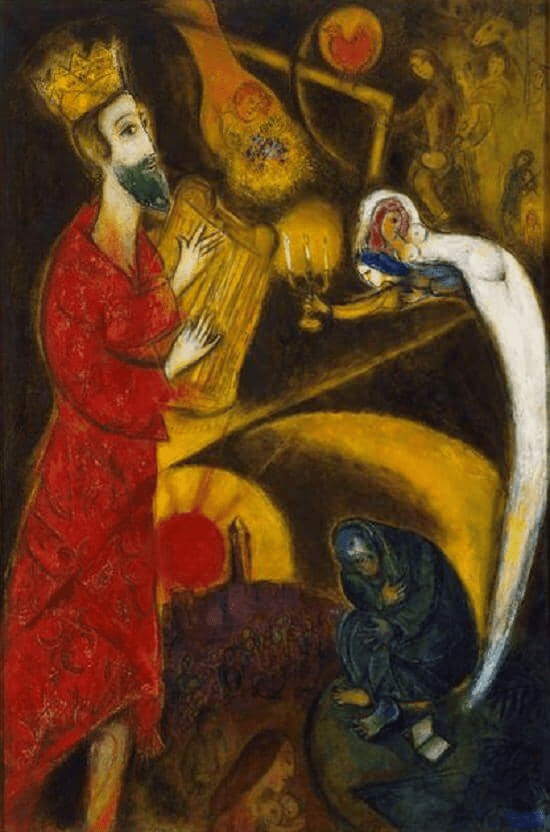
King David, by Marc Chagall, 1962

O Lord, remember in David’s favor
    all the hardships he endured;
how he swore to the Lord
    and vowed to the Mighty One of Jacob,
“I will not enter my house
    or get into my bed;
I will not give sleep to my eyes
    or slumber to my eyelids,
until I find a place for the Lord,
    a dwelling place for the Mighty One of Jacob.”

We heard of it in Ephrathah;
    we found it in the fields of Jaar.
“Let us go to his dwelling place;
    let us worship at his footstool.”

Rise up, O Lord, and go to your resting place,
    you and the ark of your might.
Let your priests be clothed with righteousness,
    and let your faithful shout for joy.
For your servant David’s sake
    do not turn away the face of your anointed one.

The Lord swore to David a sure oath
    from which he will not turn back:
“One of the sons of your body
    I will set on your throne.
If your sons keep my covenant
    and my decrees that I shall teach them,
their sons also, forevermore,
    shall sit on your throne.” (New Revised Standard Version)

King David took great pains in providing for the house of the Lord; and was very concerned about the worship of Yahweh. He went well out of his way to ensure that a temple would be built for his God.

David made as many preparations as he possibly could before his death, so that his son Solomon could follow through and build the temple. The editor of the Book of Chronicles commented on this:

David gave orders to gather together the aliens who were residing in the land of Israel, and he set stonecutters to prepare dressed stones for building the house of God. David also provided great stores of iron for nails for the doors of the gates and for clamps, as well as bronze in quantities beyond weighing, and cedar logs without number—for the Sidonians and Tyrians brought great quantities of cedar to David. 

For David said, “My son Solomon is young and inexperienced, and the house that is to be built for the Lord must be exceedingly magnificent, famous and glorified throughout all lands; I will therefore make preparation for it.” So David provided materials in great quantity before his death. (1 Chronicles 22:2-5, NRSV)

The king did all of this because God came to David and let him know that he would not be the one to build the temple; that job would fall to his son Solomon. (2 Samuel 7:4-13)

David’s final instruction to Solomon and the people had to do with the construction of a house for the Lord his God:

“Now set your mind and heart to seek the Lord your God. Go and build the sanctuary of the Lord God so that the ark of the covenant of the Lord and the holy vessels of God may be brought into the house built for the name of the Lord.” (1 Chronicles 22:19, NRSV)

The worship of God, for David, was to be the central feature of the Jewish people. All Israel and Judah were to encourage one another in worship at God’s house, the Lord’s Temple, in Jerusalem.

The priests of God wore special clothing, and handled the holy implements and the Ark of the Covenant of God. Yet, they were to be also clothed with righteousness, making sure that their outward ceremonial rituals reflected an inner moral purity and holiness before God.

David was bound and determined to not only worship the Lord himself, but to see that the entire nation of Israel had the opportunity to worship together in a central place.

Maybe a question arises for you about why David was so driven to construct a house for God. What is it that motivated King David to spend so much of his planning and energy on making sure that a temple would be constructed for the Lord?

Now when the king was settled in his house and the Lord had given him rest from all his enemies around him, the king said to the prophet Nathan, “See now, I am living in a house of cedar, but the ark of God stays in a tent.” Nathan said to the king, “Go, do all that you have in mind, for the Lord is with you.” (2 Samuel 7:1-3, NRSV)

A lot of events had transpired for David to be in the position of king, with peace all around him. The Lord had been with David, and brought him through the sort of adversities most of us will never know.

Once King David was at the pinnacle of peace and success, his thought were not about how to hold onto power, or to get more of it. He would lay his head on his pillow at night and wonder how he could give back to God for being so faithful.

And considering all that God had accomplished for him and for Israel, it seemed a travesty that he was luxuriating in a fine house, while the Ark of the Covenant – the objective presence of God among the people – was sitting in an old tent. So, David became determined to change that situation, because he could.

I wonder if when you and I are at a place in our lives where we feel safe and secure, prosperous and happy, our thoughts and dreams turn toward how we might give back to God in a worshipful way which will honor the Lord, as well as bless all the people of God.

I am curious what sort of things occupy your mind at night while your head is on your pillow, when you are feeling good about how your life is going.

Many, if not most, people will think about themselves, and what to do with what they have gained and/or accomplished. But what about you?

How will you respond to God’s grace, goodness, deliverance, and protection in your own life? What sort of ideas arise in your mind? What is in your heart to do for God and God’s people?

What are your pillow thoughts at night?

Presence itself is a great gift. The presence of God is incredibly gracious, good, and miraculous. And human presence, with each individual stamped with the image and likeness of God upon them, is also a wonderful gift from the Creator. And very much needed.

David enjoyed the presence of God, and longed for all the people to experience that divine presence. Although the Lord needed no temple to live in, David had in mind to provide one.

I imagine that King David understood that each person is a luminous icon of presence, reflecting God’s image, and needing the presence of God and others in order to have a nation who worships God as commanded in the Mosaic law.

Through communal worship at a designated site in Jerusalem, the Israelites could enjoy the beauty of God’s presence together, as well as the encouragement of one another.

Wherever there is presence and the acknowledgement of God and each other, there is freedom to offer affection, understanding, and respect.

It seems to me that these were the sort of thoughts that ran through King David’s mind, which made him determined to build a house for the Lord his God.

So, what will you do with your thoughts and your life?

Almighty God of all hope, of our thoughts and dreams: In humility, we give you thanks for all of creation; and for everything you give us. We praise you for forgiving us of our guilt and shame, even before we ask. You raise us from our broken state and make us whole. You give us the peace we yearn for.

Blessed God, fill us, your people, with your divine Spirit. Be our light in the darkness. Envelop us with your presence. Orient our hearts toward your justice; and help us always praise you. Let us ever be mindful of your power and grace in the world. Let us live as one with you in grace and in truth. Amen.