
Isaiah 40:1-11 – Comfort for the Weary

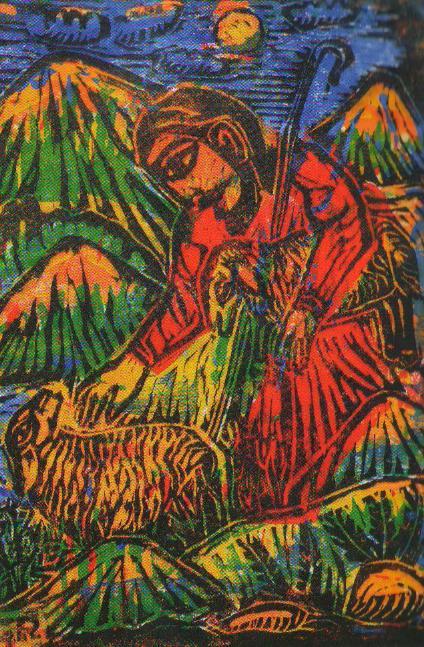
The Shepherd by Indian artist P. Solomon Raj (1921-2019)

Comfort, comfort my people,
    says your God.
Speak tenderly to Jerusalem,
    and proclaim to her
that her hard service has been completed,
    that her sin has been paid for,
that she has received from the Lord’s hand
    double for all her sins.

A voice of one calling:
“In the wilderness prepare
    the way for the Lord;
make straight in the desert
    a highway for our God.
Every valley shall be raised up,
    every mountain and hill made low;
the rough ground shall become level,
    the rugged places a plain.
And the glory of the Lord will be revealed,
    and all people will see it together.
For the mouth of the Lord has spoken.”

A voice says, “Cry out.”
    And I said, “What shall I cry?”

“All people are like grass,
    and all their faithfulness is like the flowers of the field.
The grass withers and the flowers fall,
    because the breath of the Lord blows on them.
    Surely the people are grass.
The grass withers and the flowers fall,
    but the word of our God endures forever.”

You who bring good news to Zion,
    go up on a high mountain.
You who bring good news to Jerusalem,
    lift up your voice with a shout,
lift it up, do not be afraid;
    say to the towns of Judah,
    “Here is your God!”
See, the Sovereign Lord comes with power,
    and he rules with a mighty arm.
See, his reward is with him,
    and his recompense accompanies him.
He tends his flock like a shepherd:
    He gathers the lambs in his arms
and carries them close to his heart;
    he gently leads those that have young. (NIV)

As we journey through the Christian Year, we have spent the past twenty-five weeks in the longest season on the Church Calendar: ordinary or proper time. It is only appropriate that the dog days of summer and the bulk of autumn should be within this time.

Most of the Christian’s life is lived in the mundane yet necessary work of mission. Small and seemingly obscure acts of kindness, careful yet often discreet acts of love, and graciously chosen words of encouragement which may not be noticed by many are what mostly characterize the daily pilgrimage of faith.

I am sure the ancient Jewish people felt that, for an awfully long time, they were plodding along as faithfully as they could with often little to show for it. Yet, they knew it would not always be this way. God’s people anticipated that a time was coming when their pedantic service would see the light of day.

I am sure we, too, have times when it feels as if our prayers are only bouncing off the ceiling. In such times, words of comfort and assurance come as a breath of fresh air. When we least expect it, God speaks to us tenderly and with compassion. The Lord steps into our weariness and exhausting work and says, “Enough!”

Whereas our walk with God may often feel like trudging up and down hills, sloshing through muddy valleys, and traversing hard terrain, the proclamation of comfort assures us that it will not always be this way. The way to God will be made level so that we can connect with the Lord post haste.

No matter how much our worldly circumstances break us down, even shattering our expectations and dreams, we carry with us an unflagging vision of wholeness, integrity, and hope. God is our true home, our polestar, our ultimate destiny. Feeling displaced, out of sorts, or like we just do not belong are signs that we long for our place with God.

And when we find our home with God, all might be going to hell around us, yet we are buttressed and sustained by living divine words. For those with eyes to see, ears to hear, and hearts attuned to grace, there is John the Baptist, smoothing the highway to our Lord – preparing the way to Jesus. (Mark 1:1-4)

God, as both the warrior who powerfully fights our battles, and the shepherd who lovingly tends to our needs, firmly takes the initiative to bring us home, going out of the way to gently pick us up and carry us back to the place we belong.

The good news is that the world is changed by God. The world around us is no longer the way we thought it was or was supposed to be. Despair gives way to confident expectation, and discouragement is slowly replaced by consolation. The long exile is coming to an end. Jesus is coming soon. All will be made right; justice and peace will have the day.

Let your hearts be true and humble, as befits God’s holy reign. For the glory of the Lord is on the earth and will be from everlasting to everlasting.

Glory to God in the highest, and on earth, peace to people of goodwill. We praise you; we bless you; we adore you; we give thanks to you for your great glory. Amen.

Joshua 6:1-16, 20 – Seven Times

Now the gates of Jericho were securely barred because of the Israelites. No one went out and no one came in.

Then the Lord said to Joshua, “See, I have delivered Jericho into your hands, along with its king and its fighting men. March around the city once with all the armed men. Do this for six days. Have seven priests carry trumpets of rams’ horns in front of the ark. On the seventh day, march around the city seven times, with the priests blowing the trumpets. When you hear them sound a long blast on the trumpets, have the whole army give a loud shout; then the wall of the city will collapse and the army will go up, everyone straight in.”

So, Joshua son of Nun called the priests and said to them, “Take up the ark of the covenant of the Lord and have seven priests carry trumpets in front of it.” And he ordered the army, “Advance! March around the city, with an armed guard going ahead of the ark of the Lord.”

When Joshua had spoken to the people, the seven priests carrying the seven trumpets before the Lord went forward, blowing their trumpets, and the ark of the Lord’s covenant followed them. The armed guard marched ahead of the priests who blew the trumpets, and the rear guard followed the ark. All this time the trumpets were sounding. But Joshua had commanded the army, “Do not give a war cry, do not raise your voices, do not say a word until the day I tell you to shout. Then shout!” So, he had the ark of the Lord carried around the city, circling it once. Then the army returned to camp and spent the night there.

Joshua got up early the next morning and the priests took up the ark of the Lord. The seven priests carrying the seven trumpets went forward, marching before the ark of the Lord and blowing the trumpets. The armed men went ahead of them and the rear guard followed the ark of the Lord, while the trumpets kept sounding. So, on the second day they marched around the city once and returned to the camp. They did this for six days.

On the seventh day, they got up at daybreak and marched around the city seven times in the same manner, except that on that day they circled the city seven times. The seventh time around, when the priests sounded the trumpet blast, Joshua commanded the army, “Shout! For the Lord has given you the city!…

When the trumpets sounded, the army shouted, and at the sound of the trumpet, when the men gave a loud shout, the wall collapsed; so, everyone charged straight in, and they took the city. (NIV)

Today’s Old Testament lesson is the famous account of the ancient Israelites taking the city of Jericho. The Lord gave the people unusual instructions to march around the city once each day for six days. On the seventh day, they were to proceed around the city seven times and then give a loud shout and the walls would come down. The Israelites followed the command to the letter and, as a result, saw an incredible work of God.

There are two words in this story that are repeated frequently: “seven” and “shout.” Seven priests with seven trumpets march around the city seven times on the seventh day. And the people were to do more than shout on the seventh day – they were to give a great big lung-filled roar together.

The number seven shows up many times in Holy Scripture. Maybe it is God’s favorite number. Whenever we see the number seven, it points to God. For example, the psalmist said:

I will praise you seven times a day because all your regulations are just. (Psalm 119:164, NLT) 

Ancient Israel took this verse literally and seriously by instituting a daily offering every day, seven times a day, of prayer and worship, spacing it out over the course of a twenty-four-hour period. The early church continued the practice, and even today many liturgical traditions still hold to the “Daily Office” which are seven distinct times in the day (and night) of intentionally connecting with God.

In our contemporary religious milieu and fragmented world, methinks we need to re-connect with the number seven. Maybe we would see God do the miraculous if we prayed with the words “seven” and “shout” as our guiding motifs. I wonder what kind of spiritual health would result from committing to intentional times of prayer seven times a day. I am curious if we followed our prayers with a great shout together of confident faith if we would see mighty divine works in ourselves, the church, and the world.

Almighty, ever-living God help us to obey you willingly and promptly. Teach us how to serve you with sincere and upright hearts in every sphere of life through Jesus Christ, your Son, our Lord, who lives and reigns with you in the unity of the Holy Spirit, one God, now and forever. Amen.

Joshua 4:1-24 – Remembrance

When the entire nation had finished crossing over the Jordan, the Lord said to Joshua, “Pick twelve men from the people, one man per tribe. Command them, ‘Pick up twelve stones from right here in the middle of the Jordan, where the feet of the priests had been firmly planted. Bring them across with you and put them down in the camp where you are staying tonight.’”

Joshua called for the twelve men he had appointed from the Israelites, one man per tribe. Joshua said to them, “Cross over into the middle of the Jordan, up to the Lord your God’s chest. Each of you, lift a stone on his shoulder to match the number of the tribes of the Israelites. This will be a symbol among you. In the future your children may ask, ‘What do these stones mean to you?’ Then you will tell them that the water of the Jordan was cut off before the Lord’s covenant chest. When it crossed over the Jordan, the water of the Jordan was cut off. These stones will be an enduring memorial for the Israelites.”

The Israelites did exactly what Joshua ordered. They lifted twelve stones from the middle of the Jordan, matching the number of the tribes of the Israelites, exactly as the Lord had said to Joshua. They brought them over to the camp and put them down there. Joshua also set up twelve stones in the middle of the Jordan where the feet of the priests had stood while carrying the covenant chest. They are still there today.

Meanwhile, the priests carrying the chest were standing in the middle of the Jordan. They stood there until every command that the Lord had ordered Joshua to tell the people had been carried out. This was exactly what Moses had commanded Joshua. The people crossed over quickly. As soon as all the people had finished crossing, the Lord’s chest crossed over. The priests then moved to the front of the people. The people of Reuben, the people of Gad, and half the tribe of Manasseh crossed over, organized for war ahead of the Israelites, exactly as Moses had told them. Approximately forty thousand armed for war crossed over in the Lord’s presence to the plains of Jericho, ready for battle. The Lord made Joshua great in the opinion of all Israel on that day. So, they revered him in the same way that they had revered Moses during all his life.

The Lord said to Joshua, “Command the priests carrying the chest containing the testimony to come up out of the Jordan.”

So, Joshua commanded the priests, “Come up from the Jordan.” The priests carrying the Lord’s covenant chest came up from the middle of the Jordan, and the soles of their feet touched dry ground. At that moment, the water of the Jordan started flowing again. It ran as before, completely over its banks. The people came up out of the Jordan on the tenth day of the first month. They camped at Gilgal on the east border of Jericho.

Joshua set up at Gilgal those twelve stones they had taken from the Jordan. He said to the Israelites, “In the future your children will ask their parents, ‘What about these stones?’ Then you will let your children know: ‘Israel crossed over the Jordan here on dry ground.’ This was because the Lord your God dried up the water of the Jordan before you until you crossed over. This was exactly what the Lord your God did to the Reed Sea. He dried it up before us until we crossed over. This happened so that all the earth’s peoples might know that the Lord’s power is great and that you may always revere the Lord your God.” (CEB)

I like coffee. I like coffee mugs. I like buying a coffee mug from places I visit. Although it drives my wife nuts, the mugs serve as a continual reminder of a certain place or event I have experienced. As we journey with the Israelites in the Old Testament book of Joshua, we experience with them the significant places and events of their taking the Promised Land. God did a miraculous work by causing the Jordan River to congeal so that the Israelites could cross over on dry ground in entering the land.  Once they were across on the other side, God instructed them to take twelve stones, one for each tribe, and pile them up together.

Crossing Over the Jordan River by Yoram Raanan

The purpose of the heap of twelve stones is made clear in the story and had a twofold purpose: to educate future generations inside Israel that God kept the promise to bring them into a land of abundance; and, to educate those outside Israel that God is mighty.

It is important to be tethered to the past and aware of why and how we are here. Yet, there are many families and faith communities in which the children know little about how God worked in previous generations. So, having tangible reminders of God’s past actions serves everyone to remember, and especially enables children to know the past actions of God. Just as people ask me about why I have certain coffee mugs, so having reminders of God’s grace in prominent visible places serves to aid kids and others to ask why those mementos are there.

It is good to have reminders of faith and the faithful people who influenced us around our homes, places of work, and communities so that others may know the redemptive acts of God, that the Lord keeps promises. And it is a whole lot more important than a coffee mug.

Almighty God, we praise and magnify your holy Name for all your servants who have finished their course in faith and patience. May we remember them and their service well. We humbly pray that, at the day of resurrection, we and all who are members of the mystical body of your Son may be set on his right hand, and hear his most joyful voice: “Come, you who are blessed by my Father, inherit the kingdom prepared for you from the foundation of the world.” Grant this, O merciful Father, for the sake of Jesus Christ, our only Mediator and Advocate. Amen

Psalm 90:1-6, 13-17 – Always and Forever

My Lord, you have been our home forever and ever.
You were God before the mountains were born,
    before the earth and the world were made.
    You have always been and will always be God!

You bring people into this world,
    and you change them into dust again.
To you, a thousand years is like yesterday,
    like a few hours in the night.
Our life is like a dream that ends when morning comes.
We are like grass
    that grows and looks so fresh in the morning,
    but in the evening it is dry and dying.

Lord, come back to us.
    Be kind to your servants….
Fill us with your love every morning.
    Let us be happy and enjoy our lives.
For years you have made life hard for us and have given us many troubles.
    Now make us happy for just as long.
Let your servants see the wonderful things you can do for them.
    And let their children see your glory.
Lord, our God, be kind to us.
    Make everything we do successful.
    Yes, make it all successful. (ERV)

Holy Scripture is first and foremost a collection of writings about God. There are times we may become too focused on ourselves – our fears, inadequacies, weaknesses, failures – and lose sight of God’s huge immensity. Today’s psalm helps reorient us back again to the grand Sovereign of the universe. There is a decidedly theistic worldview espoused and embedded in the psalm. It is a cosmology dominated by the largeness of a Creator who is pictured as completely in control of creation.

When it comes to us, our lives are often a weird and complex concoction of fear and joy which could combust at any time. We swing from high to low, and low to high. If we are on an even keel, it is often only because we are currently in the middle of swaying from one extreme to another. Even the seemingly consistent introverts know this – it just happens to all take place inside their vast inner world instead of on the outside for all to see.

Psalm 90 grants us a grand vision of God to anchor and steady us through the vicissitudes of life. The high and transcendent God is also close and imminently near. Because of divine transcendence and immanence, nothing gets by God. The Lord Almighty always knows the score. And God is ready to graciously dispense kindness, mercy, and steadfast love to us in daily need of it.

The appropriate response to such a God is to number our days so that we may become wise. When we appropriate and incorporate a healthy theology into our lives, we learn to measure ourselves in fresh ways and live consistently moral lives with wholeness and integrity. Therefore, a regular regimen of the psalms is important to always have before us a stout view of God who always and forever exists as our heart’s truest home.

Mighty God, the Creator and Sustainer of the universe, satisfy me in the morning with your constant love so that I might rejoice and be glad all day, every day. Let your favor rest upon me and establish the work of my hands for the glory of Jesus Christ, your Son, our Lord, who with you and the Holy Spirit reign as one God, now and forever. Amen.