Sensing the Divine (Exodus 3:1-5)

The Burning Bush by Yoram Raanan

Now Moses was tending the flock of Jethro his father-in-law, the priest of Midian, and he led the flock to the far side of the wilderness and came to Horeb, the mountain of God. There the angel of the Lord appeared to him in flames of fire from within a bush. Moses saw that though the bush was on fire it did not burn up. So Moses thought, “I will go over and see this strange sight—why the bush does not burn up.”

When the Lord saw that he had gone over to look, God called to him from within the bush, “Moses! Moses!”

And Moses said, “Here I am.”

“Do not come any closer,” God said. “Take off your sandals, for the place where you are standing is holy ground.” (New International Version)

The burning bush is one of those iconic objects and stories in Holy Scripture. Moses had an experience which changed his life, as well as the lives of all the Israelites then and now.

Having spent the first forty years of his life as a darling in the Egyptian court; and then the next forty years far from that life on the backside of the desert with a bunch of sheep; it’s an understatement to say that Moses did not expect or ever envision encountering God in a burning bush. The impossible has no possibility… Or does it?…

The experience of the burning bush fired the five senses of Moses:

  • See. There was the paradoxical sight of seeing fire in a bush that isn’t burning up.
  • Smell. All around there were the smells of sheep, the outdoors, and perhaps, even the lack of smelling burnt wood.
  • Hear. Listening to the voice and call of God from within the bush.
  • Taste. Spiritually and emotionally savoring God’s attentive justice toward the people.
  • Touch. Removing his sandals to feel the grounding of sacred space.

The story also comments on the senses of God, as well. Even though God is Spirit and is worshiped as such, God is alive with divine sensations:

  • See. Observing the approach of Moses, and the misery of the Israelites.
  • Smell. The stench of injustice wafting into God’s nostrils, bringing a strong divine reaction.
  • Hear. Listening to the cries of suffering and oppression amongst the people.
  • Taste. Anticipating the savor of showing mercy, justice, and righteousness.
  • Touch. A profound and holistic touching of Moses so that both he and the Israelites would never be the same again.

Through it all, the close identification between God and the people is expressed. The Lord feels the humiliation and pain of the Israelites – and vows to uproot them from the Egyptian factory farm of slavery and plant them firmly into rich Promised Land soil.

And what God promises to do, God has the authority and power to make good on.

Although experiencing all of this unbelievable sensory encounter, Moses knew it to be an impossible task in freeing so many Israelites from such a powerful Egyptian juggernaut.

After all, the people had their senses aflame, as well; and not in a good way:

  • See. The sight of family being worked to the bone; and cruelly treated.
  • Smell. The constant smell of bricks baking, mixed with the ever-present smell of death.
  • Hear. Listening day after day to the groans of people, just trying to survive under awful conditions.
  • Taste. Every day tasting the desert dust.
  • Touch. Overstimulated with handling tools to the point of hard callouses and dry, cracked, bloody hands.

Hundreds of years of backbreaking bondage to a national force so mighty that nothing can be done about it be broken…. Ah, but God specializes in systems of oppression and miserable people.

It is the Lord’s abilities which conquer the mightiest of foes and can extend mercy to the lowest and the least powerful. The entire Israelite situation was ripe for divine intervention and supernatural wonders to occur.

God will make a way where there seems to be no way. God works in ways which transcend our senses.

  • See. We are blind, but God gives us the gift of sight.
  • Smell. Our nostrils have become accustomed to the smell of death, but God’s aroma of life awakens us to new hope.
  • Hear. We are deaf, but God opens our ears with the sound of justice.
  • Taste. Our taste buds are shot with the gruel of poverty, but God causes our tongues to dance with the zest of mercy.
  • Touch. Our nerve endings are raw from cruel bondage, but God touches us with freedom.

You already intuitively know deep in your spirit that the impossible is possible with God. It’s never a question of God’s ability, but of God’s timing.

God is able and works the impossible in its proper time so that justice and mercy will have their full effect.

God of the impossible: I believe. Help me in my unbelief.

God of mercy: I receive. Help me in my denial.

God of justice: I accept. Help me in my rejection.

God of all time: I endure. Help me in my impatience.

God of All: I submit. Help me in my rebellion.

God of power and of might: I trust. Help me in my distrust.

God of our Lord Jesus Christ: I follow. Help me in my wandering.

God of the nations: Yes, you know that I love you. Yes, Lord, you know I love you. Lord, you know all things, and you know that I love you. So, yes, I will answer your call to go. Help me in my sending. Amen.

Mary’s Song of Praise (Luke 1:46b-55)

The Magnificat, a woodcut by Sr. Mary Grace Thul

Mary said,

“My heart praises the Lord;
    my soul is glad because of God my Savior,
    for he has remembered me, his lowly servant!
From now on all people will call me happy,
    because of the great things the Mighty God has done for me.
His name is holy;
    from one generation to another
    he shows mercy to those who honor him.
He has stretched out his mighty arm
    and scattered the proud with all their plans.
He has brought down mighty kings from their thrones,
    and lifted up the lowly.
He has filled the hungry with good things,
    and sent the rich away with empty hands.
He has kept the promise he made to our ancestors,
    and has come to the help of his servant Israel.
He has remembered to show mercy to Abraham
    and to all his descendants forever!” (Good News Translation)

It strikes me that Mary, instead of being full of worry and afraid of the future, and as an unmarried teen with child, is full of the Spirit and faith. Mary neither complained nor fretted for the nine months of her pregnancy; she praised God and was clear-headed about the grace shown to her.

Mary’s canticle gives us insight into the mystery of the incarnation: God chooses the weak, those of low esteem, and the powerless.

Mary was rather ordinary. She had no wealth. She possessed nothing which would cause anyone to pick her out of a crowd. Yet, she is the one chosen by God. And her wonderful response to grace demonstrated that there is so much more to any person than what we can see with our eyes and perceive through our earthly glasses of high positions and strength of personalities.

The mother of Jesus had the wisdom to discern that her situation typified the Lord’s egalitarian work of leveling the field. Mary’s pregnancy normalized the needs of all people. Her son, the Deliverer, would carry this understanding into his own life and ministry – declaring good news to the poor, comforting the brokenhearted, proclaiming freedom for captives, telling those who mourn that the time of the Lord’s favor has come.

Mary’s is the kind of song that has been sung by people of faith throughout the ages. It’s not only a song of faith but a declaration of resistance, in defiance of all evil powers which ignore the poor, such as Mary.

It was not a completely new sort of song; it’s in harmony with songs that other faithful followers of the Lord have sung in past generations.

Moses and Miriam sang a song to the Lord of freedom from powerful Egyptian bondage and oppression:

“I will sing to the Lord, because he has won a glorious victory;
    he has thrown the horses and their riders into the sea.
The Lord is my strong defender;
    he is the one who has saved me.
He is my God, and I will praise him,
    my father’s God, and I will sing about his greatness.
The Lord is a warrior;
    the Lord is his name.” (Exodus 15:1-3, 21, GNT)

Hannah, unable to conceive and have children, endured a long stretch of affliction from her rival – that is, until the Lord stepped in and opened her womb:

“No one is holy like the Lord;
    there is none like him,
    no protector like our God.
Stop your loud boasting;
    silence your proud words.
For the Lord is a God who knows,
    and he judges all that people do.
The bows of strong soldiers are broken,
    but the weak grow strong.
The people who once were well fed
    now hire themselves out to get food,
    but the hungry are hungry no more.
The childless wife has borne seven children,
    but the mother of many is left with none.
The Lord kills and restores to life;
    he sends people to the world of the dead
    and brings them back again.
He makes some people poor and others rich;
    he humbles some and makes others great.
He lifts the poor from the dust
    and raises the needy from their misery.
He makes them companions of princes
    and puts them in places of honor.
The foundations of the earth belong to the Lord;
    on them he has built the world. (1 Samuel 2:2-8, GNT)

Stained glass window of Hannah offering her son Samuel to the Lord by Phil Watkins

The psalmist declares his song about the Lord who turns the tables on the unfortunate and brings them privilege:

He always keeps his promises;
    he judges in favor of the oppressed
    and gives food to the hungry.

The Lord sets prisoners free
    and gives sight to the blind.
He lifts those who have fallen;
    he loves his righteous people.
He protects the strangers who live in our land;
    he helps widows and orphans,
    but takes the wicked to their ruin. (Psalm 146:6b-9, GNT)

God’s people throughout history have faced oppression. And, when in the teeth of that adversity, they have sung God’s songs of resistance against the evil powers of this world.

Along with Holy Scripture, let us also in these days of Advent just before Christmas Day, sing our traditional songs of resistance, deliverance, and hope:

“Come, Thou Long Expected Jesus”

By Charles Wesley

Come, thou long expected Jesus,
born to set thy people free;
from our fears and sins release us,
let us find our rest in thee.
Israel’s strength and consolation,
hope of all the earth thou art;
dear desire of every nation,
joy of every longing heart.

Born thy people to deliver,
born a child and yet a King,
born to reign in us forever,
now thy gracious kingdom bring.
By thine own eternal spirit
rule in all our hearts alone;
by thine all sufficient merit,
raise us to thy glorious throne.

“It Came upon the Midnight Clear” (vs.3-4)

By Edmund Sears

And ye, beneath life’s crushing load,
whose forms are bending low,
who toil along the climbing way
with painful steps and slow,
look now! for glad and golden hours
come swiftly on the wing.
O rest beside the weary road,
and hear the angels sing!

For lo! the days are hastening on,
by prophet seen of old,
when with the ever-circling years
shall come the time foretold
when peace shall over all the earth
its ancient splendors fling,
and the whole world send back the song
which now the angels sing.

“O Come, O Come, Emmanuel” (vs.1, 4, 6)

By J.M. Neale

O come, O come, Immanuel,
and ransom captive Israel
that mourns in lonely exile here
until the Son of God appear.

O come, O Branch of Jesse’s stem,
unto your own and rescue them!
From depths of hell your people save,
and give them victory o’er the grave.

O come, O Bright and Morning Star,
and bring us comfort from afar!
Dispel the shadows of the night
and turn our darkness into light.

Christ came to stand against sin, death, and the power of the Devil.

God is full of grace, mercy, and power to the powerless and the needy. The Lord has our backs. Perhaps if we all, both individually and corporately, continually used our words to identify and declare the great things God has done we would realize the consistent blessing of the Lord. 

As we near the night of our Lord’s birth, take some time to reflect on the ways God has been good to you in this Advent season, and like Mary, offer praise for each act of mercy. Mary exhibited no helplessness but had her heart calibrated to detect the grace of God when it was present – and to resist the injustice of this world.

Soli Deo Gloria

Messages of Hope (Zechariah 8:1-17)

A 14th century tapestry of the Apostle John’s vision of the New Jerusalem

The word of the Lord Almighty came to me.

This is what the Lord Almighty says: “I am very jealous for Zion; I am burning with jealousy for her.”

This is what the Lord says: “I will return to Zion and dwell in Jerusalem. Then Jerusalem will be called the Faithful City, and the mountain of the Lord Almighty will be called the Holy Mountain.”

This is what the Lord Almighty says: “Once again men and women of ripe old age will sit in the streets of Jerusalem, each of them with cane in hand because of their age. The city streets will be filled with boys and girls playing there.”

This is what the Lord Almighty says: “It may seem marvelous to the remnant of this people at that time, but will it seem marvelous to me?” declares the Lord Almighty.

This is what the Lord Almighty says: “I will save my people from the countries of the east and the west. I will bring them back to live in Jerusalem; they will be my people, and I will be faithful and righteous to them as their God.”

This is what the Lord Almighty says: “Now hear these words, ‘Let your hands be strong so that the temple may be built.’ This is also what the prophets said who were present when the foundation was laid for the house of the Lord Almighty. Before that time there were no wages for people or hire for animals. No one could go about their business safely because of their enemies since I had turned everyone against their neighbor. But now I will not deal with the remnant of this people as I did in the past,” declares the Lord Almighty.

“The seed will grow well, the vine will yield its fruit, the ground will produce its crops, and the heavens will drop their dew. I will give all these things as an inheritance to the remnant of this people. Just as you, Judah and Israel, have been a curse among the nations, so I will save you, and you will be a blessing. Do not be afraid, but let your hands be strong.”

This is what the Lord Almighty says: “Just as I had determined to bring disaster on you and showed no pity when your ancestors angered me,” says the Lord Almighty, “so now I have determined to do good again to Jerusalem and Judah. Do not be afraid. These are the things you are to do: Speak the truth to each other and render true and sound judgment in your courts; do not plot evil against each other, and do not love to swear falsely. I hate all this,” declares the Lord. (New International Version)

The name “Zechariah” means “Yahweh remembers.” The Lord indeed remembers the divine covenant which was established. And God will fulfill all promises made.

The Lord is determined to do good – not really because people so much deserve it but because it is God’s character to be good, and thus, do good, even when there is little goodness on the earth to be found.

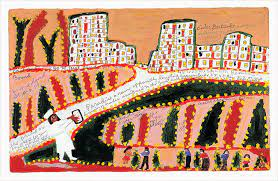
New Jerusalem by Sister Gertrude Morgan (1900-1980)

God’s judgment is but for a moment; but the Lord’s promise, salvation, and peace shall endure forever. God’s wrath is quite real and certain, yet it is a brief extension of the Lord’s steadfast love. Rebellion and judgment are never the last words; forgiveness and grace are:

Many times he [Yahweh] delivered them [the Israelites],
    but they were rebellious in their purposes
    and were brought low through their iniquity.
Nevertheless, he regarded their distress
    when he heard their cry.
For their sake he remembered his covenant
    and showed compassion according to the abundance of his steadfast love.
He caused them to be pitied
    by all who held them captive. (Psalm 106:43-46, NRSV)

All of the Old Testament prophets end their message of impending judgment with the final note of hope. That is, it won’t always be this way. There are better days ahead. The Lord’s coming is not all wrath; it’s mercy and hope. Notice the five brief messages of hope which Zechariah gives the people:

1. Yahweh burns with jealousy for Zion

Throughout the Bible, God likens the relationship to the Israelites much like a lover – as if the Lord were married to them. God’s covenant relationship with people is at the heart of understanding the whole of Scripture. Whenever they stray from divine promises, Yahweh is offended and hurt. 

God is an emotional Being, which is why we have emotions as people created in his image. Early humanity strayed so far from God that it hurt:

The Lord saw that humanity had become thoroughly evil on the earth and that every idea their minds thought up was always completely evil. The Lord regretted making human beings on the earth, and he was heartbroken. (Genesis 6:5-6, CEB)

Yet, God was gracious, sparing Noah and his family. The Lord took a group of Noah’s descendants, Abraham’s family, and set godly covenant affection on them. Through the Israelites, God hoped to lead the entire world to right relations. Yet, they, too, came to fail the gracious covenant made and set their affections on others.

Like a jilted lover, God longed for Israel to remain faithful, and, at the same time, was hurt and angry. Just as the prophet Hosea did not give up on his wife, even though she was brazenly unfaithful, so God looked at Israel as a spouse and could not bear to give her up.

2. Yahweh returns to Zion  

Jerusalem will be known as a faithful city and a holy mountain. The presence of God is what makes that happen. Because even though people can be fickle, inconsistent, complacent, and unfaithful, Yahweh remains true to the divine character of steadfast and immovable love for people.

You will never again be called ‘The People God Left.’
    Your land will never again be called ‘The Land God Destroyed.’
You will be called ‘The People God Loves.’
    Your land will be called ‘God’s Bride,’
because the Lord loves you,
    and your land will be his. (Isaiah 62:4, ERV)

3. The streets of Jerusalem will be full of children playing

The elderly will be sitting there watching the kids play, full of delight at the scene. Much too often we Westerners measure both the significance and success of our cities by its industry, businesses, buildings, wealth, and culture.

Methinks we may be misguided with such measurements. Instead, I suggest, along with the prophet, that we gage our cities by their effect on both the old and the young – because long life and children are signs of blessing from God.

4. Nothing is impossible with Yahweh

Is anything too hard for God? That, my friends, is a rhetorical question. If the Lord can cause old women to bear children (Genesis 18:10-14) and large armies to evaporate (Judges 7:1-25) then there is nothing more preposterous than to always view everything from our puny human perspective. Mary gained such a vantage and believed. We, too, have such an Advent hope within us.

“You will conceive and give birth to a son, and you are to call him Jesus. He will be great and will be called the Son of the Most High. The Lord God will give him the throne of his father David, and he will reign over Jacob’s descendants forever; his kingdom will never end.”

“How will this be,” Mary asked the angel, “since I am a virgin?”

The angel answered, “The Holy Spirit will come on you, and the power of the Most High will overshadow you. So the holy one to be born will be called the Son of God. Even Elizabeth your relative is going to have a child in her old age, and she who was said to be unable to conceive is in her sixth month. For no word from God will ever fail.”

“I am the Lord’s servant,” Mary answered. “May your word to me be fulfilled.” (Luke 1:31-38, NIV)

5. Yahweh renews and restores

Separation, diaspora, and disconnection will become a thing of the past. The Lord sets all things right again, brings people together, and heals, so that everything exists as it is meant to exist.

Deliverance from sin, death, and hell is the means of bringing renewal to the earth and its people. Salvation belongs to God. Righteousness and justice will characterize the future.

For the word of the Lord is upright,
    and all his work is done in faithfulness.
He loves righteousness and justice;
    the earth is full of the steadfast love of the Lord. (Psalm 33:4-5, NRSV)

Hope is fully realized when people put their trust in God and do their part by having strong hands and faithful hearts. We must be truthful and gracious whenever we speak. The Lord expects us to do the right thing by one another, both personally and publicly. We are to never cook up plans to take unfair advantage of others. Instead, we need to keep our lives simple and honest.

The promise of blessing is assured by God. However, the timing of that blessing is conditioned by our response. And there is no better time than the Christian season of Advent to recall what the Lord will do, as well as what God wants us to do.

May we be people of hope and let hope live in our hearts now and always, to the glory of God. Amen.

Because of Love (Psalm 21)

God Is Love by Lisa Voss, 2015

How the king rejoices in your strength, O Lord!
    He shouts with joy because you give him victory.
For you have given him his heart’s desire;
    you have withheld nothing he requested.

You welcomed him back with success and prosperity.
    You placed a crown of finest gold on his head.
He asked you to preserve his life,
    and you granted his request.
    The days of his life stretch on forever.


Your victory brings him great honor,
    and you have clothed him with splendor and majesty.
You have endowed him with eternal blessings
    and given him the joy of your presence.


For the king trusts in the Lord.
    The unfailing love of the Most High will keep him from stumbling.

You will capture all your enemies.
    Your strong right hand will seize all who hate you.
You will throw them in a flaming furnace
    when you appear.
The Lord will consume them in his anger;
    fire will devour them.

You will wipe their children from the face of the earth;
    they will never have descendants.
Although they plot against you,
    their evil schemes will never succeed.

For they will turn and run
    when they see your arrows aimed at them.
Rise up, O Lord, in all your power.
    With music and singing we celebrate your mighty acts. (New Living Translation)

The structure of today’s psalm is significant. Our contemporary way of crafting arguments is by stating a thesis at the beginning of a paper, then providing points of support for that thesis, and concluding with a restatement of the thesis. That’s not how the biblical psalms do it.

The psalm’s major thesis statement is not found at the beginning but in the middle. The verses before the major statement lead to the middle; and the verses after the middle look back and point to it.

So, what’s in the middle? An affirmation of faith in the Lord’s love prevents the king from having a failure of faith.

God’s love is smack in the middle because everything hinges on love.

The Lord leads us to victory, and prayers are answered because of love.

The Lord guides us toward prosperity of body and preservation of soul because of love.

The Lord shepherds us to the green pastures of blessing and encouragement because of love.

God is Love.

The Lord has our backs by eradicating the enemies to our souls.

The Lord follows after us and foils the evil plots of wicked people.

The Lord works behind the scenes for us, putting down devilish strategies so they won’t come near us.

Just as the core of God is love, we have been created in God’s image and likeness of love; love is the very core of our being.

So, why in the world are people not always loving in everything they do and say?

Because we have lost touch with our middle; we lack awareness of who we truly are.

How do we get in touch and reconnect with the core of our being? Here are a few simple ways of doing so:

  • Pray a psalm every single day, even multiple times in the day. Notice I said pray, not read. Psalms are prayers meant to be prayed. Reading them is wonderful but praying them is sublime!

I will praise you seven times a day because all your regulations are just. (Psalm 119:164, NLT)

Answer me, Lord, out of the goodness of your love; in your great mercy turn to me. (Psalm 69:16, NIV)

  • Pay attention to what makes you happy. The psalmist experienced God giving him the desires of his heart. He asked for what he wanted and needed to be happy.

Be happy with the Lord, and he will give you the desires of your heart. (Psalm 37:4, GW)

  • Pursue someone you’ve lost touch with. Reconnect with an old friend. Oftentimes, doing this helps reawaken a part of ourselves we forgot about.

Loyal love and faithfulness meet; deliverance and peace greet each other with a kiss. (Psalm 85:10, NET)

  • Practice self-care. Observe the Sabbath. Put your feet up. Give yourself a break. and don’t try to be perfect. Make some margin in your schedule – enough to have some extended times of silence and solitude. After all, one cannot connect with their inner core unless they are quiet enough to hear themselves.

When you are disturbed, do not sin;
    ponder it on your beds, and be silent.
Offer right sacrifices,
    and put your trust in the Lord. (Psalm 4:4-5, NRSV)

  • Praise the Lord and give thanks to God. Our self-awareness comes alive by means of offering trust and thanksgiving back to the Lord for the great things God has done.

Know that the Lord is God.
    It is he who made us, and we are his;
    we are his people and the sheep of his pasture.

Enter his gates with thanksgiving
    and his courts with praise.
    Give thanks to him; bless his name.

For the Lord is good;
    his steadfast love endures forever
    and his faithfulness to all generations. (Psalm 100:3-5, NRSV)

Since God is Love, God is in the middle and is the center of all things. Everything in the universe revolves around the Lord of Love. So, as we align our lives around this reality, we rediscover the love at the core of our being.

If we desire love, then let us go to the source of Love.

Bless us with love, O Merciful God, so that we may love as you love – and that we might be patient, tolerant, kind, caring, and loving to all people. Grant us your compassion so that we may help those in need. And bless us with your divine Love, O Lord, bless us with your love! Amen.