Jesus the King (Mark 11:1-11)

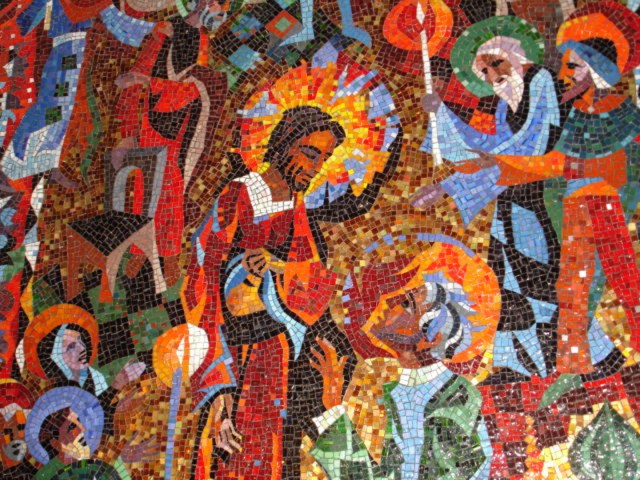
Entry Into the City, by John August Swanson (1938-2021)

As they approached Jerusalem and came to Bethphage and Bethany at the Mount of Olives, Jesus sent two of his disciples, saying to them, “Go to the village ahead of you, and just as you enter it, you will find a colt tied there, which no one has ever ridden. Untie it and bring it here. If anyone asks you, ‘Why are you doing this?’ say, ‘The Lord needs it and will send it back here shortly.’”

They went and found a colt outside in the street, tied at a doorway. As they untied it, some people standing there asked, “What are you doing, untying that colt?” They answered as Jesus had told them to, and the people let them go. When they brought the colt to Jesus and threw their cloaks over it, he sat on it. Many people spread their cloaks on the road, while others spread branches they had cut in the fields. Those who went ahead and those who followed shouted,

“Hosanna!”

“Blessed is he who comes in the name of the Lord!”

“Blessed is the coming kingdom of our father David!”

“Hosanna in the highest heaven!”

Jesus entered Jerusalem and went into the temple courts. He looked around at everything, but since it was already late, he went out to Bethany with the Twelve. (New International Version)

We are presently in the 12 Days of Christmas (December 25–January 5), the annual celebration of Christ’s birth on the Christian Calendar. It may seem odd that the Revised Common Lectionary daily readings have included a text associated with Palm Sunday. However, this is reminder to us that Jesus was born a king – which is why old King Herod saw a little baby as such a threat. (Matthew 2:1-18)

“Christ” is not the surname of Jesus, but instead is a title, meaning “anointed one.” In other words, in the New Testament Gospels, Jesus is referred to as an anointed king. It was broadly understood, within the religious milieu of the ancient Jews, that the Messiah (the Hebrew term for Christ) would come and beat up God’s enemies, restore God’s people to their former glory, and usher in an everlasting state of peace.

Jerusalem had a history as the royal city – the place where ancient Jewish kings lived and ruled. So, most ancient Jews made a clear connection between the Messiah, the king, returning to reign in Jerusalem. They anticipated that the City of David would once again be the seat of power, without any meddling Gentiles to complicate things.

Nativity, by John August Swanson

So, when Jesus entered Jerusalem – in what turned out to be the final week of his earthly life – many people looked upon this as a triumphal entry. He was close to ascending the ancient throne. The disciples of Jesus were waiting for this, and ready for a future of greatness and glory alongside their Rabbi.

Not only did people lay their palm fronds on the road in front of him declaring the ancient refrain, “Blessed is he who comes in the name of the Lord!” (Psalm 118:26) but they also added an explicit reference to the days of King David stating, “Blessed is the coming kingdom of our ancestor David!” The city was awash in the messianic hope of no longer being subject to foreign rule.

Yet we know the tragic and ironic end of the week. Jesus knew it, too, even at the time. He knew what fate awaited him by entering Jerusalem (Mark 8:31; 10:33-34). And Jesus knew without a shadow of a doubt that he was not going to be a king who gains and keeps power through military might and the bloodshed of war. Instead, only his own blood would be offered, as a sacrifice for many. The power of Love will overcome any and every earthly power.

Those with the eyes to see and the spirit to discern could understand this Jesus riding on a humble donkey instead of the proud warhorse. It made complete sense. Jesus did not enter this world with the fanfare of the rich and powerful, but quietly slipped onto the earth in a non-descript and poor Jewish family. His birth, life, and ministry, were all counter cultural. So, why not also his eventual death, resurrection, ascension, and glorification?

Yes, Jesus is a king. But no, he is not a king in any conventional sense. It is Jesus, beginning with his incredible and unexpected incarnation, who helps us reimagine what power and authority can and ought to look like.

All the trappings of control we can get so enamored about, such as wielding influence through economic wealth, social status, political power, and religious weight, all get tossed aside as mere stuffed animals compared to the real deal of moral dignity, ethical love, and compassionate justice shown to people who had absolutely no ability to either pay back Jesus or prop up a throne for him to sit upon.

Jesus is a king who gives his life for the healing of humanity – all people everywhere – including the ones we don’t much like or care about. I have no problem calling Jesus a king, just as long as we understand what sort of kingship we are actually talking about.

I serve King Jesus because he throws a monkey wrench into oppressive systems that seek to keep other people under a heavy hand of injustice. My allegiance is with Christ the Lord because he uses his prodigious authority to bring peace, light, wholeness, and integrity to all the places of the world (and the human heart) that are dark and clueless.

Today I celebrate in this Christmas season the birth of a baby who was born to die to the world and for the world. I rejoice with the angels that Christ is born in Bethlehem, the king of kings and lord of lords, the prince of peace who himself became peace so that we might live in peace.

May you discover deliverance from guilt, shame, and regret, through the One who came and was wounded for us so that we might be healed. Amen.

The Righteous and the Wicked (Isaiah 26:7-15)

The path of the righteous is level;
    you, the Upright One, make the way of the righteous smooth.
Yes, Lord, walking in the way of your laws,
    we wait for you;
your name and renown
    are the desire of our hearts.
My soul yearns for you in the night;
    in the morning my spirit longs for you.
When your judgments come upon the earth,
    the people of the world learn righteousness.
But when grace is shown to the wicked,
    they do not learn righteousness;
even in a land of uprightness they go on doing evil
    and do not regard the majesty of the Lord.
Lord, your hand is lifted high,
    but they do not see it.
Let them see your zeal for your people and be put to shame;
    let the fire reserved for your enemies consume them.

Lord, you establish peace for us;
    all that we have accomplished you have done for us.
Lord our God, other lords besides you have ruled over us,
    but your name alone do we honor.
They are now dead, they live no more;
    their spirits do not rise.
You punished them and brought them to ruin;
    you wiped out all memory of them.
You have enlarged the nation, Lord;
    you have enlarged the nation.
You have gained glory for yourself;
    you have extended all the borders of the land. (New International Version)

Within the Bible, there are really only two sorts of people: the righteous and the wicked. Repeatedly throughout Scripture, we are told that God attends to the needs, hopes, and prayers of the righteous; and conversely, God is opposed to the unjust practices and oppressive acts of the wicked.

The righteous are people who are attentive to God’s law and trust God with all their heart, soul, mind, and strength. For the righteous, God will make a way where there seems to be no way. If there’s a mountain obstructing the way of the righteous, they believe the Lord will flatten it. And if it isn’t flattened immediately, the righteous patiently wait, seeking to be obedient and full of faith, until it happens.

The world learns about life and faith and the divine through these postures of living by righteous persons. The exception to this is the wicked; they learn nothing. The wicked could see a mountain leveled before their very eyes, and refuse to see or acknowledge the power of God behind it.

All this is to say that the truly righteous persons among us stand out like a sore thumb to the prevailing wickedness of the world. Thus, the wicked would like to see them leveled, instead of a mountain. So, the wicked persons among us are committed to lies, half-truths, injustice, and even violence. They’ll use any practice that would knock down the righteous and advance the wicked person’s agenda.

Yet, in making this distinction between the two groups of people, we need to be very careful. Because whenever we group people, there is always the danger of assuming that the righteous are always righteous and the wicked always wicked – as if the righteous could never do any wrong, nor the wicked ever do anything right and just.

However, the reality is that we don’t live in a completely black and white world; there is a lot of gray. The world is far more complex than our simplistic categories of good and bad. This is why it can be so maddening to try and navigate this world each and every day.

So, when we speak of the righteous and the wicked, let’s have some clarity and understanding of the basic patterns of a person’s or a group’s life.

Biblically, the righteous are righteous – not because they are intensely moral and always actively obedient – but because the basic orientation of their lives is committed to communing and relating to the God of the universe.

And the wicked are wicked – not because they are belligerent and bullying – but because the general direction of their lives is continually bent inward to serve their own interests and ignore the Divine.

Therefore, the righteous have the foundational characteristics of yearning for God, and pursuing the Lord with all their energy. They desire a meaningful relationship with God that gives shape to their plans and purposes for living.

The righteous, as a general pattern of living, find their ultimate longings in life through belonging to God. They seek divine interventions for everything, and deeply desire the divine presence to envelop them and surround the world with love, mercy, and justice. Along with the psalmist, the righteous say:

I ask only one thing, Lord:
Let me live in your house
    every day of my life
to see how wonderful you are
    and to pray in your temple. (Psalm 27:4, CEV)

Like a deer drinking from a stream,
    I reach out to you, my God.
My soul thirsts for the living God.
    When can I go to meet with him? (Psalm 42:1-2, ERV)

As long as I have God, I don’t need anyone else in heaven or on earth. (Psalm 73:25, GW)

In contrast to these heartfelt longings, the wicked are dense and obtuse. They fail to see the beauty in any of this. Their end will be precisely what they have wanted throughout life: To be left alone and have space away from God altogether – which is the classic definition of hell.

But the righteous will also have their desires fulfilled, and shall experience peace and right relations forever with God.

How then shall we live?

Blessed is the person who does not
follow the advice of wicked people,
take the path of sinners,
or join the company of mockers.

Rather, he delights in the teachings of the Lord
and reflects on his teachings day and night.

He is like a tree planted beside streams—
a tree that produces fruit in season
and whose leaves do not wither.
He succeeds in everything he does.

Wicked people are not like that.
Instead, they are like husks that the wind blows away.

That is why wicked people will not be able to stand in the judgment
and sinners will not be able to stand where righteous people gather.

The Lord knows the way of righteous people,
but the way of wicked people will end. Amen. (Psalm 1, GW)

Go Up the Mountain (Isaiah 2:1-4)

Jerusalem from the Mount of Olives, by William Simpson (1823-1899)

The word that Isaiah, son of Amoz, saw concerning Judah and Jerusalem.

In days to come
    the mountain of the Lord’s house
shall be established as the highest of the mountains
    and shall be raised above the hills;
all the nations shall stream to it.
    Many peoples shall come and say,
“Come, let us go up to the mountain of the Lord,
    to the house of the God of Jacob,
that he may teach us his ways
    and that we may walk in his paths.”
For out of Zion shall go forth instruction
    and the word of the Lord from Jerusalem.
He shall judge between the nations
    and shall arbitrate for many peoples;
they shall beat their swords into plowshares
    and their spears into pruning hooks;
nation shall not lift up sword against nation;
    neither shall they learn war any more. (New Revised Standard Version)

Mountains make up about one-fifth of the world’s landscape and 12% of the world’s population live on them. They are more than imposing and impressive statues of rock. About 80% of our planet’s fresh water originates in the mountains.

It was on a mountain that Noah’s ark settled; Moses was given the law; and Jesus preached and died. Even the beans from my morning coffee were grown on the side of a mountain. I have everything I need in the mountainous God of all.

The most fundamental truths about God are consistency and constancy in the divine nature. God is forever present with people. 

So, it is no coincidence that the temple of God was built on a mountain at the highest point in the city of Jerusalem. Ascending the temple mount reminded every worshiper of the Lord’s ever-present protection and strength. It pointed them to the source of life. With God, every need is met and satisfied, because on the mountain and in the temple, people learn how to live in this world. They are taught the ways of the Lord.

We learn to live in peace and harmony by ascending the mountain, entering the house of God, and adopting a teachable spirit.

Today’s Old Testament lesson is a vision of the future – the way things will be. Now, things are not as they ought to be. Injustice, unrighteousness, indifference, and impurity leave their mark everywhere. It may cause folks to wonder whether the Lord is truly present, or not.

If God seems or feels aloof or unconcerned, it is not that the Lord is avoiding us or is distracted with other important matters of running the universe. It simply means God chooses to reveal the divine character and the divine will when the appropriate time warrants it, for our benefit.

A mountain looks like it never moves. Yet the slow but steady rains, the creeping of tectonic plates, and undiscernible changes within the earth shift mountain ranges over time. The Lord is most certainly responding to us, our movements and changes, in a way we cannot perceive with the naked eye.

Our responsibility in the entire affair is to engage in consistent rhythms of spirituality which place us in a position to receive grace when God decides to give it. If we are still, we can feel the movements of grace developing within us, and enveloping us with life.

Perhaps we need to become adept at being spiritual mountain goats, using our wide cloven hooves of faith to negotiate the immense crags and rocks of God. After all, we will spend an eternity getting to know God and never exhaust the exploration.

Therefore, we must not despair. Rather, we can anticipate meeting with God, just as the Israelites of old looked forward and upward in ascending the temple mountain. The truth is that God surrounds people, even when we do not always perceive it to be so. 

The sturdiness of God is able to handle and bear the weight of our heaviest burdens.

Throw all your anxiety onto him because he cares about you. (1 Peter 5:7, CEB)

If we will but look up, there is abiding help for the most vexing of problems.


I raise my eyes toward the mountains.
    Where will my help come from?
My help comes from the Lord,
    the maker of heaven and earth.
God won’t let your foot slip.
    Your protector won’t fall asleep on the job. (Psalm 121:1-3, CEB)

There is peace and settled rest when we call upon the God who surrounds us.

I call out to the Lord,
    and he answers me from his holy mountain.

I lie down and sleep;
    I wake again because the Lord sustains me. (Psalm 3:4-5, NIV)

It is through trust that we become mountains ourselves – strong in faith and giving life to those around us. And it is also no coincidence that Jesus ascended a mountain in order to deliver his most important teachings.

When Jesus saw the crowds, he went up the mountain, and after he sat down, his disciples came to him. And he began to speak and taught them, saying:

Blessed are the poor in spirit, for theirs is the kingdom of heaven.

Blessed are those who mourn, for they will be comforted.

Blessed are the meek, for they will inherit the earth.

Blessed are those who hunger and thirst for righteousness, for they will be filled.

Blessed are the merciful, for they will receive mercy.

Blessed are the pure in heart, for they will see God.

Blessed are the peacemakers, for they will be called children of God.

Blessed are those who are persecuted for the sake of righteousness, for theirs is the kingdom of heaven. (Matthew 5:1-10, NRSV)

On the mountain we encounter the Lord. In that place, we find that humility, gentleness, mercy, purity, and peacemaking are the sacred pathways of pushing back on the world’s injustice and establishing a more just and right culture.

All sorts of people, from everywhere, from every nation, will stream to receive gracious teaching. They will become aware of how to live in an egalitarian society. Everyone’s needs shall be met.

Great and mountainous God, help me to keep my heart clean and to live honestly and fearlessly, so that no outward failure can dishearten me or take away my joy of conscious integrity. Open wide the eyes of my soul so that I may see good in all things. Grant me today a vision of your truth. Inspire me with the spirit of gladness and make me to be a cup of strength to suffering souls; in the name of the strong Deliverer, our Lord and Savior, Jesus Christ. Amen.

Jesus Shows Up (John 20:19-31)

Jesus shows himself to Thomas, by Rowan and Irene LeCompte

On the evening of that first day of the week, when the disciples were together, with the doors locked for fear of the Jewish leaders, Jesus came and stood among them and said, “Peace be with you!” After he said this, he showed them his hands and side. The disciples were overjoyed when they saw the Lord.

Again Jesus said, “Peace be with you! As the Father has sent me, I am sending you.” And with that he breathed on them and said, “Receive the Holy Spirit. If you forgive anyone’s sins, their sins are forgiven; if you do not forgive them, they are not forgiven.”

Now Thomas (also known as Didymus), one of the Twelve, was not with the disciples when Jesus came. So the other disciples told him, “We have seen the Lord!”

But he said to them, “Unless I see the nail marks in his hands and put my finger where the nails were, and put my hand into his side, I will not believe.”

A week later his disciples were in the house again, and Thomas was with them. Though the doors were locked, Jesus came and stood among them and said, “Peace be with you!” Then he said to Thomas, “Put your finger here; see my hands. Reach out your hand and put it into my side. Stop doubting and believe.”

Thomas said to him, “My Lord and my God!”

Then Jesus told him, “Because you have seen me, you have believed; blessed are those who have not seen and yet have believed.”

Jesus performed many other signs in the presence of his disciples, which are not recorded in this book. But these are written that you may believe that Jesus is the Messiah, the Son of God, and that by believing you may have life in his name. (New International Version)

When Jesus shows up, there is peace. Wherever Jesus goes, the Spirit of God is there. When Jesus appears, people believe.

The Meeting

After the crucifixion of Christ, the disciples were huddled together, mostly in fear of being found out and put out by the religious authorities. Out of nowhere, Jesus showed up, smack in the middle of the anxious group of men.

Christ in the center makes all the difference. From this central place, Jesus bestowed to the disciples his peace. The very first word the risen Christ spoke to his disciples was neither a command to stop being afraid, nor a rebuke for sitting around and doing nothing, or disappointment that they all ran away in the final hour of need at the crucifixion; instead, the first word of Christ was a gift of peace.

The presence and peace of Christ melted the disciples’ fear. Christ-centered peace is graciously given; so let us gratefully receive it.

The Reality

Jesus showed up, then showed off his hands and his side. He was not fabricated out of the disciples’ imagination; he was not some ghostly apparition. Rather, Christ was standing in the middle of them, very real, very physical, and very alive.

Christ gave his disciples real truth: actual wounded hands and side on a real body. Christ is risen and alive – not just spiritually, but physically. Since the resurrection of Jesus really happened, then nothing else matters; our joy is complete. We have what we need.

The Mission

As Jesus was sent by the Father, so Jesus sent his disciples; and is still sending us out into the world. And as Jesus came not to condemn the world but to save it, so we go out with words of grace and peace. The church exists for the life of the world – to bless it with the presence and peace of Christ.

“Whoever believes in me does not believe in me only, but in the one who sent me. The one who looks at me is seeing the one who sent me. I have come into the world as a light, so that no one who believes in me should stay in darkness.” (John 12:44-46, NIV)

Our spiritual DNA makes us little Christ’s walking around, doing the will of God, for the benefit of a world in darkness. We bear the name of Christ: Christians, proclaiming a message of life, delighting in God and creation; and not destroying the earth and its inhabitants.

The Gift

Right now, we are not alone. The Holy Spirit has been graciously given to us by Jesus. Although our mission is a big one, our resource for accomplishing it is even bigger. Jesus gives the Spirit in the same way he gives himself – as a sheer gift with no strings attached. Just as God breathed life into the very first people on earth, so Jesus breathes on the disciples and gives them new life and a new heart.

I will give you a new heart and put a new spirit in you; I will remove from you your heart of stone and give you a heart of flesh. And I will put my Spirit in you and move you to follow my decrees and be careful to keep my laws… and you will be my people, and I will be your God. (Ezekiel 36:26-28, NIV)

The Privilege

Christ has redeemed us, forgave us of our guilt and shame. Now, we have the privilege of passing the forgiveness to others. The special mission of the Church is giving Jesus to others with grace and peace, so that they may believe he is truly the risen Lord; and so, receive Jesus, the Spirit, forgiveness, and purpose in life, with Christ at the center of all things.

For the one whom God has sent speaks the words of God, for God gives the Spirit without limit. The Father loves the Son and has placed everything in his hands. Whoever believes in the Son has eternal life, but whoever rejects the Son will not see life, for God’s wrath remains on them.” (John 3:34-36, NIV)

The Risen Lord, by He Qi

The Appearance

When Jesus appears, its good if we also show up to see him. It seems Thomas was late for church and missed the beginning of the service. He wasn’t with the other gathered disciples. Nobody knows where he was or what he was doing. But the important thing is that he did eventually show up, because showing up is the beginning of a changed life.

The Witness

After Jesus showed up, the disciples bore witness to what they saw and heard to Thomas. Yet Thomas, bless his doubting heart, wasn’t having it. He’s a realist. He wants proof, some actual physical evidence. Thomas was clearly a tactile learner because he needs some touch to believe any of this crazy talk of his disciple brothers.

Sometimes Thomas gets a bad rap, but he is really our Everyman. Doubt and skepticism are an important part of a full-orbed and honest faith. Jesus gave Thomas some space, time, and respect to begin wrapping his head and heart around this new reality of resurrection. I wonder if we all can do the same with others.

The Middle

A second time, Jesus shows up in the middle of the disciples. The Word became flesh and dwelt among us – and didn’t become a ghost and hang out in secret places. Once again, peace is given by Jesus to his followers.

Both appearances happen on a Sunday (which is why Christians have always worshiped on Sundays); and both meetings are literally Christ-centered (which every Christian meeting is supposed to be). Every Sunday. Christ always in the middle. Keep those two, and keep them together, and you can’t go wrong.

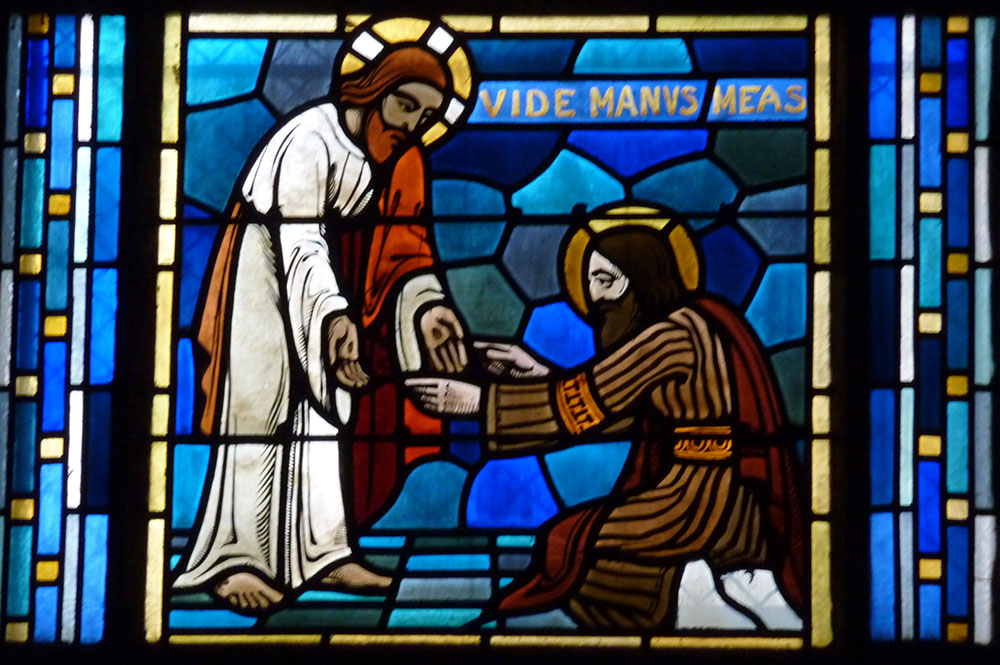
Jesus appears to Thomas with the Latin words, “See my hands,” in Notre-Dame-du-Rosaire Church, Saint-Ouen, France 

The Invitation

There’s no beating around the bush with Jesus. He immediately engaged Thomas and invited him to touch the wounds on his very real body. Christ knew Thomas’ hang-up, and went right to it. Thomas wanted evidence; Jesus offered it. If we get anything out of this encounter, it is that risen Christ honors honest doubt.

The evidence is here. Now believe it, and stop disbelieving. We have documentary evidence of the Old and New Testaments; the Church’s witness in Creeds, Confessions, and contemporary narratives of changed lives; and the internal testimony of the Holy Spirit. Therefore, look into them carefully and draw a sound conclusion.

The Confession

“My Lord and my God!” That’s the confession and the conclusion Thomas drew from the evidence – not only that Jesus is real, alive, existed, a good teacher; or other people’s Lord and God – but that he is my Lord and my God.

Jesus cared enough for Thomas to specifically meet him personally at his point of need. The grace of God keeps coming and never runs out. Jesus is filled up to the full in both grace and truth.

The Believer

Thomas had the physical evidence. But it doesn’t take that to truly believe. God blesses those who’ve never seen nor touched, but still believe. Jesus was thinking of you and me, and not only the people in front of him at the time. The Lord Jesus blesses us with the gift of peace, grace, and faith.

Though you have not seen him, you love him; and even though you do not see him now, you believe in him and are filled with an inexpressible and glorious joy, for you are receiving the end result of your faith, the salvation of your souls. (1 Peter 1:8-9, NIV)

The Conclusion

All this is for our benefit, so that we, too, may believe that Jesus is the Christ, the Son of the living God. Since Jesus is alive, he continues to bless us with his presence, power, and peace.

Jesus is with us:

  • through the Word of God, giving us his peace, showing up and meeting needs people.
  • at the Table in the sacrament of communion, bringing grace and forgiveness
  • in the person of the Holy Spirit, enabling and energizing us for mission and ministry to the world

It’s a life worth living, a Christ-centered life, full of God’s blessing.

O God and Father of our Lord Jesus Christ, in whom we receive the legacy of a living hope, born again not only from his death but also from his resurrection. May we who have received forgiveness of sins, set others free, until we enter the inheritance that is imperishable and unfading, where Christ lives and reigns with you and the Holy Spirit, one God, now and forever. Amen.