A Mighty Deliverance (Psalm 114)

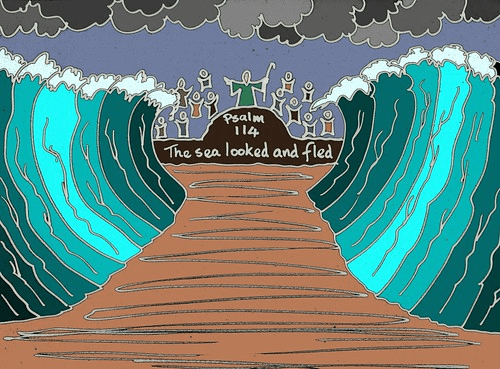
Psalm 114:3, by Stushie Art

When the people of Israel left Egypt,
    when Jacob’s descendants left that foreign land,
Judah became the Lord’s holy people,
    Israel became his own possession.

The Red Sea looked and ran away;
    the Jordan River stopped flowing.
The mountains skipped like goats;
    the hills jumped around like lambs.

What happened, Sea, to make you run away?
    And you, O Jordan, why did you stop flowing?
You mountains, why did you skip like goats?
    You hills, why did you jump around like lambs?

Tremble, earth, at the Lord’s coming,
    at the presence of the God of Jacob,
who changes rocks into pools of water
    and solid cliffs into flowing springs. (Good News Translation)

I tend to use a lot of metaphors in my conversations with others. I like word pictures, analogies, and illustrations. Maybe that’s one reason I resonate with the Old Testament. The Hebrew mind revels in story, symbol, similitude, and even the occasional sarcasm.

The turn-of-phrase is something which connects well with me – which is why I like today’s psalm. The language is freighted with metonymy (using the name of one object or concept for that of another) and personification (using an animate characteristic for an inanimate object).

This psalm is a poetic response to the Jewish Passover and exodus out of slavery to freedom. It is a brief song of thanksgiving which nicely recounts the Israelite experience from Egypt to the Promised Land. At the behest of a mighty God, the Red Sea parted when the people left Egypt, and the Jordan River stopped its flowing when the people entered the Promised Land.

It’s a whole lot more powerful to say, “When the sea looked at God, it ran away,” than it is to say, “The Red Sea parted.” God is so mighty, so powerful, so large and sovereign that we must use the full extent of language to even begin to describe the wonderful works of the Lord. A big God with awesome capability needs some wordsmithing worthy of divine greatness.

Not only does the sea flee from its place, but the river also turns back, the mountains and hills shake and skip. To try and somehow capture the immensity of God, the psalmist used language which communicates that even inanimate objects come alive and fulfill the Lord’s bidding.

It is one thing to make a flat statement such as, “Put your trust in God,” and it is quite another matter to open up the tool of language and allow it to picture a divine Being so amazing that nothing nor anyone can possibly stand in such a Sovereign’s way. And this very same God works for us, and not against us.

The Lord God almighty, Creator of heaven and earth, has taken this formidable divine power and granted us a pinch of it – because that’s all we really need. Jesus, intimately familiar with his mighty heavenly Father, commented:

If your faith is as big as a mustard seed, you can say to this mulberry tree, “Dig yourself up and plant yourself in the ocean!” And the tree will obey you. (Luke 17:6, ERV)

For assuredly, I say to you, whoever says to this mountain, “Be removed and be cast into the sea,” and does not doubt in his heart, but believes that those things he says will be done, he will have whatever he says. (Mark 11:23, NKJV)

All of creation conspires together to participate in the great liberating and saving acts of God for God’s people. And if that wasn’t enough, we have been given the Holy Spirit to be with us forever – uprooting trees and moving mountains to accomplish the good and loving plan of God here on earth as it is always done in heaven.

Mighty God you invite us to be with you, to have a place near you. Your presence is joy, light, and comfort. Your nearness is holy, awesome, and wonderful. In the play of sunlight through rainbows, in the sounds of music and laughter, in the beauty of creation and the taste of bread and wine, your presence is known. Your saving presence surrounds us, whether we are fearful or joyful, laughing or crying.

You invite us, welcome us, forgive us and renew us with fresh hope and new life. You love us into your presence. We bless and thank you. We praise and adore you. We enjoy being with you, in the name, the spirit, and the presence of Jesus. Amen.


Let Me Tell You What God Has Done For Me (Psalm 66:8-20)

Praise our God, all peoples,
    let the sound of his praise be heard;
he has preserved our lives
    and kept our feet from slipping.
For you, God, tested us;
    you refined us like silver.
You brought us into prison
    and laid burdens on our backs.
You let people ride over our heads;
    we went through fire and water,
    but you brought us to a place of abundance.

I will come to your temple with burnt offerings
    and fulfill my vows to you—
vows my lips promised and my mouth spoke
    when I was in trouble.
I will sacrifice fat animals to you
    and an offering of rams;
    I will offer bulls and goats.

Come and hear, all you who fear God;
    let me tell you what he has done for me.
I cried out to him with my mouth;
    his praise was on my tongue.
If I had cherished sin in my heart,
    the Lord would not have listened;
but God has surely listened
    and has heard my prayer.
Praise be to God,
    who has not rejected my prayer
    or withheld his love from me! (New International Version)

“God made humans because God loves stories.”

Elie Wiesel

The Church’s Prayer Book

Those of us who utilize the Revised Common Lectionary Daily Readings are familiar with having a psalm each day. In addition, the same psalm is repeated three consecutive days, following the pattern of Thursday, Friday, and Saturday readings preparing for Sunday – and Monday, Tuesday, and Wednesday readings reflecting on Sunday. The Psalter has such a prominent place in the readings because it is viewed as the Church’s Prayer Book.

Within the book of Psalms, we have the full range of human experience and emotion. Much like athletes in weight training, putting in their reps (repetitions), so the Christian is to use the weighty Psalms with repeated use for spiritual growth and development. Prayer and praise, lament and celebration, are necessary equipment for the strengthening of faith and a healthy Christian life.

Psalms of Praise and Thanksgiving

Today’s psalm is a song of thanksgiving for the community of worshipers approaching the temple and offering their sacrifices to God. Together, as the people of God, they proclaim what God has done for them. Through hardship and difficulty, they have realized abundance and joy. Personal witness and testimony are given to the congregation for answered prayer so that all may rejoice together in God’s steadfast and unfailing love.

Expressing celebration is important. Without it, our spirits are famished and find it difficult to be patient and persevere. With celebration, our spiritual muscles flex with joy and are in shape for the trials and tribulations which lie ahead. Corporate affirmation and personal appreciation are meant to work together in a grand profession of faith in God’s good guidance and help.

“Come and listen and I will tell you what God did for me,” benefits both the individual and the group. If all we ever hear and experience is hardship, our faith muscle will be overused and give out. We need stories to celebrate. We need to hear testimonies of God’s enduring love.

So, what has God done for you? What celebrations do we have today? Are you willing to share your story?

Ritual Celebration

Celebrations are necessary because they highlight the things most important to us. And it is okay to make them regular rituals – which is why I care about attending to the Christian Year with it’s centrality of Jesus and the movements of Advent, Christmas, Epiphany, Lent, Easter(tide), Ascension, Pentecost, and “Ordinary” Time.

Ritual celebration is, of course, not unique to Christianity. Rituals are part of being human. At it’s heart, ritual is a form of celebration, of remembering to observe significant events, special seasons, and daily routines. Each ritual observance is a re-telling of meaningful stories for an individual, family, or group of people.

Observing ritual celebrations:

  • Re-enforces our values.
  • Gives us a sense of belonging.
  • Marks time for us in meaningful ways.
  • Forms daily habits in us.
  • Reminds of us of who we are and what our purpose in this world is.
  • Helps us express our emotions in a healthy way.
  • Adds new stories to our lives.
  • Connects us to our spiritual ancestors and bonds us to one another.
  • Builds close relationships and trust.
  • Heals us from traumatic events.

Not observing ritual celebrations:

  • Causes a lack of identity and purpose.
  • Creates loneliness and confusion.
  • Hollows out our lives and sucks our souls of joy.

Sharing stories, and paying attention to rituals, are a primary connection between the individual and the community, a place where our identities and our values are reinforced and transformed into a force for good in the world.

Both the smallest and biggest of celebrations are appropriate, along with everything in between. While writing at my desk, a majestic male red wing blackbird perched himself on the bush in front of the window. Being only a few feet from him, I could see his feathers in detail and his glorious preening for the benefit of the females.

You are wonderful, Lord,
    and you deserve all praise,
because you are much greater
    than anyone can understand.

Each generation will announce
to the next your wonderful
    and powerful deeds.
I will keep thinking about
your marvelous glory
    and your mighty miracles.
Everyone will talk about
    your fearsome deeds,
and I will tell all nations
    how great you are.
They will celebrate and sing
about your matchless mercy
    and your power to save. (Psalm 145:3-7, CEV)

On a much grander scale, today I gathered with a family at the bedside of their loved one to grieve his death, and to also remember and celebrate his life for the gift he had been to so many. Together we were able to say, “Let the whole world bless our God and loudly sing his praises.”

We pray. God answers. We rejoice. If we don’t rejoice in the company of others, then we eventually forget – which then makes the next hardship even harder.

The practice of telling our story is the means by which we come to understand our faith. Testimony not only declares what we believe, but is also the vehicle that shapes our belief. The psalmist issues an invitation for people to come and hear, and he will tell what God has done. The story, the psalmist’s testimony of faith, is a simple one, essentially saying: I prayed to God. God listened. God answered. Praise be to God! And I will now tell you about God.

Tell a Story

When the Bible speaks about God, it most often does so by telling a story of what God has done. The Bible, as a whole, follows the pattern of a story: creation, fall, redemption, and new creation.

Beginning in the Old Testament, we get stories of God’s creative activity, humanity’s fall into sin, and God’s response of covenant and promise. The Lord calls Abraham and Sarah and their ancestors to a special relationship with a special purpose to reclaim all the world to it’s intended design.

The story continues with the Exodus from Egypt, the giving of God’s divine commandments, the wandering in the wilderness, the conquest of the land, the monarchy and finally the exile.

The New Testament picks up the story, telling about Jesus as the fulfillment of the Old Testament promises and spelling out the meaning of his death and resurrection.

The book of Acts continues the grand story of redemption and of what God has done, climaxing in the life, death and resurrection of Jesus. The apostles further the story by spreading good news of great joy: in Jesus Christ, there is grace, forgiveness, purpose, faith, hope, and love for all people everywhere.

In all the storytelling, remember to celebrate the mighty acts of God and declare what the Lord has done for you.

Creator God, because of your abundant love, you chose to bring light and order into the formless void, to create a world of unsurpassed beauty; and you saw that it was good. We ask that you continue to recreate the world with that same attentive love, to bring light into today’s ever increasing chaos and darkness. Replenish our hearts so that we too can renew the face of the earth, through Christ our Lord. Amen.

Psalm 113 – Shout Praises

“From Sunrise to Sunset Praise God” by Muha Rukab

Shout praises to the Lord!
Everyone who serves him,
    come and praise his name.

Let the name of the Lord
    be praised now and forever.
From dawn until sunset
    the name of the Lord
    deserves to be praised.
The Lord is far above
    all of the nations;
    he is more glorious
    than the heavens.

No one can compare
    with the Lord our God.
His throne is high above,
    and he looks down to see
    the heavens and the earth.
God lifts the poor and needy
    from dust and ashes,
    and he lets them take part
    in ruling his people.
When a wife has no children,
    he blesses her with some,
and she is happy.
    Shout praises to the Lord! (Contemporary English Version)

When my firstborn daughter was an infant, I was a busy seminarian as well as working a job. I had very little discretionary time on my hands. Yet, I could stand over the crib of my beautiful little bundle of a girl for long stretches of time without ever thinking about all my responsibilities. Whenever she awoke I spoke to her in that kind of baby talk that only a doting father can do. 

I imagine God looks at us in much the same way, as well as speaking and acting toward us in ways we can understand. Just as parents (hopefully) communicate on a level their kids can understand, so G-d condescends and stoops to our level in order to help us. 

The Lord is seated on high, looking down on the heavens and the earth. G-d looks at us with lovingkindness and seeks our best interests. The Lord notices the poor and acts justly on their behalf. G-d observes the needy and lifts them from their want to a place where they can thrive. The divine condescension of God is a beautiful thing because without it we would be like a helpless baby.

G-d, while being unknowable and unreachable in so many ways, has nevertheless communicated with humanity in a way people can understand and to which they can respond. The Lord has accommodated, or made allowance for, our language and general level of understanding.

The Lord, sovereign and high above us all, has chosen to stoop and coo over us here on earth. G-d’s love affectionately delights in us. The psalmist’s portrayal of G-d is not of some aloof Being who is bothered with humanity’s pestering. Rather, G-d sees, notices, and cares. We don’t need to do some sort of spiritual back flips to gain G-d’s attention. We already have it.

This psalm of praise to G-d celebrates how the Sovereign of the universe notices and acts. We are meant to remember the great deeds of G-d – both those things done in history, and the things done for us, personally. 

“Despite our earnest efforts, we couldn’t climb all the way up to God. So what did God do? In an amazing act of condescension, God climbed down to us and became one with us.”

Will Willimon

In Christianity, the concept of divine condescension and accommodation is given its supreme form in the person and work of Jesus Christ. By becoming human, Jesus accommodates himself to the human condition. Through his life, teaching, and ministry, Christ speaks as G-d, communicating sufficiently and effectively to humanity.

The redemptive events of Christ – his incarnation, holy life, death, resurrection, ascension, and glorification – are divine acts of grace, mercy, and love to all humanity. Praise and thanksgiving are the appropriate responses to such events done on our behalf.

This is one reason why the spiritual practice of journaling is such a good personal discipline because we then have a record of the ways in which G-d has acted on our behalf. When we look back and remember, we can praise the Lord all over again for lifting us from the ash heap. And this will fortify our spiritual mettle for the times when we need encouragement.

Keeping a gratitude journal and writing each day about at least one way the Lord has acted on your behalf, can bring encouragement, transformation, and joy to your life. I suggest you write for your own eyes only. This is between you and G-d. Therefore, you need not be concerned for correct spelling and grammar. It doesn’t even need to be legible, as long as you can read your own writing!

“Praise is the rehearsal of our eternal song. By grace we learn to sing, and in glory we continue to sing. What will some of you do when you get to heaven, if you go on grumbling all the way? Do not hope to get to heaven in that style. But now begin to bless the name of the Lord.”

Charles Spurgeon

What’s more, shouting our praises is not only appropriate but encouraged – even commanded. Shouting is both cathartic and fun. It builds emotional resilience and spiritual strength. Coupled with writing, shouting our praises has the effect of bringing spiritual growth and maturity to our lives.

We, of course, want to avoid shouting at others. Yet, we can take advantage of shouting while driving alone, out in the woods by ourselves, or even into a pillow. This isn’t weird. Shouting goes appropriately with praise and celebration.

In fact, it would be weird if there were no shouting. Try telling a sports fan watching their favorite team that they aren’t supposed to shout. Or just see what happens when a woman longing for children becomes pregnant for the first time.

Emotional expressions are expected whenever G-d shows up and accomplishes great deeds for us. To not do so is a sign of having spiders in your heart and garlic in your soul. It’s not right.

What are you thankful for today? Is there something in this day for which to praise the Lord, whether big or small? Will you give yourself permission to shout?

Accept, O Lord, our thanks and praise for all you have done for us. We thank you for the splendor of the whole creation, the beauty of this world, the wonder of life, and the mystery of love. We thank you for the blessing of family and friends, and the loving care which surrounds us on every side. We thank you for setting us at tasks which demand our best efforts and leading us to accomplishments which satisfy and delight us. We thank you also for those disappointments and failures that lead us to acknowledge our dependence on your mercy and grace.

Above all, we thank you for your Son, our Lord, Jesus Christ, the truth of his Word, the example of his life; his steadfast obedience, by which he overcame temptation; his dying, through which he overcame death; and his rising to life again, in which we are raised to new life. Grant us the gift of your Spirit so that we may know Christ and make him known; and through him, at all times and in all places, we may give thanks to you in and for all things. Amen.