You Can’t Leverage a Leviathan (Job 41:1-11)

“Can you draw out Leviathan with a fishhook
    or press down its tongue with a cord?
Can you put a rope in its nose
    or pierce its jaw with a hook?
Will it make many supplications to you?
    Will it speak soft words to you?
Will it make a covenant with you
    to be taken as your servant forever?
Will you play with it as with a bird
    or put it on a leash for your young women?
Will traders bargain over it?
    Will they divide it up among the merchants?
Can you fill its skin with harpoons
    or its head with fishing spears?
Lay hands on it;
    think of the battle; you will not do it again!
Any hope of capturing it will be disappointed;
    one is overwhelmed even at the sight of it.
No one is so fierce as to dare to stir it up.
    Who can stand before it?
Who can confront it and be safe?
    —under the whole heaven, who?” (New Revised Standard Version)

Just as “Behemoth” is an English transliteration of the Hebrew word (Job 40:15), so is the word “Leviathan” (לִוְיָתָן). The reason for merely transliterating the words is that we don’t really know what sort of creatures they are with any certainty.

Yet, what we do know, is that both of them are strong and ferocious creatures, described by God as beyond the control of humans. They cannot be domesticated, or serve as pets. That’s because no human could ever hunt or capture one of them. Just to look at a Leviathan would cause a person to flee in fear.

The biblical character of Job had been through a lot. Back in the beginning of the Book of Job, he is described as a man who is upright and blameless. Because of this, Satan entered the picture, going to God and accusing Job of only being faithful because he was blessed. So, God allowed Satan to afflict Job, but not kill him.

Yet, Job knew nothing about this celestial conversation. All he knew was that he lost everything and everyone he cared about. On top of it all, Job experienced painful sores which left his health ravaged and his body unable to do much of anything.

Job’s three “friends” came to comfort him. But they did just the opposite by arguing with him and accusing him of secret sinning. All Job wanted was some vindication, some answers to his questions, and some sort of sense to all the senseless suffering.

After long speeches of both Job and his companions, God’s agonizing silence was finally broken. For several chapters (Job 38-41) God gives no answers, but instead, asks his own questions. The gist of God’s confrontational response comes down to this:

You are wondering about things that are way above your ability to know and understand. But what you need to know is that life consists in relationships, in dialogue and interaction with me, and especially with honesty and vulnerability which goes along with those relations.

Life cannot be boiled down to a nice, neat system of good people getting good stuff, and bad people getting bad stuff. Yell at me, and rage at me, if you must. Then you will be honest, real, and relating to me. But I have no tolerance for anyone who tries to be Me, and thinks they know how things actually are, and how they work.

There is no “The Universe For Dummies” by God on the way things operate in the universe. That’s because it cannot be dumbed-down enough for any human to grasp. All we have is relational interaction and connection.

We can’t even figure out what in the world creatures like Behemoth and Leviathan are, let alone understand how to deal with them. Methinks that despair has a much more prominent place for us humans than we realize. But that is a bigger discussion than Behemoth, and so, is for another time.

It could be that God talking of Leviathan – this big uncontrollable and unpredictable creature – is one way of helping us come to grips with our divine/human relationship.

You and I have absolutely no control over God. It’s not remotely possible, at all. And if nobody can domesticate, let alone capture, a Leviathan, then there is no possibility of ever using God as a personal pet for our own purposes.

Far too many of us humans, demand God to show up and explain himself; or we do all sorts of genuflections and pray volumes of words to try and leverage God into answering us and giving us what we want. But there is no leveraging a Leviathan.

Precious few persons on this earth simply let God be God; and choose to focus on being a real, vulnerable human who needs and wants God. Such persons do not try and capture God, because they have already been captured by God.

We are all at the mercy of God, and in no way can manipulate or cajole God toward our agenda for how we think things ought to go. We might as well try and catch a Leviathan.

Humanity does not hold onto God; God holds onto us. God is not obliged to serve us and do our bidding; but we are very much obliged to God in service and fidelity.

God, I believe, rightly seems perturbed by all of longwinded speeches, only because he was being treated as some sort of divine vending machine who dispenses the proper candy bar with an obligatory monetary oblation.

Do we actually believe that we can do a sort of spiritual credit card slide, and get a belly full of goodies? If you want good from God, then do good and be a good person, right?…

Um, no. Frankly, that kind of spirituality irks God. Good people sometimes get bad stuff. And that reality bothers some of us humans to no end.

There is a reason for all that occurs, but it’s way above our human pay grade to know and understand what it’s really all about. So, treat God as God, as the Sovereign of the universe, as the Holy One whom we must relate to in truth, honesty, realness, and vulnerability.

This is another day, O Lord. I don’t really know what it will bring forth. Regardless, make me ready for whatever this day may be. If I am to stand up, help me to stand bravely. If I am to sit still, help me to sit quietly. If I am to lie low, help me to do it patiently. And if I am to do nothing, let me do it gallantly. Make these words more than words, and please give me the Spirit of Jesus. Amen.

Mercy and Judgment (Revelation 8:1-5)

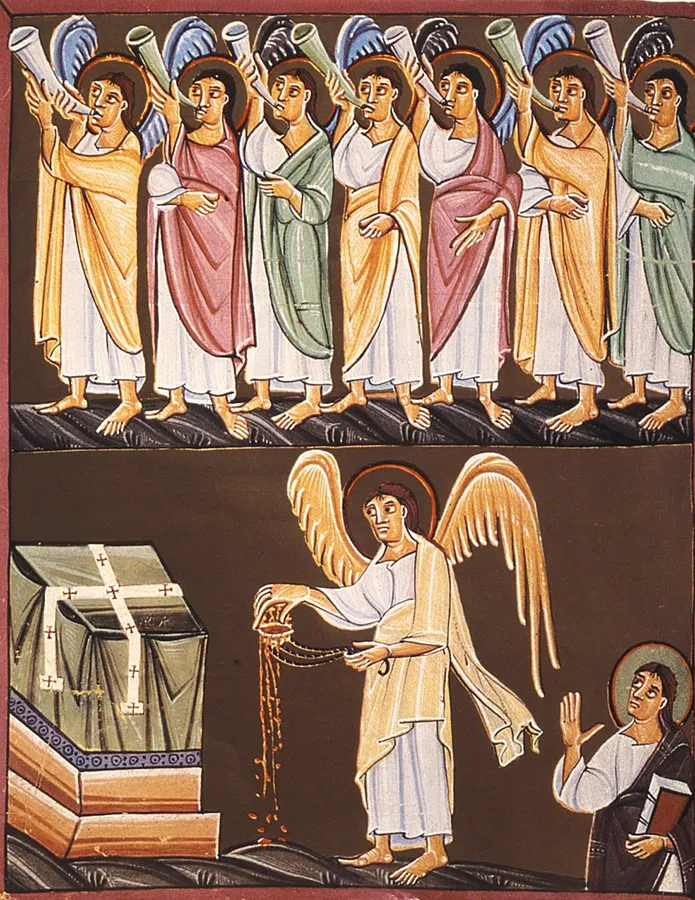
Seven angels with seven trumpets, and the angel with a censer, from the Bamberg Apocalypse, c.1020 C.E.

Then, when the Lamb opened the seventh seal, there was silence in heaven for about half an hour.

Then I saw the seven angels who stand before God, and seven trumpets were given to them. Another angel came and stood at the altar, and he held a gold bowl for burning incense. He was given a large amount of incense, in order to offer it on behalf of the prayers of all the saints on the gold altar in front of the throne. 

The smoke of the incense offered for the prayers of the saints rose up before God from the angel’s hand. Then the angel took the incense container and filled it with fire from the altar. He threw it down to the earth, and there were thunder, voices, lightning, and an earthquake. (Common English Bible)

When I was kid, growing up on a Midwest American farm, I remember times when severe weather was coming. I knew it was going to be bad whenever everything became still and there was complete silence: No wind, no birds singing, no insects chirping, nothing moving whatsoever. It was the eerie silence which precedes something big coming.

That is the way it will be in heaven when the seventh seal is opened. The silence is so quiet that you know a lot of noise and movement are about to happen. It’s not serene silence; it’s scary silent.

With the opening of the seventh seal, a climactic moment is reached. The silence is not only an anticipation of the coming drama, but is also a sign of reverence and awe.

The seventh seal initiates a series of woes: The seven trumpets. But before the trumpets begin, an angel appears. Standing before a heavenly altar, the angel mixes incense along with prayers from the people, then offers them on the altar.

These prayers of the people are for justice, and a longing for the kingdom to come, and God’s will to be done, on earth, as it is always done in heaven.

The imagery relates to us that God hears the prayers, and will act, according to the divine character and will.

The angel takes fire from the altar and hurls it down to earth, causing thunder and lightning, and an earthquake. In other words, the prayers are being answered; they are having an effect. Judgment on the earth begins with the blowing of the seven trumpets.

As we may expect, the incredible silence gives way to an equally incredible noise of weather and the earth moving. And the angel, serving as a quiet and contemplative high priest, now moves to becoming a judge upon the earth.

It turns out that mercy and judgment are not two contrasting concepts and actions; they are two sides of the very same coin. The altar of mercy becomes the source of judgment.

Whenever there is an injustice, we want (and expect) to have that act acknowledged and taken care of by a proper authority. To have a judge simply say that he/she is merciful and will acquit the guilty, does not work in every situation. Mercy only exists because of the presence of guilt and judgment.

God takes care of sin because God loves. An unloving deity would be unconcerned, random, and capricious in handling injustice. But not the God of the Bible. God shows mercy to the righteous, and will judge the wicked.

God’s mercy extends to the point of acquitting the guilty, if God so desires to do so. And everyone needs mercy, because we all have committed injustices in our lives.

Yet, by means of humble contrition and faith, we can mercifully discover gracious amnesty. This is why Jesus came, to take care of the sin issue once for all through the Cross.

We have been made holy by God’s will through the offering of Jesus Christ’s body once for all. (Hebrews 10:10, CEB)

In the time of the Apostle John’s vision, which is the Book of Revelation, Christians were facing persecution and martyrdom. The prayers of the suffering believers rose to heaven:

They cried out with a loud voice, “Holy and true Master, how long will you wait before you pass judgment? How long before you require justice for our blood, which was shed by those who live on earth?” (Revelation 6:10, CEB)

God’s response to the prayers of the saints is to send judgmental fire against the earth by the hand of the angel. In John’s apocalyptic vision, not only are the believers in Christ facing trials and tribulations for their faith, but the unbelieving persecutors who victimize the saints will be punished, as well.

If the persecutors use fiery elements against the believers, God can (and will) turn that fire back on the them. This is similar to the Book of Exodus, in which the plagues that struck and judged the Egyptians were, at the same time, a means of protecting and preserving the Israelites.

The Book of Revelation included in the Christian canon of scripture, not for the purpose of predicting the time or the season in which Jesus Christ will come back to judge the living and the dead. Rather, John’s Apocalypse is meant to encourage the followers of Christ that their suffering will not last forever; and neither will the arrogance of the wicked.

We don’t know when all of this end-of-the-age stuff is going to shake out. Which is why it is so important we learn to persevere through suffering. Because we might have to wait awhile.

Prayer for us then becomes not simply something we do if we have a bit of discretionary time; it becomes vital for us. We discern that we must speak with God. We are compelled to offer our prayers. We feel the great need to cry out and petition God for justice and righteousness.

It seems, if I don’t pray, I won’t make it. Therefore, I must pray. I will pray with all of my heart and soul, till I cannot pray anymore. And then I will pray some more, because I need God.

There is nothing easy about moving through suffering. It’s hard to persevere. It hurts to be the brunt of another’s violent tongue and/or hand. Yet, we do not experience this alone. The divine presence is with us. And that makes all the difference.

Oh God:
Give me strength to live another day;
Let me not turn coward before its difficulties, or fail in its duties;
Let me not lose faith in other people;
Keep me sweet and sound of heart, in spite of ingratitude, treachery, or meanness;
Preserve me from minding little stings, or giving them;
Help me to keep my heart clean, and to live so honestly and fearlessly that no outward failure can dishearten me, or take away the joy of conscious integrity;
Open wide the eyes of my soul that I may see good in all things;
Grant me this day some new vision of your truth;
Inspire me with the spirit of joy and gladness and make me the cup of strength to suffering souls; in the name of the strong Deliverer, our only Lord and Savior, Jesus Christ. Amen.

Sing a New Song (Psalm 98:1-5)

Oh, sing to the Lord a new song!
For He has done marvelous things;
His right hand and His holy arm have gained Him the victory.
The Lord has made known His salvation;
His righteousness He has revealed in the sight of the nations.
He has remembered His mercy and His faithfulness to the house of Israel;
All the ends of the earth have seen the salvation of our God.

Shout joyfully to the Lord, all the earth;
Break forth in song, rejoice, and sing praises.
Sing to the Lord with the harp,
With the harp and the sound of a psalm, (New King James Version)

I still remember, years ago when I was in college, a guy with a pony tail and wearing flip-flops, walking up with a guitar on his back in front of a gathering of fellow students who were Christians.

Yet, most evident, was his broad smile which seemed to engulf his entire face. He talked about his life before Christ – which was all of his life up until the week before – and what Jesus had done for him.

Then, he took his guitar and announced that he wrote a song to this very text, the first few verses of Psalm 98. I wish I had a recording of it, especially because of how he sang it with such volume and exuberance, as if the words had just been crafted yesterday.

Even though the psalm is ancient, the psalmist himself was inviting people to sing a song infused with a new perception of life on this earth.

There is always plenty of room to reflect on what God has done, and is doing, in this very big world. Not only can we consider the immensity and intricacy of the created order, but we can also declare all the things we cannot detect with our five senses.

And perhaps those are the things which impact us the most, when we sense and feel the reality of God’s work in the world, and in our lives. At least that’s what my pony-tailed smiling friend was so excited about.

The things which exist beyond our normal human experience are no less real than our daily mundane activities. This is the realm where the Lord makes the greatest impact of all. God hasn’t only done great things, but has done great things for me.

We have to use metaphors and personifications in order to even begin understanding the wonder and awe of God’s saving power in our very real here-and-now lives. God’s mighty right hand and holy arm of power speak to the incredible strength and authority which can reach into the thickest and nastiest of garbage dumpsters to pull out the pearl of great price, that is, you and me.

Consider God, the One who puts all things right, and is just and good in all things – paying attention to the least of us, and lifting up with divine deliverance from the most dire and awful of circumstances.

Indeed, the Lord has made God’s salvation known, and revealed God’s righteousness to the nations.

Sometimes it takes someone with a fresh new song to wake us up to the reality that we can discern the activity of God every day, in all the ordinary and myriad ways of our lives. Along with all of creation, and pony-tail guy, we join the chorus of those who are already singing with the unique voice God provided for us.

And those many songs all include, at their center, the reality that before I chose God, God chose me; that when I forget, God remembers; that with my waxing and waning of love, God is consistently steadfast and faithful with love; and that God provides salvation, and judges the people with equity, even when I show favoritism.

With each new testimony of God’s saving work, it becomes harder and harder for others to insist that God is absent, hidden, or negligent. God is there. God is here. God is everywhere.

We can get so wrapped up in our own small worlds, and our own little safe places, where everyone looks like me, acts like me, and thinks like me. But the world is much bigger than our contrived spaces in which we can set ourselves up as master and commander.

The Lord mercifully breaks through all of our puny posturing and petulance, and saves us from ourselves. God pushes and cajoles us to see beyond the end of our noses. We are moved to see a new perspective we haven’t noticed before.

And once we make out what God is doing, and does for me, then bursting into song with shouting and volume is the organic response to our experience. If you think about it, there is really no other way to respond, once you have gotten a glimpse of God’s activity, and discerned something that was previously undiscernible.

Even the rocks will cry out in the face of such love and grace.

It’s okay to open your mouth, once your eyes have been opened, and let a new song come tumbling out. Because joy is the response of being delivered from what once bound us.

Gracious and Loving God, you have filled the world with beauty: Open our eyes to behold your gracious hand in all these works; that, rejoicing in your whole creation, we may learn to serve you with gladness; for the sake of him through whom all things were made, your Son Jesus Christ our Lord.

How To Live When Things Are Bad (Isaiah 33:10-16)

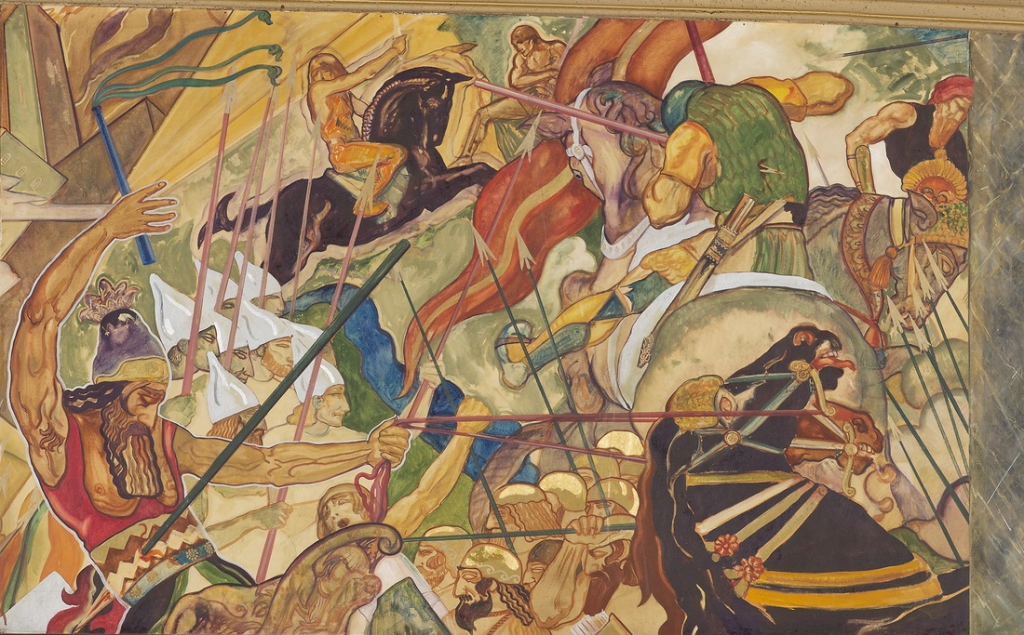
Mural depicting the wars of Israel and Judah with the surrounding nations, Wilshire Boulevard Temple, Los Angles

But the Lord says: “Now I will stand up.
    Now I will show my power and might.
You Assyrians produce nothing but dry grass and stubble.
    Your own breath will turn to fire and consume you.
Your people will be burned up completely,
    like thornbushes cut down and tossed in a fire.
Listen to what I have done, you nations far away!
    And you that are near, acknowledge my might!”

The sinners in Jerusalem shake with fear.
    Terror seizes the godless.
“Who can live with this devouring fire?” they cry.
    “Who can survive this all-consuming fire?”
Those who are honest and fair,
    who refuse to profit by fraud,
    who stay far away from bribes,
who refuse to listen to those who plot murder,
    who shut their eyes to all enticement to do wrong—
these are the ones who will dwell on high.
    The rocks of the mountains will be their fortress.
Food will be supplied to them,
    and they will have water in abundance. (New Living Translation)

The Assyrians were a nasty bunch. So were the people of Jerusalem, at the time of Isaiah’s prophecy. Maybe the folks in Judah played the comparison game and thought they were better than their foe. After all, the Assyrians were experts in war and torture.

Jerusalem was understandably terrified of the Assyrian army. And they trusted God, that is, to a degree. There’s a difference between looking to the Lord because you’re between a rock and a hard place, and placing faith in God because that is the default response of your life.

Easy for me to say. I’ve never stood on a city wall watching a powerful army surrounding me like a bunch of bullies on the playground.

Jerusalem was intimidated to the point of letting the Assyrian ruffians take their gold and silver. Well, actually, it wasn’t their gold; it was God’s. And when the army left, the city was still intact. But for how long?

It was humiliating. Being the victim of a bully always is. And because they’re bullies, it’s never enough. Like feeding the neighbor’s cat, the Assyrians end up going nowhere. They want more. In fact, they never really intended on leaving anyway. It was all a double-cross.

Judah, out of their fear and anxiety, made a bargain with the devil. A bully is a bully because they can be. Give in to them, and it only enables them to keep bullying. The Assyrians were ready for battle. It’s what they always did: fight and conquer.

It was at this point that Jerusalem finally got the clue that they’d been living with God in the background, not the foreground. They did their own thing, much like the hated and dreaded Assyrians.

So, the only recourse the people of Judah had was the mercy of their God. Yet, even though they ought to have petitioned the Lord from the get-go, at least they noticed the Lord is still there.

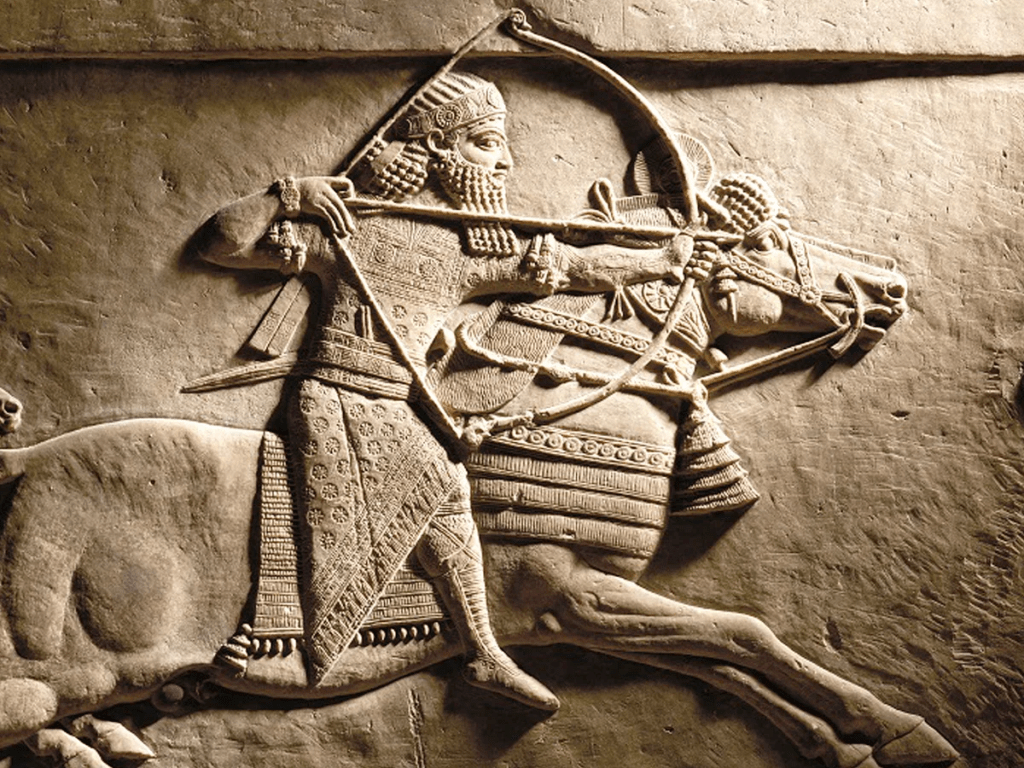
Assyrian king, British Museum

Unfortunately, most of our repentant overtures are way overdue. And yet, because of divine grace, the crazy mess we make of our lives is the very same place where a merciful God meets us.

Any sort of help is surely undeserved. It always is. The Lord, however, avoids making us grovel in our own vomit. God accepts us where we are, and not where we ought to be.

In truth, we all need to make a change, and not just the bullies. The sheer reality of God demands that we pay attention to what is right, just, and good. And the prophet Isaiah informed the people exactly how we must live in a world full of bullies and busted dreams.

We are to have an awareness of ethics and morality, a concern for humanity, and an orientation to help everyone thrive and flourish in this life.

The answer to life’s question of how to exist in this world and do more than just survive comes down to human morality:

  • Live right
  • Speak the truth
  • Despise exploitation
  • Refuse bribes
  • Reject violence
  • Avoid evil pleasures

The safe and stable way to live is to participate in the rhythms of mercy and justice that are woven into the fabric of the universe. The path to a contented and satisfying life is through goodness, not hatred.

Security and satisfaction don’t come through control of all circumstances; it comes by discerning that God has ultimate control, and that this God is good, not evil; just, not unjust; and righteous, not capricious.

According to the prophet, God will determine when the suitable time for assistance will come for us. And the Lord will deal with the ungodly according to the divine timetable, and not when we believe judgments should be rendered.

None of this is in our purview. Sometimes, talking about this sort of theology is a way of taking the focus off of our own need for an ethical and moral life. Sometimes, it is a helpful way of coming to grips with what is happening. Discernment is needed with oneself in these matters.

Trusting God means to exercise patience and perseverance, to focus on faith, to discipline ourselves in prayer, and to express confidence in hope.

We are not necessarily ruined whenever our circumstances are dire. The worse things become, the greater the display of divine power that can come.

By orienting ourselves around God and God’s strength and will, we grow in courage and develop in faith. We learn to trust in the worst of situations. We discover that the Lord knows the score of things, that God understands what’s going on.

And God laughs at the ungodly who believe they can bully the godly around. The most brilliant of military commanders is like a little toddler before the sovereign Lord of the universe. The fiery words they blow will blow back on them and consume their arrogance.

So, let us not harden our own hearts, but exercise a change of heart to let God be God, and to want for nothing but the courts of the Lord.

Let us not be like the bullies of Assyria who lived without a thought to the divine reality in front of them. Let us not become tormented, as if a fire were devouring us with inward anguish of soul, but instead:

  • Walk in right relations with others and with the Lord
  • Maintain truth and integrity in everything
  • Be free from corruption and offending others and God
  • Act with love toward your neighbor and your God
  • Refuse to accept a bribe
  • Restrain evil impulses
  • Open wide the spigot of goodness and justice

God is our refuge and strength, an ever-present help in trouble. Safety and abundance of good things is provided by the Lord. God protects. And God supplies. Rely upon God’s promises, and not the empty bellowing of others.

Be safe. Be strong. Be spiritual. We are all in this life together.

O God, my refuge and strength: In this place of unrelenting light and noise, enfold me in your holy darkness and silence, so that I may rest secure under the shadow of your wings. Amen.