Pray and Give Thanks (1 Timothy 2:1-7)

First of all, then, I urge that supplications, prayers, intercessions, and thanksgivings be made for everyone, for kings and all who are in high positions, so that we may lead a quiet and peaceable life in all godliness and dignity. This is right and acceptable before God our Savior, who desires everyone to be saved and to come to the knowledge of the truth. For

there is one God;
    there is also one mediator between God and humankind,
Christ Jesus, himself human,
    who gave himself a ransom for all

—this was attested at the right time. For this I was appointed a herald and an apostle (I am telling the truth; I am not lying), a teacher of the gentiles in faith and truth. (New Revised Standard Version)

In our extreme busyness, do any of us stop long enough to consider what is of upmost importance in our lives? Or do we scurry about, not considering why we fill every minute of the day with constant motion and activities which – if we are honest – only frustrate us?

Whether we know anything about William Shakespeare’s tragic play, Hamlet, or not, many a person lives out his centuries old words:

Life’s but a walking shadow, a poor player,

That struts and frets his hour upon the stage,

And then is heard no more. It is a tale

Told by an idiot, full of sound and fury,

Signifying nothing.

Writing to Timothy, a new and young pastoral leader of the Ephesian Church, the Apostle Paul made it clear what is, above all, the activity which the church and all believers in Jesus are to engage in: prayer.

Perhaps that sounds too trite or simple. Yet, there is really nothing easy about prayer. To pray is more like heading out on a wrestling mat with the Incredible Hulk. This is going to take some serious work.

The most important activity we can do is to keep persevering in prayer, never giving up, but continually getting back out there on the wrestling mat of prayer and putting all of your energy into it.

Everyone in leadership must be prayed for. Yes, each person who leads needs our prayers, without exception.

Christians are to be, first and foremost, people of prayer. And those prayers are to be for all sorts of various situations, and for all sorts of persons.

We are to pray for specific needs; general circumstances and situations; urgent and emergent requests; and, as the capstone to all prayer, expressions of thanksgiving and gratitude are most needed.

A weak and ineffective prayer is one that gives no thanks to God, nor offers gratitude to God for anyone.

Conversely, however, prayer filled with power and effectiveness is stuffed with thanksgiving to God, and liberally offers thanks to God for everyone, including the ones we don’t much care about.

Specifically, whenever we fail to pray for, and give thanks for, the very people we don’t much like, and would rather not pray for, at all, then we ought not expect any of our prayers to be heard nor answered by the God who is concerned for every human being on the face of this planet.

For the Christian, prayer is never optional nor merely occasional; prayer is necessary and vital, all the time. And prayer is a close relative to thanksgiving.

Pray in the Spirit at all times in every prayer and supplication. To that end, keep alert and always persevere in supplication for all the saints.

Ephesians 6:18, NRSV

Do not be anxious about anything, but in everything by prayer and supplication with thanksgiving let your requests be made known to God. (Philippians 4:6, NRSV)

In the ancient world of Paul and Timothy, much like our present contemporary world, prayers are needed so that we can live peaceably, with godliness and dignity.

We need religious tolerance and political stability, guaranteed by people in leadership positions. We need God’s sovereign and gracious enablement and direction of world leaders, so that God’s benevolent kingdom will come, and God’s ethical will be done, here on this earth, as it is always done in God’s heaven.

Christians recognize one God. The ancient Romans acknowledged many gods. In fact, veneration of the Roman Emperor as a god began after the assassination of Julius Ceasar in 27 B.C.E. He was proclaimed as divine, and added to the official pantheon of state gods in the Empire. Praying to divinized Ceasars became a real thing in the Roman world.

Paul clearly instructed Timothy to pray for Kings and Caesars, and not to them. Just like everyone else, rulers are dependent upon the mercy of God. Leaders are mortal, not divine; and ought never to be treated like gods.

So, when the Apostle stated that there is one God and one Mediator between God and humanity, he was clearly saying that Christ is King, and Ceasar is not. This was subversive language, at the time, and could get a Christian into some serious trouble.

For us today, it may seem silly to worship a ruler. Yet, we in our contemporary culture have a definite bent toward divinizing particular celebrities, politicians, sports icons, and music and movie stars. Some of what folks do certainly looks like worship of famous persons.

All of the celebrities of this world need God, and need our prayers for them (and not to them!) as people, like us, requiring deliverance from guilt and shame, just like we do.

I am a Calvinist, a person who holds to a Christian tradition from the Reformer John Calvin. I have encountered many people who believe that Calvinism is determinism, as if people are wholly bad, and cannot make choices because everything is already predetermined.

A Reformed Christian tradition simply places emphasis where (we believe) emphasis is due: upon God, and God’s sovereign decrees, commands, will, and decisions. Because ultimately, everything comes down to God, not us.

We worship God, not our choices, or anyone else’s. Before we ever chose God, God chose us.

Everyone needs deliverance, but not everyone receives it. The Reformed concept of “limited atonement” simply recognizes that not everyone will be redeemed. The atonement of Christ is unlimited in its scope for all people, but limited in its application to some persons.

The heart of God is that everyone would be saved and come to a knowledge of the truth. Yet, not everyone experiences this.

This, in no way, flies in the face of a Christian theological tradition like Calvinism. A human judge may pronounce a severe sentence upon the accused; but that does not necessarily mean that the judge desires it, or enjoys putting someone away.

Jesus, the Son of God, and Son of Humanity, gave himself as a ransom for all. This assumes we all carry a significant debt that cannot simply be canceled; it must be reckoned with and redeemed.

Statue of Christ the Redeemer, Rio de Janeiro, Brazil

Spiritual captives need freedom. Spiritual debtors need redemption. The spiritually oppressed need a champion, a warrior. Spiritual slaves need someone to pay for their release from bondage.

The death of Christ is the atoning act which provides new life for humanity. An existential exchange happened, in which Jesus vicariously took our place, and released us from the power of sin, death, and hell.

This is the good news which Christianity proclaims: In Jesus Christ, we are forgiven, and are now free to live a good, right, and just life. There is now nothing hindering our prayers. We have full access to God through Christ.

Thus, we are to use this incredible privilege of accessibility by praying to God on behalf of everyone; and giving thanks for all things, especially the deliverance which has been secured for us.

There are quite enough grumpy curmudgeons in this world. We don’t need any more of them. What we do need, and can never get enough of, are people who have heartfelt thanksgiving – and are grateful for both the good and the bad; those they don’t like, as well as the people they do like; those in an opposing political party, along with their own; their enemies, and their friends.

The good news of Jesus changes us to be people who exist in the world for good; and not for ill. And those who insist on hate speech and hateful actions, are evidencing that they are not people of prayer, and are ingrates who do not know God.

They shall find out the hard way that there is no unlimited atonement.

The Gospel is not a tale told by an idiot.

Lord Jesus Christ, Son of God, have mercy on me, a sinner.

Christ, have mercy, and grant me your peace. Amen.

A Reason To Hope (Ruth 2:15-23)

When she got up to glean, Boaz instructed his young men, “Let her glean even among the standing sheaves, and do not reproach her. You must also pull out some handfuls for her from the bundles and leave them for her to glean, and do not rebuke her.”

So she gleaned in the field until evening. Then she beat out what she had gleaned, and it was about an ephah of barley. She picked it up and came into the town, and her mother-in-law saw how much she had gleaned. Then she took out and gave her what was left over after she herself had been satisfied. 

Her mother-in-law said to her, “Where did you glean today? And where have you worked? Blessed be the man who took notice of you.”

So she told her mother-in-law with whom she had worked, saying, “The name of the man with whom I worked today is Boaz.” 

Then Naomi said to her daughter-in-law, “Blessed be he by the Lord, whose kindness has not forsaken the living or the dead!” Naomi also said to her, “The man is a relative of ours, one of our nearest kin.”

Then Ruth the Moabite said, “He even said to me, ‘Stay close by my young men until they have finished all my harvest.’ ” 

Naomi said to Ruth, her daughter-in-law, “It is better, my daughter, that you go out with his young women, otherwise someone might bother you in another field.” 

So she stayed close to the young women of Boaz, gleaning until the end of the barley and wheat harvests, and she lived with her mother-in-law. (New Revised Standard Version)

Ruth was both a widow and a foreigner from Moab. She and her mother-in-law Naomi had no land. Widowed foreign women were likely to be poor. They were vulnerable to abuse by being out in the fields during harvest time, trying to glean whatever leftovers they could find after the harvesters came through.

The covenant code of Israel prescribed laws concerning how to treat the poor. There was even instruction on what to do in just such a situation of the landowning harvester Boaz and the poor gleaner Ruth:

“When you reap your harvest in your field and forget a sheaf in the field, you shall not go back to get it; it shall be left for the alien, the orphan, and the widow, so that the Lord your God may bless you in all your undertakings. When you beat your olive trees, do not strip what is left; it shall be for the alien, the orphan, and the widow.

“When you gather the grapes of your vineyard, do not glean what is left; it shall be for the alien, the orphan, and the widow. Remember that you were a slave in the land of Egypt; therefore I am commanding you to do this. (Deuteronomy 24:19-22, NRSV)

The law stipulated a spirit of generosity toward the poor in the land. The reason for the law is that the Israelites had been slaves in Egypt, and experienced the cruelty of abusive slavedrivers. Israel was to remember this, and ensure that no foreigners would experience what they themselves had to go through for 400 hundred years in Egypt.

Ruth gleaning, by James Tissot, c.1898

Fortunately for Ruth, Boaz was an observant Jew, concerned for the intent and spirit of God’s law. He held to the covenant law both legally and spiritually.

Boaz remembered God’s grace to Israel. He blessed Ruth, and commended her for placing herself in God’s hands.

If not for the covenant code’s opportunity for the poor to glean, Boaz would have faced a dilemma. Once he became aware Ruth and Naomi’s poverty, he surely would not have let them starve. Yet, neither would he likely have made them dependent upon himself.

It is important to preserve the dignity of people, which is why the Old Testament is filled with social and economic laws concerning the poor in Israel.

Ruth was given the chance to glean and work for the harvest. This allowed her to use the grain for making bread. Furthermore, her own labor freed herself and her mother-in-law from being dependent as beggars. All of this helped make the two of them less vulnerable to exploitation by those with little concern for God’s covenant code.

Rather than being smothered either by sheer dependency, or through being used and exploited, God’s law operated as intended, thanks to the pious concern of Boaz.

This did not go unnoticed by Naomi. She clearly saw the gracious hand of God acting through Boaz.

Regardless of who we are, whether rich or poor, old or young, we can be gracious. We can commit ourselves to working hard for one another. We can be concerned for the common good of everyone.

God’s grace turns our hearts and minds, our heads and hands, toward ensuring that all persons have what they need to grow, thrive, and flourish in this life. This is exactly what biblical justice is all about. It’s what Boaz was about.

This will include concerns about equity. A just society will involve some sort of distribution of resources. It will mean making sure that our collective values, communal priorities, and social structures uphold the inherent dignity of human life. We will protect the most vulnerable among us.

A culture attuned to grace will champion the underprivileged and not use them as political pawns to achieve personal goals. A people focused on grace will place faith in God’s presence and provision for us all.

Those with much will care for the disadvantaged, and will uphold laws that do so. Those with little will take advantage of opportunities to both receive and give, and will make their voices heard on behalf of the needy.

Since God is just toward all, so we who are created in God’s image are to also be just.

Since God is good in all that God does, we too, are to be good.

Since God is gracious, merciful, and kind to the poor, so we are to be full of grace, mercy, and kindness.

Since God is love, so we are to love, not hate.

Faith and hope are born within the heart, because there is a reason to do so. Let us all be the people who give others a reason to trust God, hope for a better tomorrow, and love, despite any unloving situations.

Soli Deo Gloria

Accountability Is Real, and It Matters (Ezekiel 14:12-23)

The word of the Lord came to me: “Son of man, if a country sins against me by being unfaithful and I stretch out my hand against it to cut off its food supply and send famine upon it and kill its people and their animals, even if these three men—Noah, Daniel and Job—were in it, they could save only themselves by their righteousness, declares the Sovereign Lord.

“Or if I send wild beasts through that country and they leave it childless and it becomes desolate so that no one can pass through it because of the beasts, as surely as I live, declares the Sovereign Lord, even if these three men were in it, they could not save their own sons or daughters. They alone would be saved, but the land would be desolate.

“Or if I bring a sword against that country and say, ‘Let the sword pass throughout the land,’ and I kill its people and their animals, as surely as I live, declares the Sovereign Lord, even if these three men were in it, they could not save their own sons or daughters. They alone would be saved.

“Or if I send a plague into that land and pour out my wrath on it through bloodshed, killing its people and their animals, as surely as I live, declares the Sovereign Lord, even if Noah, Daniel and Job were in it, they could save neither son nor daughter. They would save only themselves by their righteousness.

“For this is what the Sovereign Lord says: How much worse will it be when I send against Jerusalem my four dreadful judgments—sword and famine and wild beasts and plague—to kill its men and their animals! 

“Yet there will be some survivors—sons and daughters who will be brought out of it. They will come to you, and when you see their conduct and their actions, you will be consoled regarding the disaster I have brought on Jerusalem—every disaster I have brought on it. You will be consoled when you see their conduct and their actions, for you will know that I have done nothing in it without cause, declares the Sovereign Lord.” (New International Version)

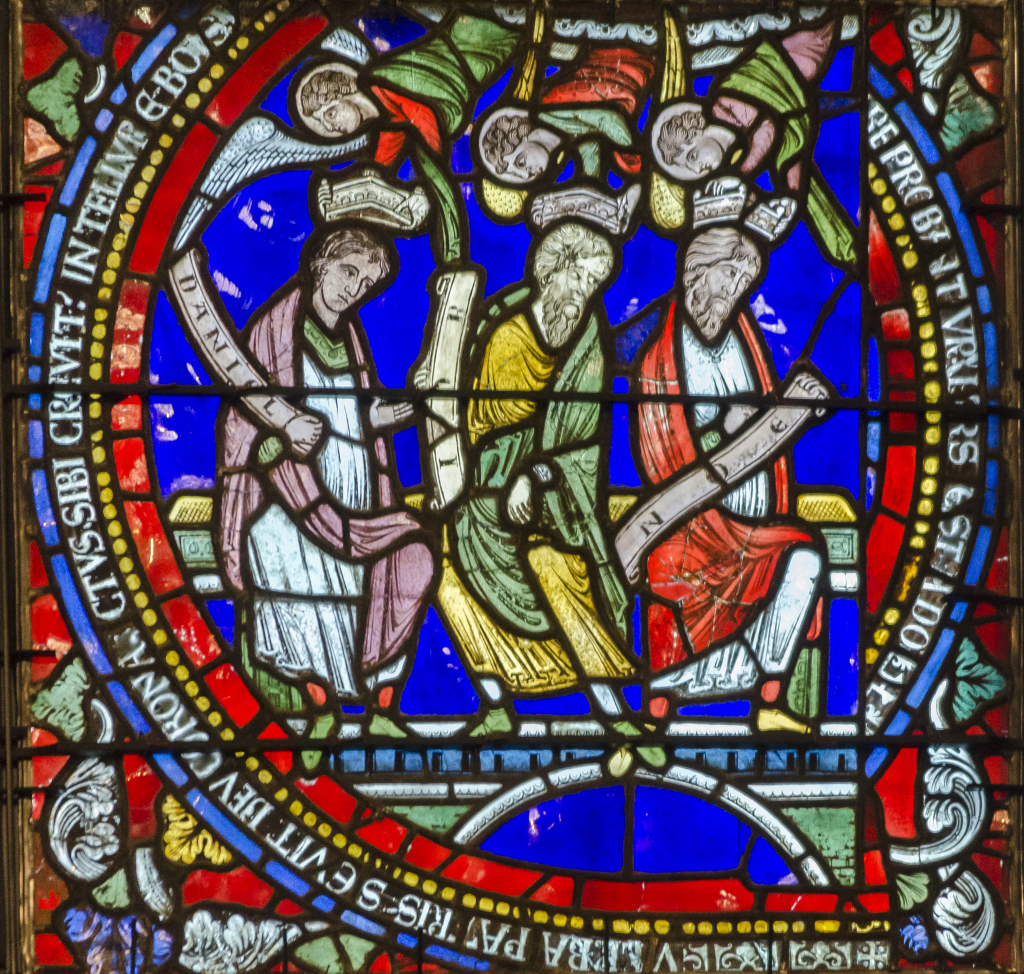
Stained glass of the three righteous men: Daniel, Job, and Noah

No person, group, institution, or nation can act unjustly forever. The prophet Ezekiel made it clear that everyone will be held accountable for injustice and wickedness, for crimes against humanity and against God.

Furthermore, there is no nation or group which can rely on a few persons who do right, while the rest of the people swim in injustice and unrighteousness. Righteous persons save only themselves; they cannot make decisions and take over the life of another person.

Ezekiel wanted to make sure his listeners got the message of individuals only saving themselves, and not riding on the coattails of others. The prophet went out of his way to communicate that each individual person will be held responsible for their own actions; they will be judged on what they themselves have done, and not what another has or has not done.

Even the family of a righteous person will not be spared divine judgment because of that individual’s righteousness. One shall be held accountable for what that one has done, period.

Specifically, in the text, God was ready to execute judgment on Jerusalem. War, wild animals, famine, and disease would come upon them because of unfaithfulness, injustice, and unrighteousness.

Just because the city had the temple, this would not save them. Just because there are a few righteous persons in the city, they would not save it. Just because a close loved one is faithful and righteous, will not mean that God would spare the city.

A few good works of a few people, do not cancel out pervasive and consistent evil which is perpetrated by many people. Each person is responsible for their own behavior. No one gets a pass, simply because they know certain people and are well-connected.

Evil is evil, no matter whether it is perpetrated by believers or unbelievers. No nation, and no person, is off the hook; all persons will be held accountable for doing justice, loving mercy, and walking humbly with God.

Even if three of the most righteous persons show up – Noah, Daniel, and Job, who were famous for their moral integrity – their combined righteousness and faithfulness would not keep away divine judgment from happening in an immoral and unethical society. Only those three alone would be delivered.

There is no such thing as salvation by proxy. Each individual person must work on themselves, without blaming others, inordinately depending on others, nor ignoring God and wishing God did not see, or does not exist at all.

Evil persons do not get any preferential treatment from God, just because they have a prominent position or are famous. The Lord, as Sovereign of the universe, has every right to exact divine retribution. And God will do it without showing favoritism.

Just as God shows mercy without prejudice, so will God extend judgment without any prejudice.

The presence of great light means that there is also the presence of great darkness. If we want a great God of love and mercy, then we must also accept the God of wrath and judgment; and vice versa.

We are made in God’s image, and not the other way around. It is our task to submit to the high, holy, and sovereign Lord of all. It is not God’s job to be the divine Santa Claus who submits to us. The Lord is no divine genie who we can keep in a bottle, and summon whenever we so desire.

No matter one’s theology or spirituality, everyone discerns that they are to be responsible in this life, and are accountable to forces greater than themselves.

This is one of those universal realities that all of us need to sync our lives with – or suffer the consequences.

Almighty God and Sovereign Lord of all, I embrace my accountability to you. Forgive me for when I live as though I need not give an account of what I said and did. I affirm that I am accountable for how I treat others; and I realize that what I do to others, positive or negative, I am doing to you, their Creator. Sustain me in faith and patience, I pray. Amen.

Be Honest (Job 42:7-9)

Job’s Sacrifice, by William Blake (1757-1827)

After the Lord had finished speaking to Job, he said to Eliphaz, “I am angry with you and your two friends, because you did not speak the truth about me, the way my servant Job did. Now take seven bulls and seven rams to Job and offer them as a sacrifice for yourselves. Job will pray for you, and I will answer his prayer and not disgrace you the way you deserve. You did not speak the truth about me as he did.”

Eliphaz, Bildad, and Zophar did what the Lord had told them to do, and the Lord answered Job’s prayer. (Good News Translation)

After all of Job’s terrible trouble in losing everything and everyone he cared about; after all of the longwinded speeches of his supposed friends; and after God’s breaking of silence through unanswerable questions; the epilogue of the story brings us God’s verdict concerning Job and his situation.

God finally dispenses his assessment, and renders his judgment. The Lord was not at all happy with Job’s companions; and was pleased with Job. Therefore, God made a decision against the companions, and for Job.

Four times in three verses, God refers to Job as “my servant,” but does not describe the friends as such. It is Job, and not Job’s friends, who spoke truth. Only Job spoke words consistent with reality.

At best, the friends spoke unhelpful words. At the worst, their words were hurtful and full of hubris. In retrospect, they probably should have at least kept their mouths shut. And ideally, they could have been true comforters, and consoled Job in his agony.

This gets at something which I believe we all need to get a firm hold upon: Not extending help, mercy, and consolation to those in dire straits, pisses-off God.

It irks God because it is a misrepresentation of God’s basic character, and distorts God’s true nature.

Being dishonest and pretending to be okay when one is not…

telling someone who is hurting to suck it up and confess their sin…

believing that the world operates according to good guys getting health and wealth, and bad guys getting sickness and poverty…

downright angers the holy and merciful God of the universe.

Job, unlike the Three Stooges he had as friends, affirmed what is right and true:

  • God is the Sovereign of the universe who dispenses both good and bad (Job 2:10)
  • God is the One who gives and who takes away (Job 1:21)
  • God is the Lord to whom we must bow in willing submission (Job 42:5-6)

In the dialogue with his friends, Job rightly insisted that God is sometimes an enemy, and that God’s inexplicable silence and absence is unjust and destructive.

I don’t want you to easily pass over what I just referred to, or to flip-out over it. In truth, God is both present and absent. And God’s absence hurts. Sometimes, it hurts like hell. We must affirm that God is sometimes silent. There are times when it feels like God is on vacation and is paying no attention.

I want you to get ahold of this important dimension to the spiritual life:

Human pretentions and posturing only present a false self to God and the world. That sort of behavior angers God. The Lord wants honest vulnerability.

Whereas Job’s friends insisted on maintaining theological respectability and an ordered theological system, Job essentially said, “To hell with all that!”

And Job was right.

Job contended with God. He cried, yelled, and exposed his innermost thoughts and feelings to God. Job was real. No phoniness existed with him. Yet, Job did not forsake God, curse God, or say there was no God.

The genuine spiritual life is always a tricky and risky combination of devotion and confrontation toward God.

Job presented his true self to God.

Job’s friends presented to God what they believed God wanted to see and hear.

There is a big difference between those two approaches.

God affirmed Job. God was against Job’s friends.

Maybe today it is necessary to rethink what you have always believed it is which gets God’s affirmation, and what raises God’s ire.

If we cannot be honest about what we are really thinking, and about how we are really doing, then we are hopeless people. In that state, no one can help us. And God is not pleased.

The final verdict of God is that only the prayers of one who speaks truth, like Job, will be effectively heard. Less honest prayers, like those of Job’s wife and friends, are foolish and ineffective.

One of the big overall messages of the Book of Job is this: For God’s sake, be honest!

My own culture is one of Midwest nice. That’s a nice way of saying that Midwesterners are mostly dishonest creatures. Every Midwesterner I know, understands being nice and polite to someone’s face, and then speaking gossip and slander to their back.

Ask any Midwestern American how they are doing, and they’ll tell you, “Just fine,” or “Great!” or “The sun is shining,” or some other deflection or blathering lie about how they are really doing. More than once, I have actually heard a depressed person with suicidal ideation tell another person that they are “doing fine today.”

That sort of claptrap gets us nowhere, especially with God. The Lord is okay with you and I telling him what we really think, even if we are extremely upset with God. God isn’t bothered by our anger, yelling, or messed-up thinking. But God is bothered by our pretending, our dishonesty, and our false presentations.

None of this means that we must wear our heart on our sleeve. In fact, I have found that persons who declare to me that they “tell it like it is,” are some of the most false people on the planet. It’s usually a sign that I’m not going to get from them how they are really feeling. It usually means they’re angry, and want to talk smack against someone, without ever examining themselves.

Don’t be a jerk. There are nice jerks, and obnoxious jerks, but in the end, they’re all just jerks. You and I really can speak honest words of truth, without being a jerk about it.

Job was honest, real, raw, hurt, angry, sad, lonely, and grieving out of his mind. And he was no jerk. And God affirmed him.

Personally, I’d rather have God’s affirmation than anyone else’s. How about you?

Almighty God, help us to speak and act truthfully in all situations. May we be honest with ourselves and with others, building trust and integrity in our relationships. Thank you for your example of truth and honesty. Help us to follow in your footsteps and to live with authenticity.

Guide us to be honest even when it is difficult, recognizing that honesty is the foundation of trust and respect. Help us to confront our own falsehoods and to seek the truth in all aspects of our lives. May we create environments where honesty is valued and encouraged, fostering open and transparent communication.

We pray for those who struggle with honesty, asking for your guidance and support in their journey towards truthfulness. Thank you for the clarity and peace that comes from living honestly. Help us to embrace and uphold this value every day. Amen.