Then Joshua son of Nun secretly sent two spies from Shittim. “Go, look over the land,” he said, “especially Jericho.” So, they went and entered the house of a prostitute named Rahab and stayed there.
The king of Jericho was told, “Look, some of the Israelites have come here tonight to spy out the land.” So, the king of Jericho sent this message to Rahab: “Bring out the men who came to you and entered your house, because they have come to spy out the whole land.”
But the woman had taken the two men and hidden them. She said, “Yes, the men came to me, but I did not know where they had come from. At dusk, when it was time to close the city gate, they left. I don’t know which way they went. Go after them quickly. You may catch up with them.” (But she had taken them up to the roof and hidden them under the stalks of flax she had laid out on the roof.) 7 So the men set out in pursuit of the spies on the road that leads to the fords of the Jordan, and as soon as the pursuers had gone out, the gate was shut.
Before the spies lay down for the night, she went up on the roof and said to them, “I know that the Lord has given you this land and that a great fear of you has fallen on us, so that all who live in this country are melting in fear because of you. We have heard how the Lord dried up the water of the Red Sea for you when you came out of Egypt, and what you did to Sihon and Og, the two kings of the Amorites east of the Jordan, whom you completely destroyed. When we heard of it, our hearts melted in fear and everyone’s courage failed because of you, for the Lord your God is God in heaven above and on the earth below.
“Now then, please swear to me by the Lord that you will show kindness to my family, because I have shown kindness to you. Give me a sure sign that you will spare the lives of my father and mother, my brothers and sisters, and all who belong to them—and that you will save us from death.”
“Our lives for your lives!” the men assured her. “If you don’t tell what we are doing, we will treat you kindly and faithfully when the Lord gives us the land.” (NIV)
I personally know of many persons who struggle with the notion that persons of ill repute can exhibit any kind of faith. *Sigh* Methinks such persons ought to reread their Bibles with more acumen, for “sinners” of all kinds fill the pages of Holy Scripture.
In our Old Testament lesson for today, Rahab the prostitute not only displays faith; she displays the kind of belief that lands her in the great hall of faith in the New Testament:
Rahab, the prostitute, welcomed the Israelite spies like friends. And because of her faith, she was not killed with the ones who refused to obey. (Hebrews 11:31, ERV)
Rahab evidenced a confident and unwavering belief that God existed and would surely overtake her city of Jericho with a profession of faith which rivals any life-long pious believer:
“I know that the Lord has given you the land, and that dread of you has fallen on us, and that all the inhabitants of the land melt in fear before you.” (Joshua 1:9, NRSV)
Rahab’s bold assertion of faith is both sincere and linked to God’s promise that the Israelites would take the land. Rahab is Exhibit A of the kind of person that inherits the kingdom of God. Rahab’s faith, not her works or reputation, is what spared her life and spared her from judgment.
Please ponder and consider that truth for a bit. Sit with it if you must. Rahab was not judged by God or the spies. In far too many quarters of the Christian world, judgment instead of mercy is levied to persons like Rahab. If there is anyone who should have a non-judgmental presence toward “sinners” it is Christians. And, if there is any institution which ought to consistently, both personally and through policy, display unflagging grace and forsake judgment, it is the Church.
Yet, unfortunately, as many have experienced, the Church has often fallen short of the glory of God’s grace in Christ by condemning people of ill repute. *Sigh* Perhaps we all need to rethink what faith truly is: not a checklist of doctrinal beliefs to sign-off on but a confident and bold action based solidly in the promises of God.
Knowing what those promises are, and living our lives appropriately in consideration of them, is the kind of faith that pleases God. Those who attempt to be judge, jury, and executioner need not apply as followers of God.
Genuine righteousness is never earned; it is given by the compassionate grace of God. So, let us lay hold of God’s promise of grace and mercy with gusto! Let the gracious God, who is full of steadfast love, effect the way we live our lives. Let us believe with a bold biblical belief that God always does what has been decreed and proclaimed.
Lord God Almighty, I may have not always lived my life well, yet I trust you today that you can and will deliver me from all my troubles because you are with me. May your Holy Spirit give me the gift of faith to believe in such a way that forever impacts how I live my life. Amen.
If you really keep the royal law found in Scripture, “Love your neighbor as yourself,” you are doing right. But if you show favoritism, you sin and are convicted by the law as lawbreakers. For whoever keeps the whole law and yet stumbles at just one point is guilty of breaking all of it. For he who said, “You shall not commit adultery,” also said, “You shall not murder.” If you do not commit adultery but do commit murder, you have become a lawbreaker.
Speak and act as those who are going to be judged by the law that gives freedom, because judgment without mercy will be shown to anyone who has not been merciful. Mercy triumphs over judgment. (NIV)
One of my bedrock foundational unshakable beliefs is that God’s big world spins on the axis of grace. Without grace we would all be living in some nightmarish dystopian novel just trying to survive. Grace is the force which overwhelms and overcomes everything.
When I was growing up, we had a dog named Sam. Sam loved being on the farm. More than once he tussled with a skunk. In those times, I could barely get close enough to clean him up because he stunk so badly. Favoritism stinks, and God has a hard time getting close to us when we show partiality to others. God is going to clean us up when smelling the stench of discrimination on us.
Showing favoritism to some over others is evidence the dog is running away from the bath of grace. To develop relationships and interact with people the way God wants us to, we must be free from prejudice. Favoring the rich over the poor stinks because God cares about those trapped in poverty. When Jesus began his ministry, he lifted-up the importance of poor folk by placing himself in the position of extending grace to them:
The Spirit of the Sovereign Lord is on me, because the Lord has anointed me to proclaim good news to the poor. (Isaiah 61:1; Luke 4:18, NIV)
In the Old Testament, there are seven different words for the “poor” because poverty was a pervasive reality (and still is!). The various reasons for poverty range from being born into poverty, being lazy, or being oppressed and/or in slavery. The types of poor persons run the gamut from simple beggars to the pious and humble poor. These spiritual poor persons were called in biblical times the “anawim” (Hebrew עֲנָוִ֣ים). The anawim are humble and gentle folk caught in grinding poverty with no other option but to put their trust in God.
The mistreatment, exploitation, and inattention to the needs of the poor are a chief reason why Holy Scripture is filled with references about how to treat them. The anawim are dear and near to the heart of God:
“Poor persons will never disappear from the earth. That’s why I’m giving you this command: you must open your hand generously to your fellow Israelites, to the needy among you, and to the poor who live with you in your land.” (Deuteronomy 15:11, CEB)
“If you hire poor people to work for you, don’t hold back their pay whether they are Israelites or foreigners who live in your town. Pay them their wages at the end of each day because they live in poverty and need the money to survive. If you do not pay them on time, they will complain about you to the Lord, and he will punish you.” (Deuteronomy 24:14-15, CEV)
Listen to this, you who rob the poor and trample down the needy! You can’t wait for the Sabbath day to be over and the religious festivals to end so you can get back to cheating the helpless. You measure out grain with dishonest measures and cheat the buyer with dishonest scales. And you mix the grain you sell with chaff swept from the floor. Then you enslave poor people for one piece of silver or a pair of sandals.
Now the Lord has sworn this oath by his own name, the Pride of Israel: “I will never forget the wicked things you have done!” (Amos 8:4-7, NLT)
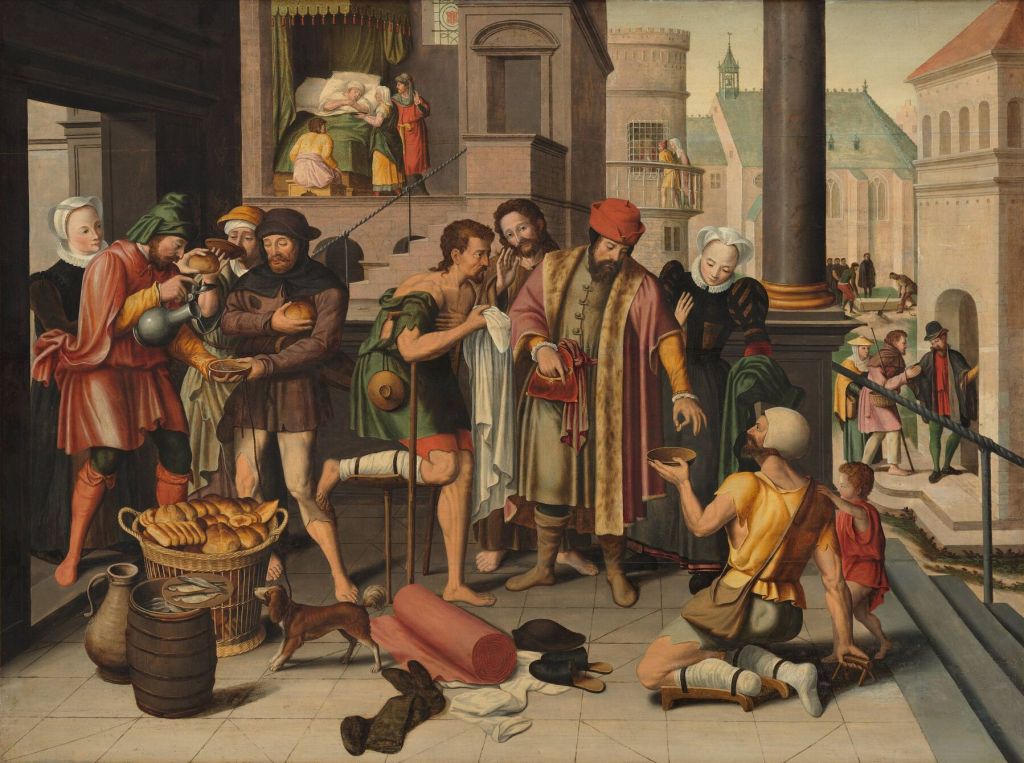
The Seven Corporal Works of Mercy by Unknown Dutch artist, 1580.
Nothing gets God’s hackles up more than unjust and unfair favoritism which is devoid of mercy and grace toward the poor. It all stinks to high heaven, and when God smells it, divine egalitarian power is not far behind.
It is the poor in spirit with no trust in stuff and ingenuity who will enter the kingdom of heaven. The humble person gives grace to another even though the person cannot offer something in return. It is easy to be merciful to people who have a deal with you about scratching each other’s backs. However, it is altogether a different thing to be gracious simply because it is the right thing to do and pleases the heart of God.
God cares about the condition of our souls and not the balance of our bank accounts. Inattention to the poor and needy only betrays a heart of unjust favoritism – a materialistic heart full of greed. A 2012 Boston Globe article asked the following question: Does money change you?
The Globe article stated, “most people are convinced that gaining a lot of money … wouldn’t change who they are as people. Yet, a mounting body of research is showing, wealth can actually change how we think and behave—and not for the better. Rich people have a harder time connecting with others, showing less empathy to the extent of dehumanizing those who are different from them. They are less charitable and generous. They are less likely to help someone in trouble. And they are more likely to defend an unfair status quo. If you think you would behave differently in their place, meanwhile, you are probably wrong: These are not just inherited traits but developed ones. Money, in other words, changes who you are.”
The University of Minnesota’s Carlson School of Management found in their research that even the mere suggestion of getting more money makes people less friendly, less sensitive to others, and more likely to view some groups of people as inferior to others. Another series of studies from the University of California at Berkley concluded that wealthier people tend to be less compassionate toward others in a bad situation than people from lower-class backgrounds. Their research concluded, “If you win the lottery and you want to avoid becoming an insensitive jerk, there is a simple solution: Give at least half the money away.”
Some poor people, as in the days of the Apostle James, are willing to put up with being treated unfairly so they might get a piece of the rich person’s pie. Favoritism ignores the sin in others to gain something from them. God says that is stinking thinking.
Favoritism is flat out a violation of God’s law. The entire law is summed up in two commands: Love God and love neighbor. Favoritism violates our neighbor, and therefore, is sinful disobedience of God. Any needy human we encounter is our neighbor – no matter their social or economic status, their ethnicity, race, gender, or anything that identifies them as different. They are to be helped when we can do so.
We are to speak and act with mercy because we will eventually have to face the Judge. God is always watching us – every word and every action. Judge Jesus will respond to how we have treated each person we encountered and how we talked about other people when they were not around. We will all appear before Christ at the end of the age and must give an account of ourselves. (2 Corinthians 5:10)
Words are important, so they ought to be full of grace, seasoned with salt. Showing mercy instead of favoritism is the way love expresses itself. Mercy is best given when we have first received it ourselves from God. A heart touched by the grace of the Lord Jesus is one which will stand in the judgment.
We rid ourselves of favoritism’s stench through the cleansing bath of God’s mercy in Jesus Christ. There is grace available if we will receive it. God is the expert in transforming lives, renewing minds, and putting to death the pride of favoritism. The work is done with needed grace and compassionate mercy.
So, we are to make it our goal to be a grace-givers, to have willing hearts which seek to emulate the mercy of Christ. The bath of mercy and grace takes away the stank of prideful favoritism and leaves us with the sweet aroma of love, justice, peace, and joy in the Holy Spirit.
Divine Mercy by English painter Stephen B. Whatley, 2009
My dear friends, remember the warning you were given by the apostles of our Lord Jesus Christ. They told you that near the end of time, selfish and godless people would start making fun of God. And now these people are already making you turn against each other. They think only about this life, and they don’t have God’s Spirit.
Dear friends, keep building on the foundation of your most holy faith, as the Holy Spirit helps you to pray. And keep in step with God’s love, as you wait for our Lord Jesus Christ to show how kind he is by giving you eternal life. Be helpful to all who may have doubts. Rescue any who need to be saved, as you would rescue someone from a fire. Then with fear in your own hearts, have mercy on everyone who needs it. But hate even the clothes of those who have been made dirty by their filthy deeds.
Offer praise to God our Savior because of our Lord Jesus Christ! Only God can keep you from falling and make you pure and joyful in his glorious presence. Before time began and now and forevermore, God is worthy of glory, honor, power, and authority. Amen. (CEV)
The New Testament book of Jude is a short and quick read, but it packs a mighty big punch. Although the letter is ancient, the words from Jude are a pertinent and prescient description for today. In all corners of life, from religion to politics to families and workplaces, many people have become so opposed to other’s ideas and ways of life that they wantonly turn against each other.
Speaking into our polarized world, Jude provides some much needed direction for Christians on this earth: build on the foundation of spiritual prayer; keep in step with God’s love; help all who have doubts; rescue the perishing; have mercy on the needy; and hate evil. To top it off, Jude reminds us to offer praise to God because of Jesus.
Anyone today would find it hard to discover a better approach to life and ministry for the believer than this succinct plan of Jude. It only makes sense to follow a clear biblical agenda, especially in these days of uncertainty and unrest. What is more, Jude’s advice is applicable to anyone navigating the world of hate and injustice.
These verses sound like a good point of conversation for church leaders and bible study facilitators, as well as for those of another faith or creed who are exploring broad principles of connection with communities at odds with one another.
How might the Christian implement this into the life of the church, and of daily life? What in these biblical verses could be used in various contexts where people are belligerent and dismissive of others? Dedicated conversations around these questions may well lead to some helpful and practical ways of cultural engagement with others of differing views and lives.
May the God who created a world of diversity and vibrancy go with us as we embrace life in all its fullness.
May the Son who teaches us to care for the stranger, the immigrant, and the foreigner go with us as we try to be good neighbors in our communities.
May the Spirit who breaks down our barriers and celebrates community go with us as we find the courage to be holy in all we do while creating a place of welcome for all. Amen.
“For the kingdom of heaven is like a landowner who went out early in the morning to hire workers for his vineyard. He agreed to pay them a denarius for the day and sent them into his vineyard.
“About nine in the morning he went out and saw others standing in the marketplace doing nothing. He told them, ‘You also go and work in my vineyard, and I will pay you whatever is right.’ So, they went.
“He went out again about noon and about three in the afternoon and did the same thing. About five in the afternoon he went out and found still others standing around. He asked them, ‘Why have you been standing here all day long doing nothing?’
“‘Because no one has hired us,’ they answered.
“He said to them, ‘You also go and work in my vineyard.’
“When evening came, the owner of the vineyard said to his foreman, ‘Call the workers and pay them their wages, beginning with the last ones hired and going on to the first.’
“The workers who were hired about five in the afternoon came and each received a denarius. So, when those came who were hired first, they expected to receive more. But each one of them also received a denarius. When they received it, they began to grumble against the landowner. ‘These who were hired last worked only one hour,’ they said, ‘and you have made them equal to us who have borne the burden of the work and the heat of the day.’
“But he answered one of them, ‘I am not being unfair to you, friend. Didn’t you agree to work for a denarius? Take your pay and go. I want to give the one who was hired last the same as I gave you. Don’t I have the right to do what I want with my own money? Or are you envious because I am generous?’
“So, the last will be first, and the first will be last.” (NIV)
We as humans have an innate sense of right and wrong, justice and injustice. We want life to be fair. It disturbs us when there is favoritism, discrimination, and preferential treatment. When things seem askew and others seem more privileged, envy can creep in and settle in our bones.
The envy can go even deeper. For example, is it fair that any child should struggle with health issues like cancer, epilepsy, and mental disorders? Is it fair to have healthcare disparities? Is it fair to have a spouse taken from you before their time? Is it fair to lose your job because of a pandemic? Is it ever fair to be treated like a second-class citizen?
Pat answers to people’s genuine struggles will not do, such as “Well, you just need to work hard and hope for the best;” “We have to take what is given us and accept these things;” “Think of all those starving children in India;” or the more crass, “Suck it up buttercup; life was never meant to be a rose garden.” Those statements simply do not help.
At the heart of envy is the belief that others are getting something that I deserve.
Plenty of jerks have healthy grandkids, grow old with their spouses, and retire in comfort with plenty of money. “It isn’t fair!” we cry.
God does not always operate according to our standards of fairness. God’s very nature is to be generous and full of grace. The parable which Jesus told about the vineyard workers is a story not of unfairness, but a story of generosity and grace. It is all in how you look at it.
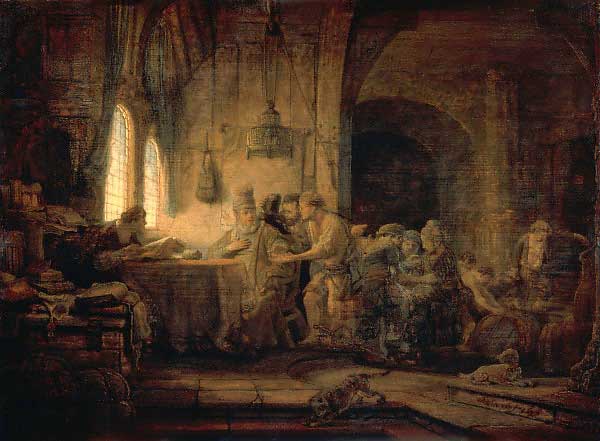
Parable of the Workers in the Vineyard by Rembrandt, 1637
A normal workday in the ancient world was ten hours, not counting breaks. The workday began at 6:00am. A denarius was a typical day’s wage for laborers. The landowner went out at the third hour, 9:00am; the sixth hour, noon, etc. He kept returning to hire more workers even up to the last hour of the workday. Laborers were always paid at the end of the day. In this parable, the last workers were paid first, which prompted the first workers hired to think they would be getting more, even though they had been promised a denarius. So, they grumbled about not getting more. They thought the landowner was not being fair.
Grumbling. Complaining. Murmuring. It is the bane of our existence. Decades ago, when gas station attendants still filled tanks for customers, I was working at a station and had a lady go berserk on me for not checking her oil and cleaning her windshield, because I did it for the car in front of her. Even though there was a sign right in front of her that said checking oil and cleaning windshields is only done upon request, the lady thought she was getting gypped.
In truth, the landowner did not cheat or defraud the workers in any way. He paid the agreed upon wage, just like he promised. Should he want to pay everyone the same even though the amount of work was different was his own business. The problem was not with the owner, it was with the worker’s envy of the owner’s generosity toward the others. God distributes gifts because he is gracious, not because we have earned anything.
Our standard of fairness is not the rule of the kingdom of God – grace is.
The founder of Methodism, John Wesley, was physically thrown out of a church one Sunday because of a sermon he was preaching on the grace of God. Afterwards, when Wesley wrote about this to a friend, he said, “There is no Christian Doctrine more repugnant than the affirmation that we are saved by the grace of God through faith.”
Deep down many believe we control our destiny, and that we save ourselves by what we do. We discern that if we serve God all our lives, in the end, God will reward us. We believe that our pious activities, our acts of service and our work for the Lord, will bring us salvation, or, at least a leg up in the kingdom of God over others who have not worked as hard or as long as we have. After all, we do the right thing.
So, what about those who have not figured out Christianity… those who do not have the correct or proper beliefs… or those who have not straightened out their lives? According to a worldview of human fairness, they are out of luck. They should be in church. They should work harder, faster, and better. Then, they could get their lives in order. If they would only understand fairness, we reason, then all would be well.
Parable of the Vineyard Workers from unknown artist in the Middle Ages
But there is a problem, because the parable of the workers told by Jesus seems to be saying that is not how it works, at all. Jesus seems to be saying that grace and grace alone saves, that God’s amazingly naive and irresponsible grace is available to anyone and everybody. And that troubles the workers to no end.
Whenever we run headlong into God’s unfair grace and see that God’s way of doing things is so far removed from our way, there is bound to be grumbling. After all, if God is going to run a vineyard like the one in the gospel lesson and give everybody the same pay regardless of their actual work hours, then what’s the use of getting up early in the morning to work?
What is the good of sitting in church, listening to sermons from a crazy preacher who is no better than us, if these outsiders, these Johnny-and Jane-come-lately’s can waltz in at the last minute and receive the same treatment as the rest of us? For many church folks who diligently serve, it is not fair to pay so much attention to outsiders and build ministry around people who aren’t even here, who don’t yet know Jesus.
The conclusion and point of the parable: The last will be first, and the first will be last. In Luke’s prodigal story, the elder brother grumbles and gripes: “All these years I’ve been slaving for you and never disobeyed your orders. But when this son of yours who has squandered your property with prostitutes comes home, you kill the fatted calf!” It is the firstborn son that complains. (Luke 15:11-32)
In both the parable of the prodigal son and the parable in today’s lesson, “good” people are the ones who fail to see the heart of the Father and of the landowner. The “firsts” got off track because, over time, they forgot the kingdom hinges on grace, not effort, on not simply doing the right things over a long period of time.
God controls the flow of mercy, not us.
We will likely be surprised in heaven with those already sitting at God’s banquet table, and equally surprised with who is not there. Resentment can move us away from the table of mercy God is preparing. The problem comes whenever we think we are above other people. We might be sinners, but we are not as bad as some other people are! We commit ordinary sins, not mass murder!
Here is the unvarnished truth: God does not owe you or I a thing, and God cares about all kinds of people, not just us and people who think and live like we do. Our hearts need to be big enough to center ministry around other people who are different than us.
If our hearts are small, we easily get jealous when God pays attention to prodigals and profligates. Grace becomes too repugnant a doctrine for us.
The gospel of Jesus Christ is about grace. Life is not all about being decent. It is not all about morality, and it is certainly not about our own goodness. The gospel is about being steeped in and surrounded by the grace of God in Christ, so that we, in turn, can show others grace. Grace is the way God deals with us beyond what we deserve or feel we have earned.
Grace is unfair; we get what we do not deserve.
May we allow God’s grace to so permeate our hearts and lives so that we will give it to others as freely as we have received.Praise be to you, almighty and everlasting Father of our Lord Jesus Christ. In Christ, you have given us every spiritual blessing in heaven. In Christ, you chose us before the world was made. You chose us in love to be your holy people—people who could stand before you without any fault. And before the world was made, you decided to make us your own children through Jesus Christ. It pleased you to do it. And this brings praise from us because of your wonderful grace, given to us freely, in Christ, the one you love. We have forgiveness of sins because of this lavishly rich grace. Thank you, O my Father, for your grace extending to me in Christ! Amen










 Rev. Tim Ehrhardt