Hosea 6:1-6 – “I Desire Mercy!”

By Brazilian street artist Edward Kobra, building in New York City, 2018

Come, let us return to the Lord.
He has torn us to pieces
    but he will heal us;
he has injured us
    but he will bind up our wounds.
After two days he will revive us;
    on the third day he will restore us,
    that we may live in his presence.
Let us acknowledge the Lord;
    let us press on to acknowledge him.
As surely as the sun rises,
    he will appear;
he will come to us like the winter rains,
    like the spring rains that water the earth.

“What can I do with you, Ephraim?
    What can I do with you, Judah?
Your love is like the morning mist,
    like the early dew that disappears.
Therefore I cut you in pieces with my prophets,
    I killed you with the words of my mouth—
    then my judgments go forth like the sun.
For I desire mercy, not sacrifice,
    and acknowledgment of God rather than burnt offerings.” (NIV)

My favorite word in all Holy Scripture is the Hebrew word chesed.  It is such a rich word that no one English word can capture its depth.  So, chesed is translated in various ways across English translations of the Bible as mercy, grace, steadfast love, covenant loyalty, kindness, compassion and more. It is no wonder, then, that since chesed marks the character and activity of God, the Lord very much desires people to reflect this same stance toward others. 

In today’s Old Testament lesson, God was calling and wooing wayward people to return to a divine life of closeness with the Lord. God demonstrated chesed by not putting the people away, like a spouse outright divorcing an unfaithful partner, but committed to loving the Israelites even when they were unlovely.

At all times, the response God wants is not simply going through the motions of outward worship. Ritual practices mean little if there is no heart behind them. The Lord longs for people to demonstrate both fidelity and fealty through mercy and a steadfast love to God and neighbor. Both our work and our worship are to be infused with divine mercy. 

Chesed by Havi Mandell

God deeply desires a close relationship with humanity and is profoundly pained when people whore after other gods to meet their needs and love them. Hosea’s prophecy is an impassioned plea for all persons to find their true fulfillment and enjoyment in a committed loving divine/human union, like a marriage.

In Christian readings of Hosea’s prophecy, repentance means accepting God’s chesed through Jesus Christ. The believer is to allow the character of God to rule and reign in their heart so that love and commitment come flowing out in words, actions, thoughts, and dispositions. Mercy finds its highest expression in the person and work of Jesus. Thus, Advent is a season of anticipating the great love and mercy of God through the incarnation of Christ.

It is no wonder, then, that Jesus lifted Hosea’s prophecy as a treasured principle of operation when asked why he deliberately made connections with “questionable” people:

While Jesus was having dinner at Matthew’s house, many tax collectors and sinners came and ate with him and his disciples. When the Pharisees saw this, they asked his disciples, “Why does your teacher eat with tax collectors and sinners?” On hearing this, Jesus said, “It is not the healthy who need a doctor, but the sick. But go and learn what this means: ‘I desire mercy, not sacrifice.’ For I have not come to call the righteous, but sinners.” (Matthew 9:10-12, NIV)

And when confronted about “questionable” activities Jesus appealed to the same source of Hosea’s prophecy:

“Look! Your disciples are doing what is unlawful on the Sabbath.” Jesus answered, “Haven’t you read what David did when he and his companions were hungry? He entered the house of God, and he and his companions ate the consecrated bread—which was not lawful for them to do, but only for the priests. Or haven’t you read in the Law that the priests on Sabbath duty in the temple desecrate the Sabbath and yet are innocent? I tell you that something greater than the temple is here. If you had known what these words mean, ‘I desire mercy, not sacrifice,’ you would not have condemned the innocent.” (Matthew 12:2-7, NIV)

One can never go wrong with mercy and grace. If in doubt between whether to judge another or show mercy, the Christian’s choice is clear. Grace and love create connections – reconnecting the disconnected. The heart of true Christian spirituality is a deep kinship with the divine. Whenever that relation is broken or severed, it is vital to restore it. The means of doing so is not judgment but mercy.

Chesed is more than a word; it is a way of life. God wants mercy. Grace is the Lord’s divine will. So, let us today receive the forgiveness of Jesus and devote ourselves to prayer and works of love which come from a heart profoundly touched by grace.  May the result be healing of that which has been broken, and reconciled relationships with others.

Merciful and loving God, the One who shows amazing grace, forgive us for our wanderings away from the divine life. Return us, again, to the grace of Jesus Christ our Savior so that our hearts will be renewed and aflame with love for others.  In the Name of the Father, Son, and Spirit, the Great Three in One.  Amen.

2 Timothy 2:8-13 – The Hound of Heaven

Remember Jesus Christ, raised from the dead, descended from David. This is my gospel, for which I am suffering even to the point of being chained like a criminal. But God’s word is not chained. Therefore, I endure everything for the sake of the elect, that they too may obtain the salvation that is in Christ Jesus, with eternal glory.

Here is a trustworthy saying:

If we died with him,
    we will also live with him;
if we endure,
    we will also reign with him.
If we disown him,
    he will also disown us;
if we are faithless,
    he remains faithful,
    for he cannot disown himself. (NIV)

C.S. Lewis once described God as the Hound of Heaven.  By that phrase he meant that God doggedly pursued him and would not let go.  Lewis came into Christian faith, in his own words, “kicking and screaming” as God’s faithful pursuit won out in his life. 

The Apostle Paul reminded his young protégé Timothy of some basic theology to keep him on track and encouraged in a tough ministry.  Paul gave Timothy a trustworthy saying that he could easily remember and say to himself day after day, especially when the going got tough: 

If we died with Christ,
    we will live with him.
If we don’t give up,
    we will rule with him.
If we deny
    that we know him,
he will deny
    that he knows us.
If we are not faithful,
    he will still be faithful.
Christ cannot deny
    who he is. (CEV)

The beauty, wonder, and distinction of God is his amazing grace. There is no ambiguity with God. The Lord is not fickle but loves and holds tight even when we are unlovely and practice avoidance. When God pursues, God finds; when God holds on, there is no letting go.

This trustworthy saying of Scripture is a good, short, solid expression of theological truth to memorize, meditate upon, and say to ourselves repeatedly.  We belong to Jesus Christ.  God is with us.  The Hound of Heaven will always sniff us out and bring us to himself.

Lewis likely got his phrase “Hound of Heaven” from an English poem of the same name by Francis Thompson (1859-1907). Thompson was a tortured soul who flirted in and out of depression, opium addiction, and suicidal thoughts for much of his adult life. Yet, he understood, perhaps better than most, that a loving God never stops pursuing a wayward heart. The poem’s beginning and end says this:

I fled Him, down the nights and down the days;
I fled Him, down the arches of the years;
I fled Him, down the labyrinthine ways
Of my own mind; and in the mist of tears
I hid from Him, and under running laughter….

How hast thou merited—
Of all man’s clotted clay the dingiest clot?
Alas, thou knowest not
How little worthy of any love thou art!
Whom wilt thou find to love ignoble thee,
Save Me, save only Me?
All which I took from thee I did but take,
Not for thy harms,
But just that thou might’st seek it in My arms.
All which thy child’s mistake
Fancies as lost, I have stored for thee at home:
Rise, clasp My hand, and come.
Halts by me that footfall:
Is my gloom, after all,
Shade of His hand, outstretched caressingly?
Ah, fondest, blindest, weakest,
I am He Whom thou seekest!
Thou dravest love from thee, who dravest Me.

Theology is not an impersonal affair. Personal religion still exists. The individual’s wax and wane between faith and faithlessness shall never negate divine grace. The Lord of the universe loves you. There is a deep Divine desire to shower grace upon you, to shelter and protect you. There is no need to run. Yet, if you do, God remains steadfast in his dogged pursuit. The hunt will continue….

Thank you, O God, for your great faithfulness, even to me.  I believe. Help me in my unbelief! I give unceasing praise and undying devotion to you for your grace of being the One who never lets up, through Jesus Christ my Lord.  Amen.

Isaiah 40:1-11 – Comfort for the Weary

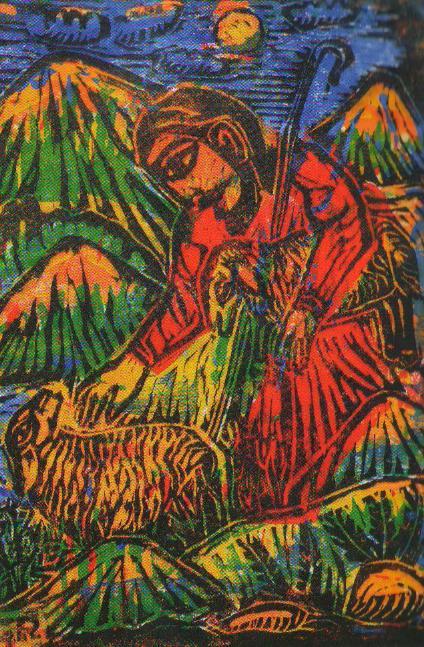
The Shepherd by Indian artist P. Solomon Raj (1921-2019)

Comfort, comfort my people,
    says your God.
Speak tenderly to Jerusalem,
    and proclaim to her
that her hard service has been completed,
    that her sin has been paid for,
that she has received from the Lord’s hand
    double for all her sins.

A voice of one calling:
“In the wilderness prepare
    the way for the Lord;
make straight in the desert
    a highway for our God.
Every valley shall be raised up,
    every mountain and hill made low;
the rough ground shall become level,
    the rugged places a plain.
And the glory of the Lord will be revealed,
    and all people will see it together.
For the mouth of the Lord has spoken.”

A voice says, “Cry out.”
    And I said, “What shall I cry?”

“All people are like grass,
    and all their faithfulness is like the flowers of the field.
The grass withers and the flowers fall,
    because the breath of the Lord blows on them.
    Surely the people are grass.
The grass withers and the flowers fall,
    but the word of our God endures forever.”

You who bring good news to Zion,
    go up on a high mountain.
You who bring good news to Jerusalem,
    lift up your voice with a shout,
lift it up, do not be afraid;
    say to the towns of Judah,
    “Here is your God!”
See, the Sovereign Lord comes with power,
    and he rules with a mighty arm.
See, his reward is with him,
    and his recompense accompanies him.
He tends his flock like a shepherd:
    He gathers the lambs in his arms
and carries them close to his heart;
    he gently leads those that have young. (NIV)

As we journey through the Christian Year, we have spent the past twenty-five weeks in the longest season on the Church Calendar: ordinary or proper time. It is only appropriate that the dog days of summer and the bulk of autumn should be within this time.

Most of the Christian’s life is lived in the mundane yet necessary work of mission. Small and seemingly obscure acts of kindness, careful yet often discreet acts of love, and graciously chosen words of encouragement which may not be noticed by many are what mostly characterize the daily pilgrimage of faith.

I am sure the ancient Jewish people felt that, for an awfully long time, they were plodding along as faithfully as they could with often little to show for it. Yet, they knew it would not always be this way. God’s people anticipated that a time was coming when their pedantic service would see the light of day.

I am sure we, too, have times when it feels as if our prayers are only bouncing off the ceiling. In such times, words of comfort and assurance come as a breath of fresh air. When we least expect it, God speaks to us tenderly and with compassion. The Lord steps into our weariness and exhausting work and says, “Enough!”

Whereas our walk with God may often feel like trudging up and down hills, sloshing through muddy valleys, and traversing hard terrain, the proclamation of comfort assures us that it will not always be this way. The way to God will be made level so that we can connect with the Lord post haste.

No matter how much our worldly circumstances break us down, even shattering our expectations and dreams, we carry with us an unflagging vision of wholeness, integrity, and hope. God is our true home, our polestar, our ultimate destiny. Feeling displaced, out of sorts, or like we just do not belong are signs that we long for our place with God.

And when we find our home with God, all might be going to hell around us, yet we are buttressed and sustained by living divine words. For those with eyes to see, ears to hear, and hearts attuned to grace, there is John the Baptist, smoothing the highway to our Lord – preparing the way to Jesus. (Mark 1:1-4)

God, as both the warrior who powerfully fights our battles, and the shepherd who lovingly tends to our needs, firmly takes the initiative to bring us home, going out of the way to gently pick us up and carry us back to the place we belong.

The good news is that the world is changed by God. The world around us is no longer the way we thought it was or was supposed to be. Despair gives way to confident expectation, and discouragement is slowly replaced by consolation. The long exile is coming to an end. Jesus is coming soon. All will be made right; justice and peace will have the day.

Let your hearts be true and humble, as befits God’s holy reign. For the glory of the Lord is on the earth and will be from everlasting to everlasting.

Glory to God in the highest, and on earth, peace to people of goodwill. We praise you; we bless you; we adore you; we give thanks to you for your great glory. Amen.

Jeremiah 31:31-34 – A New Covenant

The Last Supper by Francis Newton Souza, 1990

“The day is coming,” says the Lord, “when I will make a new covenant with the people of Israel and Judah. This covenant will not be like the one I made with their ancestors when I took them by the hand and brought them out of the land of Egypt. They broke that covenant, though I loved them as a husband loves his wife,” says the Lord.

“But this is the new covenant I will make with the people of Israel after those days,” says the Lord. “I will put my instructions deep within them, and I will write them on their hearts. I will be their God, and they will be my people. And they will not need to teach their neighbors, nor will they need to teach their relatives, saying, ‘You should know the Lord.’ For everyone, from the least to the greatest, will know me already,” says the Lord. “And I will forgive their wickedness, and I will never again remember their sins.” (NLT)

For the past few weeks, the Daily Lectionary readings brought us steady admonitions of passing faith onto future generations, with obedience as the key to it all. However, God’s ancient people kept going through significant times of unfaithfulness, infidelity, and disobedience. As if they had some sort of spiritual A.D.D., the people could not seem to keep their eyes off the glittering gods from the surrounding nations.

For certain, God has always possessed a faithful remnant of people devoted to observing the covenant. Yet, the nation in the prophet Jeremiah’s day floundered and broke faith with the teaching given to them.

Since God’s grace has the last word, the sins and shortcomings of the backslidden people who failed to pass on the covenant teachings to their progeny would have a better ending than judgment.

God’s answer to repeated human failings was to establish a new covenant, unprecedented in its audacious mercy.

Rather than rewriting commands on stone tablets (as with Moses on Mount Sinai) and having a remedial class on covenant, God would instead do the extraordinary by writing the law on human hearts – that way they would know the Lord in a direct and immediate way. What is more, it would be for everybody, neither only for the remnant nor for the spiritual elite.

From the least to the greatest, from young to old, even from Jew to Gentile, God would forgive once and for all.

If that is not the most gracious act ever decreed, I do not know what is. This was a radical move of spiritual amnesty which was completely undeserved and most definitely not something any other god from any other nation would ever do. It was unthinkable – completely off everyone’s radar. Yet, that is exactly what grace does.

From a New Testament (New Covenant) perspective, Jesus is the fulfillment of all God’s good covenant promises to the people. Furthermore, God’s Holy Spirit serves as the continuing presence of Jesus within us, teaching us and guiding us in the ways of God. Our only task, then, is to live into those promises – to know them, claim them, and bank on them. 

We are most obedient when we believe the promises of God and throw all our hope in them.

The implications of this divine decree are enormous. It means:

  • I cannot do a dang thing to earn God’s acceptance because I already have it! (John 6:37; Colossians 1:21-22; Romans 8:33-39, 15:7-12)
  • I need not fear judgment because Jesus has already taken care of the sin issue, once for all! (Romans 6:5-10; Hebrews 7:27-28, 10:5-10; 1 John 4:17-18)
  • I lack nothing because God has already given me everything I need for life and godliness in this present evil age! (Philippians 4:19; 2 Peter 1:3-4)
  • I can know God, right now, without jumping through spiritual hoops or over imposed hurdles because Jesus leveled the way and made it clear! (John 14:6; Ephesians 2:8-9; Hebrews 2:9-18)
  • I can enjoy forgiveness and a clean heart because God has decreed it to be so! (Psalm 103:8-12; Ezekiel 36:25-27; Luke 22:20; Hebrews 8:7-13, 10:14-18)

If this were not enough, Jesus has sent the Spirit to be with us forever, to guide us and lead us into realizing the law written on our hearts. We are never alone. God is with us.

Jesus said, “The Companion, the Holy Spirit, whom the Father sends, will teach you everything and will remind you of everything I told you. Peace I leave with you. My peace I give you. I give to you not as the world gives. Do not be troubled or afraid.” (John 14:26-27, CEB)

In this world of trepidation, fear, uncertainty, and unrest, there is peace, grace, and love because of Father, Son, and Spirit, the one true God, the Blessed Holy Trinity, the Divine Warrior who fights our battles, the Lord of Hosts who has our backs. Yes, this God, and no other god, has the chutzpah to make promises to us and the power to back them up.

Our Father in heaven,
Reveal who you are.
Set the world right;
Do what’s best—as above, so below.
Keep us alive with three square meals.
Keep us forgiven with you and forgiving others.
Keep us safe from ourselves and the Devil.
You’re in charge!
You can do anything you want!
You’re ablaze in beauty!
Yes! Yes! Amen!