You religious teachers are nothing but show-offs, and you’re in for trouble! You build monuments for the prophets and decorate the tombs of good people. And you claim that you would not have taken part with your ancestors in killing the prophets. But you prove that you really are the relatives of the ones who killed the prophets. So, keep on doing everything they did. You are nothing but snakes and the children of snakes! How can you escape going to hell?
I will send prophets and wise people and experts in the Law of Moses to you. But you will kill them or nail them to a cross or beat them in your meeting places or chase them from town to town. That’s why you will be held guilty for the murder of every good person, beginning with the good man Abel. This also includes Barachiah’s son Zechariah, the man you murdered between the temple and the altar. I can promise that you people living today will be punished for all these things!
Jerusalem, Jerusalem! Your people have killed the prophets and have stoned the messengers who were sent to you. I have often wanted to gather your people, as a hen gathers her chicks under her wings. But you wouldn’t let me. And now your temple will be deserted. You won’t see me again until you say,
“Blessed is the one who comes in the name of the Lord.” (Contemporary English Version)
Christ’s scathing and damning critique is against a distorted spirituality, a false Christianity, a controlling leadership that stifled and snuffed-out the true worship of God.
Here is what Jesus is getting at with his woe on the leadership who are so concerned with the tombs of the prophets: Honoring dead people, while ignoring live people, is not good. Respecting the prophets and pastors and godly people of the past means nothing if we ignore the prophet and pastor that is right in front of our face.
The surest way to hell is to give credence to those long gone yet fail to honor their teaching and the people keeping the true spirit of that instruction. It is to call evil good, and good evil.
The telltale signs of hypocrisy include:
Not practicing what they preach, rather than embodying and modeling the message.
The goal I pursue is the prize of God’s upward call in Christ Jesus. So, all of us who are spiritually mature should think this way, and if anyone thinks differently, God will reveal it to him or her. 16 Only let’s live in a way that is consistent with whatever level we have reached. Brothers and sisters, become imitators of me and watch those who live this way—you can use us as models. (Philippians 3:14-17, CEB)
Keeping people out instead of inviting them in.
I tell you for certain that I am the gate for the sheep. Everyone who came before me was a thief or a robber, and the sheep did not listen to any of them. I am the gate. All who come in through me will be saved. Through me they will come and go and find pasture. (John 10:7-9, CEV)
Focusing on externals and refusing to do one’s own inner work.
God does not see as humans see. Humans look at outward appearances, but the Lord looks into the heart. (1 Samuel 16:7, GW)
Majoring on the minors through upholding the letter of the law while forsaking the spirit of the law.
You keep meticulous account books, tithing on every nickel and dime you get, but on the meat of God’s Law, things like fairness and compassion and commitment—the absolute basics! —you carelessly take it or leave it. Careful bookkeeping is commendable, but the basics are required. Do you have any idea how silly you look, writing a life story that’s wrong from start to finish, nitpicking over commas and semicolons? (Matthew 23:23-24, MSG)
Despite the presence of hypocrisy and the misplaced energy of people, the last word to everything is God’s grace.
At the end of his tirade, Jesus did something we would do well to follow: He broke into a tear-filled, heart-rending love song for his wayward people. Today’s Gospel lesson is not just a blast-the-bad-guys message; it is a deep concern for people to know the true worship of God.
Keeping the law only truly happens when we can connect our action to a face. For example, if we follow safety protocols at work because we have to, someone will get hurt sooner than later. But if we do it with the faces of people in mind, desiring to do what is best for them, there will likely be fewer incidents.
Jesus wants people to honor God’s law so they will live well. The Lord sees faces and the stories behind those faces. He doesn’t want people damaging one another with their detached sense of moral superiority.
So, let’s be gracious, merciful, and kind – not only because we must – but because we desire to be compassionate toward our fellow humanity, as well as honor our God.
Merciful God, help us to realize when we’re being judgmental of others. Lord, I confess I am neither above you nor the master of all things. I am your servant and your child. Thank you that you have wild and abundant grace for me. Teach me your ways and help me be receptive to them, so I will not fall. I surrender all my ways, thoughts, opinions, perceptions and decisions to you, Lord Jesus. Amen.
At the foot of the mountain, a large crowd was waiting for them. A man came and knelt before Jesus and said, “Lord, have mercy on my son. He has seizures and suffers terribly. He often falls into the fire or into the water. So, I brought him to your disciples, but they couldn’t heal him.”
Jesus said, “You faithless and corrupt people! How long must I be with you? How long must I put up with you? Bring the boy here to me.” Then Jesus rebuked the demon in the boy, and it left him. From that moment the boy was well.
Afterward the disciples asked Jesus privately, “Why couldn’t we cast out that demon?”
“You don’t have enough faith,” Jesus told them. “I tell you the truth, if you had faith even as small as a mustard seed, you could say to this mountain, ‘Move from here to there,’ and it would move. Nothing would be impossible.” (New Living Translation)
As we reflect on today’s Gospel lesson, let’s keep in mind that any time we see Jesus exorcising demons, we need to resist the idea that anyone having similar symptoms today is demonic in origin. Any chronic health condition a person experiences, without seeing any healing take place, does not necessarily mean the condition is due to the person’s lack of faith.
Conversely, it is also possible to relegate such healing accounts to a different time and place. My own view of Scripture, along with personal experience, informs me that demonization is real. We may underestimate how influential and widespread demonization occurs in this modern time and place.
The nature of faith is not located in its amount or intensity but in its object. All of life requires some faith. Even sitting in a chair. When I sit, the amount or intensity of my faith isn’t the issue – the object, the chair, is the issue. If a leg on the chair breaks and I flop to the floor, its not reasonable for me to conclude that it happened because of my lack of faith.
The disciples’ inability to heal the boy.
I’m not sure what is more difficult: to be the person suffering, or to observe a loved one suffering. The father is desperate and hurting, watching his son suffer with seizures. The man is utterly discouraged because Christ’s disciples were not able to help.
So, the desperate father approached Jesus and knelt, begging him to have mercy and help his son.
Our Lord’s response, I admit, is not likely what my response would be. I would be more like, “I’m so sorry this is happening to you. This is terrible. Let’s take care of this.” Jesus did honor the father’s request and healed the boy, but not before he had some words.
Jesus was exasperated, and he let everyone know about it. Why was he so disappointed?
Because his disciples knew better. The disciples were not ignorant or unable. They had what they needed to deal with the boy and his father. Jesus already equipped them to do this kind of ministry:
Jesus called his twelve disciples together and gave them authority to cast out evil spirits and to heal every kind of disease and illness… “Heal the sick, raise the dead, cure those with leprosy, and cast out demons. Give as freely as you have received!” (Matthew 10:1, 8, NLT)
The reason for the disciples’ inability to heal was their lack of faith.
Jesus was perturbed with his disciples because they were not utilizing faith.
Jesus is bothered when believers don’t believe.
Up until this encounter, the disciples were healing people and doing the work Jesus gave them to do. Yet now they cannot. What changed? They relied on their own power, abilities, and experience, instead of relying on the power of God to heal.
The Gospel of Mark includes Jesus saying that this kind of demon can only be dislodged through prayer (Mark 9:14-29). In short, the disciples didn’t pray. They didn’t tap into God’s power. They didn’t use the authority Jesus gave them. Rather, the disciples rested on their own laurels.
Their lack of prayer translated into a lack of power.
If we are unable to do the work God has called us to do, it isn’t because we lack the authority or ability. It is a lack of faith.
Effective ministry happens because of faith.
The power of faith is in the person to whom it is directed. If we trust solely in ourselves, we will fail. However, if we trust in Jesus, then even the tiniest of faith will be able to do the impossible.
The power is not in particular words, or in a certain formula – the power is in faith rightly directed toward Jesus. Most demonic manifestations are much more subtle – such as thoughts of how I am not enough, how I have no right to try and help another, and how unable I am to do the will of God.
Conclusion
Here is a simple observation of Christ’s words: We are not told that if we have faith as big as a mountain that we can move one. Instead, Jesus tells us that if we have any faith at all, even as small as a tiny seed, directed toward God and not ourselves, the sky is the limit – we will have all the ability we need to do the will of God.
So, what is that impossible thing that could be done in your life with properly directed faith?
What miracle, healing, or resistance to a bad spirit needs to take place around us?
Discouragement is the most common tool of the devil in keeping us from realizing genuine manifestations of faith. Jesus has already accomplished victory over sin, death, and Satan. We must, then, claim all the will of God for today.
Resist the devil and he will flee from you (James 4:7). Step out in faith and do the will of God. The first step is always one of prayer….
High and Holy One, because your mercy is everlasting and your truth endures from generation to generation, show mercy to the sick and infirmed of either body or soul. Grant them deliverance from mental, emotional, spiritual, and physical illness. Blessed Lord, keep them under your care, for only in you can we live in safety and wellbeing. Visit them with your saving health. Do not let their hope be taken away, through Jesus Christ, our Lord. Amen.
My brothers and sisters, believers in our glorious Lord Jesus Christ must not show favoritism. Suppose a man comes into your meeting wearing a gold ring and fine clothes, and a poor man in filthy old clothes also comes in. If you show special attention to the man wearing fine clothes and say, “Here’s a good seat for you,” but say to the poor man, “You stand there” or “Sit on the floor by my feet,” have you not discriminated among yourselves and become judges with evil thoughts?
Listen, my dear brothers and sisters: Has not God chosen those who are poor in the eyes of the world to be rich in faith and to inherit the kingdom he promised those who love him? But you have dishonored the poor. Is it not the rich who are exploiting you? Are they not the ones who are dragging you into court? Are they not the ones who are blaspheming the noble name of him to whom you belong?
If you really keep the royal law found in Scripture, “Love your neighbor as yourself,” you are doing right. But if you show favoritism, you sin and are convicted by the law as lawbreakers. For whoever keeps the whole law and yet stumbles at just one point is guilty of breaking all of it. For he who said, “You shall not commit adultery,” also said, “You shall not murder.” If you do not commit adultery but do commit murder, you have become a lawbreaker.
Speak and act as those who are going to be judged by the law that gives freedom, because judgment without mercy will be shown to anyone who has not been merciful. Mercy triumphs over judgment. (New International Version)
Being an Outsider
It’s awkward feeling like an outsider. As a young pastor in Michigan, I once went to make a hospital call on one of my parishioners. He was having a procedure done at Ford Hospital in Detroit. I had never been there before. I parked my car and walked into the hospital, just like I had done at several hospitals before.
Yet, there was something different that I couldn’t quite put my finger on. Then, I realized, I didn’t see any other Caucasian people. Every person I encountered was African-American.
Up to that point in my life, I was never a minority in any situation. Although everyone in the hospital was polite and respectful, it was still weird for me. I distinctly remember thinking to myself in the midst of that experience, “Huh, so that’s what it feels like for my African-American friends!”
Imagine being a visitor to a church worship service. You are just a normal person trying to make ends meet, without much money or resources, and only a few clothes with none of them being very dressy. You have never been to this church before. You pull up in a fifteen year old car that has a few rattles to it and park. “Wow, that building is big! I don’t know anybody here, except Mary.”
Mary isn’t here today. You gin-up the courage to get out of the car and walk into the building. “Where do I go? Will anybody notice me? How am I supposed to act? Where do I sit?” All the things we take for granted are at the forefront of your mind.
Favoritism is Insider Judgment
Not everyone thinks or lives the same – and that is the point the Apostle James is trying to get across to us. If we are only attentive, aware, and care about people who look like us, think like us, and live like us, then we are playing favorites. And God calls that being judgmental.
The word “favoritism” comes from an idiom literally meaning, “lifting up the face.” That is, taking something merely at face value. To make a biased judgment based on only surface impressions is not good. It is not the way of Jesus, who associated with people of dubious morality and came into close contact with ostracized persons, like lepers. Discrimination based on limited understanding is soundly condemned in Scripture.
Those who show favoritism aren’t good.
Proverbs 28:21, CEB
Be fair, no matter who is on trial—don’t favor either the poor or the rich. (Leviticus 19:15, CEV)
Times change; God’s heart doesn’t. The Lord cares for all kinds of people, not just insiders. Peter had to get that into his head and heart concerning Gentiles, whom he considered inferior. He took for granted they were to always be outsiders. It took a series of visions from God for Peter to get this testimony into his life:
“Now I understand that God doesn’t play favorites. Rather, whoever respects God and does what is right is acceptable to him in any nation.” (Acts 10:34-35, GW)
A poor woman once wanted to join a church. She went to the pastor, and he told her to pray about becoming a member. The pastor did not see the woman for months and then one day met her on the street. He asked her if she had been praying and what she had decided about joining the church. She said, “I did what you asked me to do, and one day while I was praying, the Lord said to me, ‘Don’t worry about getting into that church – I’ve been trying to get into it myself for the last twenty years!’”
The church the Apostle James addressed had the mistaken notion certain persons were better than others because of their ability to financially contribute and wield influence. Put yourselves in the shoes of those ancient church folks.
These are refugees trying to make it in a strange country. It was tempting and easy to suck-up to the rich persons who came to their meetings. They needed some stable donors, and not some poor people who were going to drain their already short resources. Showing preferential treatment to the wealthy only made sense to them.
Favoritism is a Heart Problem
For the Apostle James, showing favoritism reflected a terrible malady of the heart: a divided loyalty between God and the world. When things got rocky, the church turned to money and those with it, instead of coming to the Lord and seeking God’s unlimited resources. Inattention to the poor and needy might make good business sense but will result in spiritual death when Jesus comes back to judge the living and the dead.
Far too many Christians believe poor people are poor because they are lazy and don’t want to work. There are certainly lazy people in this world, and maybe we are some of them – too spiritually lazy to take the time and effort to get to know persons in poverty and those very different from ourselves.
In the third century, a church deacon named Lawrence was in charge of the church’s treasury (benevolence fund) in Rome. One day the prefect (mayor) of the city asked Lawrence to gather up and give him “the wealth of the church.” Lawrence sent back a message: “I will bring forth all the precious things that belong to Christ, if only you will give me a little time to gather everything together.” The prefect agreed, as he dreamed of what he could do with the money, gold, and silver.
For three days, Lawrence walked through all the alleys and squares of Rome and gathered the church’s real treasure—the poor, the disabled, the blind, the homeless, and the lepers. The people he gathered included a man with two eyeless sockets, a disabled man with a broken knee, a one-legged man, a person with one leg shorter than the other, and others with grave infirmities.
Lawrence wrote down their names and lined them up at the entrance to the church at his appointment with the prefect. “These are the treasures of the Church of Christ!” Lawrence declared, as he presented the ragged crowd to the astonished prefect. “Their bodies may not be beautiful, but within these vessels of clay they bear all the treasures of divine grace.”
The ground is level at the foot of the cross. Jesus was not an upwardly mobile and tech-savvy Jew; he was a king who chose to serve and get into the lives of the poor, the pitiful, the wretched and the marginal folks of society – just as he did with the rich and influential.
Growing up, I had a dog named “Sam.” Sam loved being on the farm. One time he tussled with a skunk. I could barely get close enough to him to clean him up because he stunk so badly. Favoritism stinks, and God has a hard time getting close to us when we show partiality to others. And he is going to clean us up when he smells the stench of discrimination on us.
Showing favoritism to some over others is evidence that the dog is running away from the bath of grace. To develop relationships and interact with people the way God wants us to, we must be free from prejudice.
Three Reasons Why Favoritism Stinks
1. A theological reason: Jesus doesn’t show favoritism to the rich.
“The Spirit of the Lord is on me, because he has anointed me to proclaim good news to the poor.” (Luke 4:18, NIV)
In the Old Testament, God said:
There will always be poor people in the land, so I command you to give freely to your neighbors and to the poor and needy in your land. (Deuteronomy 15:11, NCV)
God is looking for humble persons, giving grace to people who cannot offer something in return. It is easy to be merciful to people who will turn around later and scratch our backs. It is altogether a different thing to give without any expectations of response.
2. A logical reason: Favoritism comes from a materialistic heart.
Money does change us. Research by the University of Minnesota’s Carlson School of Management found that even the mere suggestion of getting more money makes people less friendly, less sensitive to others, and more likely to support statements like “some groups of people are simply inferior to others.”
Another series of studies from the University of California at Berkley concluded that wealthier people tend to be less compassionate towards others in a bad situation than people from lower-class backgrounds.
Some people are willing to put up with being treated unfairly, just so they can be the recipients of a rich person’s wealth and position. Favoritism ignores the sin in others in order to gain something from them. That is stinking thinking.
3. A biblical reason: Favoritism is a violation of God’s law.
The entire law is summed up in two commands: Love God. Love neighbor. Favoritism is a violation of loving our neighbor. Therefore, to discriminate on any basis is to disobey God.
Who is my neighbor? The parable of the Good Samaritan tells us that any needy human being we encounter – no matter their social or economic status, their ethnicity, race, gender, religion, or anything identifying them as different – is to be helped when we have the opportunity to do so.
Ernest Gordon was a P.O.W. who wrote a book about his experiences in a Japanese concentration camp in 1942. The Japanese were ruthless and horribly treated their prisoners. With barely any food to survive, the law of the jungle ruled amongst the prisoners. But a Christian prisoner operated with a different set of rules. He continually shared his food with other prisoners to the point where he actually starved to death because of it.
The other prisoners could not understand why this guy would do such a thing, until they found a Bible in his few belongings. One by one the prisoners read his Bible and found in it the principle of love and not showing favoritism. Eventually, the entire camp changed and came to know Christ because of one man’s humble spirit to be generous with what he had.
Speak and Act with Mercy
Words are important, and are to be full of grace, seasoned with salt. An active faith without merciful words is not really faith at all – it is an excuse to keep a galloping tongue going. Showing mercy, instead of favoritism, is the way love expresses itself.
The stench of showing favoritism goes away with a cleansing bath of God’s mercy in Jesus Christ. God is the expert in:
Turning people from only associating with those they are comfortable with, to lovingly reaching out to people very different from themselves.
Changing people from the stinking thinking about what they can continually obtain and consume, to people who are loving and generous with their words and their physical resources.
Putting to death a proud spirit that looks to get ahead and accomplish an agenda by any means possible, to giving new life through humble repentance.
Let’s make it our goal to give grace, to be like Jesus. Amen.
Leaving that place, Jesus withdrew to the region of Tyre and Sidon. A Canaanite woman from that vicinity came to him, crying out, “Lord, Son of David, have mercy on me! My daughter is demon-possessed and suffering terribly.”
Jesus did not answer a word. So, his disciples came to him and urged him, “Send her away, for she keeps crying out after us.”
He answered, “I was sent only to the lost sheep of Israel.”
The woman came and knelt before him. “Lord, help me!” she said.
He replied, “It is not right to take the children’s bread and toss it to the dogs.”
“Yes it is, Lord,” she said. “Even the dogs eat the crumbs that fall from their master’s table.”
Then Jesus said to her, “Woman, you have great faith! Your request is granted.” And her daughter was healed at that moment.
Jesus left there and went along the Sea of Galilee. Then he went up on a mountainside and sat down. Great crowds came to him, bringing the lame, the blind, the crippled, the mute and many others, and laid them at his feet; and he healed them. The people were amazed when they saw the mute speaking, the crippled made well, the lame walking and the blind seeing. And they praised the God of Israel. (New International Version)
Not much happens until something becomes urgent.
A doctor, a financial planner, or a preacher can tell us something until they are blue in the face, but it usually doesn’t mean much without a sense of urgency that a change must occur – that the way things are isn’t going to cut it any longer.
We can say eating healthy is of value, yet unless there is a sense of urgency to it, it is difficult to do. Someone can proclaim that retirement savings is important, yet unless there is a sense of desperate action, it likely won’t happen.
Christians say prayer is important, lost people matter to God, and ministry to youth is the hope of the world. Yet without a sense of urgency, there is procrastination and talking, resulting in zero change.
It’s the difference between law and gospel, or between duty and grace. The law and duty are important elements of the Christian life. The law shows us our sin and gives us direction how to live. However, law and duty can only take us so far – it cannot effect real and lasting change. Only the gospel of grace can do that.
Law and duty alone won’t do it. And when we figure out it doesn’t work, we try and hide our struggle by keeping up the appearance of being a good Christian. Then, we boil down the rules of the Christian life to merely being nice and attending church (law). Our deep hurts and damaged emotions are handled by burying them in layers of law in order to protect ourselves from any more disappointment.
Nothing could be further from today’s Gospel lesson. We have a Gentile Canaanite woman, who is as far from God as one can get in the ancient world. She is neither concerned about appearances nor hiding to mask her pain. The woman cares about her daughter’s terrible suffering from demonization. She recognizes Jesus as the Promised One and seeks him out.
Only grace, not law-keeping, will save, deliver, or heal anyone.
Grace is bestowed to the humble who recognize the great urgency of needing Jesus – in God’s good timing, not ours. Faith is exemplified by a willingness to beg. It’s demonstrated with dogged persistence in the face of the slimmest of odds.
The Canaanite woman screams for help.
Her daughter is suffering. The region of Tyre and Sidon is demon territory – the home region of the Old Testament character, Jezebel – a place far from the covenant people of Israel’s ways.
The woman has no leverage, no ground of appeal, and no spiritual pedigree. There is no way to approach Jesus by any other means than crying out to him with her deeply felt need. In her sense of urgency, noise and humility is all she has.
Jesus is silent.
Have you ever felt like God is silent, as though your prayers were doing nothing but bouncing off the ceiling?
God is often silent. Yet, let’s not misinterpret this lack of response as thinking God didn’t hear, or doesn’t care, or something is wrong with me. Silence from God is just that – agonizing divine silence….
A superficial reading of the story may lead us to believe Jesus is aloof, or elitist, that maybe he isn’t interested in certain people. It seems to me, a better way of interpreting the silence is through the lens of our patience and perseverance, a sort of faith testing.
There is some mystery to this story we may never fully grasp. However, the story lets us know Jesus is not a coin machine where we can slip in a dollar and get immediate change. Jesus is a person, not a mechanism to figure out, to get what we want from him. This is not the way of grace.
The disciples want Jesus speaking to get rid of the screaming obnoxious woman.
“Holy cow, Jesus, just give her what she wants so she’ll go away!” They wanted a healing, but it wasn’t out of a sense of compassion or grace. “After all, we’ve got important Jesus-work to do here, and we don’t need this woman upsetting the peace, rocking the boat, challenging the status quo, making waves, and ruining our sanctified party.”
The disciples labeled the woman as loud and undeserving. Frankly, they may have been right. But they were operating out of law, not grace.
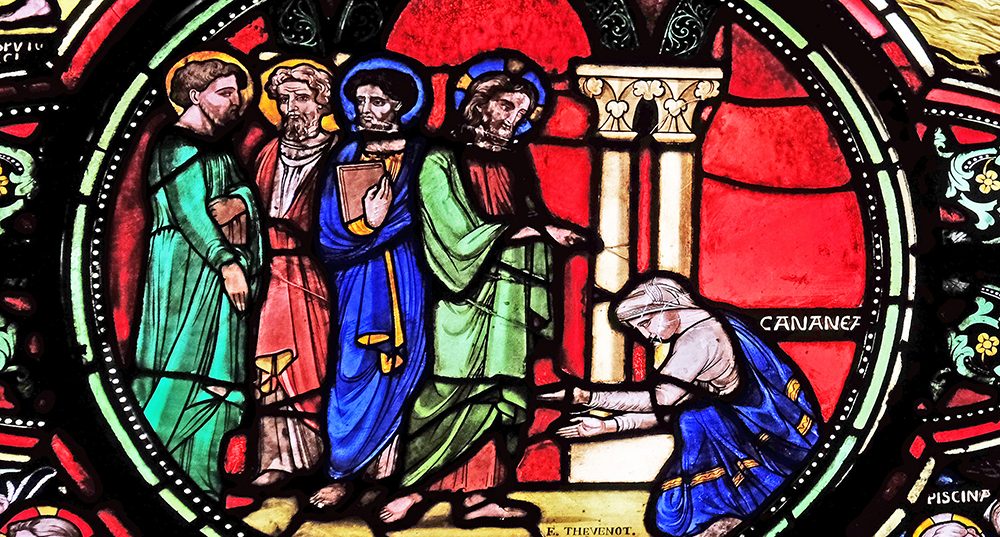
Jesus and the Canaanite woman, from Saint Germain-l’Auxerrois church in Paris, France
Sometimes the most compassionate thing we can do is not give everybody what they want, right away.
Jesus did not come to this earth to ensure everybody gets their way and stays happy so that no one is upset. In fact, Christ did quite the opposite. Jesus sought to do his father’s will by establishing the kingdom of God on this earth – teaching values that weren’t part of the religious culture, telling the most “godly” people of the time they were a brood of vipers, and generally offending a lot of people who claimed to know God.
Jesus cared enough about the woman to not immediately give her what she wanted. She had to go hard after Jesus, to keep going after him, to exercise her faith muscle.
Jesus doesn’t give the disciples what they want, either.
Two different petitions were given to Jesus, and his response doesn’t really address either one of those asking’s. He just says he was sent to the lost sheep of Israel. Yet the woman responds as if she doesn’t even hear what Jesus just said.
The chosen nation of Israel was meant by God to be a missionary people. All nations on earth are blessed through Abraham, through the Jewish people. It has always been God’s design to have the Gentiles come to faith, and the way that was to happen was through Israel being a great missionary people proclaiming God and being a light to the nations.
I tell you that Christ became a servant of the Jews to show that God has done what he promised their great ancestors. Christ also did this so that the non-Jewish people could praise God for the mercy he gives to them. The Scriptures say,
“So, I will give thanks to you among the people of other nations; I will sing praise to your name.” (Romans 15:8-9, ERV)
And that is exactly what happened. I am a Gentile Christian today because a small group of Jewish persons took the gospel of grace given them by Jesus and fulfilled their role as a missionary people.
The woman worships and tries Jesus again.
Jesus never said “no” to the woman. This was the basis for her asking again. She reasons much like an infatuated teenager who asks the girl of his affections, “so, what kind of chance do I have going out with you?” The girl responds to the teenage boy, “a million to one.” And the boy responds to her, “so, what you’re saying to me is that there’s a chance!”
Slim as the woman’s chances seem, she saw an opening where others might not. This is precisely the nature of true faith – it sees possibilities where none seem to exist.
This is raw, real, and persistent faith. If we don’t resonate with this kind of faith and persistence, there is not a sufficient level of urgency in our lives. The bald fact is: If we don’t pray, it’s because there is no desperation. We are still more fixed on law than gospel. Duty only goes so far.
Jesus still doesn’t answer the woman’s request, but gives her a metaphor about dogs, instead.
Jesus is restating what he said about the Jews: Salvation is through the Jews, not around them. We cannot ignore or get rid of the Old Testament because the gospel comes through it.
The woman still doesn’t give up but works with the metaphor.
She doesn’t argue with Jesus about being a dog; doesn’t insist she ought to be an exception; doesn’t say she has a right to be like the Jews; and doesn’t claim Jesus is being unfair or uncaring.
The woman simply accepts Christ’s words. Then, replies that even as a dog she would be allowed to receive a few crumbs from the table of the children. She might be a dog, but she’s still in the house, even if it’s under the highchair. The woman is looking for mercy as expectantly as my own dog looks at me with those sad brown eyes while I’m eating.
Jesus honors her faith.
Why? Because she humbly looked for grace. We need not write an essay to God about why our requests should be answered, as if Jesus needs convincing. We just need to seek the mercy of God.
Faith, coupled with urgency, doggedly persists. It believes Jesus will deliver. Great faith overcomes discouragement, despite the odds. It doesn’t listen to naysayers who want us to shut up and quit bothering them. Urgent prayers are an unabashed begging before Jesus because only he can help. Begging isn’t sexy. It isn’t comfortable. But it’s needed.
So, pray. Pray like it’s the only thing that will make a difference. Pray with a sense of urgency.









 Rev. Tim Ehrhardt