Romans 4:1-12 – Saved by Grace Through Faith

“Abraham Journeying to the Land of Canaan” by Giovanni Benedetto Castiglione (1609-1664); The Fitzwilliam Museum; http://www.artuk.org/artworks/abraham-journeying-to-the-land-of-canaan-5550

So how do we fit what we know of Abraham, our first father in the faith, into this new way of looking at things? If Abraham, by what he did for God, got God to approve him, he could certainly have taken credit for it. But the story we’re given is a God-story, not an Abraham-story. What we read in Scripture is, “Abraham entered into what God was doing for him, and that was the turning point. He trusted God to set him right instead of trying to be right on his own.”

If you’re a hard worker and do a good job, you deserve your pay; we don’t call your wages a gift. But if you see that the job is too big for you, that it’s something only God can do, and you trust him to do it—you could never do it for yourself no matter how hard and long you worked—well, that trusting-him-to-do-it is what gets you set right with God, by God. Sheer gift.

David confirms this way of looking at it, saying that the one who trusts God to do the putting-everything-right without insisting on having a say in it is one fortunate man:

Fortunate those whose crimes are whisked away,
    whose sins are wiped clean from the slate.
Fortunate the person against
    whom the Lord does not keep score.

Do you think for a minute that this blessing is only pronounced over those of us who keep our religious ways and are circumcised? Or do you think it possible that the blessing could be given to those who never even heard of our ways, who were never brought up in the disciplines of God? We all agree, don’t we, that it was by embracing what God did for him that Abraham was declared fit before God?

Now think: Was that declaration made before or after he was marked by the covenant rite of circumcision? That’s right, before he was marked. That means that he underwent circumcision as evidence and confirmation of what God had done long before to bring him into this acceptable standing with himself, an act of God he had embraced with his whole life.

And it means further that Abraham is father of all people who embrace what God does for them while they are still on the “outs” with God, as yet unidentified as God’s, in an “uncircumcised” condition. It is precisely these people in this condition who are called “set right by God and with God”! Abraham is also, of course, father of those who have undergone the religious rite of circumcision not just because of the ritual but because they were willing to live in the risky faith-embrace of God’s action for them, the way Abraham lived long before he was marked by circumcision. (The Message)

“Abraham Journeys Forth into the Unknown” by Yoram Raanan

We all need help. Yes, we like our independence and would rather give help than receive it. Yet, there are some things which we can do nothing about without some divine intervention. This is where faith comes into the picture.

“Faith” is a big word in Holy Scripture and in the Christian life. Faith encompasses the totality of how we come to Jesus Christ, and then how we live for him. In talking about faith, it is important to distinguish between the faith which saves us from guilt, shame, sin, death, and hell, and the faith which sanctifies and makes us holy. 

“Salvation” and “sanctification” are also big words in Scripture and in life. If we are fuzzy on our understanding and application of these two spiritual realities of salvation and sanctification, we are going to end up sleepwalking through life as spiritual zombies.

Christianity’s answer to the vital help we need for deliverance is the death and resurrection of Jesus Christ. This deliverance, or salvation, only occurs by faith. A person is “saved” by knowing about Jesus and his finished work on the cross and trusting that this work has taken care of my need for salvation, once for all. 

Christ sacrificed himself for us. He took our place. The punishment that belonged to us, he bore. When we acknowledge our lost and wayward lives, and believe Jesus is the way, the truth, and the life, then we are delivered and experience salvation from the awful emptiness of life. 

A person cannot earn this deliverance; they cannot buy it or work for it. No, salvation is a gift that comes only by faith in the person and work of Jesus. That is the essence of saving faith in Christianity. It is a one-time event of trust.

“Sanctification,” on the other hand, is what begins when becoming a believer in Jesus. The word simply means “to become holy,” or, “to be set apart for God.” Sanctification is not a singular event, but a process Christians engage in for the rest of their earthly lives. 

Whereas saving faith is a gift given to us without effort, sanctification requires a great deal of effort. We work and struggle and expend lots of energy to live the Christian life. 

“Grace [God’s gift to us in granting forgiveness] is not opposed to effort, it is opposed to earning. Earning is an attitude. Effort is an action. Grace, you know, does not just have to do with forgiveness of sins alone.” 

Dallas Willard

When a student gets a college scholarship at a university, the giving of the scholarship is a one-time event. It is granted to the student. They now possesses it and are able to attend school without trying to earn the money to pay for it. 

But that scholarship has been given for a reason – so that the student can now focus entirely on their studies and/or sport. The work has just begun. More blood, sweat, and tears will take place living into that scholarship than the student could ever imagine. It won’t be easy, and it will consume the student’s waking hours for the next four years.

Our life is a matter of faith, not of sight.

2 Corinthians 5:7, GNT

The biblical character of Abraham is Exhibit A of faith. He was delivered from an empty way of life in a pagan country and given a gift of grace to move to the country God would show him. Abraham did nothing to earn this favor. Before Abraham chose God, God chose him. 

Abraham sojourned as a pilgrim throughout the land God gave him, which mirrored his spiritual sojourning and learning to be a follower of God. Abraham likely faced the greatest test of faith a person could ever experience; he was asked to sacrifice his son. He responded to God with complete obedience.

Abraham’s faith was made complete by what he did; and it occurred well before his circumcision of being physically marked as belonging to God. 

We are made right not on our own but through the sheer grace of God in Christ by faith. Then, we continue to exercise faith by living into the righteousness given to us by the mercy of God.

God’s mercy is so abundant, and his love for us is so great, that while we were spiritually dead in our disobedience he brought us to life with Christ. It is by God’s grace that you have been saved. In our union with Christ Jesus he raised us up with him to rule with him in the heavenly world. He did this to demonstrate for all time to come the extraordinary greatness of his grace in the love he showed us in Christ Jesus. For it is by God’s grace that you have been saved through faith. It is not the result of your own efforts, but God’s gift, so that no one can boast about it.

Ephesians 2:4-9, GNT

God grants his faith scholarships to whomever he wants: rich and poor, men and women, from every race, ethnicity, and background imaginable across the entire earth. 

From the standpoint of faith, Abraham did nothing to receive God’s gracious scholarship of faith. He did not work for it. It was granted to him solely because of God’s grace. Then, his faith was confirmed and proven as genuine by his life of faith and obedience.

Therefore, our own deliverance and ability to live rightly is firmly rooted in faith – and not by holding a prominent position, having a particular pedigree, or expending personal power. All of humanity needs the saving help of Jesus Christ. Salvation is in Christ alone, by grace alone, through faith alone.

Lord Jesus Christ, I am sorry for the things I have done wrong in my life. Please forgive me. I now turn from everything that I know is wrong. Thank you that you died on the cross for me, so that I could be forgiven and set free. Thank you that you offer me forgiveness and the gift of your Spirit. I receive that gift with a grateful heart. Amen.

How Do We Start Our Ministry?

Welcome, friends! Luke 10:25-37 contains the familiar story of the Good Samaritan. It’s a parable of mercy, relationship, trust, and meeting a pressing need. It’s a story of God’s love for humanity. Click the videos below and let’s explore what it means to stop and help….

Pastor Tim Ehrhardt, Luke 10:25-37
The Maranatha Singers

God the Father, Creator of heaven and earth,
Have mercy upon us.

God the Son, Redeemer of the world,
Have mercy upon us.

God the Holy Spirit, Sanctifier of the faithful,
Have mercy upon us.

Blessed Holy Trinity, the God whom we serve,
Have mercy upon us, and grant us your peace. Amen.

Psalm 119:89-96 – Relying on the Eternal

Your word, O Lord, will last forever;
    it is eternal in heaven.
Your faithfulness endures through all the ages;
    you have set the earth in place, and it remains.
All things remain to this day because of your command,
    because they are all your servants.
If your law had not been the source of my joy,
    I would have died from my sufferings.
I will never neglect your instructions,
    because by them you have kept me alive.
I am yours—save me!
    I have tried to obey your commands.
The wicked are waiting to kill me,
    but I will meditate on your laws.
I have learned that everything has limits;
    but your commandment is perfect. (Good News Translation)

Our present life, currently in the here and now, is characterized by limitations and continual change. Whatever is up today can be down tomorrow, and vice versa. The people around us, as well as our own emotions, can be often frustratingly fickle. And our circumstances are constantly changing, not to mention our bodies and minds. For some, even their very life hangs in the balance due to either a personal enemy or the enemy of disease, disaster, or death.

In this orbit of revolving change, we are limited in our choices. We can make changes to our lifestyle that will hopefully extend the quality and quantity of life, yet every one of us will eventually die. There is decision-making we can make with our resources and finances, yet if a company closes and jobs are lost, or the market plunges and our investments tank, there is no nice seamless transition to getting back on our feet.

It might be easy to slide into discouragement, if we all we know is a domino effect of change, revolving circumstances, and an inability to influence very little of it all. Yet, there is hope because there is another side to the coin.

Although life situations change, and we experience limitations in both our choices and our abilities, there are some bedrock realities which will never change that we can bank and build our lives upon. God’s Word and God’s faithfulness are eternal; they will last forever.

Whenever it feels as if nothing is on solid ground, it is necessary to come back to the things we know which are permanent and reliable. Notice some of the unchangeable elements of God’s Word….

Love never dies. Inspired speech will be over some day; praying in tongues will end; understanding will reach its limit. We know only a portion of the truth, and what we say about God is always incomplete. But when the Complete arrives, our incompletes will be canceled.

When I was an infant at my mother’s breast, I gurgled and cooed like any infant. When I grew up, I left those infant ways for good.

We don’t yet see things clearly. We’re squinting in a fog, peering through a mist. But it won’t be long before the weather clears, and the sun shines bright! We’ll see it all then, see it all as clearly as God sees us, knowing him directly just as he knows us!

But for right now, until that completeness, we have three things to do to lead us toward that consummation: Trust steadily in God, hope unswervingly, love extravagantly. And the best of the three is love. (1 Corinthians 13:8-13, MSG)

Jesus Christ is the same yesterday, today, and forever! (Hebrews 13:8, CEB)

Notice the unchangeable nature of God’s faithfulness….

Your steadfast love, O Lord, extends to the heavens,
    your faithfulness to the clouds.
Your righteousness is like the mighty mountains,
    your judgments are like the great deep;
    you save humans and animals alike, O Lord. (Psalm 35:5-6, NRSV)

This saying is reliable:

“If we have died together, we will also live together.
        If we endure, we will also rule together.
        If we deny him, he will also deny us.
If we are disloyal, he stays faithful”
    because he can’t be anything else than what he is. (2 Timothy 2:11-13, CEB)

It is possible to have peace smack in the middle of hardship and adversity. Racing thoughts do not need to be a given experience whenever there are those who oppose us or give us grief. Relying upon God’s Holy Word is the very ballast and rock we need. It will never fail nor pass away….

Just thinking of my troubles
and my lonely wandering
    makes me miserable.
That’s all I ever think about,
    and I am depressed.
Then I remember something
    that fills me with hope.
The Lord’s kindness never fails!
If he had not been merciful,
    we would have been destroyed.
The Lord can always be trusted
    to show mercy each morning.
Deep in my heart I say,
“The Lord is all I need;
    I can depend on him!”

The Lord is kind to everyone
    who trusts and obeys him.
It is good to wait patiently
    for the Lord to save us. (Lamentations 3:19-26, CEV)

This present life with all its change, limitations, and transience can and will give way to that which is permanent, unending, timeless, immortal, imperishable, and indestructible.

Praise be to the God and Father of our Lord Jesus Christ! In his great mercy he has given us new birth into a living hope through the resurrection of Jesus Christ from the dead, and into an inheritance that can never perish, spoil or fade. (1 Peter 1:3-4, NIV)

May you know the joy and peace of relying upon the eternal and changeless reality of God.

Our God and Father, thank you that in a world of despair that you are our hope. In a world of darkness, you are our light. In a world of sorrow, you are our joy. Help us to strengthen and encourage one another with your eternal faithfulness and steadfast love, through Jesus Christ our Lord. Amen.

Psalm 145 – Some Solid Robust Theology

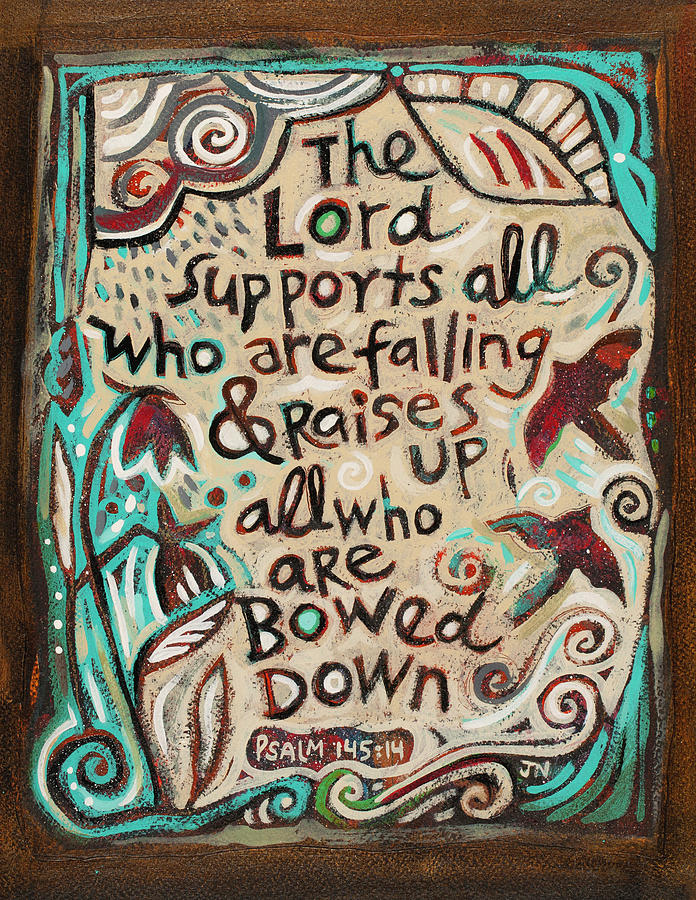
Psalm 145:14 by Jen Norton

I will praise you,
my God and King,
    and always honor your name.
I will praise you each day
    and always honor your name.
You are wonderful, Lord,
    and you deserve all praise,
because you are much greater
    than anyone can understand.

Each generation will announce
to the next
    your wonderful
    and powerful deeds.
I will keep thinking about
your marvelous glory
    and your mighty miracles.
Everyone will talk about
    your fearsome deeds,
    and I will tell all nations
    how great you are.
They will celebrate and sing
    about your matchless mercy
    and your power to save.

You are merciful, Lord!
    You are kind and patient
    and always loving.
You are good to everyone,
    and you take care
    of all your creation.

All creation will thank you,
    and your loyal people
    will praise you.
They will tell about
    your marvelous kingdom
    and your power.
Then everyone will know about
    the mighty things you do
    and your glorious kingdom.
Your kingdom will never end,
    and you will rule forever.

Our Lord, you keep your word
    and do everything you say.
When someone stumbles or falls,
    you give a helping hand.
Everyone depends on you,
and when the time is right,
    you provide them with food.
By your own hand
    you satisfy
    the desires of all who live.

Our Lord, everything you do
    is kind and thoughtful,
    and you are near to everyone
    whose prayers are sincere.
You satisfy the desires
    of all your worshipers,
    and you come to save them
    when they ask for help.
You take care of everyone
who loves you,
    but you destroy the wicked.

I will praise you, Lord,
    and everyone will respect
    your holy name forever. (Contemporary English Version)

These days, everywhere I go there is high anxiety, even downright fear. In my city, the highest murder rate in its history marked the past year. In the hospital for which I am the chaplain, the coronavirus with all its deathly strains is bringing grief and bereavement to many families. Within many churches, their future viability is in question, and parishioners wonder about the future.

When there seems to be no light at the end of the tunnel, with apprehension and stress as the very air we breathe, there is an angle to the whole situation the psalmist wants us to consider. We are to give weight and consideration to some solid robust theology.

Everyone has a theology. All persons have some sort of understanding of a god, G-d, or no god at all. In the hard circumstances of life, it might seem as if our theology isn’t serving us well. We may feel as if G-d is aloof, distant, or just plain disinterested. So, let’s pay attention to the psalmist. Notice his theology….

The Lord saves… is merciful… powerful… kind… patient… loving… and good. G-d keeps divine promises… helps… gives… provides… protects… and is near to those who humbly seek the divine. In short, the Lord cares for all creation and all creatures, including you and me, and tackles injustice like a hefty linebacker on a string-bean running back.

Yes, G-d deserves all praise, glory, and honor because standing behind all the anxiety of the age is a very large deity who acts with good purpose.

Let this psalm (and the entire psalter) buoy you up with good solid theology because the Lord is righteous in all dealings and is present to all who call for help. G-d hears. G-d responds. Perhaps neither according to our idea of timeliness nor to our expectation. Yet, deliverance is at hand, even if it comes in a form different than we were anticipating.

I am taking time to read today’s psalm several times over, to let it awash my soul with significant doses of truth and mercy. There are simply times when all of us need to remember and be reminded that there is a G-d in heaven who is willing and able, as well as a friend close at hand. 

True human satisfaction does not come through personal ingenuity or accumulation of more knowledge or more stuff.  Rather, our deepest desires and needs are fulfilled in the G-d who cares.

Anxiety, stress, fear, and apprehension don’t simply melt away. We, like the psalmist, need to practice the active verbs within the text: I will praise you… I will always honor your name… I will keep thinking about your marvelous glory and miracles… I will tell all nations how great you are… because the Lord saves and satisfies.

May that be your experience today, and every day.

Mighty G-d, you are both far and near, totally above us, yet close at hand.  Preserve me with your mighty power so that I might not fall into sin, nor be overcome by adversity. But in all I do direct me to the fulfilling of your purposes through Jesus Christ, my Lord.  Amen.