Psalm 139:1-6, 13-18 – Known and Loved by God

The Inescapable God by Mike Moyers

You have looked deep
into my heart, Lord,
    and you know all about me.
You know when I am resting
    or when I am working,
and from heaven
    you discover my thoughts.

You notice everything I do
    and everywhere I go.
Before I even speak a word,
    you know what I will say,
and with your powerful arm
you protect me
    from every side.
I can’t understand all of this!
Such wonderful knowledge
    is far above me….

You are the one
who put me together
    inside my mother’s body,
and I praise you because of
the wonderful way
    you created me.
Everything you do is marvelous!
    Of this I have no doubt.

Nothing about me
    is hidden from you!
I was secretly woven together
    out of human sight,
but with your own eyes you saw
    my body being formed.
Even before I was born,
you had written in your book
    everything about me.

Your thoughts are far beyond
    my understanding,
much more than I
    could ever imagine.
I try to count your thoughts,
but they outnumber the grains
    of sand on the beach.
And when I awake,
    I will find you nearby. (Contemporary English Version)

Many people struggle with their basic self-image. And it’s no wonder why.

Beautiful people reign over the television and the movies; the rich and powerful are highlighted in the media; and those with perfect teeth and immaculate attire are splashed in front of us in the daily barrage of advertisements. 

Meanwhile, the rest of us 99% of the population, quickly notice we do not measure up to such a high standard. You don’t have to be a people watcher to know that less than perfect bodies are the norm and that most folks do not have a budget to live like the other 1% humanity.

If we make comparisons with others too much and for too long, it gets downright depressing. Yet, into this dark abyss of one’s self-image enters the biblical truth that each one of us, no matter our station in life, was personally hand-crafted by a heavenly Being who loves us dearly.

We are indeed fearfully and wonderfully made. The Creator took great care to make us and form us just so. 

The real standard from which we ought to judge ourselves is this: God knows us intimately, inside-and-out, and neither condemns us nor shames us but loves us wholly.

So then, rather than wasting our emotional energy and mental faculties on wishing we looked different or were more like so-and-so who seems to always have it all together, try practicing what the psalmist David did: Praise God. 

Whenever we have the notion that we do not measure up to our imposed arbitrary standard, keep in mind that the only real measurement is grace. No matter who we are, the entire race of humanity has been created in the image of God, and, on that basis alone, we have inherent value, worth, and majesty. Let us, then, treat ourselves and others with the yardstick of grace.

The inner critic, that is, the inner judgmental dialogue we have with ourselves, needs to be replaced with the truth of Psalm 139. Although we might be rather hard on ourselves and say things in the reclusive parts of our minds and hearts that we would never say to others, nor tolerate others saying about someone else – God speaks to us with tender words of grace.

Perhaps you think that only you know the depth of your own sorrows, hurts, fears, insecurities, and worries. Except… God. The Lord knows it all intimately – and is not one bit repulsed. 

You see, God knows that the answer to all the self-doubts is Divine care and protection. You and I have the freedom to plumb the recesses of our hearts and souls – to bring out all that is inside the cluttered closet of our minds and lay it on the table without fear of God calling you what you call yourself.

Therefore, please do not quickly pass over the inspired words from Holy Scripture contained in today’s psalm. Take the time to carefully digest each phrase slowly so that the message becomes internalized and believed in real-time experience.

One of the theories of human psychology is that people are driven by two primary needs: 

  1. To intimately know another person.
  2. To be intimately known by another person. 

God knows us even better than we know ourselves – and still loves us! There is nothing we learn about ourselves that God does not already know. No human relationship can even come close to the level of knowing that God has for us and about us.

To know God is perhaps the greatest and highest pursuit we could ever enjoy. God is so immense and infinite that we will spend an eternity getting to know the Lord and will never get to the end of it. That is the kind of God we serve. 

Be encouraged today and always with the reality that you are known, and can know, God – and even more, loved deeply as a specially fashioned creature.

O God, thank you that I am wonderfully made in your likeness. I praise you that I am fully accepted, even when I do not accept myself. In Jesus Christ you have demonstrated the height of your love and mercy. May this grace be with me every day so that I will conduct myself in a manner worthy of being part of the human family. Amen.

Psalm 58 – Curse the Wicked

Do you rulers indeed speak justly?
    Do you judge people with equity?
No, in your heart you devise injustice,
    and your hands mete out violence on the earth.

Even from birth the wicked go astray;
    from the womb they are wayward, spreading lies.
Their venom is like the venom of a snake,
    like that of a cobra that has stopped its ears,
that will not heed the tune of the charmer,
    however skillful the enchanter may be.

Break the teeth in their mouths, O God;
    Lord, tear out the fangs of those lions!
Let them vanish like water that flows away;
    when they draw the bow, let their arrows fall short.
May they be like a slug that melts away as it moves along,
    like a stillborn child that never sees the sun.

Before your pots can feel the heat of the thorns—
    whether they be green or dry—the wicked will be swept away.
The righteous will be glad when they are avenged,
    when they dip their feet in the blood of the wicked.
Then people will say,
    “Surely the righteous still are rewarded;
    surely there is a God who judges the earth.” (New International Version)

The term “imprecatory” means to call down a curse on a person or group of people. There are eighteen imprecatory psalms within the Old Testament psalter, all of which make a clear petition for God to turn the evil back on the people who inflict it (or try to) on others. Maybe this surprises you that there is such language in the Bible.

There is nothing sanitized about imprecatory psalms. They are as raw and real as it gets, expressing deep anger. Whatever you might think about how a proper pious person ought to pray, imprecatory curses are likely not your first thought. But here they are, contained in Holy Scripture for our use.

One reason for the imprecatory psalms is that it is not any person’s place for revenge or retaliation. Instead, for people who are genuinely caught in the crosshairs of evil, for those who have awful trouble dogging them, prayer is their most effective recourse.

Sometimes you just have to tell it like it is. There is a time to do your best in putting up a good face so that you can deal with people who keep gossiping, slandering, and trying to get their way. Yet, there is also a time to call such behavior “evil” and cry out to God for help.

There are many folks who consider imprecatory psalms a problem because of their detailed expressions of cursing. Yet, such psalms refuse to put a positive spin on malevolent motives, wicked words, and destructive actions.

Desperate people utter desperate prayers. Their unflinching sense of injustice will not allow them to sugarcoat the villainous plans of corrupt people.

Evil is never toppled with tepid prayers from wimpy worshipers. Rather, nefarious agendas are thwarted in the teeth of specific, focused, and intense prayers directed with spiritual precision to the very core of diabolical forces.

We need not be shy about being real with God, even with praying imprecatory prayers. There really are people in this world, maybe even in your own life, that have malicious intent against you or others. Our job is not personal revenge, but to entrust ourselves to the God who fights for the poor, the oppressed, and the needy against the arrogant and the powerful. Let your prayers reflect your life.

With no cursing of evil, our emotional pain and spiritual anger come out sideways in an unkind sort of “snarky-ness” toward each other. What I am proposing is that our terrible hurt and our rage needs to be acknowledged and voiced.

Our bitterness must have an outlet, not directed toward one another, but toward the evil itself – and even toward God because God is big enough to handle our rage, whereas other humans are not.

Victimization needs a voice, and a bit of raging and cursing is the means to do it. Giving voice to our deep anger is cathartic and therapeutic. Our speech needs to be congruent with the intensity of our pain because where there are no valued words of assault for victims, the risk of hurting each other becomes much higher.

Despair with no voice and no one to hear will eventually transition to harming others.

Spiritual problems require spiritual implements to solve. And the imprecatory psalms are a major tool for pushing back the dark forces of this world. They are a significant means of spiritual assertiveness against heinous acts, acerbic words, systemic evil, depraved people, and horrible circumstances.

God’s wrath is an expression of God’s love because God is not okay with evil taking root in the lives and institutions of humanity.

Prayer is our privilege of coming to the God who upholds justice and righteousness. For if God is for us, who can be against us?

1 Peter 3:8-12 – Bless and Do Not Curse

Ethiopian artist depiction of Jesus teaching on love

Finally, all of you be harmonious, sympathetic, affectionate, compassionate, and humble. Do not return evil for evil or insult for insult, but instead bless others because you were called to inherit a blessing. For

The one who wants to love life and see good days must keep his tongue from evil and his lips from uttering deceit.
And he must turn away from evil and do good;
he must seek peace and pursue it.
For the eyes of the Lord are upon the righteous and his ears are open to their prayer.
But the Lord’s face is against those who do evil.
(New English Version)

It’s one thing to bestow a blessing to folks when they seem worthy of it – but it’s quite another thing when you have stinkers in your life. Bless the very ones who are abusive toward me? Some might think the Apostle Peter was off his rocker to instruct believers to bless the insufferable persons in their lives.

Peter, however, was only passing on what he had learned from the Lord Jesus:

“You have heard that it was said: You must love your neighbor and hate your enemy. But I say to you, love your enemies and pray for those who harass you so that you will be acting as children of your Father who is in heaven. He makes the sun rise on both the evil and the good and sends rain on both the righteous and the unrighteous. 

If you love only those who love you, what reward do you have? Don’t even the tax collectors do the same? And if you greet only your brothers and sisters, what more are you doing? Don’t even the Gentiles do the same? Therefore, just as your heavenly Father is complete in showing love to everyone, so also you must be complete. (Matthew 5:43-48, CEB)

The instruction to bless the hateful ingrates in our lives only seems strange when the avoidance of suffering and experiencing a pain-free existence is the summum bonum of life.

I get it. We don’t like to suffer. I don’t like to suffer. It hurts! I’m not really into pain. I’m not a high tolerance pain kind of guy. I have no problem taking a pain pill at the first sign of discomfort. Even so, I know there will be times I am going to have pain – physical, mental, emotional, and spiritual – and there is going to be no way around it. 

To live in this broken world is to experience suffering. To suffer as a Christian, however, is different because we are following the way of our Lord Jesus Christ.

Just as Christ suffered, we can expect to suffer as his followers, as well. We are not above our Master. The real issue is whether we will suffer because of our own foolishness and selfishness, or because of our devotion to Christ in being kind, humble, and gracious. 

When insults come our way, we don’t need to respond in the same way with our own insults. Verbal cruelty is not the way of Christ. Anger, slander, gossip, lies, manipulative words, and belligerent bullying have absolutely no place in the kingdom of God for any reason. 

God takes a zero-tolerance policy toward hate speech, manipulation, and gaslighting.

The consistent witness of the New Testament is to bless and do not curse, to love and not to hate, to use our tongues for spreading words of encouragement and not of condemnation. Peter’s instruction and Christ’s teaching also totally jives with the Apostle Paul:

The Apostle Paul also learned from the Lord Jesus and upholds the need to bless and not curse:

Bless those who persecute you; bless and do not curse…. Live in harmony with one another…. Do not repay anyone evil for evil. Be careful to do what is right in the eyes of everyone. If it is possible, as far as it depends on you, live at peace with everyone. 

Do not take revenge, my dear friends, but leave room for God’s wrath, for it is written: “It is mine to avenge; I will repay,” says the Lord. On the contrary:

“If your enemy is hungry, feed him;
    if he is thirsty, give him something to drink.
In doing this, you will heap burning coals on his head.”

Do not be overcome by evil but overcome evil with good. (Romans 12:14-21, NIV)

Christians are to us their words for blessing, not cursing; for love, not hate; for truth, not lies; for building-up, not tearing-down; for proclaiming good news, not bad news laced with insults. 

If we suffer because of love, we shall receive blessing from God. If we suffer for giving-in to retaliation and our base desires for revenge, then we will suffer the consequences of our own stupidity.

God has called us to bless the world, not condemn it. 

Christians are to be on the front lines of spreading respect, civility, kindness, and the gospel. It is no problem showing love and respect to people we like. It’s a whole other ballgame to do the same for those who treat us with disrespect and hate.

Yet, God watches over all who obey him, and listens to their prayers. God will handle the hate-filled person; that’s not something we are to do.

Our task is to have a deep concern for humanity, both the ones we like, as well as the ones we don’t.

Loving Lord Jesus, you suffered and died on my behalf. It is a small thing for me to follow you and walk in the way of suffering. I know and have the confident expectation that blessing awaits. Keep me true to following you through all the adversity I face in this fallen broken world. Even so, come Lord Jesus, you who lives and reigns with the Father and the Spirit, one God, now and forever. Amen.

Isaiah 24:1-13 – Dehumanization Pollutes the Earth

The Lord is going to turn the earth into a desolate wasteland.
He will mar the face of the earth and scatter the people living on it.
The same will happen to people and priests,
male slaves and masters,
female slaves and masters,
buyers and sellers,
lenders and borrowers,
debtors and creditors.
The earth will be completely laid waste and stripped
because the Lord has spoken.

The earth dries up and withers.
The world wastes away and withers.
The great leaders of the earth waste away.

The earth is polluted by those who live on it
because they’ve disobeyed the Lord’s teachings,
violated his laws,
and rejected the everlasting promise.
That is why a curse devours the earth,
and its people are punished for their guilt.
That is why those who live on the earth are burned up,
and only a few people are left.

New wine dries up, and grapevines waste away.
All happy people groan.
Joyful tambourine music stops.
Noisy celebrations cease.
Joyful harp music stops.
People no longer drink wine when they sing.
Liquor tastes bad to its drinkers.
The ruined city lies desolate.
The entrance to every house is barred shut.
People in the streets call for wine.
All joy passes away,
and the earth’s happiness is banished.
The city is left in ruins.
Its gate is battered to pieces.

That is the way it will be on earth among the nations.
They will be like an olive tree which has been shaken
or like what’s left after the grape harvest. (God’s Word Translation)

A lot of people shy away from biblical passages, like today’s Old Testament lesson from Isaiah. Too negative, not enough positivity.

Like it, or not, Isaiah 24, along with many other texts of a similar vein, exist in Holy Scripture. And I insist we must pay attention to such texts of doom and gloom. For if we only choose to deal with the encouraging and inspirational texts of the Bible, we will have a severely truncated faith which will not stand in the hard times.

The voice I offer, however, isn’t a beat-you-up tone. I seek to have a pastoral voice that upholds the best of biblical ethics and human dignity. 

Because every person (and I do mean every person) on planet earth is created in the image and likeness of God, each individual human being is a person of worth and deserves respect and kindness.

People do and say terrible things every day. Because of that reality, it doesn’t mean God’s image has left or taken a vacation, or that someone deserves a pejorative label which stigmatizes and ostracizes them from the human family. 

For the Christian, the supreme ethic of life is love. We hold to the Great Commandment: Love God and love neighbor. All other commands of Holy Scripture hang on the commands to love, upheld by Jesus himself.

Jesus answered, “‘Love the Lord your God with all your heart, with all your soul, and with all your mind.’ This is the greatest and the most important commandment. The second most important commandment is like it: ‘Love your neighbor as you love yourself.’ The whole Law of Moses and the teachings of the prophets depend on these two commandments.” (Matthew 22:37-40, GNT)

It is because of the presence of God and Love that difficult biblical texts occur in Scripture. When people, in God’s image, defile that image through oppressing fellow image-bearers and turning from commands to live ethically and lovingly in the world, God has something to say about it. And we get texts like today’s from the prophet Isaiah.

Therefore, we must all ask ourselves if we are loving others in this world as intended by our Creator and Redeemer. 

We routinely hear, through social media posts, political pundits, religious prognosticators, and daily interactions around the water cooler, opinions laced with profound hate, disrespect, and misunderstanding.

Whenever disasters occur – whether yet another act of gun violence, a natural calamity, or economic ruin – there are a host of stories which surround them all. Some of those stories are heartwarming tales of people rushing in to bring comfort, solace, and support. And there are far too many stories of abject fear, ignorance, and calloused behavior directed at others, even victims, with selfish and misguided tools of wrath.

There is such a constellation of issues and problems to unpack and deal with in this world that I do not nor cannot even begin to try to do such a task. I only want to bring a small bit of light to the shadows of the human heart which inevitably tries to dehumanize others who do not agree with his/her opinion and group-think.

For example, there is no lack of people who persist in dehumanizing LGBTQ individuals and gay communities.  One man told me recently, in a matter-of-fact manner, that the Orlando, Florida shooting from 2016 was most likely a judgment from God upon homosexuals because of our government’s straying from godliness. 

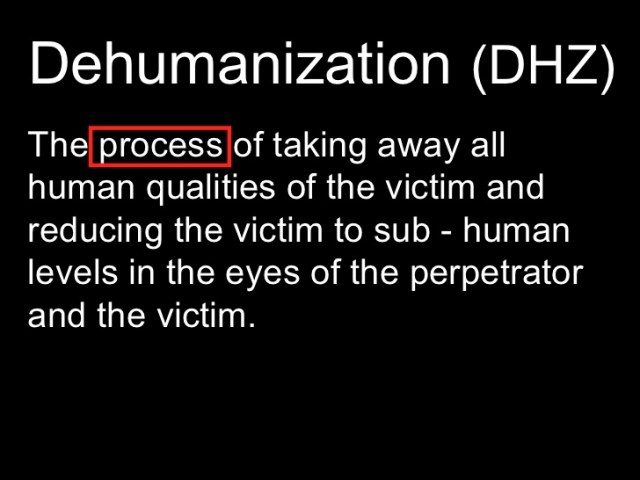
Those in LGBTQ circles are quite familiar with this kind of speech. To label it correctly: It is hate speech – dehumanizing speech – the kind of attitude and talk which pollutes the world and raises the hackles of a holy and loving God. 

When people of any particular kind of group, whether gay or straight, Democrat or Republican, Christian or non-Christian, are verbally (and actually) mowed-down like animals, it is because they are being looked at as nothing but animals, or monsters, or anything but a human being.

The apple does not fall far from the tree of the knowledge of good and evil.

We must come to grips with the fact that every person killed on this planet is a destruction of God’s image. And we are not the judges of whether any loss of life is God’s judgment, or not. To make any sort of claim to knowing this is, at best, extreme hubris, and, at worst, germinating the seeds of a future holocaust of killing. 

Whenever any one person or group places a superimposed label upon another person or subculture of people of being monstrous, hateful, and undeserving of justice, then that person or group must come to grips with their own poverty of spirit and embrace the real love which Jesus has demonstrated and offers. And, if they don’t, they ought not be surprised when their tree gets shaken by God, or even cut down and thrown into the fire.

No matter what side one falls on, there is no biblical precedent or place to dehumanize another person or group of people, period. 

Christians and churches, especially, need to stop acting and reacting to the parts of culture and society they don’t like and start living and loving like Jesus by building relationships with a broad spectrum of groups and individuals.

It falls to the faith communities of this land to initiate love and to live above hate speech. And the onus is on Christians to model a supremely loving ethic toward all people.

I admit that many Christians do not have a good track record on this. And I further admit that I have observed an eerie silence from far too many of them in the face of great human tragedy, as if nothing of particular consequence has happened. 

This post is a very small and meager attempt on my part to offer something of the loving Christ to others. For, the church is nothing at all, if it isn’t all about Jesus and his gospel of grace.

Gracious Father, lead us from death to life, from falsehood to truth, from despair to hope, from fear to trust. Let peace fill our hearts and our world. Let us dream together, pray together and work together, to build one world of peace and justice for all, through the One who made peace possible, Jesus Christ, your Son, our Lord, who with you and the Holy Spirit reign as one God, now and forever. Amen.