Holy Saturday (Psalm 31:1-4, 15-16)

In you, O Lord, I seek refuge;
    do not let me ever be put to shame;
    in your righteousness deliver me.
Incline your ear to me;
    rescue me speedily.
Be a rock of refuge for me,
    a strong fortress to save me.

You are indeed my rock and my fortress;
    for your name’s sake lead me and guide me;
take me out of the net that is hidden for me,
    for you are my refuge….

My times are in your hand;
    deliver me from the hand of my enemies and persecutors.
Let your face shine upon your servant;
    save me in your steadfast love. (New Revised Standard Version)

Holy Saturday is a quiet place sandwiched between the ignominy of the Cross and the celebration of Resurrection – a day of solitude, silence, and stillness. 

This isn’t a particularly popular day. People don’t rave about Holy Saturday. Many Christians haven’t even a thought that this day could have any significance. Yet, this very day has its place in the scheme of the Christian life.

Whenever Christians quickly jump to triumphal language about victory, and speak little-to-nothing about suffering, then we are left with a cheap grace which has been purchased with the counterfeit currency of velocity. 

Today is meant for us to get of our heads and wrap our hearts around the important reality that Jesus Christ was truly and bodily dead in the grave. 

It was real suffering on Good Friday, and it’s a real death on Holy Saturday. There’s no movement. All is silent and still. Jesus is in the solitude of a dark graveyard tomb. 

There’s no getting around this: If we want Resurrection Day with all its celebration and glory, then we cannot circumvent Holy Saturday with its quiet silence and somber sadness. 

Holy Saturday must be observed if we are to experience real and practical freedom from the bondage of shame. And shame is powerful. It keeps a person locked within themselves, alone with their secrets hidden far from others.

Far too often we may try and cope with our shameful words or actions through promising to work harder, pledging to have greater willpower, or complaining that life is unfair. None of this gets to the root of our shame.

Unlike guilt, which our conscience identifies as specific behaviors to repent of, shame is the message of our inner critic who obnoxiously decries that we are somehow flawed, not enough, and inherently lacking intelligence, courage, or volition.

Shame is the insidious mechanism which interprets bad events we experience as the result of our own badness. In other words, we didn’t just do something bad – we ourselves are bad. We reason (wrongly) that if we were good, bad things wouldn’t happen to us.

If that were true, we would need a serious re-interpretation of Jesus, who suffered terribly and was killed. In actuality, he’s lying in a cold grave because of the power of evil in the world, and not because he was personally culpable.

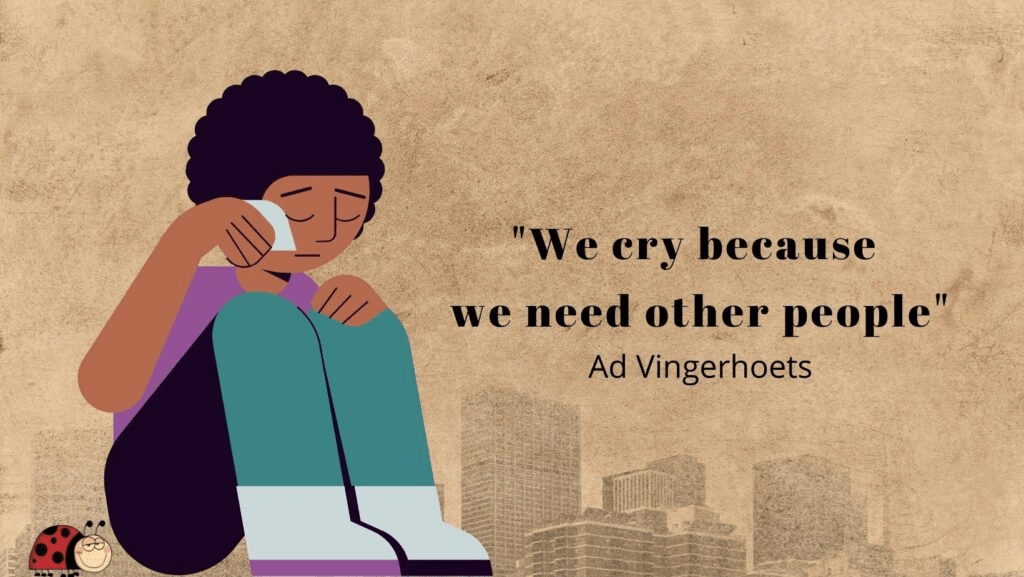
Shame is the vampire who lives in the shadows and feeds on secrets – which is why the posture of shame is to hide our face in our hands. If shame persists, we withdraw from others and experience grinding loneliness. 

Therefore, the path out of shame is to openly name our shame and tell our stories, that is, nailing the stake of vulnerability into the heart of shame, and exposing it to the light, causes it to disintegrate and vaporize.

In contrast to the unhealthy hiding of ourselves within prison walls of shame is seeking refuge and hiding ourselves in God. Even a cursory look at today’s psalm evidences an open and vulnerable person who wants nothing to do with shame. The psalmist unabashedly and without shame is quite forward in presenting his wants to God.

The psalms are meant for repeated use, to be voiced aloud again and again. In doing this simple activity, we shame-proof our lives. God’s face shines upon us and takes away the shadows of shame. It is no coincidence that Jesus forsook the shame of the cross through publicly uttering the words of this psalm: “Into your hands I commit my spirit.” (Luke 23:46)

Unchecked verbal violence will eventually lead to physical violence.

If wordy persecution comes from others, the primary tactic will most likely be shaming the people such persons want to control. Such enemies will frame a justification for violence because the people for whom they are leveling shame are “bad,” even “monsters.” If verbal persecution comes from within, the shame can reach a critical mass of suicidal ideation and perhaps outright attempts at ending one’s life.

We cannot long co-exist with the living death of shame. But the good news is that we don’t have to. Instead, we can live in the strong fortress and the rock of refuge which is God.

The Lord traffics in redeeming mercy and steadfast love, not in the demeaning judgment of shame. We can flee to God and find grace to help us in our time of need. There is no shame in reaching out for help. We all need deliverance from something. It’s a matter of whether we are open to ask for it, or not.

Holy Saturday is here for you to know that Jesus Christ absorbed all of the world’s massive shame, yesterday, on Good Friday. Christ died. And the shame he took on, died with him. It’s no more and will rise no more.

But someone will rise….

Father God, into your hands I commit my spirit – everything I am and all that I hope to be – so that Jesus Christ might be exalted in me through the power of your Holy Spirit. I choose to leave shame where it belongs – nailed to the cross. With your divine enablement, I shall walk in the newness of life through expressing my needs and wants with courage, confidence, and candor. May it be so according to your steadfast love. Amen.

Maundy Thursday (Psalm 116:1-2, 12-19)

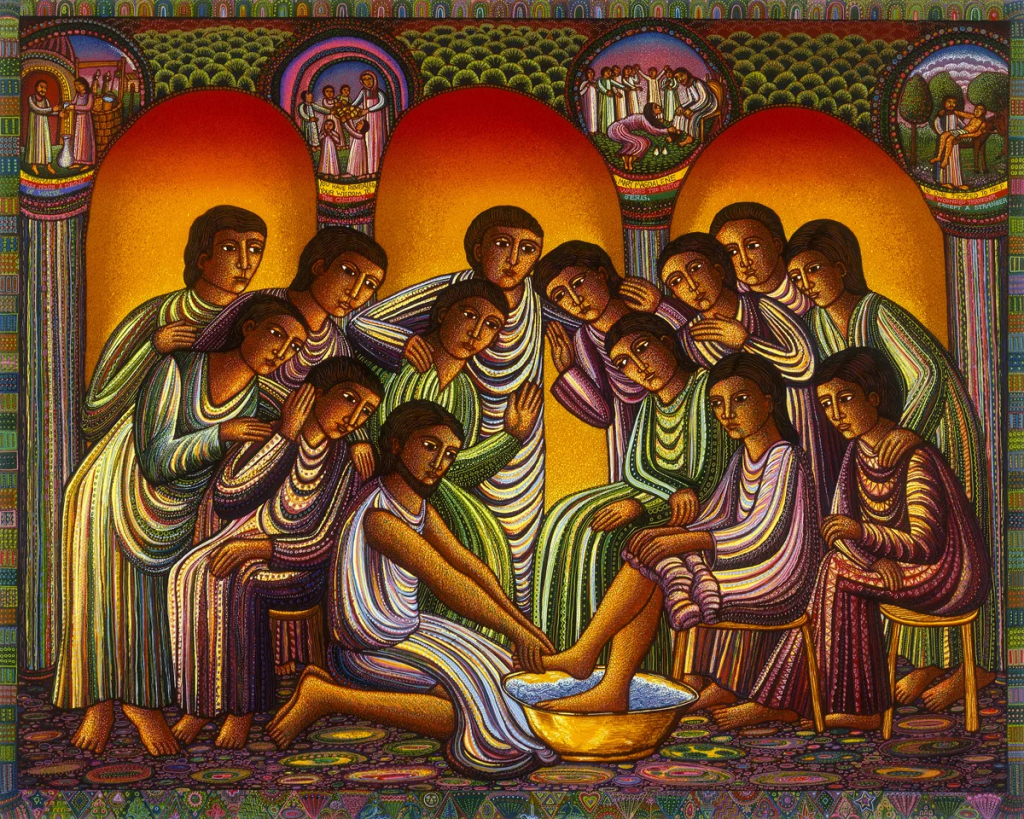
Washing of the Feet, by John August Swanson, 2000

I love the Lord because he has heard
    my voice and my supplications.
Because he inclined his ear to me,
    therefore I will call on him as long as I live….

What shall I return to the Lord
    for all his bounty to me?
I will lift up the cup of salvation
    and call on the name of the Lord;
I will pay my vows to the Lord
    in the presence of all his people.
Precious in the sight of the Lord
    is the death of his faithful ones.
O Lord, I am your servant;
    I am your servant, the child of your serving girl.
    You have loosed my bonds.
I will offer to you a thanksgiving sacrifice
    and call on the name of the Lord.
I will pay my vows to the Lord
    in the presence of all his people,
in the courts of the house of the Lord,
    in your midst, O Jerusalem.
Praise the Lord! (New Revised Standard Version)

“Pain and suffering have come into your life, but remember pain, sorrow, suffering are but the kiss of Jesus — a sign that you have come so close to Him that He can kiss you.”

Mother St. Térèsa of Calcutta (1910-1997)

There is more to the passion of Christ than sheer suffering and sorrow; the Via Dolorosa is, paradoxically, also the road to joy.

Yes, suffering is painful and unpleasant. Yet, since we all must suffer in some way, the real issue is whether our suffering is meaningless or has purpose to it. We are able to bear our suffering if we are confident that a redemptive outcome is at the end of it.

The Lord Jesus submitted to suffering because he knew that all the mockery, torture, and abuse was the pathway to deliverance for humanity.

Because of the joy awaiting him, he endured the cross, disregarding its shame. Now he is seated in the place of honor beside God’s throne. Think of all the hostility he endured from sinful people; then you won’t become weary and give up. (Hebrews 12:2-3, NLT)

Since Jesus has gone before us, enduring shame so that it could be put to death in us, we are able to live free from guilt and the ignominy of sin. What’s more, Christ’s suffering gives shape and meaning to our own suffering.

“I cannot but wonder at the virtue that lies in suffering; we are worth nothing without the cross. I tremble and am in an agony while it lasts, and all my conviction of its salutary effects vanish under the torture, but when it is over, I look back at it with admiration, and am ashamed that I bore it so ill.”

François Fénelon (1651-1715)

On this Maundy Thursday, we remember that in the midst of suffering there is the hope of glory, and in the center of pain there is the confident expectation that it will be used as the fertilizer to help love grow and bloom in the dormant places of this world.

“Love proves itself by deeds, so how am I to show my love? Great deeds have forbidden me. The only way I can prove my love is by scattering flowers and these flowers are every little sacrifice, every glance and word, and the doing of the least actions for love.”

St. Thérèse of Lisieux (1873-1897)

There cannot be love without suffering; to love is to sacrifice on behalf of another.

Because we live in a broken world full of pride and hubris, greed and avarice, hate and envy, we are victims of loveless systems and unjust actions. We need love to rescue and redeem us from the sheer muck of existential guilt and shame, evil and injustice.

Christians around the world are journeying through Holy Week, the most sacred time of the year for followers of Christ. When we think about Holy Week, we are familiar with Good Friday and certainly Easter, but Maundy Thursday? 

On this day, the Church remembers the final evening Jesus shared with his disciples in the upper room before his arrest and crucifixion. The experiences in the upper room were highly significant because this was the last teaching, modeling, and instruction Jesus gave before facing the cross. Jesus was careful and deliberate to communicate exactly what was important to him: to love one another.

“A new command I give you: Love one another. As I have loved you, so you must love one another.  By this everyone will know that you are my disciples if you love one another.” (John 13:34-35, NIV)

Maundy Thursday marks three important events in Christ’s Last Supper with his disciples: 

  1. The washing of the disciples’ feet (the action of loving service)
  2. The instituting of the Lord’s Supper (the remembrance of loving sacrifice)
  3. The giving of a “new” commandment to love one another (the mandate of a loving lifestyle)

The message of Maundy Thursday is this: Jesus Christ loves me just as I am, and not as I should be. He loves me even with my dirty stinky feet, my herky-jerky commitment to him, and my pre-meditated sin. 

Today is a highly significant day on the Church Calendar and in the Christian Year – one which deserves to be observed, and an opportunity to remember the important words and actions of Jesus on our behalf. Through Jesus Christ we are to live always in love, modeling our life and ministry after him. 

“I have found the paradox that if I love until it hurts, then there is no hurt, but only more love.”

Mother Térèsa

In Christ, love is to characterize our life together as we proclaim God’s love in both word and deed. A watching world will take notice and desire to lay down their hate and animosity if the followers of Christ are deeply and profoundly centered in the love of God.

God our Father, you invite us to participate in the life, suffering, death, and resurrection of your Son. Inspire us by his service, and unite us in his love; who lives and reigns with you, in the unity of the Holy Spirit, one God, now and forever. Amen.

How Can the World Change? (Philippians 1:21-30)

For to me, living is Christ and dying is gain. If I am to live in the flesh, that means fruitful labor for me, yet I cannot say which I will choose. I am hard pressed between the two: my desire is to depart and be with Christ, for that is far better, but to remain in the flesh is more necessary for you. Since I am convinced of this, I know that I will remain and continue with all of you for your progress and joy in faith, so that, by my presence again with you, your boast might abound in Christ Jesus because of me.

Only, live your life in a manner worthy of the gospel of Christ, so that, whether I come and see you or am absent and hear about you, I will know that you are standing firm in one spirit, striving side by side with one mind for the faith of the gospel and in no way frightened by those opposing you. For them, this is evidence of their destruction but of your salvation. And this is God’s doing. For he has graciously granted you the privilege not only of believing in Christ but of suffering for him as well, since you are having the same struggle that you saw I had and now hear that I still have. (New Revised Standard Version)

I believe that one of the greatest tragedies of this contemporary age is that millions of people suffer in silence, alone, with nobody knowing what they’re going through. Countless others cry by themselves, even in public. It’s as if someone who is suffering or sad is a pariah whom we cannot get close to.

It is not supposed to be this way. Suffering by oneself is a tragedy. Suffering with others is a privilege. We are not only meant to be one in spirit when things are going well and it’s a joyous occasion; we’re also to maintain that close unity when the world seems to be falling apart and there are those who are profoundly hurting in either mind, spirit, or emotion.

A few years ago, I stood amongst a gathered group of people, most of whom I did not know.  I was there for a memorial service of a fellow colleague. She received the kind of news that no one wants to hear. In a matter of weeks, she was gone. Not every funeral I attend (or even officiate) is beautiful. This one was, and here’s why: It was a collective experience of both joy and sorrow.

I walked away from my friend’s remembrance with a clear conviction – one that had been percolating and forming within me for quite some time.

This conviction might seem exaggerated, yet it by no means is meant to be. It’s just what I have come to believe about the universal human experience.  It comes from the confidence and experience of a lifetime of observation and ministry.

It is neither merely a heartfelt sentiment nor a passing feeling. No, it really is a conviction, a firm principle or persuasion. It is this:

Crying with strangers in person has the power to change the world.

I think I’ve always known this. It just crystalized for me through that experience. After all, I have watched with awe the privilege of walking into a dying patient’s room, full of tearful family, and be with them in their pain.  The sharing of stories is powerful, eliciting both great joy, reminiscent laughter, and profound gratitude; as well as tremendous sorrow, grinding grief, and sad lament. 

Tears and celebration mix in a sacred alchemy producing a kind of care which transcends description.

It’s one thing to observe other’s joy and sorrow on the evening news, or even from afar. It is altogether a different reality to participate up close and personal. It’s something akin to watching a travel documentary on Yellowstone Park versus visiting the place in person; there’s just no comparison. 

Shared human experiences of suffering will nearly always translate into new and emerging capacities for empathy. And where empathy exists, there is hope for all humanity. 

Being with another person or group of people in their suffering creates a Grinch-like transformation in which our hearts suddenly enlarge. A single tear from a singular small little Who girl in Whoville had the power to penetrate years of hardness of heart and change what everyone thought was a shriveled soul full of garlic and gunk.

Said a different way: The spiritual and emotional heart of a human being is able to shrink or expand. It shrinks from spending far too much time alone and/or holding others at bay, at arms-length, while playing the armchair critic to those who are out rubbing shoulders with real flesh and blood people. 

The Grinch never went back to his isolation. Instead, he did what Whoville thought was the unbelievable: The Grinch fully participated in the joy of the community, up close and personal.  It was a full-bore holding of hands, singing, and eating – which illustrates a conviction I’ve held for a long time:

Hospitality, that is, showing love to outright strangers through celebrative participation with food and drink, has the power to change the world.

Hospitality cannot happen from afar. Sitting around the table with strangers and interacting with them is needed. It alters our perspectives so that we live our shared humanity. It is rather difficult to hate someone when you get to know them and discover their loves and joys, hurts and wounds.

This all leads toward asking one of the most fundamental and basic biblical questions that must be asked by every generation and considered by everyone who respects God and/or the Christian Scriptures:

Am I able to see the image of God in someone very different from myself?

The Christian doesn’t have to go very far to answer this one, at least from an objective cerebral perspective.  Jesus saw the humanity in everyone he encountered, from Jew to Gentile, from sinner to saint.  In fact, Jesus saw this image so deeply within another that he sat around the table and ate with people whom others saw as not worthy to eat with.  Jesus’ willingness to participate in the hospitality of strangers was downright scandalous.  It isn’t a stretch to say that it got him killed.

What’s more, Jesus wept. He cried in public with strangers. For followers of Christ who seek to emulate him in his practical ministry, that point ought to be noticed. After all, we choose to remember and participate in the life of Christ through the elements of bread and wine at the Table. God’s radical hospitality toward us is truly meant to translate to an open heart toward those who look and act differently than me.

The great fourteenth century mystic, Julian of Norwich, a female devotee of Christ and an influential theologian in her own right amongst a world of men who tended to see the image of God in women as flawed, understood what it would take to reawake image-bearing humanity. She stated:

“All that is contrary to peace and love — is in us and not in God. God’s saving work in Jesus of Nazareth and in the gift of God’s spirit, is to lessen our wrath in the power of his merciful and compassionate love.”

Julian of Norwich

Don’t think for a minute that suffering with and crying with strangers is an easy thing for me. Truth is, crying is not something I typically do, or even like to do. Yet, constrained by the love of God in Christ, and putting myself in a position to feel with the emotions of others in front of me, I allow those tears to come.

Yes, collective experiences of emotion have the power to change the world. Yet, this occurs only if we show up.  Perhaps that was the reason for the Christian doctrine of the incarnation: Jesus is our Immanuel, God with us, the One who is present.  He showed up, and salvation happened.

And that is what the Philippian Church needed to remember, tap into, and live as one Body of Christ for the life of the world.

Be Resilient, Not Resistant (Exodus 16:9-21)

The Israelites gather manna in the desert, by Ercole de’ Roberti (1451-1496)

Then Moses told Aaron, “Say to the entire Israelite community, ‘Come before the Lord, for he has heard your grumbling.’”

While Aaron was speaking to the whole Israelite community, they looked toward the desert, and there was the glory of the Lord appearing in the cloud.

The Lord said to Moses, “I have heard the grumbling of the Israelites. Tell them, ‘At twilight you will eat meat, and in the morning you will be filled with bread. Then you will know that I am the Lord your God.’”

That evening quail came and covered the camp, and in the morning there was a layer of dew around the camp. When the dew was gone, thin flakes like frost on the ground appeared on the desert floor. When the Israelites saw it, they said to each other, “What is it?” For they did not know what it was.

Moses said to them, “It is the bread the Lord has given you to eat. This is what the Lord has commanded: ‘Everyone is to gather as much as they need. Take an omer for each person you have in your tent.’”

The Israelites did as they were told; some gathered much, some little. And when they measured it by the omer, the one who gathered much did not have too much, and the one who gathered little did not have too little. Everyone had gathered just as much as they needed.

Then Moses said to them, “No one is to keep any of it until morning.”

However, some of them paid no attention to Moses; they kept part of it until morning, but it was full of maggots and began to smell. So Moses was angry with them.

Each morning everyone gathered as much as they needed, and when the sun grew hot, it melted away. (New International Version)

Despite the grumbling and complaining, the Lord determined to do good, even though the ancient Israelites in the desert were quite unworthy of it. It is to God’s glory to act according to the divine nature of mercy and grace, unlike the mass of humanity.

What’s more, the Lord not only freely gave, but also provided abundantly for the people – and all they had to do was go out and gather what God so mercifully bestowed. No matter what people do or don’t do, the Lord is always true to character, showing steadfast love.

Most of the people responded with obedience to God’s instructions concerning the manna from heaven. Yet, there were still some who ignored the commands, preferring to act with avarice by hoarding the abundance of food gathered.

A miser collects with a stingy attitude and cruel heart; but the Lord takes it away with maggots, moths, or any other creature God calls upon to correct the erring person. An individual is part of a society that is to be concerned for the whole of their citizens.

Whether hoarding or handing out, everyone is meant to move through an unwanted situation or missed expectation with faith and resilience. The following are three simple phrases to keep in mind and practice amidst the complexity of overwhelming circumstances:

Let it be

Accept the situation as it is and not as you want it to be. Embrace the awkward and uncomfortable. Situations, such as wondering where your next meal is coming from, aren’t helped with grumbling. We need to face what is actually in front of us.

Sometimes you were publicly exposed to insult and persecution; at other times you stood side by side with those who were so treated. You suffered along with those in prison and joyfully accepted the confiscation of your property, because you knew that you yourselves had better and lasting possessions. So do not throw away your confidence; it will be richly rewarded. (Hebrews 10:33-35, NIV)

Let it go

Difficult feelings and a more than a few unhelpful thoughts pop up for us when experiencing trouble. Try to see the big picture and consider alternative thoughts. Let go of the disobedient thoughts and bitter feelings.

Repent, then, and turn to God, so that your sins may be wiped out, that times of refreshing may come from the Lord, and that he may send the Messiah, who has been appointed for you—even Jesus. (Acts 3:19-20, NIV)

Let it in

Open yourself to God’s Spirit, self-compassion, and cut yourself some slack. You are going through a hard thing. Reflect on what you handled well, and also what you could have done differently.

For we do not have a high priest who is unable to empathize with our weaknesses, but we have one who has been tempted in every way, just as we are—yet he did not sin. Let us then approach God’s throne of grace with confidence, so that we may receive mercy and find grace to help us in our time of need. (Hebrews 4:15-16, NIV)

The process – let it be, let it go, and let it in – is a circuitous path and not a neat linear progression. You will get all your needs met, and so, move at pace that works for you, instead of trying to compulsively gather manna at someone else’s anxious pace.

Let grumbling be turned to gratitude, murmuring to mercy, and complaining to consent. This is the path of resilience.

Heavenly Father, you have promised to hear what we ask in the Name of your Son: Accept and fulfill our petitions, we pray, not as we ask in our ignorance, nor as we deserve in our sinfulness, but as you know and love us in your Son Jesus Christ our Lord. Amen.