
Who Is Jesus? (Luke 2:22-40)

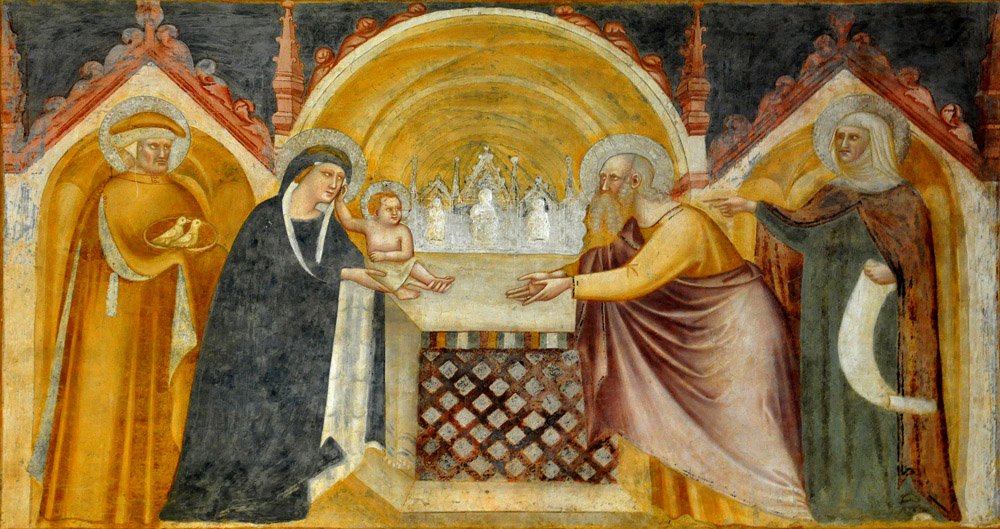
The Presentation in the Temple, 14th century fresco in Pomposa Abbey, Codorigo, Italy

When the time came for the purification rites required by the Law of Moses, Joseph and Mary took him to Jerusalem to present him to the Lord (as it is written in the Law of the Lord, “Every firstborn male is to be consecrated to the Lord”), and to offer a sacrifice in keeping with what is said in the Law of the Lord: “a pair of doves or two young pigeons.”

Now there was a man in Jerusalem called Simeon, who was righteous and devout. He was waiting for the consolation of Israel, and the Holy Spirit was on him. It had been revealed to him by the Holy Spirit that he would not die before he had seen the Lord’s Messiah. Moved by the Spirit, he went into the temple courts. When the parents brought in the child Jesus to do for him what the custom of the Law required, Simeon took him in his arms and praised God, saying:

“Sovereign Lord, as you have promised,
    you may now dismiss your servant in peace.
For my eyes have seen your salvation,
    which you have prepared in the sight of all nations:
a light for revelation to the Gentiles,
    and the glory of your people Israel.”

The child’s father and mother marveled at what was said about him. Then Simeon blessed them and said to Mary, his mother: “This child is destined to cause the falling and rising of many in Israel, and to be a sign that will be spoken against, so that the thoughts of many hearts will be revealed. And a sword will pierce your own soul too.”

There was also a prophet, Anna, the daughter of Penuel, of the tribe of Asher. She was very old; she had lived with her husband seven years after her marriage, and then was a widow until she was eighty-four. She never left the temple but worshiped night and day, fasting and praying. Coming up to them at that very moment, she gave thanks to God and spoke about the child to all who were looking forward to the redemption of Jerusalem.

When Joseph and Mary had done everything required by the Law of the Lord, they returned to Galilee to their own town of Nazareth. And the child grew and became strong; he was filled with wisdom, and the grace of God was on him. (New International Version)

The Gospel accounts of Matthew, Mark, Luke, and John actually contain very little information about the childhood of Jesus. That’s because the Gospels are not biographies – in the sense we think of them – but rather they are narratives that seek to answer a fundamental question about faith and life on this earth: Who is this Jesus?

C.S. Lewis went about exploring that very question. He reasons with us in his classis work, Mere Christianity:

“I am trying here to prevent anyone saying the really foolish thing that people often say about Him: I’m ready to accept Jesus as a great moral teacher, but I don’t accept his claim to be God. That is the one thing we must not say. A man who was merely a man and said the sort of things Jesus said would not be a great moral teacher. He would either be a lunatic — on the level with the man who says he is a poached egg — or else he would be the Devil of Hell. You must make your choice. Either this man was, and is, the Son of God, or else a madman or something worse. You can shut him up for a fool, you can spit at him and kill him as a demon or you can fall at his feet and call him Lord and God, but let us not come with any patronizing nonsense about his being a great human teacher. He has not left that open to us. He did not intend to.”

C.S. Lewis, Mere Christianity

St. Luke’s account of Christ’s childhood stories, seeks to make some important theological points about Jesus:

  • born a Jew amongst devout religious Jews in a thoroughly Jewish society, under Roman authority (Luke 2:1-7)
  • born of a woman, born under the law (Galatians 4:4-5)
  • obedient to his heavenly Father (Luke 2:49; Mark 3:35)
The Presentation in the Temple, 14th century marble statue in the National Museum of the Middle Ages, Paris, France

So, as such, the presentation of Jesus in Jerusalem at the temple is motivated by specific requirements of the law of Moses:

The Lord said to Moses, “Say to the Israelites: ‘A woman who becomes pregnant and gives birth to a son will be ceremonially unclean for seven days…. On the eighth day the boy is to be circumcised. Then the woman must wait thirty-three days to be purified from her bleeding. She must not touch anything sacred or go to the sanctuary until the days of her purification are over….

“‘When the days of her purification for a son… are over, she is to bring to the priest at the entrance to the tent of meeting a year-old lamb for a burnt offering and a young pigeon or a dove for a sin offering….

“‘These are the regulations for the woman who gives birth to a boy… But if she cannot afford a lamb, she is to bring two doves or two young pigeons, one for a burnt offering and the other for a sin offering. In this way the priest will make atonement for her, and she will be clean.’” (Leviticus 12:1-8, NIV)

What’s more, every first-born male (as Jesus was) specifically belongs to the Lord, and is set apart.

The Lord said to Moses, “Consecrate to me every firstborn male. The first offspring of every womb among the Israelites belongs to me… you are to give over to the Lord the first offspring of every womb….”

“In days to come, when your son asks you, ‘What does this mean?’ say to him, ‘With a mighty hand the Lord brought us out of Egypt, out of the land of slavery. When Pharaoh stubbornly refused to let us go, the Lord killed the firstborn of both people and animals in Egypt.

This is why I sacrifice to the Lord the first male offspring of every womb and redeem each of my firstborn sons.’ And it will be like a sign on your hand and a symbol on your forehead that the Lord brought us out of Egypt with his mighty hand.” (Exodus 13:1-2, 12, 14-16, NIV)

Luke was making the connection that when Joseph and Mary presented Jesus to the Lord in Jerusalem, they were essentially dedicating his life to God. Jesus will be the means of redemption for all the people.

Mary would have remembered the words the angel Gabriel told her, that her son will not only be holy, but also be called the Son of God. The life of Jesus – conception, birth, and presentation at the temple – is demonstrably dedicated fully and completely to his heavenly Father. Deliverance for both Jews and Gentiles is focused in the person of Jesus.
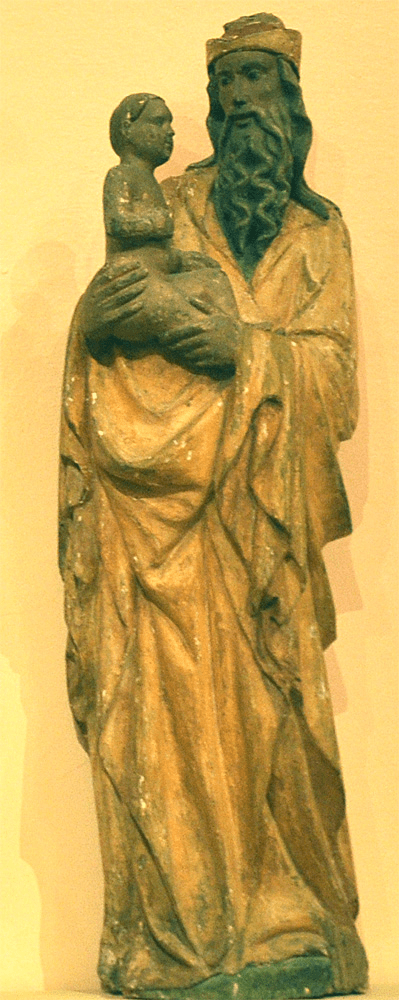
Simeon and the Child Jesus, 16th century statue in Zadar, Croatia

Simeon and Anna show up at the presentation of Jesus as devout Jews who are awaiting the fulfillment of God’s promises of consolation and redemption for Israel.

“I, the Lord, have called you in righteousness;
    I will take hold of your hand.
I will keep you and will make you
    to be a covenant for the people
    and a light for the Gentiles.” (Isaiah 42:6, NIV)

Break forth; shout together for joy,
    you ruins of Jerusalem,
for the Lord has comforted his people;
    he has redeemed Jerusalem.
The Lord has bared his holy arm
    before the eyes of all the nations,
and all the ends of the earth shall see
    the salvation of our God. (Isaiah 52:9-10, NRSV)

Simeon and Anna became the spokespersons for the redemption that is to come through Jesus. They both got a glimpse of the salvation that would, one day, reveal itself to the whole world. Forgiveness of sins, deliverance from death and hell, and freedom from guilt and shame all become laser focused on the suffering servant of God.

Who is Jesus? He is the ultimate meaning of Christmas, the incarnation of the Son of God, the Savior of the world. Amen.

Jesus the King (Mark 11:1-11)

Entry Into the City, by John August Swanson (1938-2021)

As they approached Jerusalem and came to Bethphage and Bethany at the Mount of Olives, Jesus sent two of his disciples, saying to them, “Go to the village ahead of you, and just as you enter it, you will find a colt tied there, which no one has ever ridden. Untie it and bring it here. If anyone asks you, ‘Why are you doing this?’ say, ‘The Lord needs it and will send it back here shortly.’”

They went and found a colt outside in the street, tied at a doorway. As they untied it, some people standing there asked, “What are you doing, untying that colt?” They answered as Jesus had told them to, and the people let them go. When they brought the colt to Jesus and threw their cloaks over it, he sat on it. Many people spread their cloaks on the road, while others spread branches they had cut in the fields. Those who went ahead and those who followed shouted,

“Hosanna!”

“Blessed is he who comes in the name of the Lord!”

“Blessed is the coming kingdom of our father David!”

“Hosanna in the highest heaven!”

Jesus entered Jerusalem and went into the temple courts. He looked around at everything, but since it was already late, he went out to Bethany with the Twelve. (New International Version)

We are presently in the 12 Days of Christmas (December 25–January 5), the annual celebration of Christ’s birth on the Christian Calendar. It may seem odd that the Revised Common Lectionary daily readings have included a text associated with Palm Sunday. However, this is reminder to us that Jesus was born a king – which is why old King Herod saw a little baby as such a threat. (Matthew 2:1-18)

“Christ” is not the surname of Jesus, but instead is a title, meaning “anointed one.” In other words, in the New Testament Gospels, Jesus is referred to as an anointed king. It was broadly understood, within the religious milieu of the ancient Jews, that the Messiah (the Hebrew term for Christ) would come and beat up God’s enemies, restore God’s people to their former glory, and usher in an everlasting state of peace.

Jerusalem had a history as the royal city – the place where ancient Jewish kings lived and ruled. So, most ancient Jews made a clear connection between the Messiah, the king, returning to reign in Jerusalem. They anticipated that the City of David would once again be the seat of power, without any meddling Gentiles to complicate things.

Nativity, by John August Swanson

So, when Jesus entered Jerusalem – in what turned out to be the final week of his earthly life – many people looked upon this as a triumphal entry. He was close to ascending the ancient throne. The disciples of Jesus were waiting for this, and ready for a future of greatness and glory alongside their Rabbi.

Not only did people lay their palm fronds on the road in front of him declaring the ancient refrain, “Blessed is he who comes in the name of the Lord!” (Psalm 118:26) but they also added an explicit reference to the days of King David stating, “Blessed is the coming kingdom of our ancestor David!” The city was awash in the messianic hope of no longer being subject to foreign rule.

Yet we know the tragic and ironic end of the week. Jesus knew it, too, even at the time. He knew what fate awaited him by entering Jerusalem (Mark 8:31; 10:33-34). And Jesus knew without a shadow of a doubt that he was not going to be a king who gains and keeps power through military might and the bloodshed of war. Instead, only his own blood would be offered, as a sacrifice for many. The power of Love will overcome any and every earthly power.

Those with the eyes to see and the spirit to discern could understand this Jesus riding on a humble donkey instead of the proud warhorse. It made complete sense. Jesus did not enter this world with the fanfare of the rich and powerful, but quietly slipped onto the earth in a non-descript and poor Jewish family. His birth, life, and ministry, were all counter cultural. So, why not also his eventual death, resurrection, ascension, and glorification?

Yes, Jesus is a king. But no, he is not a king in any conventional sense. It is Jesus, beginning with his incredible and unexpected incarnation, who helps us reimagine what power and authority can and ought to look like.

All the trappings of control we can get so enamored about, such as wielding influence through economic wealth, social status, political power, and religious weight, all get tossed aside as mere stuffed animals compared to the real deal of moral dignity, ethical love, and compassionate justice shown to people who had absolutely no ability to either pay back Jesus or prop up a throne for him to sit upon.

Jesus is a king who gives his life for the healing of humanity – all people everywhere – including the ones we don’t much like or care about. I have no problem calling Jesus a king, just as long as we understand what sort of kingship we are actually talking about.

I serve King Jesus because he throws a monkey wrench into oppressive systems that seek to keep other people under a heavy hand of injustice. My allegiance is with Christ the Lord because he uses his prodigious authority to bring peace, light, wholeness, and integrity to all the places of the world (and the human heart) that are dark and clueless.

Today I celebrate in this Christmas season the birth of a baby who was born to die to the world and for the world. I rejoice with the angels that Christ is born in Bethlehem, the king of kings and lord of lords, the prince of peace who himself became peace so that we might live in peace.

May you discover deliverance from guilt, shame, and regret, through the One who came and was wounded for us so that we might be healed. Amen.

God Will Give a New Heart (Ezekiel 36:24-28)

I will take you from every nation and country and bring you back to your own land. I will sprinkle clean water on you and make you clean from all your idols and everything else that has defiled you. I will give you a new heart and a new mind. I will take away your stubborn heart of stone and give you an obedient heart. I will put my spirit in you and will see to it that you follow my laws and keep all the commands I have given you. Then you will live in the land I gave your ancestors. You will be my people, and I will be your God. (Good News Translation)

As a hospital chaplain who has spent a great deal of time on cardiac care units, I have had several occasions to follow patients through the process of a heart transplant. I sat with them as they wondered if they would ever get a new one, because their own heart could no longer sustain the rest of their life. Would they die before receiving one? What would happen to their families?

Then, finally the day came for many (unfortunately, not all); there is a heart for them! After the incredible transplant surgery, joy abounds, knowing there is a new lease on life, a fresh experience. Through weeks or months of waiting and flirting with the Grim Reaper of death, hope is realized. Their old useless heart now replaced with a vibrant one, full of life!

However, the process is not yet over. Typically, about two or three days into possessing this new heart, a new realization comes along with it: Someone else had to die so that I could live….

He personally carried our sins
    in his body on the cross
so that we can be dead to sin
    and live for what is right.
By his wounds
    you are healed. (1 Peter 2:24, NLT)

God will…

Life comes from death. Resurrection can only happen when there is a crucifixion. Gaining a new spiritual heart has been achieved at the greatest of costs. “I will” is uttered nine times by God in five verses of Ezekiel’s prophecy. In gracious acts of determination to restore fallen people, God makes promises and has the authority and power to back them up.

Our new heart is waiting to be animated by God’s Spirit so that our observance of God’s law is infused with divine might. Our consent to surgery is all that is needed. Consider just a few of the great “I will” statements of Holy Scripture:

I will instruct you and teach you in the way you should go; I will counsel you with my loving eye on you.” (Psalm 32:8, NIV)

“If someone trusts me, I will save them.
    I will protect my followers who call to me for help.
When my followers call to me, I will answer them.
    I will be with them when they are in trouble.
    I will rescue them and honor them.
I will give my followers a long life
    and show them my power to save.” (Psalm 91:14-16, ERV)

I will strengthen you; I will help you; I will uphold you with my victorious right hand.” (Isaiah 41:10, NRSV)

“Call to me and I will answer you and tell you great and unsearchable things you do not know.” (Jeremiah 33:3, NIV)

I will never leave you nor forsake you.” (Hebrews 13:5, NKJV)

The emphasis in today’s Old Testament lesson is on God’s role, not ours. The prophet Ezekiel’s hope is not in the faithfulness of the people in following some new set of rules. Instead, God is their hope. God will save them by gathering, cleansing, and giving Israel a new heart, mind, and spirit to obey God’s words.

God will gather

Those in diaspora, scattered far and abroad in exile, will be gathered back from the nations and into their own land. God will reverse the experience of dispersion by reassembling the people.

He will raise a banner for the nations
    and gather the exiles of Israel;
he will assemble the scattered people of Judah
    from the four quarters of the earth. (Isaiah 11:12, NIV)

God will cleanse

God will purify the people, cleansing them from their rebellion and defilement. Since the people’s exile was a punishment for their corruption, they were therefore in need of purification.

I will cleanse them from all the sin they have committed against me and will forgive all their sins of rebellion against me. (Jeremiah 33:8, NIV)

God will give

Specifically, God does the seemingly impossible: gives a new heart. The people’s old sinful stubbornness is replaced wholesale with fresh desires for justice and righteousness. They will think and act differently because of this gracious newness.

Much like the real physical heart that can barely function any longer, the people’s collective heart was nearly dead, and as unresponsive as a stone. They needed a transplant, so that they could come alive again to God’s moral law and benevolent rule in the world.

“This is the covenant I will make with the people of Israel
    after that time,” declares the Lord.
“I will put my law in their minds
    and write it on their hearts.
I will be their God,
    and they will be my people.” (Jeremiah 31:33, NIV)

Despite all the threats of judgment throughout the long prophecy of Ezekiel, and all the distressing experiences of the people’s exile, God still desired to be their God. The Lord wants a relationship with people, and will do what it takes to restore it when it becomes broken and damaged. Indeed the Lord is a God of restoration.  

May Christ make his home in your heart as you trust in him.

May your spiritual roots grow down deep into God’s love and keep you strong.

May you have the power to grasp, along with all God’s people, how wide, how long, how high, and how deep is the love of God.

May you experience the love of Christ, though it is too great to understand fully.

May you be made complete with all the fullness of life and power that comes from God.

May your new heart pump with the grace of Jesus Christ, the love of God, and the encouragement of the Spirit. Amen.

A New Covenant (Jeremiah 31:31-34)

The Lord says, “The time is coming when I will make a new covenant with the people of Israel and with the people of Judah. It will not be like the old covenant that I made with their ancestors when I took them by the hand and led them out of Egypt. Although I was like a husband to them, they did not keep that covenant. The new covenant that I will make with the people of Israel will be this:

I will put my law within them and write it on their hearts. I will be their God, and they will be my people. None of them will have to teach a neighbor to know the Lord, because all will know me, from the least to the greatest. I will forgive their sins and I will no longer remember their wrongs. I, the Lord, have spoken.” (Good News Translation)

It’s important to pass on the faith to future generations of believers. The key to embracing a life of faith is obeying God’s commands and decrees.

Yet, both within the Old Testament and within our own contemporary religious milieu, God’s people persist in going through significant times of unfaithfulness, infidelity, and disobedience.., Oftentimes, people cannot seem to keep their eyes off the glittering gods that surround them, as if they had some sort of spiritual A.D.H.D.

Also persistent is the God who possesses a faithful remnant of people devoted to observing the covenant and living into the divine promises given to them. Yet, the kingdom of Judah in the prophet Jeremiah’s day, floundered in their commitments and broke faith with the teaching provided for them.

Since God’s grace has the last word, the sins and shortcomings of backslidden people who failed to pass on the covenant teachings to their progeny will have a better ending than that of divine judgment. God’s answer to repeated human failings is to establish a new covenant, unprecedented in its audacious mercy.

Rather than rewriting commands on stone tablets (as with Moses on Mount Sinai) and having a remedial class on the divine covenant and promises for the people, God will instead do the extraordinary, by writing the law on human hearts. That way, people will know the Lord in a direct and immediate way.

And on top of that, it will be for everybody; it won’t only be for the remnant, nor for just the spiritual elite. From the least to the greatest, from young to old, even from Jew to Gentile, God will forgive sins and shortcoming, guilt and shame, once and for all with the new covenant.

If that’s not the most gracious act ever decreed, I’m not sure what is. This is a radical move of spiritual amnesty. It’s completely undeserved. And it’s definitely not something any other god from any other nation would ever do. It’s unthinkable – completely off everyone’s radar. Yet, that is exactly what grace does. Grace provides a way where there seems to be none.

From a New Testament (New Covenant) perspective, Jesus is the fulfillment of all God’s good covenant promises to the people. Furthermore, God’s Holy Spirit serves as the continuing presence of Jesus within us, teaching us and guiding us in the ways of God. 

Our only task, then, is to live into those promises – to know them, claim them, and bank on them. We are most obedient when we believe the promises of God and throw all our hope in them.

The implications of the divine decree of a new covenant are enormous. It means:

  • I cannot do a darn thing to earn God’s acceptance, because I already have it! (John 6:37; Colossians 1:21-22; Romans 8:33-39, 15:7-12)
  • I don’t need to be afraid of judgment because Jesus has already taken care of the sin issue, once for all! (Romans 6:5-10; Hebrews 7:27-28, 10:5-10; 1 John 4:17-18)
  • I lack nothing, because God has already given me everything I need for life and godliness in this present evil age! (Philippians 4:19; 2 Peter 1:3-4)
  • I can know God, right now, without jumping through spiritual hoops or over imposed hurdles, because Jesus leveled the way and made it clear! (John 14:6; Ephesians 2:8-9; Hebrews 2:9-18)
  • I can enjoy forgiveness and a clean heart because God has decreed it to be so! (Psalm 103:8-12; Ezekiel 36:25-27; Luke 22:20; Hebrews 8:7-13, 10:14-18)

If this were not enough, Jesus has sent the Spirit to be with us forever, to guide us and lead us into realizing the law written on our hearts. We are never alone. God is with us.

Jesus said, “The Companion, the Holy Spirit, whom the Father sends, will teach you everything and will remind you of everything I told you. Peace I leave with you. My peace I give you. I give to you not as the world gives. Do not be troubled or afraid.” (John 14:26-27, CEB)

In this world of trepidation, fear, uncertainty, and unrest, there is peace, grace, and love because the Father, Son, and Spirit, the one true God, the Blessed Holy Trinity, the Divine Warrior who fights our battles, the Lord of Hosts, has our backs. Yes, this God, and no other god, has the chutzpah to make promises to us and the power to back them up.

Our Father in heaven,
Reveal who you are.
Set the world right;
Do what’s best—as above, so below.
Keep us alive with three square meals.
Keep us forgiven with you and forgiving others.
Keep us safe from ourselves and the Devil.
You’re in charge!
You can do anything you want!
You’re ablaze in beauty!
Yes! Yes! Amen!