Giving Freely for a Worthy Project (Exodus 25:1-22)

Gathering To Build the Tabernacle, by Yoram Raanan

The Lord said to Moses, “Tell the Israelites to bring me an offering. You are to receive the offering for me from everyone whose heart prompts them to give. These are the offerings you are to receive from them: gold, silver and bronze; blue, purple and scarlet yarn and fine linen; goat hair;ram skins dyed red and another type of durable leather; acacia wood; olive oil for the light; spices for the anointing oil and for the fragrant incense; and onyx stones and other gems to be mounted on the ephod and breast-piece.

“Then have them make a sanctuary for me, and I will dwell among them. Make this tabernacle and all its furnishings exactly like the pattern I will show you.

“Have them make an Ark of acacia wood—two and a half cubits long, a cubit and a half wide, and a cubit and a half high. Overlay it with pure gold, both inside and out, and make a gold molding around it. Cast four gold rings for it and fasten them to its four feet, with two rings on one side and two rings on the other. Then make poles of acacia wood and overlay them with gold. Insert the poles into the rings on the sides of the ark to carry it. The poles are to remain in the rings of this ark; they are not to be removed. Then put in the ark the tablets of the covenant law, which I will give you.

“Make an atonement cover of pure gold—two and a half cubits long and a cubit and a half wide. And make two cherubim out of hammered gold at the ends of the cover. Make one cherub on one end and the second cherub on the other; make the cherubim of one piece with the cover, at the two ends. The cherubim are to have their wings spread upward, overshadowing the cover with them. The cherubim are to face each other, looking toward the cover. Place the cover on top of the ark and put in the ark the tablets of the covenant law that I will give you. There, above the cover between the two cherubim that are over the ark of the covenant law, I will meet with you and give you all my commands for the Israelites. (New International Version)

Israel gathers to bring gifts for the construction of the Tabernacle

Details matter. Typically, when something is important to someone, they go into great detail about it. It won’t do for them to ignore the nuances of what they care about. So when God goes into intricate detail about the construction of the portable sanctuary, the Tabernacle, the people can take notice that this has great significance.

The Israelities were delivered from Egyptian slavery. Now, in the desert of the Sinai peninsula, they are to worship in a particular way with certain sacred objects for its use. The sacred tent, the Tabernacle, was the center of Israel’s religious life while wandering in the years between Egypt and the Promised Land. It became God’s dwelling place amongst the people – the place where sacrifices were offered and Moses their leader communicated with the Lord.

The instruction manual given to Moses from God for the holy implements of worship was very specific and involved a lot of people. It was such an important and technical project that it required the participation of all the people. In a national-level sort of fundraiser, God asked Moses to ask the Israelites to bring their contributions and donations as freewill offerings for the work to be done.

Moses went up Mount Sinai to meet with God. The expressed purpose was to provide divine instructions concerning the law, worship, and how to live in the Promised Land once they get there. Since the Tabernacle was a central part of the nation’s covenant with God, the Lord sought to communicate how everything was to be built.

But before it could all happen, there needed to be a collection of the materials for construction. And it was not something to be taxed or required; it was an ask. The true heart of righteousness is that giving is an opportunity to help and do the right thing; it’s a privilege.

Righteousness is a healthy dynamic of freely giving, and thus, freely receiving. It benefits everyone – both giver and receiver. The wise and righteous person understands that it is the giver who benefits most.

When everyone has an opportunity to give, all persons are of equal status; there is no charity because the whole community acts as one person together in ensuring needs are satisfied.

If everyone gives, then we benefit from living in a society where everyone’s needs are met, and none are in want. The truly righteous society that is full of justice and goodness is the one in which everyone is privileged, and everyone receives the benefits of giving.

In the New Testament, the Apostle Paul picked up on this form of right living and described it to the Corinthian Church:

“And now, brothers and sisters, we want you to know about the grace that God has given the Macedonian churches. In the midst of a very severe trial, their overflowing joy and their extreme poverty welled up in rich generosity. For I testify that they gave as much as they were able, and even beyond their ability.

Entirely on their own, they urgently pleaded with us for the privilege of sharing in this service to the Lord’s people. And they exceeded our expectations: They gave themselves first of all to the Lord, and then by the will of God also to us… For if the willingness is there, the gift is acceptable according to what one has, not according to what one does not have.” (2 Corinthians 8:1-5, 12, NIV)

Paul went on to encourage the believers that each individual should give what they have decided in their heart to give, not reluctantly or under compulsion. Why? Because God loves a cheerful giver, and not a reluctant miser. (2 Corinthians 9:7)

If something is important enough to warrant a full detailed and technical plan, then it’s worthy enough to allow others to freely give for that project as they so desire.

Everyone is blessed when we know what has to be done, and are willing to freely give what we possess to make that important thing happen.

Lord of our lives, teach us how to use our money and our possessions. Deliver us from stinginess and wasteful extravagance; inspire our giving with the spirit of true generosity. Help us always to remember your generous love for us, that we may be wise and faithful stewards of the good gifts you have given us. Amen.

A Prayer of Confession (Ezra 9:5-15)

Ezra In Prayer, by Gustave Doré, 1866

Then, at the evening sacrifice, I rose from my self-abasement, with my tunic and cloak torn, and fell on my knees with my hands spread out to the Lord my Godand prayed:

“I am too ashamed and disgraced, my God, to lift up my face to you, because our sins are higher than our heads and our guilt has reached to the heavens. From the days of our ancestors until now, our guilt has been great. Because of our sins, we and our kings and our priests have been subjected to the sword and captivity, to pillage and humiliation at the hand of foreign kings, as it is today.

“But now, for a brief moment, the Lord our God has been gracious in leaving us a remnant and giving us a firm place in his sanctuary, and so our God gives light to our eyes and a little relief in our bondage. Though we are slaves, our God has not forsaken us in our bondage. He has shown us kindness in the sight of the kings of Persia: He has granted us new life to rebuild the house of our God and repair its ruins, and he has given us a wall of protection in Judah and Jerusalem.

“But now, our God, what can we say after this? For we have forsaken the commands you gave through your servants the prophets when you said: ‘The land you are entering to possess is a land polluted by the corruption of its peoples. By their detestable practices they have filled it with their impurity from one end to the other. Therefore, do not give your daughters in marriage to their sons or take their daughters for your sons. Do not seek a treaty of friendship with them at any time, that you may be strong and eat the good things of the land and leave it to your children as an everlasting inheritance.’

“What has happened to us is a result of our evil deeds and our great guilt, and yet, our God, you have punished us less than our sins deserved and have given us a remnant like this. Shall we then break your commands again and intermarry with the peoples who commit such detestable practices? Would you not be angry enough with us to destroy us, leaving us no remnant or survivor? Lord, the God of Israel, you are righteous! We are left this day as a remnant. Here we are before you in our guilt, though because of it not one of us can stand in your presence.” (New International Version)

God had made a covenant with the Israelites. The Lord graciously gave them laws and stipulations to live by before entering the Promised Land.

Yet, much of Jewish history during the times of the kings was characterized by a breakdown in morality. Cheating on workers and preying upon the weak became commonplace. The poor were fleeced for what little they had, and reduced to servitude.

Failing to obey God completely, the people intermarried with the surrounding nations. The worship of Yahweh was, at times, in severe neglect, due to worshiping the gods of other places. As a result, divine judgment brought a Babylonian captivity and an exile of the people to a foreign land.

But God, who is rich in mercy, brought many of the people back to Palestine and Jerusalem. The Babylonians were conquered by the Persians, who had a different philosophy about how to handle the nations within their empire. And they were open to Jerusalem being rebuilt and the temple restored.

Ezra was a scribe (a copier of Scripture) and one of the returning exiles. Ezra left Babylon in 458 B.C.E. with a considerable group of people. Because of Ezra’s position as a Jewish scribe, and as a descendant of Levi, the Persian king authorized him to reinforce the Torah (the Law) by reading it and setting up the necessary administrative systems to ensure it would be followed.

Under Persian rule, each subject people was allowed to live by its ancestral laws, which were enforced by the imperial government. Violations of the laws of the group to which one belonged constituted an offense against the state precisely because they led to instability.

Soon after Ezra arrived in Jerusalem, he learned of the spiritual state of the Jews there. They had intermarried freely with the non-Jewish women of the land, and had ceased to keep the Jewish holidays and other commandments.

This situation devastated Ezra. He tore his clothes and sat in mourning the entire day until evening. After the evening sacrifice was brought, he got up and began praying loudly to God, weeping for forgiveness for the sins of his people.

Ezra read the Torah publicly to the entire people. Indeed, this was a covenant‑renewal ceremony in the strict sense. To make the Torah understandable to them, he had it explained, because Hebrew was no longer in most people’s vernacular. (Nehemiah 8:1-18)

In today’s Old Testament lesson, we have Ezra’s prayer, his great confession of sin, and concern that the people not get into the same situation which brought God’s judgment and exile upon them to begin with.

It is a prayer laced with love for the covenant code, the Jewish people, and most of all, for God. A very complicated situation prompted Ezra’s prayer, and would take much courage and wisdom to confront and deal with.

Whenever things are awry, circumstances are less than desirable, and situations seem overwhelming, the place to begin is to pray. Admittedly, prayer is not everything; but it is certainly something – and something powerful – for which we have both the duty and the delight to engage in.

And in praying, there is perhaps no better way to begin, than with a heartfelt prayer of confession:

Gracious God, our sins are too heavy to carry, too real to hide, and too deep to undo. Forgive what our lips tremble to name, what our hearts can no longer bear, and what has become for us a consuming fire of judgment.

Set us free from a past we cannot change; open to us a future in which we can be changed; and grant us grace to grow more and more in your likeness and image; through Jesus Christ our Lord. Amen.

Leave a Supportive Spiritual Legacy (Deuteronomy 11:18-21)

 “So commit yourselves wholeheartedly to these words of mine. Tie them to your hands and wear them on your forehead as reminders. Teach them to your children. Talk about them when you are at home and when you are on the road, when you are going to bed and when you are getting up. Write them on the doorposts of your house and on your gates, so that as long as the sky remains above the earth, you and your children may flourish in the land the Lord swore to give your ancestors.” (New Living Translation)

The biblical book of Deuteronomy is a farewell address by Moses to the Israelites.

Moses was about to die. The Israelites were about to enter the Promised Land.

So, Moses restated God’s law and called the people to remember all that God had done. He exhorted the people to communicate the law and their heritage to the next generations.

If God’s words and God’s ways are continually observed, then the people would prosper in God’s Promised Land.

The overarching call and command of Moses to the people is to love God with everything they have and everything they are.

God’s people are to have a dedicated commitment of mind, body, emotions, and spirit to the law of God. Each ability and gift, and all that makes a person a person, is to have its clear direction and orientation toward loving God through obeying God’s commands.

The love of God is meant to become a habit in the normal daily rhythms of life. How do we do that? Impress God’s commands by talking about them in every sort of context: home and family; neighborhood and workplace; morning and evening. People are even to write out God’s commands and have them in front of us all the time. 

Indeed, the entire day is an opportunity to love God by talking about God’s words. Discussing God’s words and commands doesn’t need to be forced or awkward. Yet, it is something which needs some intention and purpose to it.

Most people like talking about things which are important to them. If someone is really into classic cars, he does not have to try and force a conversation about it because it just comes out of him. Because they go to car shows, maybe own a classic car that they are continually tinkering with, and read up on car magazines, a discussion about the subject is quite natural to them.

So, the best way to live into God’s law is to spend time with God through regular Bible reading, focused and earnest prayer, conversing with others, and taking advantage of opportunities to learn and know about God. For the Christian, talking about Jesus is meant to be organic, springing from a heart which loves God and observes God’s law.

When it comes to family, an expert theologian or biblical scholar is not needed; there just needs to be a willingness and a curiosity to ask questions.

Back when raising my girls, most of our conversations at the table centered around one question I would ask. We discussed it, talked about it, and mulled it over. Sometimes it was a deep theological question. At other times, it was a practical question. My wife and I often had others share a meal with us, so I usually asked our guests to tell their God story or participate with us in the question. If they were not Christian, I would ask them what they thought about Jesus and faith, and why.

God loves it when we have conversation in the home around biblical teaching. God also loves it when we have discussions in public. Some Orthodox Jewish persons still to this day wear a “phylactery” on their foreheads – a small box with little Scripture passages inside of it – testifying to their value of the written Word.

I’m not sure that’s what Moses had in mind when he talked about binding God’s commands on the forehead and tying them as symbols on the hands. Much of the Hebrew language is metaphorical, speaking about concrete things as a way of communicating something intangible. So, I wonder if the big idea here is simply to be open about faith and love for God and the law.

Although I don’t believe we have to take today’s verses quite so literally, there is, however, something to be said for keeping Holy Scripture continually in front of us, in order to remember divine commands and promises.

It’s good to write some Bible verses and place them on your bathroom mirror, the dash of your car, in your pants pocket, or anywhere you will see them on a regular basis. It’s a practical way of remembering to observe all that God has commanded.

Physical reminders of significant spiritual events can help us keep the words of God in our lives. When the Israelites experienced God in some significant way, they built an altar. For example, when they approached the Jordan River to enter the land, God caused the water to stop flowing so that they could cross over. Here is what happen next: 

Joshua erected a monument, using the twelve stones that they had taken from the Jordan. And then he told the People of Israel, “In the days to come, when your children ask their fathers, ‘What are these stones doing here?’ tell your children this: ‘Israel crossed over this Jordan on dry ground.’

“Yes, God, your God, dried up the Jordan’s waters for you until you had crossed, just as God, your God, did at the Red Sea, which had dried up before us until we had crossed. This was so that everybody on earth would recognize how strong God’s rescuing hand is and so that you would hold God in solemn reverence always.” (Joshua 4:20-24, MSG)

Passing the spiritual baton and leaving a heritage for future generations is a sacred trust. One of the best ways for that to happen is within the home, talking about God and Scripture as a daily routine, as well as freely conversing about spirituality in public.

There are several ways churches can impress Scripture to younger generations: 

  1. Train them to lead. Adults do not have to do everything in the church. Every generation can be empowered to engage in ministries on a regular basis. Everyone needs a mentor to do anything well – which means taking others with us along the journey of ministry so they can both shadow and participate.
  2. Empathize with young people and young families. That means avoiding criticism. It’s easy for older generations to be critical about another generation’s lack of involvement; or how they live their lives. They don’t need our criticism, but our help. Empathy means that we recognize others are trying to do the best they can in a crazy world. And it’s a world quite different from the one I grew up in. This is a very competitive world, requiring more energy and drive than previous generations. Being a student today is not like being a student when I was a kid.  Being a young parent is not the same today as it once was. Today’s family structure is completely changed; what we think of as a traditional family only makes up 7% of the American population. The stance to take on this is not to criticize, but to encourage and help.
  3. Take the message of Jesus seriously.  Discussion, conversation, questions, and mutual sharing are the ways Jesus developed his followers; and it’s a way we can reach younger generations. Dialogue goes a lot further than simply telling others what they should believe and do.
  4. Adopt a young person, or a young family. If you consider yourself part of an older generation, consider taking a younger person or family under your wing, who is not related to you. Invite them to a meal, read these verses, and discuss them together. Commit to praying for them daily for a set period.
  5. Look for ways to support children, teens, and young families. Prioritizing younger generations means they don’t have to do everything our way. Rather, it means we will listen to what they need in loving God and building into their own families.
  6. Be great neighbors. Discuss, teach, empower, and develop young people – without criticism – into good neighbors who engage their local community by addressing issues with great love and lots of compassion.

There are many more ways to engage. The idea here is that we think about how to embody the teaching we have in Deuteronomy by passing on God’s love and God’s words. So, where will you start?…

Trust and Obey (Deuteronomy 32:44-47)

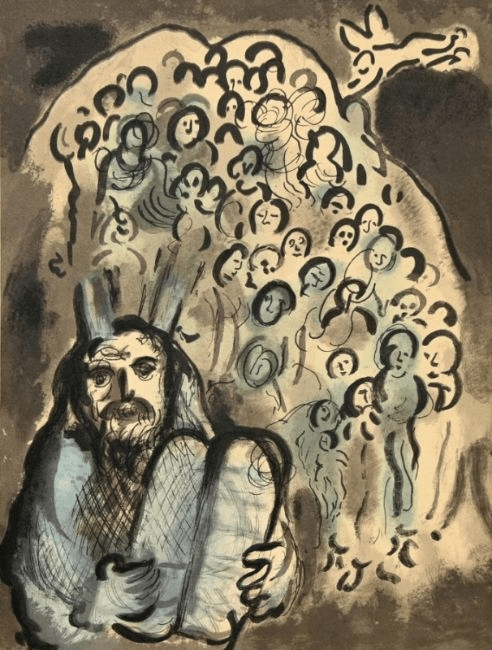
Moses and His People, by Marc Chagall, 1973

Moses and Joshua son of Nun recited this song, so that the people of Israel could hear it.

When Moses had finished giving God’s teachings to the people, he said, “Be sure to obey all these commands that I have given you today. Repeat them to your children, so that they may faithfully obey all of God’s teachings. These teachings are not empty words; they are your very life. Obey them and you will live long in that land across the Jordan that you are about to occupy.” (Good News Translation)

It seems that most people don’t like being told to do anything. There’s a lot of reasons for that. For me, it’s a trust issue. I have a very hard time obeying an authority that I don’t have much faith in.

That’s why I’m just fine submitting myself to God and obeying God’s commands and instructions – because I am firmly convinced that God knows what God is doing; and what’s more, that God has my best interests at mind and at heart.

The ancient Israelites were exhorted by Moses to obey all of God’s teachings because it would be the best way for them to live as a new nation in a new land. The Lord truly wanted what was best for the people, and so, God made sure to give them solid instructions on how to live and thrive together as a nation.

Deuteronomy is the fifth and final book of the Hebrew Torah, and of the Bible’s Pentateuch. The core of the book is a restatement of God’s Law received at Mount Sinai 40 years earlier for the generation about to enter the Promised Land.

The book of Deuteronomy emphasizes God’s love, justice, and transcendence; and stresses the covenant relationship between God and Israel. It looks forward to Israel’s life in the land being established. Foundational to their society, was maintaining God’s social and religious laws.

And those laws were in no way meant to be onerous or oppressive, but were a divine gift to the people. By obeying the Law, the divine/human relationship was secured and the people brought close to God. Foremost to the society was a humanitarianism and concern for the welfare of the poor and disadvantaged.

What’s more, Deuteronomy has a strong intellectual orientation. It urges all Israelites to study God’s laws. There is the expectation that everyone is to be smart and learn how to live wisely.

The participation of Joshua with Moses in teaching he laws was appropriate and important because Joshua was the one who would take over the leadership of Israel and bring them into the Promised Land. The leaders of the people were thoroughly committed to God’s Law – and it was through their wholehearted devotion that they could encourage others to follow them and do the same.

They were to take all of God’s words to heart. The mind, will, and emotions of individuals and families were to be captivated by the standard of God’s divine gift of the law to them. Only in this way would obedience truly become a reality. In other words, it takes complete faith and trust in order to obey.

The way to receive all the blessings of being in the land is through knowing God’s instructions and following them with wholehearted obedience. That means future generations need to be educated about the Law’s stipulations and about the necessity of obeying them with confidence.

Moses made it clear to the people that the divine laws are what life is to be oriented around. God and God’s Law cannot be separated because God’s Law is an expression of God’s very character. For the ancient Israelites, there was no other way.

Many generations later, King David received and learned these laws, understanding the relationship between the Lord and the Law:

The law of the Lord is perfect;
    it gives new strength.
The commands of the Lord are trustworthy,
    giving wisdom to those who lack it.
The laws of the Lord are right,
    and those who obey them are happy.
The commands of the Lord are just
    and give understanding to the mind. (Psalm 19:7-8, GNT)

When it comes to passing on the faith and spiritually forming others, we must have a holistic concern for both what and whom is being taught, as well as how to teach and why we do it. 

For Moses, he was open about expressing the great redemptive acts of God that brought deliverance and vindication to the people. He was convinced that there is no God but the Lord. And he wanted all Israel to know this and to never forget.

All of us, in every generation of believers, are to remember, recite, and rehearse the mighty acts of God, who secured salvation for us. We are responsible to learn, know, and keep the commands of the Lord in our hearts so that we can live into the freedom we possess as believers.

And the Lord has made it known that learning, knowing, remembering, and doing is no trifle thing; rather, this is our very life.

This is one reason why I have devoted myself to the reading, learning, teaching, and living of the Bible. It’s important stuff! And I can testify that living according to the understanding I have of God and Scripture is satisfying, as well as far superior to any other way I have ever tried to live before.

God’s Word must be personally received – no one else can do the work that I myself must do. God’s Word must be faithfully shared and communicated with our children. And God’s Word must be carefully obeyed and observed with head, heart, and hands. This is the responsibility of every believer.

Moses knew that the people could not possibly enjoy life if they deliberately chose to ignore the words given to them in love. I’m glad that, by grace, I know that, too.

Blessed Lord, who caused all Holy Scriptures to be written for our learning: Grant us so to hear them, read, mark, learn, and inwardly digest them, that we may embrace and ever hold fast the blessed hope of everlasting life, which you have given us in our Savior Jesus Christ. Amen.