The Farewell Speech of Joshua (Joshua 23:1-16)

The tomb of Joshua in the West Bank

After a long time had passed and the Lord had given Israel rest from all their enemies around them, Joshua, by then a very old man, summoned all Israel—their elders, leaders, judges and officials—and said to them:

“I am very old. You yourselves have seen everything the Lord your God has done to all these nations for your sake; it was the Lord your God who fought for you. Remember how I have allotted as an inheritance for your tribes all the land of the nations that remain—the nations I conquered—between the Jordan and the Mediterranean Sea in the west. The Lord your God himself will push them out for your sake. He will drive them out before you, and you will take possession of their land, as the Lord your God promised you.

“Be very strong; be careful to obey all that is written in the Book of the Law of Moses, without turning aside to the right or to the left. Do not associate with these nations that remain among you; do not invoke the names of their gods or swear by them. You must not serve them or bow down to them. But you are to hold fast to the Lord your God, as you have until now.

“The Lord has driven out before you great and powerful nations; to this day no one has been able to withstand you. One of you routs a thousand, because the Lord your God fights for you, just as he promised. So be very careful to love the Lord your God.

“But if you turn away and ally yourselves with the survivors of these nations that remain among you and if you intermarry with them and associate with them, then you may be sure that the Lord your God will no longer drive out these nations before you. Instead, they will become snares and traps for you, whips on your backs and thorns in your eyes, until you perish from this good land, which the Lord your God has given you.

“Now I am about to go the way of all the earth. You know with all your heart and soul that not one of all the good promises the Lord your God gave you has failed. Every promise has been fulfilled; not one has failed. 

“But just as all the good things the Lord your God has promised you, have come to you, so he will bring on you all the evil things he has threatened, until the Lord your God has destroyed you from this good land he has given you. If you violate the covenant of the Lord your God, which he commanded you, and go and serve other gods and bow down to them, the Lord’s anger will burn against you, and you will quickly perish from the good land he has given you.” (New International Version)

Orthodox icon of Joshua

The Person

Joshua, the son of Nun, was the protégé of Moses, as the Israelites wandered the wilderness. After the death of Moses, Joshua became their military commander, leading the people into the Promised Land.

The biblical book of Joshua involves the Israelite conquest and settlement of Canaan. After securing decisive victories in the middle, north, and south of Canaan, the land was allotted to the twelve tribes of Israel.

Close to his death at 110 years old, Joshua gave a farewell speech to the people in which he called them to remember God’s actions, and be faithful to the Lord. He also warned them that if they failed in their memory and in their faith, they would lose the very land which was promised to them.

The Conquest

Throughout the Book of Joshua, there is a very positive view of conquering the land of Canaan. There are several notable stories of stepping out in faith despite the fear of engaging a much larger foe.

God is pictured as the real force behind all of the Israelite success, bringing the people into the land by through a miraculous parting of the Jordan River, and securing victory over great cities like Jericho by means of supernatural help.

After entering the land, the covenant with God was reaffirmed. The Israelites had moved around the Sinai desert for 40 years, and the new generation of people needed both circumcision and law in order to become faithful inhabitants of the land.

By the end of chapter 12 of Joshua, each of the native nations in Canaan had fallen. The conquest was complete, albeit with some of the Canaanites still living in the land. This would eventually prove to be a problem after Joshua’s death.

Allocation of the Land

A detailed account of the land’s division for all of the Israelite tribes covers chapters 13 to 22 in Joshua. Nearly all of the tribes settled between the Jordan River and the Mediterranean Sea, with a few exceptions settling along the eastern bank of the Jordan.

The reason for this traces back to a story in the Book of Numbers in which the tribes of Gad, Reuben, and Manasseh ask to settle there. At the time, Moses agreed to their request on the condition that they help complete the conquest of the land before being allowed to return and settle in their own, which they did.

Moses and Joshua

The book of Joshua and the story of Moses have a lot of similarities, such as:

  • Moses led the Israelites out of Egypt; and Joshua led them into Canaan.
  • Moses led the Israelites miraculously through the Red Sea; and Joshua led them miraculously across the Jordan River.
  • Moses sent out spies into Canaan; and Joshua sent spies to Jericho.
  • Moses allocated land on the east side of the Jordan River; and Joshua allocated land on the west side of the Jordan.
  • Moses gave a prolonged address before dying; and Joshua also gave a parting address to the people.

The Farewell Speech

Joshua’s farewell speech was both an exhortation and an encouragement to the Israelites. Joshua gave them a charge to remain faithful to God, just as God had faithfully fulfilled the promise of giving the people the land of Canaan. We get the sense that Joshua knew what was coming down the pike, and that unfaithfulness was in their future.

We also get the spiritual sense from Joshua that unless one’s heart is filled to the full of God’s law and love, something or someone else will come along and fill the void, no matter how big or small. Our happiness, fulfillment, and satisfaction is to be found in the Lord.

Joshua was insistent that to remain true to God is to remember what God has done. The Israelites were to always keep in their memory how the Lord brought them victory and fought their battles for them. By being continually reminded, the people would always trust and obey their God.

Indeed, even for believers today, if we can keep in mind God’s past faithfulness, it will help us have faith in God for the present time.

And just as the Israelites needed to hold onto and keep the Book of the Law in their minds and hearts, so we are to be ever mindful of God’s Holy Word. Christians are especially to realize the connection we have with Jesus and the Spirit.

“Be strong and very courageous. Be careful to obey all the law my servant Moses gave you; do not turn from it to the right or to the left, that you may be successful wherever you go. Keep this Book of the Law always on your lips; meditate on it day and night, so that you may be careful to do everything written in it. Then you will be prosperous and successful.”

Joshua 1:7-8, NIV

We are to avoid compromising our faith and marrying into foreign concepts that would take us away from our fidelity to the Lord. As Christians, our lives are to maintain the center of Christ. It is therefore imperative that we continually have the words and ways of Jesus ever before us. Otherwise, false gods can easily take over our lives.

The consequences of disobedience are much like those of trying to defy the law of gravity. It won’t go well with you to believe you can walk off the roof of your house in faith and be just fine.

Whereas many people may believe that God is punishing them when there are devastating consequences, typically we create our own problems by refusing to pay attention and listen to God’s warnings to avoid stupidity.

But if we remember our history with God, and God’s history with others, perhaps we will not take our spiritual lives for granted, nor let our spirits fall into disuse.

Not one good promise from God failed to be realized for the ancient Israelites. And all the good promises fulfilled in the person of Jesus are connected to his Church. Ultimately, our blessings come through the person and work of Christ – and not our own abilities, or lack thereof.

God almighty, Lord of heaven and earth, renew us with your divine love, energize our souls, nourish our spirits, empower us to show our faith, help us to walk with you, abide in us always, and teach us to continually remember you and follow you at all times and in every way. Amen.

There Is Hope (Psalm 89:20-37)

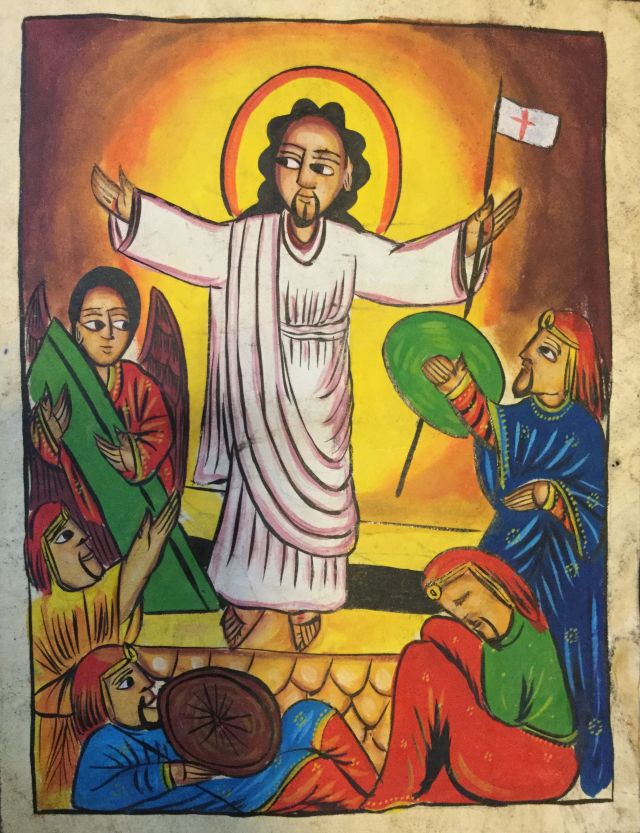
Ethiopian Orthodox depiction of Jesus

“I have found my servant David;
    with my holy oil I have anointed him;
my hand shall always remain with him;
    my arm also shall strengthen him.
The enemy shall not outwit him;
    the wicked shall not humble him.
I will crush his foes before him
    and strike down those who hate him.
My faithfulness and steadfast love shall be with him,
    and in my name his horn shall be exalted.
I will set his hand on the sea
    and his right hand on the rivers.
He shall cry to me, ‘You are my Father,
    my God, and the Rock of my salvation!’
I will make him the firstborn,
    the highest of the kings of the earth.
Forever I will keep my steadfast love for him,
    and my covenant with him will stand firm.
I will establish his line forever
    and his throne as long as the heavens endure.
If his children forsake my law
    and do not walk according to my ordinances,
if they violate my statutes
    and do not keep my commandments,
then I will punish their transgression with the rod
    and their iniquity with scourges,
but I will not remove from him my steadfast love
    or be false to my faithfulness.
I will not violate my covenant
    or alter the word that went forth from my lips.
Once and for all I have sworn by my holiness;
    I will not lie to David.
His line shall continue forever,
    and his throne endure before me like the sun.
It shall be established forever like the moon,
    an enduring witness in the skies.” (New Revised Standard Version)

Back when today’s psalm was originally crafted, there was a lot of stress for the Jews in Jerusalem. The city was in ruins, the land without their king, and the people were experiencing divine judgment from their God.

Into this situation, the psalmist brought some light from darkness; and hope for the survivors, that blessings lay in the future. The psalm is a song of prayer, speaking of the Lord’s faithfulness and steadfast love because of the promises made to the people’s ancient ancestor, King David.

The covenant between God and the people, made so many centuries ago, will never be broken. Why? Because fidelity to that covenant doesn’t depend on the people, but on the faithfulness of God and God’s timeless moral law.

The Lord God, the Almighty, did not forsake nor forget the people. The Lord’s mercies are new every morning; and God’s faithful love is forever.

Renewal and restoration are very real possibilities, despite the dire circumstances, and the people’s spiritual infidelity. Once again in history, one worthy of the throne of David will sit to judge the people with equity and grace.

The Son of David will be the custodian of God’s covenant promises. Evil shall be defeated. Authority to forgive sins, and to grant eternal life, will be established on earth. Indeed, the Lord’s enduring words and ways will be accomplished on this earth, as they are always done in God’s heaven.

The divine covenant will find its ultimate fulfillment in One whose throne is established for all eternity. The anointed one, the God-Man, will carry the burden of government on his shoulders; his rule and authority shall extend over the whole earth. (Isaiah 9:7)

Acting with the power of God, this Ruler is the visible image of the invisible God – the Mighty God, Eternal Father, Prince of Peace. For the Christian, these qualifications and descriptions are all met in the person of Jesus the Christ.

In a thoroughly and unabashed Christo-centric reading of the psalm, Jesus is the ultimate Messiah and High Priest who offered himself as the faultless, acceptable, eternal, and final sacrifice on behalf of the whole world. (Isaiah 53)

Therefore, since we are justified by faith, we have peace with God through our Lord Jesus Christ, through whom we have obtained access to this grace in which we stand, and we boast in our hope of sharing the glory of God. (Romans 5:1-2, NRSV)

Through Jesus, the New Testament perspective is that the old Mosaic Covenant became obsolete, and the New Covenant – promised by the prophets Jeremiah and Ezekiel – took its place. (Jeremiah 31:31-34; Ezekiel 36:25-27; Hebrews 8:13)

Although this High Priest died, he also was raised to life, and ascended to heaven – where he continues to intercede for God’s people.

He holds his priesthood permanently because he continues forever. Consequently, he is able for all time to save those who approach God through him, since he always lives to make intercession for them. (Hebrews 7:24-25, NRSV)

Before David was anointed king, Saul and his enemies hunted him and tried to kill him. Yet, through all of those twists and turns of harrowing circumstances, David trusted in the Lord and patiently waited for God to ensconce him as king. In time, that is precisely what happened. And David became the greatest king Israel ever had.

In much the same way, that fox King Herod tried to kill Jesus. Then later, Herod’s son, along with the religious establishment, sought to kill Jesus, as well. Behind the murderous intent, and every intent of doing away with the innocent, are the dark evil forces of this world.

The Accuser, Satan, the devil, tried to tempt the Christ and subvert the will of God, thus making the New Covenant something that would never happen. But Jesus was obedient to the Father – obedient even to death. (Philippians 2:8)

Christ Jesus offered himself willingly. His death may have been orchestrated by the existence of evil on this earth, yet it was God who allowed it all to occur, so that evil’s murderous tool, death, would become impotent.

The power of sin, death, and hell has been broken; but it will take awhile before the kingdom of God is established in all its grace and glory, and David’s fallen Tabernacle restored.

No matter how difficult, chaotic, and frustrating our current earthly situation may be, God will still establish the king; the good work begun and effected shall ultimately be thoroughly fulfilled. Jesus is coming again.

Until then, the good news is proclaimed that the kingdom of God is near. There is grace and forgiveness in the name of Jesus. Peace is no longer a pipe dream. Hope is real.

O Lord, when evil darkens our world, give us light. When despair numbs our souls, give us hope. When we stumble and fall, lift us up. When doubts assail us, give us faith. When nothing seems sure, give us trust. When ideals fade, give us vision. When we lose our way, be our guide, so that we may find serenity in Your presence, and purpose in doing Your will. Amen.

What Will You Do with Jesus? (John 5:1-18)

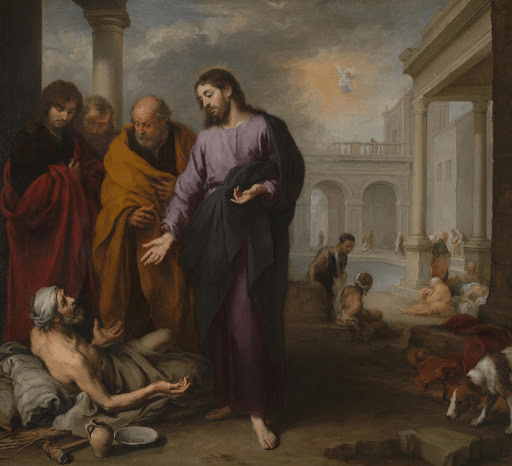
Healing the Paralytic, by Bartolomé Esteban Murillo, 1670

Sometime later, Jesus went up to Jerusalem for one of the Jewish festivals. Now there is in Jerusalem near the Sheep Gate a pool, which in Aramaic is called Bethesda and which is surrounded by five covered colonnades. Here a great number of disabled people used to lie—the blind, the lame, the paralyzed. One who was there had been an invalid for thirty-eight years. When Jesus saw him lying there and learned that he had been in this condition for a long time, he asked him, “Do you want to get well?”

“Sir,” the invalid replied, “I have no one to help me into the pool when the water is stirred. While I am trying to get in, someone else goes down ahead of me.”

Then Jesus said to him, “Get up! Pick up your mat and walk.” At once the man was cured; he picked up his mat and walked.

The day on which this took place was a Sabbath, and so the Jewish leaders said to the man who had been healed, “It is the Sabbath; the law forbids you to carry your mat.”

But he replied, “The man who made me well said to me, ‘Pick up your mat and walk.’ ”

So they asked him, “Who is this fellow who told you to pick it up and walk?”

The man who was healed had no idea who it was, for Jesus had slipped away into the crowd that was there.

Later Jesus found him at the temple and said to him, “See, you are well again. Stop sinning or something worse may happen to you.” The man went away and told the Jewish leaders that it was Jesus who had made him well.

So, because Jesus was doing these things on the Sabbath, the Jewish leaders began to persecute him. In his defense Jesus said to them, “My Father is always at his work to this very day, and I too am working.” For this reason they tried all the more to kill him; not only was he breaking the Sabbath, but he was even calling God his own Father, making himself equal with God. (New International Version)

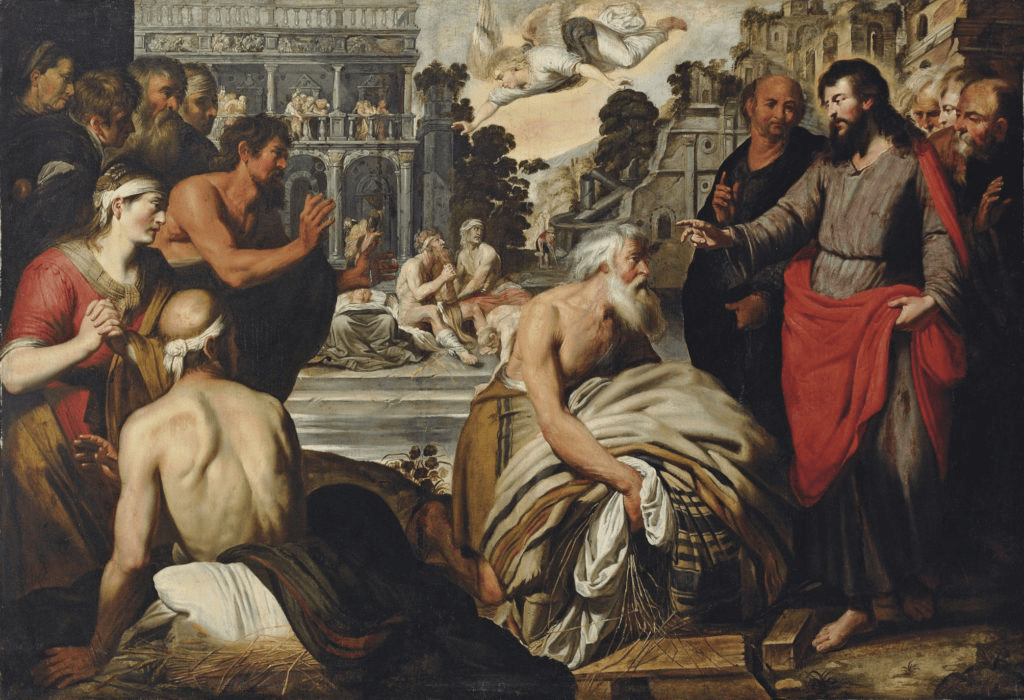
Christ at the Pool of Bethesda, by Artus Wolffort, c. 1625

During one of the yearly Jewish festivals, on a Sabbath day, a miracle happened. Miracles of healing are typically accompanied by celebration and joy. But not so much with this one.

It’s one of those things about living in a messed up world of broken systems, that an invalid can start walking and there are people who have frowns and furrowed brows about it.

Granted, the man who was healed by Jesus may seem a bit hard to like in some ways. We don’t really know what he was into, but when Christ bestows healing on you, then says to stop sinning, it’s probably a significant sin to warrant the Lord’s exhortation.

Regardless of any sort of sin, the man appears to be paraplegic. Especially in the ancient world, this meant all sorts of problems had to be navigated – such as needing others to literally carry you around (no wheelchair or handicapped accessible anything), long periods of social isolation, lack of bodily control over your bowels and bladder, and the continual needs for cleanliness.

This made the man hard to like by many people just because he likely had strong body odors and had to crawl to get around if no one would help. He would not have been pleasant to look at. But he would have to make sure you did because, in the absence of any charity, the guy’s only option was to beg.

I’m glad there are greater forces in the world than indifference and dislike. There is grace – which is an act of bestowing honor and/or forgiveness to another person. It is not dependent upon whether one deserves it. Grace chooses not to hold something over or against another. It is a deep concern for others that comes from within and not from without.

“I do not understand at all the mystery of grace – only that it meets us where we are but does not leave us where it found us.”

Anne Lamott

Another gracious act that Jesus did was to honor the man’s dignity by respecting him with a question. By asking a question, we don’t assume we know what’s best for another. Sincere questions acknowledge another’s basic humanity. “Do you want to get well?” Jesus asked.

In the life of being an invalid and having little control over much of anything, including one’s own body, being asked a question is to receive the gift of autonomy.

There are many times in my work as a hospital chaplain that I speak with patients who don’t have a lot of control in their lives. I go out of my way to ask questions such as, “May I come in?” “Is it alright with you if I pull up a chair and sit down?” “Would you be okay telling me about what is going on?” “May I pray with you?”

This is important, because there are too many other people in this world who would just barge into a room, act like they own the place, and talk at them, and not with them – hence reinforcing to the person that they’re nothing compared to others, that they don’t have any real say.

The man’s response to Jesus was to essentially say that he is alone. He has no one to help him. Even though the man is in a city, surrounded by hundreds and thousands of others, he is lonely.

Not anymore. Jesus saw him, even inquired about him and learned about the man. Jesus Christ, the Lord of all, cared about a non-descript invalid and was sincerely curious about him. In a world of everyone for himself, Jesus championed the lonely and the lost.

A simple command to obey was all. Christ told the man to pick up his mat and walk. That’s it. Just as words created the world, so a few words created a whole new life for the man. So, he got up, and he walked.

It’s interesting that the religious leaders never seemed to notice the man when he was lame, but now that he’s up and walking around, they pay attention to his apparent work on a Sabbath.

The invalid was validated by Jesus, but Jesus, the one validated by the Father, was invalidated by the religious leaders, who are the spiritual invalids.

It was against the (their) rules to carry something around. Apparently, it was okay for people to be lonely, not contribute to society in meaningful and dignifying ways, and to suffer; but it’s not okay to walk and carry a mat.

Even worse, is anyone who would heal on the Sabbath and tell the healed person to walk and carry a mat. It was so bad, apparently, that it warranted persecuting such a person. But that’s what happens when people are forced to serve rules, instead of the rules serving people.

On top of it all, Jesus was working; and he justified it by stating that his Father keeps working. This was dangerously close to blasphemy by likening himself to God. For the religious leaders, not only was Jesus unethical in breaking the law, but he was also theologically immoral; he claimed a special relation with God.

The more that laypeople get to know Jesus, the more compelling he becomes; they want to follow him. But the more that clergy discover Jesus, the more angry they become and want to do away with him.

Ultimately, it is Jesus we must contend with, and not the law and our interpretations of scripture. We need to decide what we are going to do with Jesus… what will you do?…

A Controversial Christ (Mark 2:23-3:6)

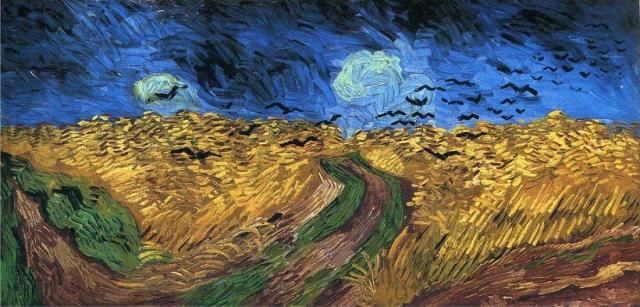
Wheatfield with Crows, by Vincent Van Gogh, 1890

One Sabbath day as Jesus was walking through some grainfields, his disciples began breaking off heads of grain to eat. But the Pharisees said to Jesus, “Look, why are they breaking the law by harvesting grain on the Sabbath?”

Jesus said to them, “Haven’t you ever read in the Scriptures what David did when he and his companions were hungry? He went into the house of God (during the days when Abiathar was high priest) and broke the law by eating the sacred loaves of bread that only the priests are allowed to eat. He also gave some to his companions.”

Then Jesus said to them, “The Sabbath was made to meet the needs of people, and not people to meet the requirements of the Sabbath. So the Son of Man is Lord, even over the Sabbath!”

Jesus went into the synagogue again and noticed a man with a deformed hand. Since it was the Sabbath, Jesus’ enemies watched him closely. If he healed the man’s hand, they planned to accuse him of working on the Sabbath.

Jesus said to the man with the deformed hand, “Come and stand in front of everyone.” Then he turned to his critics and asked, “Does the law permit good deeds on the Sabbath, or is it a day for doing evil? Is this a day to save life or to destroy it?” But they wouldn’t answer him.

He looked around at them angrily and was deeply saddened by their hard hearts. Then he said to the man, “Hold out your hand.” So the man held out his hand, and it was restored! At once the Pharisees went away and met with the supporters of Herod to plot how to kill Jesus. (New Living Translation)

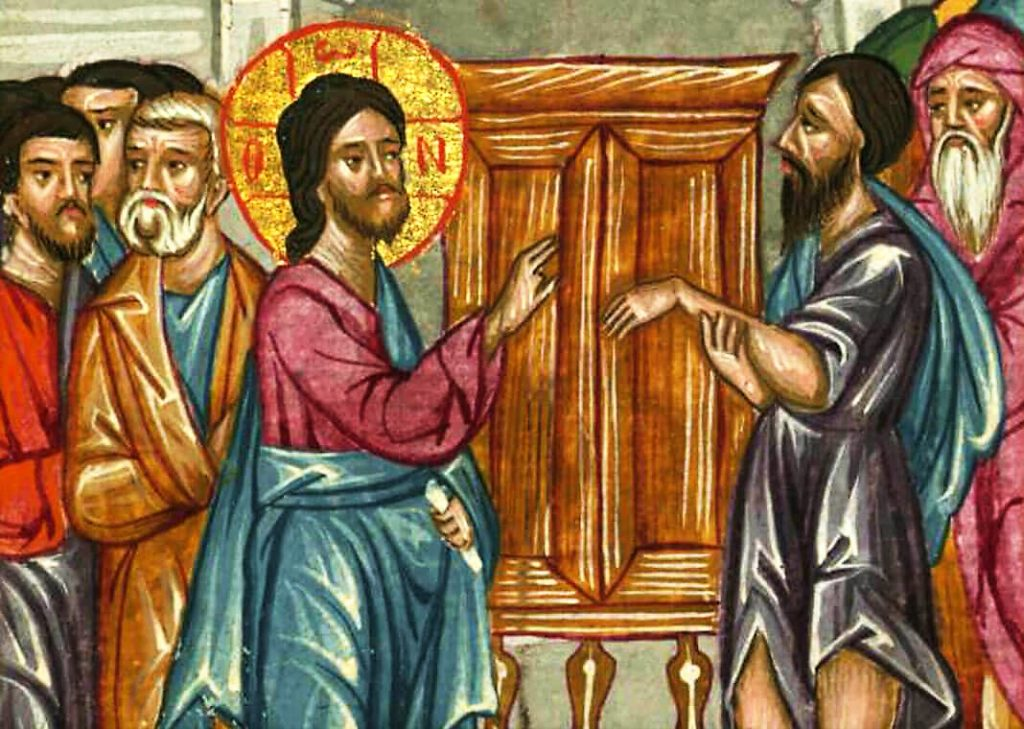
Jesus Heals the Man with the Withered Hand, by Ilyas Basim Khuri Bazzi Rahib, 1684

I am continually amazed whenever good people are surprised by being embroiled in the muck of human controversy. Since we live in a profoundly fallen world, good is often going to buck up against the bad. Besides, Jesus often found himself in a controversy of some kind; and we are not above our Lord.

There are two distinct yet similar controversies in today’s lesson; and they highlight why there were some folk who were all upset about the way Jesus went about things. Such people eventually came to the dark decision that Jesus needed to go away, permanently.

Much of the controversy between Jesus and the religious leaders came down to particular views of God’s law; and, of course, whose view was going to win out over the other. It ended up becoming what almost all controversies are about: Deciding who is really in power and calls the shots.

The Politics of Hunger

It was a Sabbath day. Jesus and his disciples were walking through the fields. And they were hungry. So the disciples took some grain, broke off the heads, and ate them. To any non-Jewish person, there’s no problem here. But the Pharisees were concerned.

First, they observed the disciples walking through grain fields. The Pharisees thought they should be staying put on the Sabbath. Second, and perhaps more significantly, the religious leaders saw Christ’s disciples gleaning – which was working on the Sabbath. To them, any respectable Jew prepared their food the day before. This is a lack of holiness, of not taking the Sabbath seriously. And this was completely unacceptable to the Pharisees.

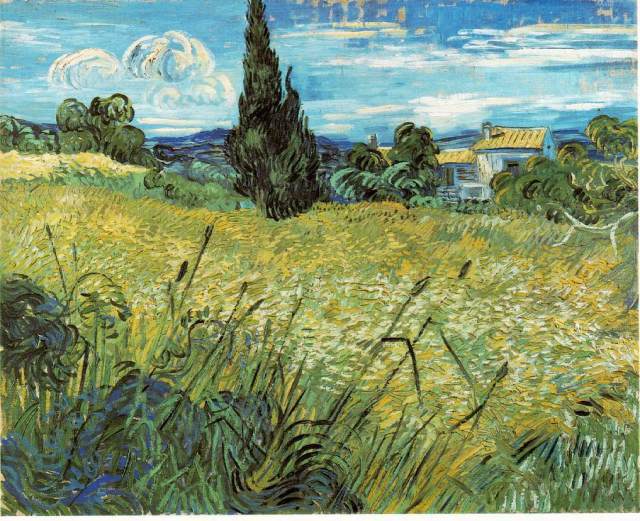
Wheat Field and Cypress by Vincent Van Gogh, 1890

Jesus, however, viewed walking through the fields differently. He did not consider the Sabbath as trivial; Jesus instead stood back and took a big picture perspective of it all. And that view included the ancient story of David, who took the consecrated bread in the tabernacle which was reserved only for Levite priests. (1 Samuel 21:1-6; Leviticus 24:8-9)

The reason David wanted the bread was because he was a fugitive, on the run from King Saul who was trying to take his life. Jesus insisted, on that day, the priest on duty did nothing wrong in giving the special bread to David. Yes, the strict letter of the law was broken; and, no, this was not wrong – because the priest was helping to save a life, and a very important one at that.

Jesus discerned there are times when particular laws come into conflict; so it’s necessary to maintain the spirit of a law in order to maintain a high value and meet a pressing human need. In a sense, Jesus gave a covenant code legal opinion on the subject.

It’s no surprise, to any reader of the New Testament Gospels, that Christ would behave this way; and that it would drive the religious leaders bananas. After all, they, the Pharisees, upheld law and rendered legal decisions – not this upstart wannabe. Jesus took an authoritative stance on what was happening, and the leaders did not at all like their own authority questioned.

This wasn’t some maverick interpretation by Jesus. He simply pointed out that the Sabbath is a gift, given to people to promote life and health – and not a burden that folks are to carry. Any decent Sabbath-keeper knew this.

It appears the leaders didn’t like being reminded of it from Jesus. What’s more, Jesus was much too close to likening himself to David. Yet another reason to despise this uppity teacher.

The Legality of Suffering

A second controversy brought the issue of who is in charge and who gets to arbitrate community values into a greater light. There is perhaps no other place for that conflict to happen than in the synagogue, the meeting place of worshipers. The juiciest things always seem to happen in a place of worship.

In the first story, the religious leaders were caught surprised over the behavior of Jesus and his disciples. They’re determined not to make that mistake again. From this point forward, it seems the Pharisees are continually waiting for a chance to put down Jesus as a lawbreaker and rabblerouser.

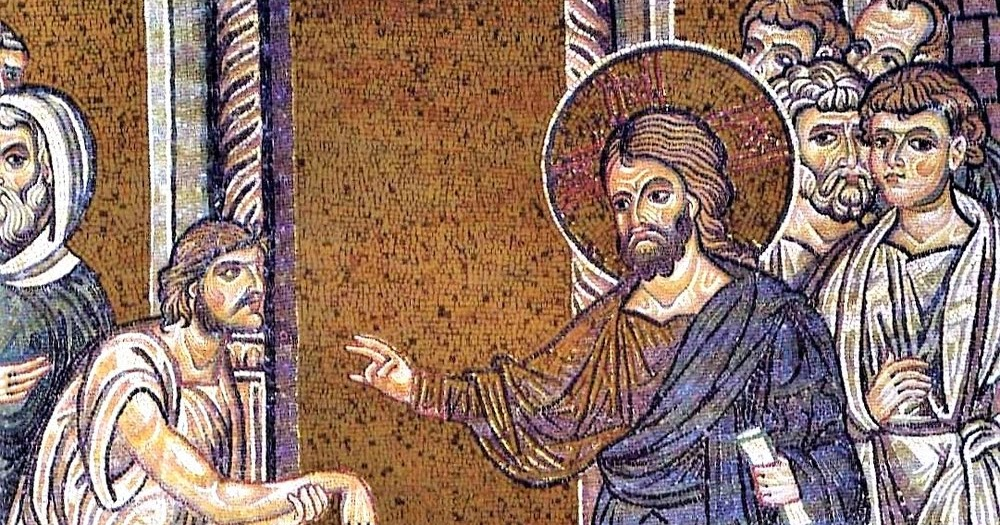
Byzantine mosaic of Christ healing the man with a withered hand, Cathedral of Monreale, Palermo, Sicily

For them, the issue wasn’t about the ability to heal, but whether it’s being done on the Sabbath. Much like the grainfield incident, healing is work, and working on the Sabbath is a direct violation of God’s immutable law. The religious leaders wanted to prove that Jesus has no regard for God’s will.

Law, for many Pharisees in Christ’s day, was meant to bring order so that chaos does not rule. Obedience to the law is a pre-condition for blessing. Without a clear demonstration of holy living, the community could be under a curse, much like their ancestors before them who were exiled for disregarding God’s law.

Yet again, Jesus cut through the anxious fear and authoritative posturing and went directly to the intended spirit of the law. The Sabbath, of all days in the week, ought to be a time for doing good, not harm; and to save life, not kill it. Jesus was not doing anything that could be considered work, anymore than his disciples were actually gleaning or harvesting grain.

There is no better day than the Sabbath for restoring a man’s withered and malformed hand, for giving him back his ability to make a living and contribute to the community. Much more was restored to the man than a physical ability; he now had the ability to better his life and his family, not to mention the local economy. It ought to be all good…

Unfortunately, the Pharisees didn’t see it that way, that the man gained his dignity back, his wholeness and his joy. They could only see a threat to their own hegemony.

The Beginning of the End

So, this marks the beginning of the end. The leaders are so upset and angry, they began plotting for Christ’s destruction. Unlikely political allies came together because of a common enemy. To view Jesus as a threat to society is, at the least, messed up. But that’s what happens when people cannot see beyond the end of their nose. They make bad choices.

Even though Jesus came to give life, others want to take his. Despite the fact that Jesus did not reject the law or demean the Sabbath, people with a short-sighted agenda and hard hearts could only see someone upsetting the status quo.

Today, these same things can quickly turn to hostility. The legal implications of one’s values and commitments can get nasty fast. Opinions can harden, resulting in oppression, persecution, and even death.

The most noble of motives can go sour; and the best of intentions, the highly educated, and the most gifted persons among us can become despotic in their leadership. Indeed, absolute power corrupts absolutely.

This is why the gracious and benevolent kingdom of God will win the day. Hard-hearted people become desperately out of touch with what is most important; they are calloused to the human need in front of their faces. I believe that the words and ways of Jesus can dispel those dark forces and impulses.

I’ll take a controversial Christ any day because that is the path to life abundant and everlasting.

Whenever unjust, oppressive, harmful, and fearful systems hold on, the ministry of Jesus exposes them for what they are, and will deliver us from evil.

Thanks be to God!