
What Is It You Are Trying To Do? (Mark 10:2-16)

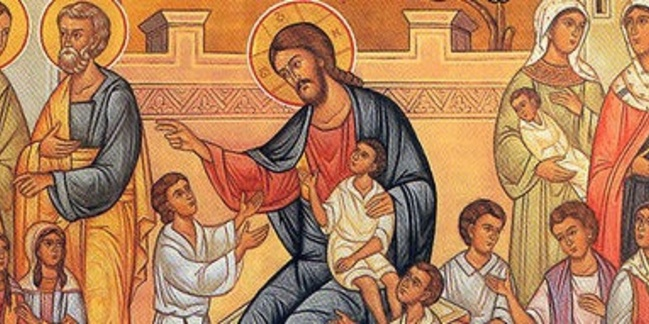
Jesus blesses the children

Some, testing him, asked, “Is it lawful for a man to divorce his wife?” He answered them, “What did Moses command you?” They said, “Moses allowed a man to write a certificate of dismissal and to divorce her.” But Jesus said to them, “Because of your hardness of heart he wrote this commandment for you. But from the beginning of creation, ‘God made them male and female.’ ‘For this reason a man shall leave his father and mother and be joined to his wife, and the two shall become one flesh.’ So they are no longer two but one flesh. Therefore what God has joined together, let no one separate.”

Then in the house the disciples asked him again about this matter. He said to them, “Whoever divorces his wife and marries another commits adultery against her, and if she divorces her husband and marries another, she commits adultery.”

People were bringing children to him in order that he might touch them, and the disciples spoke sternly to them. But when Jesus saw this, he was indignant and said to them, “Let the children come to me; do not stop them, for it is to such as these that the kingdom of God belongs. Truly I tell you, whoever does not receive the kingdom of God as a little child will never enter it.” And he took them up in his arms, laid his hands on them, and blessed them. (New Revised Standard Version)

Trying To Parse the Law?

The topic of divorce has always been a hot button issue throughout human history. And there have continually been diverse views and opinions about it. This is also true of Holy Scripture. A variety of interpretations are offered by many about the Bible’s view of divorce, and Christ’s words concerning it.

Much like today, divorce in the first century was accepted as part of what happens in society, even among Jews, although it was more proliferate in other cultures. Most of the discussions about divorce centered in legal details, with some speaking against it as bad for society.

Among the Jewish religious leaders and experts in the law, it was generally recognized that divorce occurs, with Mosaic legislation proscribing how to carry out divorce (Deuteronomy 24:1-4). Yet, other scripture texts frame the existence of divorce as questionable for God’s people. (e.g. Genesis 2:24; Malachi 2:13-16)

Trying to Test Jesus?

Anyone who doesn’t like another, will often confront them on a hot button issue that has plenty of diverse opinion to it. This is why the Pharisees sought to get Christ’s take on the topic of divorce.

Essentially, Jesus reframed divorce so that it was no longer simply a legal topic, but involves real people. Christ talked about divorce in a way that upheld the dignity of persons, especially women; and lifted up the true sanctity of marriage.

In turning the discussion from a legalities to God’s design for humanity and marriage, Jesus cut to the heart of the matter, to God’s intent, and to human frailty. He focused on relationships, because they were inherent from the beginning.

Yes, divorce is a reality, and it is has its place in society. But no, it’s not supposed to be this way. The very word “divorce” means there is a separation, a breech, a disconnection of relationship. This is why Christ went to another topic: adultery.

Trying To Divorce Women?

Jesus said that a person initiating a divorce in order to marry another person commits adultery. In saying this, he was not offering a legal conversation of details. Rather, Christ was focusing on people; he was concerned for wives and women.

The conversation between Jesus and the Pharisees was a discussion between men, and presupposed a man’s point of view on divorce. Women did not have the ability to initiate divorce in the ancient society.

And Christ seems to have had no stomach for being drawn into abstract legal debates between a bunch of men. Instead, he cared about the people involved in an actual divorce, especially the women.

For all intents and purposes, women (and their sexuality) were the property of men – the father, and then later, the husband. In this social milieu, whenever a husband initiated a break in the relationship, it was important for a woman to have a certified document of divorce. Without that certification, a woman divorcee would be landlocked, unable to do much of anything, as well as be the brunt of societal gossip, slander, or worse.

Since Jesus was talking to the men, the Pharisees, he pointedly looked at them and let them know that, although they might initiate a divorce, it in no way justified their sneaking and creeping around. It didn’t cover their adulterous relationship(s) nor their adulterous hearts.

All this is to say that Christ very much opposed divorce on the grounds of putting a wife away out of a desire for a different spouse. He intended on empowering women. In a divorce situation, because a man was in control of the process, it was then the man who commits adultery against the woman.

Both logically and legally, a woman could never commit adultery because of divorce – only the man. What’s more, adultery is not primarily a violation of the law, but of the woman. Jesus believed it was high time for some accountability with the men.

Even though contemporary Western society is much different than the ancient social structure, Christ’s teaching is still relevant. The need to uphold not just the law, but the rights of women is a must for today, as well.

Unless we can observe Christ’s concern for women’s justice and rights, there will be men who continue to leverage their own gender over and against females and wives. And there will continue to be both husbands and wives who initiate divorce for their own adulterous motives, thus putting their spouse in moral, legal, emotional, and spiritual jeopardy.

Trying To Keep Children Away?

The overarching ethics of Jesus, and the law of God, is to provide justice and righteousness for the most vulnerable among us. And this is why the teaching about divorce is coupled with instruction about children.

In our contemporary society, children have rights and are accorded significant status. That was not true in the ancient world. Children were mostly viewed as potential adults. Until then, kids were to stay quiet unless spoken to, and to obey their parents with absolutely no talk-back.

Christ’s disciples did what any student following their teacher would do; they kept the kids at bay so that Jesus could do his important ministry work. But what the disciples discovered is that the kids were actually part of that important ministry work. As children, they were vulnerable, at the low end of the social scale, and had no personal rights other than being part of a family.

To become like a little child in order to enter the kingdom of God did not mean becoming innocent; it meant becoming humble and dependent, and embracing meekness, gentleness, and lowliness. It meant to become the last and the least among us. Because the last will be first, and the least will become great.

Trying To Get It Right?

It’s important for us to uphold the sanctity of human life, and the spirit of the law. The law is intended to preserve and protect life – and is not to be used to find loopholes or ways to get what you want.

Meeting the needs of all people – whether they be men, women, children, and whether they be rich or poor – is to be everyone’s concern. Why? Because justice and righteousness are at the heart of God’s concern for humanity.

Merciful God, who discerns each heart: We confess our family is most often like strangers to us. So, give to all parents and children the grace to see one another as they truly are, and as you have called them to be. In the name of Jesus Christ, our mediator and advocate, we pray. Amen.


You Live For Whatever You Love (Luke 16:14-18)

The Pharisees, who loved money, heard all this and were sneering at Jesus. He said to them, “You are the ones who justify yourselves in the eyes of others, but God knows your hearts. What people value highly is detestable in God’s sight.

“The Law and the Prophets were proclaimed until John. Since that time, the good news of the kingdom of God is being preached, and everyone is forcing their way into it. It is easier for heaven and earth to disappear than for the least stroke of a pen to drop out of the Law.

“Anyone who divorces his wife and marries another woman commits adultery, and the man who marries a divorced woman commits adultery. (New International Version)

No one can serve two masters. Everyone is committed to something, based upon who or what they are truly serving. Everybody has a master which informs them of ultimate values in life.

In other words, we live for what or whom we love.

Money

The Gospel writer Luke flatly and unequivocally mentioned the Pharisees as loving money. They lived for it. Money was their ultimate value.

With money as master, God is not.

If one’s thoughts, desires, and motives are fueled by Master Money, then that person can say they love and serve God, but they would be lying through their teeth.

If one’s activities are dominated by investments, buying and selling, and conversations with financial planners, then it isn’t God to whom they are praying; Mammon is their God.

The servants of Master Money may attempt to justify themselves, and rationalize their service to Mammon. They might talk about how much they give to charitable organizations, support their local church with monetary gifts, and underwrite a community building project. Yet, the real muster of benevolence is to whom all the money is truly being directed.

Money itself is not the problem; it’s the love of money that’s the issue (1 Timothy 6:10). Such a love of money had taken root into the Pharisee’s heart. They were offended by the words of Jesus, who exposed their true master.

Kingdom

The religious leaders claimed to be all about the Mosaic Law – which is why Jesus addressed this. In Christ’s view, the law and the prophets were until John the Baptist. John’s ministry caused a kerfuffle, because he was the forerunner of Messiah. He pointed to Jesus as the hoped for Savior.

The kingdom of God was at hand. But the religious establishment was too rooted in money as their ultimate deliverer.

Jesus is the Son over God’s house, and the Ruler of God’s empire. Christ is the kingdom. Since the time of John, the kingdom of God has been proclaimed, and everyone is pressing into it.

Multitudes of people flocked and followed Jesus in his earthly ministry. They listened to him talk of God’s kingdom being near. They seized hold of it, striving and pressing to get in.

There were folks who dropped everything, gave up everything, and forsook everything, just to pursue the kingdom of God. Their press toward the kingdom was a reflection of their values. And money had nothing to do with it.

Those who are Christians, in name only, may know something of Jesus and might talk a good line of theology, but they are far from the kingdom of God. They talk, but they don’t press. Someone who presses cries out with the psalmist:

How lovely is your dwelling place,
    Lord Almighty!
My soul yearns, even faints,
    for the courts of the Lord;
my heart and my flesh cry out
    for the living God. (Psalm 84:1-2, NIV)

Someone who presses is ready and willing to do some heavy spiritual lifting. They’ll put in the time and the effort toward the kingdom of God. It’s Jesus they think about, not money.

Law

Believers and followers of Jesus are concerned for what God cares about. And Jesus was concerned about Holy Scripture. He intended on keeping every jot and tittle of the Torah, the Law.

Although we have many differing interpretations of varying passages in the Bible, Jesus is still concerned for the fulfillment of all God’s good promises. Our own angst about upholding the Bible isn’t shared by Christ. Our arguments and divisions don’t sway Jesus into our anxiety.

Christ knows that every word of God shall not fail. It would be easier for the world to spontaneously blow up than for any one word of God to fall away unfulfilled. Money and stuff will pass away, but not God’s Word.

The basic moral and ethical will and law of God hasn’t gone anywhere. Just because the Ten Commandments are not posted publicly anywhere, doesn’t mean they have disappeared.

God’s holy law is like a mirror in front of us, showing us how we are to judge ourselves. The Apostle Paul likened the law to a schoolmaster that drives us to Christ (Galatians 3:24-27).

Furthermore, the law acts as a restraint to evil in the world. It has the value of revealing to us what is not pleasing to God. And if I am pressing into the kingdom of God, I want to know what God loves and hates.

The Pharisees were supposedly the experts in God’s law. Some folks are quite hard on the Pharisees. Yet, rather than bashing on them as a group of people, we need to let the law be our own mirror; we must be concerned with our own righteousness, or lack thereof.

It’s easy for us, along with the old Pharisees, to be legalists – adding principles and traditions to the law that are not the law itself. Holding to these traditions can become as important, or more, as the actual law. They can end up becoming the standard we judge everything by, instead of the actual law, as it is.

Divorce

The morass of traditions surrounding the law is what Jesus was referring to in speaking about divorce. Christ had no use for a husband who could divorce his wife for various incidents, including not being pretty anymore, breaking a dish, or burning the toast.

All of that rigmarole was why Jesus came back to affirming the sanctity of marriage. He pointed out that divorce under conditions of tradition, not law, were tantamount to adultery. Christ was thinking of women’s rights.

In a society in which women were dependent upon men for having their needs met, Jesus did not want women to experience injustice from men. In God’s economy, men are neither free to do whatever they want with women, nor with marriage. Their money needs to be used for wife and family, and not in cleverly contrived ways to get around the law.

We live for what we love. If someone loves money, it will not end well for them. If someone loves God and doing God’s will, then there is life and peace.

Let’s just make sure that we are truly doing God’s will, and not our own secret or unconscious intentions. Because no one can serve two masters.

Blessed God, help me to do Your revealed will fully, gladly, and immediately; and to love You with all my heart, soul, mind, and strength. Enable us all to love our neighbors as ourselves; and to seek the good of people from everywhere. Save us from being unhappy Christians. Deliver us from the sinful habit of complaint. May we rejoice in You, be constant in prayer, and give thanks in all circumstances; through Jesus Christ our Lord, in the strength of the Holy Spirit. Amen.

How Much Is Too Much? (1 Kings 4:20-28)

King Solomon’s court, by Claude Vignon (1593-1670)

The people of Judah and Israel were as numerous as the sand on the seashore; they ate, they drank and they were happy. And Solomon ruled over all the kingdoms from the Euphrates River to the land of the Philistines, as far as the border of Egypt. These countries brought tribute and were Solomon’s subjects all his life.

Solomon’s daily provisions were thirty cors of the finest flour and sixty cors of meal, ten head of stall-fed cattle, twenty of pasture-fed cattle and a hundred sheep and goats, as well as deer, gazelles, roebucks and choice fowl. For he ruled over all the kingdoms west of the Euphrates River, from Tiphsah to Gaza, and had peace on all sides. During Solomon’s lifetime Judah and Israel, from Dan to Beersheba, lived in safety, everyone under their own vine and under their own fig tree.

Solomon had four thousand stalls for chariot horses, and twelve thousand horses.

The district governors, each in his month, supplied provisions for King Solomon and all who came to the king’s table. They saw to it that nothing was lacking. They also brought to the proper place their quotas of barley and straw for the chariot horses and the other horses. (New International Version)

Wealth, in and of itself, is neither good nor bad – it just is. The real issue is why any particular person wants to be wealthy, how we view wealth, and what we do with it when we have it.

In ancient Israel, under King Solomon, the Israelites enjoyed a time of prosperity, safety, and abundance. To flourish and thrive in life is good. The ability to meet basic needs, and to enjoy life is good.

King Solomon on his throne, by Frans Francken the Younger (1581-1642)

But what about beyond that? Is there such a thing as too much? And what about others who may not be able to make ends meet?

Solomon certainly had a lot. Yet, we do have warnings in Holy Scripture about exorbitant wealth. Here is what the Deuteronomic law says concerning any future king:

The king, moreover, must not acquire great numbers of horses for himself or make the people return to Egypt to get more of them, for the Lord has told you, “You are not to go back that way again.” He must not take many wives, or his heart will be led astray. He must not accumulate large amounts of silver and gold. (Deuteronomy 17:16-17, NIV)

Whatever standard one may use, I would say 12,000 horses falls into the great-numbers-of-horses category. And likewise, having 1,000 wives is most likely 999 too many for just about every man on the planet.

Indeed, Solomon’s heart was eventually led astray. It’s quite sad. Even the wisest and wealthiest person who ever lived was not able to sustain complete faithfulness to God. The remainder of Deuteronomy’s instruction about a future king is this:

When he takes the throne of his kingdom, he is to write for himself on a scroll a copy of this law, taken from that of the Levitical priests. It is to be with him, and he is to read it all the days of his life so that he may learn to revere the Lord his God and follow carefully all the words of this law and these decrees and not consider himself better than his fellow Israelites and turn from the law to the right or to the left. Then he and his descendants will reign a long time over his kingdom in Israel. (Deuteronomy 17:18-20, NIV)

In all fairness, King Solomon started out paying attention to God’s law. In his wisdom, he sought to learn and obey – but it ended up being only a partial obedience.

A dimension of any rule or government is to realize that – with any sort of success, security, and wealth – there is always a dark underbelly to it. That is, there are people within that government who are not enjoying its largess and wealth.

Under the new expanded governmental system, Solomon had his kingdom, and its subject peoples, divided into districts in order to give provisions, as well as laborers for his ambitious building projects. Not everyone was enjoying leisure time under a fig tree.

King Solomon set up an economic system that transferred wealth from nations subservient to Israel, and from subsistence farmers within Israel, to support the massive needs of Jerusalem.

The city, under Solomon, was living off the surplus grain to feed all of the horses, as well as the tribute exacted from surrounding nations. In other words, the wealth was being centralized by Solomon for his many projects and interests.

All of the opulence was meant to impress people with wealth, exhibiting Israel’s and Solomon’s great power and wisdom. Yet, if we are to follow the old adage, “follow the money,” we would discover a governmental system that extracted money from others; and produces a lot of oppression, grievances, and exploitation – hence, the dark underbelly of it all.

This sort of situation is precisely why we have prophetic literature in the Old Testament. The prophets are especially attuned to the cries of injustice amongst the people. Every society needs such persons who are within the system, yet are able to be a voice for those who are voiceless.

Had King Solomon moved beyond his partial obedience to complete and total obedience, I surmise that he likely would have considered the needs of everyone within his empire, before establishing a system of government that depended upon economic exploitation.

Specifically, perhaps Solomon ought to have engaged more vigorously and robustly with the covenant code between God and Israel that he was supposed to know so well.

And perhaps, Christianity and the Church have been too lax on the subject of handling Holy Scripture. Because, for all of our talk of being faithful to scripture, that talk has not translated into a solid social and economic understanding of human need and justice.

It simply will not do to label anything we don’t like as communist or socialist. And it will not do to say King Solomon was wealthy and successful, as if that, in and of itself, is the evidence of God’s favor. In reality, it means little, apart from a complete fidelity to God’s law.

In my judgment, Jesus did better than all of this. He pointed us to an alternative system which considers the common good of all persons, and not just some people. The ethics and morality of his Sermon on the Mount lays out the foundational means upon which any sort of governmental system ought to build upon. (Matthew 5-7)

But seek first his kingdom and his righteousness, and all these things will be given to you as well.

Jesus (Matthew 6:33, NIV)

If we are looking for the same sort of wealth and success as Solomon, that means we’ll need to ignore Jesus. Yet, if faithfulness, obedience, humility, righteousness, mercy, purity, and peacemaking matter more than our economic bottom line, then I believe we will discover that the pursuit of these virtues leads to having all of our needs met, as well.

Lord of our lives, teach us how to use our money and our possessions. Deliver us from stinginess and wasteful extravagance; inspire our giving with the spirit of true generosity. Help us always to remember your generous love for us, that we may be wise and faithful stewards of the good gifts you have given us. Amen.

Avoid the Downward Spiral (Judges 6:1-10)

The Israelites did evil in the eyes of the Lord, and for seven years he gave them into the hands of the Midianites. Because the power of Midian was so oppressive, the Israelites prepared shelters for themselves in mountain clefts, caves and strongholds. Whenever the Israelites planted their crops, the Midianites, Amalekites and other eastern peoples invaded the country. 

They camped on the land and ruined the crops all the way to Gaza and did not spare a living thing for Israel, neither sheep nor cattle nor donkeys. They came up with their livestock and their tents like swarms of locusts. It was impossible to count them or their camels; they invaded the land to ravage it. Midian so impoverished the Israelites that they cried out to the Lord for help.

When the Israelites cried out to the Lord because of Midian, he sent them a prophet, who said, “This is what the Lord, the God of Israel, says: I brought you up out of Egypt, out of the land of slavery. I rescued you from the hand of the Egyptians. And I delivered you from the hand of all your oppressors; I drove them out before you and gave you their land. I said to you, ‘I am the Lord your God; do not worship the gods of the Amorites, in whose land you live.’ But you have not listened to me.” (New International Version)

Frankly, the biblical Book of Judges is rather depressing. Its descriptive arc is a sad downward spiral of forgetfulness and disobedience – with the people crying out for deliverance and being saved – and then another slide, even lower than before, into memory issues, and negligence of the law.

Newer and greater levels of depravity occur, the further one reads into the Book of Judges. Indeed, early in the book we are given the reason for such an immoral and idolatrous slide:

The people served the Lord throughout the lifetime of Joshua and of the elders who outlived him and who had seen all the great things the Lord had done for Israel…

After that whole generation had been gathered to their ancestors, another generation grew up who knew neither the Lord nor what he had done for Israel. Then the Israelites did evil in the eyes of the Lord and served the Baals. They forsook the Lord, the God of their ancestors, who had brought them out of Egypt. They followed and worshiped various gods of the peoples around them. They aroused the Lord’s anger because they forsook him and served Baal and the Ashtoreths. 

In his anger against Israel the Lord gave them into the hands of raiders who plundered them. He sold them into the hands of their enemies all around, whom they were no longer able to resist. Whenever Israel went out to fight, the hand of the Lord was against them to defeat them, just as he had sworn to them. They were in great distress. (Judges 2:7, 10-15, NIV)

In today’s Old Testament lesson, yet another round of disobedience brought yet another threat, in the form of the Midianites and Amalekites. Midian’s annual raids of Israelite land destroyed crops and led to the livestock eventually starving. The people were left just trying to eek-out a living and survive.

The Midianites were a nomadic people, subsisting mostly through trade. They were not farmers, and really did not need to raid Israel. It seems they came and did their damage just to keep Israel weak and under their thumb, unable to compete in the caravan markets that Midian depended upon.

The story of crop destruction, and Midianites as thick as locusts, communicates divine judgment and connects with Joshua’s warning to remember God and be faithful to the covenant law:

“If you violate the covenant of the Lord your God, which he commanded you, and go and serve other gods and bow down to them, the Lord’s anger will burn against you, and you will quickly perish from the good land he has given you.” (Joshua 23:16, NIV)

The Israelites cried out in their distress to God for deliverance. They were answered by an unknown prophet who clearly connected the people’s disloyalty to their adverse situation. Although Canaanite gods may have been tolerant of worshiping other deities, the Lord, Israel’s God, is certainly not.

In the case of the ancient Israelites, the people’s disobedience caused their suffering. The prophet did not promise any sort of deliverance. And the distressed people were left wondering if they had been abandoned by God.

This entire situation is a set up for the character of Gideon, who will come on the scene as one of the dominant deliverers in the Book of Judges. And Gideon’s story further illustrates the ever-increasing relationship between Israel, Canaan, and immoral behavior.

By the time we get to the end of the book, there is a sort of morbid and depressing anarchy that has settled amongst the people, ending in the statement:

In those days Israel had no king; everyone did as they saw fit. (Judges 21:26, NIV)

That was not a statement of freedom, but of depravity. It was almost like living in a dystopian society in which nobody was really safe.

Yet God always has had a remnant of people who are faithful and remember the great things which the Lord has done.

So, if we want to avoid the downward spiral in the Book of Judges, the believer is encouraged to keep memory of God’s works, words, and ways in this world; and to remain faithful in obeying God’s law and embracing God’s love.

We need the law of love, and the love of law, in order to rightly relate to our neighbor and be concerned for the common justice of all persons – instead of living in a bubble of supposed safety, doing only what seems right to me.

Lord God, almighty and everlasting Father, you have brought us in safety to this new day: Preserve us with your mighty power, that we may not fall into sin, nor be overcome by adversity; and in all we do, direct us to the fulfilling of your purpose; through Jesus Christ our Lord. Amen.