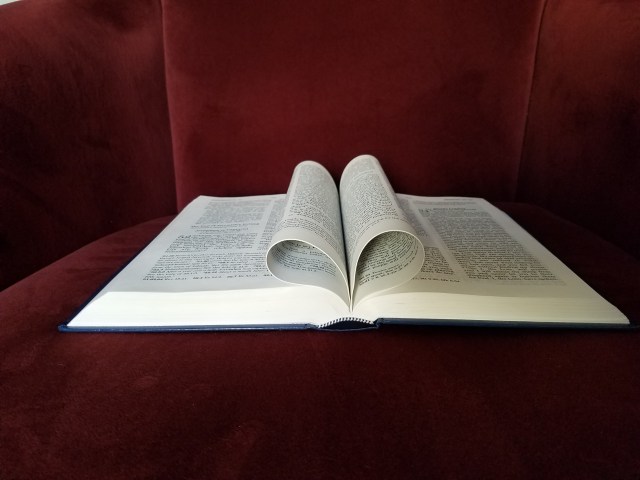
Psalm 119:97-104 – God the Teacher

I deeply love your Law!
    I think about it all day.
Your laws never leave my mind,
    and they make me much wiser
    than my enemies.
Thinking about your teachings
    gives me better understanding
    than my teachers,
and obeying your laws
makes me wiser
    than those
    who have lived a long time.
I obey your word
    instead of following a way
    that leads to trouble.
You have been my teacher,
    and I won’t reject
    your instructions.
Your teachings are sweeter
    than honey.
    They give me understanding
    and make me hate all lies. (CEV)

We live in a wonderful, complex, beautiful, broken, and upside-down world. The information we access, the choices we make, and the networking we engage in all require a great deal of wisdom.  Throw into the mix the reality that most things rarely go as we plan, and you have a recipe for disappointment and/or frustrating anger.  So, is there a path, a way of approaching this world that can help us navigate all its twists and trials?  Yes, there is a light through it all. Today’s psalm informs us how to proceed.

Wisdom in the Old Testament is the ability to take revealed truth and put it into concrete daily practice. So then, a life marked by the love and study of God’s Word brings both right living and enjoyment. God is our teacher and faithfully guides us into grateful living through his promises and commands. We can put ourselves in a position to sit at the master’s feet and receive gracious instruction for life.

Lectio Divina is one way of doing just that: allowing God to teach us through his Holy Word. Lectio Divina is an ancient Latin term which means “spiritual reading.”  It means to read Holy Scripture not just to know its contents, but to experience its power to restore, heal, transform, provide wisdom, and draw close to God. 

Lectio Divina is a simple way to prayerfully read the Bible, meditate on its message, and listen for what God may be saying for us to do.  It can be done privately, or with a small group of people.  The goal for the Christian is to become more Christ-like.

Lectio Divina is based upon reading a selected text of Scripture three times. Each reading is followed by a period of silence after which each person is given the opportunity to briefly share what they are hearing as they listen to God (if done in a group).

First Reading

During the first reading, read the text aloud twice. Read slowly and carefully. The purpose of the first reading is for each person to hear the text and to listen for a word, phrase or idea that captures their attention. As group members recognize a word, phrase, or idea, they are to focus their attention on it, repeating it within their minds several times.

Second Reading

During the second reading, read the text again. This time, listeners are to focus their attention on how the selected word, phrase or idea speaks to their life that day. What does it mean for you today? How is Christ, the Word, speaking to you about your life through this word, phrase, or idea? What is Christ, the Word, speaking to you about your life through this word, phrase, or idea? After the reading, a brief period of silence is observed and then group members share briefly what they have heard.

Third Reading

Read the text again. This time, listeners are to focus on what God is calling them to do or to become. Experiencing God’s presence changes us. It calls us to something. During this final reading, focus on what God is calling you to do or to be.  After the third reading, there is a period of silence, then group members share what they are being called to do or to be.

The psalms, especially Psalm 119, are meant to be read over-and-over again, to be used for prayer, worship, and study. Devoting ourselves to the psalms and grafting them into our lives is one of the best practices we can do to live a healthy and happy spiritual life.

Almighty God extend your goodness to me according to your Holy Word. Teach me knowledge and good judgment because I trust your commands. I seek to obey your wondrous Word. You are good, and what you do is always good. Teach me your decrees through Jesus Christ my Lord in the wisdom of your Holy Spirit. Amen.


Romans 7:7-20 – Facing Our Bundle of Contradictions

contradiction
“Humanity is an embodied paradox, a bundle of contradictions.”-Charles Caleb Colton, 1780-1832

What shall we say, then? Is the law sinful? Certainly not! Nevertheless, I would not have known what sin was had it not been for the law. For I would not have known what coveting really was if the law had not said, “You shall not covet.” But sin, seizing the opportunity afforded by the commandment, produced in me every kind of coveting. For apart from the law, sin was dead. Once I was alive apart from the law; but when the commandment came, sin sprang to life and I died. I found that the very commandment that was intended to bring life actually brought death. For sin, seizing the opportunity afforded by the commandment, deceived me, and through the commandment put me to death. So then, the law is holy, and the commandment is holy, righteous and good.

Did that which is good, then, become death to me? By no means! Nevertheless, in order that sin might be recognized as sin, it used what is good to bring about my death, so that through the commandment sin might become utterly sinful.

We know that the law is spiritual; but I am unspiritual, sold as a slave to sin. I do not understand what I do. For what I want to do I do not do, but what I hate I do. And if I do what I do not want to do, I agree that the law is good. As it is, it is no longer I myself who do it, but it is sin living in me. For I know that good itself does not dwell in me, that is, in my sinful nature. For I have the desire to do what is good, but I cannot carry it out. For I do not do the good I want to do, but the evil I do not want to do—this I keep on doing. Now if I do what I do not want to do, it is no longer I who do it, but it is sin living in me that does it. (NIV)

The Apostle Paul’s vulnerable expression of his dilemma resonates deeply with many people. There are times when we say things to ourselves such as, “I told myself I wasn’t going to be like my mother, and here I am responding just like she would;” “I know better than to drive by the liquor store on my way home and pick up a pint of vodka, yet, I still did it;” or, “I don’t want to die, but my thoughts keep racing about a plan for suicide.” And, there are many more situations in which we are both frustrated and befuddled by our doing the things we do not want to do, and not doing the things we want to do.

Yes, indeed, Paul’s existential angst is a timeless description of our common human condition. We all can relate to the seeming inability to do what is right in so many situations. It can really drive us nuts, even to a constant and never-ending low-level discouragement that underlies almost everything we do.

Paul’s prescription for dealing with this does not rely on law. He understood that putting our willpower and effort into obeying commands gets us nowhere because we will eventually fail. Neither our brains nor our spirits work that way. Our willpower was never designed to be the driver of what we do and do not do. If anything, willpower, and the lack thereof demonstrate just how much we are climbing the ladder on the wrong wall. People are a bundle of contradictions, doing good, then bad, and flip-flopping back and forth with great frustration.

God’s law was not crafted to transform us from the inside-out. The law has three solid purposes, none of which are meant to bring deep personal transformation: attention to the law works to restrain sin in the world; use of the law provides us with a helpful guide for grateful living in response to divine grace; and, it’s use here by Paul is to show us how bad off we really are in this world and in need of forgiveness.

We need a change of habits, and this is different than adopting a list of laws. Habits are developed from our desires, our affections. In other words, we do what we love – more specifically, our ultimate love(s) drive us to do what we want. To put it in a straightforward way: We sin because we like it. And the path to overcoming any besetting sin is to have an ultimate love trump the lesser sin which we like.

St Augustine quote 2

For example, I have developed daily habits or rituals of faith which enable me to commune with God. I love God with all my heart, soul, mind, and strength, and this ultimate love enables me to push out all competing gods who want my devotion. I also love my wife with all my heart. We work on developing habits of a marital relationship which reinforce our love for each other. Love is what drives me to do right and good by her.

So, what do we do when we mess up? For the Christian, no matter what the question is, the answer is always grace. God’s grace in the finished work of Jesus Christ applied to us by the Holy Spirit is the operative power that changes lives. The law has no power to do that kind of work. Freedom from the tyranny of our misplaced desires and disordered loves comes from Christ’s forgiveness through the cross. Like a lover enamored with his beloved, our desires become oriented toward Jesus for his indescribable gift to us. That is the strength of grace.

Saving God, I thank you for delivering me from sin, death, and hell through your Son, the Lord Jesus.  May your Holy Spirit apply the work of grace to my life every day so that I can realize spiritual healing and practical freedom from all that is damaging and destructive in my soul.  Amen.

Exodus 19:16-25 – An Awesome God

Mount Sinai

On the morning of the third day, thunder roared, and lightning flashed, and a dense cloud came down on the mountain. There was a long, loud blast from a ram’s horn, and all the people trembled. Moses led them out from the camp to meet with God, and they stood at the foot of the mountain.  All of Mount Sinai was covered with smoke because the Lord had descended on it in the form of fire. The smoke billowed into the sky like smoke from a brick kiln, and the whole mountain shook violently. As the blast of the ram’s horn grew louder and louder, Moses spoke, and God thundered his reply. The Lord came down on the top of Mount Sinai and called Moses to the top of the mountain. So, Moses climbed the mountain.

Then the Lord told Moses, “Go back down and warn the people not to break through the boundaries to see the Lord, or they will die. Even the priests who regularly come near to the Lord must purify themselves so that the Lord does not break out and destroy them.”

“But Lord,” Moses protested, “the people cannot come up to Mount Sinai. You already warned us. You told me, ‘Mark off a boundary all around the mountain to set it apart as holy.’”

But the Lord said, “Go down and bring Aaron back up with you. In the meantime, do not let the priests or the people break through to approach the Lord, or he will break out and destroy them.”

So, Moses went down to the people and told them what the Lord had said. (NLT)

As Christians await the Day of Pentecost and the giving of the Spirit, the Revised Common Lectionary reminds us of another great anticipation from the Old Testament. The ancient Israelites were amazingly delivered from Egyptian slavery, miraculously walked through the Red Sea, and traveled with wondrous anticipation to Mount Sinai. Now, in today’s reading, they are about to meet with God!

The scene of this meeting is not exactly the romantic highland encounter of the Man from Snowy River (my wife’s all-time favorite movie). The landscape is much more akin to the dark and volcanic Mount Doom from The Lord of the Rings. The picture appears more foreboding than loving. The thing about mountain top experiences is that they are not all monolithic one-size-fits-all encounters with bright rainbows and happy skipping unicorns.

Holy Scripture is replete with mountain experiences. Mountains serve as symbols for significant encounters with a mighty God. Whether it is Christ’s transfiguration on a mountain; or, the giving of the law on a mountain; the awesome mountain serves as a tangible symbol of divine majesty, strength, and sovereignty. And, I might add, conversely, valleys in Scripture are symbolic of difficulty and suffering.  Our God is a God of both mountain and valley. That is, the God of the Bible is both transcendent and immanent; he rules with power and might high above us on his holy mountain; yet, he also comes near to us in the valley of the shadow of death.

Leading up to the giving of the Ten Words (Commandments) in Exodus 20, Exodus 19 portrays an awesome scene of God in his transcendent holiness and power. In fact, the experience was so otherworldly that the people were afraid to even come near the mountain. The Israelites needed limits placed on themselves because of God’s holy presence. Just like coming too near the immense power of the sun will destroy us, so getting near God can ruin us if we do not respect his holiness.

Respecting God’s power and transcendence brings the reality of his immanence into greater appreciation. God has gone to extreme lengths to reveal himself to his people. For the Christian, it all culminates through the incarnation of Christ, the sending of the Son. In Jesus, the transcendence and immanence of God meet perfectly to bridge the chasm between humanity and the divine.  Because of Jesus, the awesome sounds of thunder and trumpet do not lead to fear; they announce grace to those who approach God by faith.

You have not come to a mountain that can be touched and that is burning with fire; to darkness, gloom and storm; to a trumpet blast or to such a voice speaking words that those who heard it begged that no further word be spoken to them, because they could not bear what was commanded: “If even an animal touches the mountain, it must be stoned to death.” The sight was so terrifying that Moses said, “I am trembling with fear.” But you have come to Mount Zion, to the city of the living God, the heavenly Jerusalem. You have come to thousands upon thousands of angels in joyful assembly, to the church of the firstborn, whose names are written in heaven. You have come to God, the Judge of all, to the spirits of the righteous made perfect, to Jesus the mediator of a new covenant….

See to it that you do not refuse him who speaks. If they did not escape when they refused him who warned them on earth, how much less will we, if we turn away from him who warns us from heaven? At that time, his voice shook the earth, but now he has promised, “Once more I will shake not only the earth but also the heavens.” The words “once more” indicate the removing of what can be shaken—that is, created things—so that what cannot be shaken may remain.

Therefore, since we are receiving a kingdom that cannot be shaken, let us be thankful, and so worship God acceptably with reverence and awe, for our “God is a consuming fire.” (Hebrews 12:18-29, NIV)

Our God is an awesome God. As Christians anticipate Pentecost, we connect the consuming fire of Mount Sinai with the fire of the Spirit. The divine drama of both experiences has provided God’s people with spiritual power. Both the deliverance of the Israelites from Egyptian slavery by God and the deliverance secured on Mount Zion from spiritual slavery by Jesus are meant to free us to do the will of God. With God’s Word and God’s Spirit given to us, we are emancipated from an empty way of life to experience the fullness of Christ.

May the Spirit who hovered over the waters at creation breathe life into your spirit.

May the Spirit whose presence on the mountain was a consuming fire grant you a revived spirit.

May the Spirit who overshadowed the virgin Mary at the conception of our Lord overwhelm your spirit with joy.

May the Spirit who set the Church afire on Pentecost aflame every spirit on earth with the love of Christ.

And, may the Spirit who exhorts, encourages, helps, and comforts be your blessing and your life today and always. Amen.

Psalm 19

            Different cultures have multiple words for things which are important to them.  For example, in most Asian countries there are various words for “rice” depending upon which strain it is and in what manner it is cooked.  Rice is important to them.  In America, we only have one word for “rice” no matter where it comes from or how it is prepared.  However, whereas the country of Indonesia might only have one generic word for “money,” we in the West have a plethora of terms for it:  coins; bills; dollars; checks; debit accounts; stock; bonds; annuities, etc.  Americans have dozens of words for “money” because it is weaved into the fabric of our capitalistic way of life.
             When we come to the text of Psalm 19, we encounter several words for “law:” testimony; precept; commandment; and, rules.  Not only that, even the physical creation itself proclaims God’s law and his speech throughout the earth.  The law is important to Hebrew culture and to the Scriptures.  Indeed, we would not have the Bible as we know it without being filled with all kinds of commandments.
             Therefore, a healthy way to approach God’s Holy Word is to pay careful attention to the commands because they are important.  The law of God is to be as familiar to the Christian as Jesus and the Spirit.  We need God’s guidance and direction in order to live rightly and please him in every way.  When we look at the law with gratitude and seek to obey God through it, we will learn to avoid sin and lead a blameless life.  So, to commit God’s Word to heart and to memory would be sage for every believer.
             Gracious God, let the words of my mouth and the meditation of my heart be acceptable in your sight, O Lord, my rock and my redeemer.  Amen.