A Call to Truth and Justice (Exodus 23:1-9)

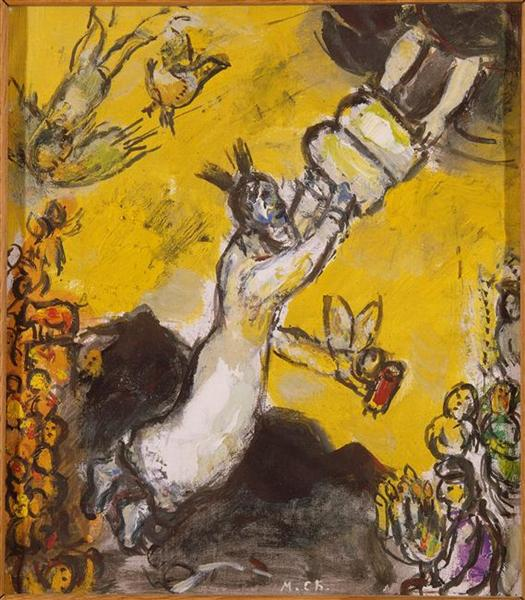
Moses Receives the Law, by Marc Chagall, 1963

“You must not pass along false rumors. You must not cooperate with evil people by lying on the witness stand.

“You must not follow the crowd in doing wrong. When you are called to testify in a dispute, do not be swayed by the crowd to twist justice. And do not slant your testimony in favor of a person just because that person is poor.

“If you come upon your enemy’s ox or donkey that has strayed away, take it back to its owner. If you see that the donkey of someone who hates you has collapsed under its load, do not walk by. Instead, stop and help.

“In a lawsuit, you must not deny justice to the poor.

“Be sure never to charge anyone falsely with evil. Never sentence an innocent or blameless person to death, for I never declare a guilty person to be innocent.

“Take no bribes, for a bribe makes you ignore something that you clearly see. A bribe makes even a righteous person twist the truth.

“You must not oppress foreigners. You know what it’s like to be a foreigner, for you yourselves were once foreigners in the land of Egypt. (New Living Translation)

On Mount Sinai, God gave Moses the Ten Commandments. These laws are basic ethical commands given to the people in their relationship to God and to one another. Following those Ten Words, the next several chapters of Exodus provide detailed instructions and commands for the Israelites in their own social, economic, and cultural context.

Today’s Old Testament lesson is part of this sequence of specific laws for the Israelites. These laws all have to do with being honest in legal matters. There is to be no perversion of justice through perjury, favoritism, bending to dishonest pressure, bribery, and false charges. What’s more, there must be no overlooking of the poor and powerless; and no disregard for the immigrant and foreigner.

All the sequences of commands – covering Exodus chapters 20-25 – are connected back to the basic Ten Commandments. The laws about justice and injustice are the fleshing-out of the ninth command to not testify falsely against your neighbor.

In other words, we are not to lie in public, especially when a person’s life or livelihood is at stake. We are to practice right relations with others; and do justice for all persons without prejudice or favoritism. We do this because God shows no favoritism and judges rightly with proper justice.

He will not judge by what he sees with his eyes,
    or decide by what he hears with his ears;
but with righteousness he will judge the needy,
    with justice he will give decisions for the poor of the earth. (Isaiah 11:3-4, NIV)

The Lord is a just God – it is inherent to the divine character. Therefore, our actions, as people created in the image of God, are to always be just, right, and truthful. There is a special place in God’s heart for the poor and powerless, and so, we ought also to consider their needs and treat them well and with respect – because true religion gives to those who we know cannot pay us back.

This, then, also is why immigrants and foreigners are mentioned. They need proper justice, and not negligence on our part to provide them with what they need. Throughout Holy Scripture we are admonished to not oppress the stranger from another place.

For through him [Christ] we both have access to the Father by one Spirit. Consequently, you are no longer foreigners and strangers, but fellow citizens with God’s people and also members of his household, built on the foundation of the apostles and prophets, with Christ Jesus himself as the chief cornerstone. (Ephesians 2:18-20, NIV)

The Lord watches over the foreigner
    and sustains the fatherless and the widow,
    but he frustrates the ways of the wicked. (Psalm 146:9, NIV)

Jesus picked up on the basic commands of God in his Sermon on the Mount – which, in many ways, is a restatement of the Ten Commandments by getting to the heart of them. Concerning the matter of giving false pledges, he said:

“Again you have heard that it was said to those who lived long ago: Don’t make a false solemn pledge, but you should follow through on what you have pledged to the Lord… Let your yes mean yes, and your no mean no. Anything more than this comes from the evil one. (Matthew 5:33, 37, CEB)

In court, we offer an oath, swearing that we will tell the truth and only the truth – and no lying. This is the only way that injustice can be avoided and justice can be established.

“I swear on a stack of Bibles I won’t…” “I will, if I get around to it….” These are a few of the caveats we give when making a promise or oath. Oaths communicate our truthful intentions of being above board with a high level of integrity.

It’s not okay when we bear false testimony concerning an event or incident that has taken place. There is no excuse for saying something is truthful when you know it isn’t quite true or all true. That makes us liars.

The Lord detests lying lips, but he delights in people who are trustworthy. (Proverbs 12:22, NIV)

Jesus wants us to clarify our values of right and wrong; make wise decisions; identify what we know is truth and error; and follow through on speaking the truth in love.

Any human society cannot stand unless it is committed to justice for all. People everywhere have a universal need for communities and nations which pursue truth, justice, benevolence, and integrity for everyone within their sphere of influence and responsibility.

Almighty God, who created us in your own image: Grant us grace to fearlessly contend against evil; and to make no peace with oppression, so that we may reverently use our freedom. Help us to employ that freedom in the maintenance of justice in our communities and among the nations, to the glory of your holy Name; through Jesus Christ our Lord, who lives and reigns with you and the Holy Spirit, one God, now and forever. Amen.

The Divine Teacher and Leader (Isaiah 48:17-21)

Thus says the Lord,
    your Redeemer, the Holy One of Israel:
I am the Lord your God,
    who teaches you how to succeed,
    who leads you in the way you should go.
O that you had paid attention to my commandments!
    Then your prosperity would have been like a river
    and your success like the waves of the sea;
your offspring would have been like the sand
    and your descendants like its grains;
their name would never be cut off
    or destroyed from before me.

Go out from Babylon; flee from Chaldea;
    declare this with a shout of joy; proclaim it;
send it forth to the end of the earth;
    say, “The Lord has redeemed his servant Jacob!”
They did not thirst when he led them through the deserts;
    he made water flow for them from the rock;
    he split open the rock, and the water gushed out. (New Revised Standard Version)

A presupposition is something that is assumed in advance or taken for granted. In my own life, I live with the following basic presupposition: Christianity works. It stands behind my faith and confidence, informing everything I do.

I believe in a good God, who genuinely wants people to succeed in life, and will do whatever it takes to help us, doing what is best for us, for our own good.

God is our divine teacher and leader. The Lord is the One who gave Israel the Ten Words (commandments) and the Law to live by. Yahweh is the One who mercifully delivered the ancient Israelites out of Egyptian slavery, protected them in the desert, and led them into the Promised Land.

Furthermore, for the Christian, God the Father is the One who sent God the Son, Jesus, to be with us and amongst us as Teacher and Lord, leading us and saving us. God the Father and God the Son together sent God the Holy Spirit to be with us always – continually teaching us all things, reminding us of Christ’s teaching, and providing needed leadership for our earthly spiritual journey.

Every provision has been given for us to live into a successful life. Yet, in the case of both the Jews who originally heard Isaiah’s prophecy, as well as for many of us as contemporary believers, we have paid scant attention to the divine commandments – nor have we submitted to the divine leadership.

God is teaching and God is leading. We, however, are having difficulty in heeding the instruction and the guidance.

“Hear, O my people, and I will speak,
    O Israel, I will testify against you.
    I am God, your God…

You give your mouth free rein for evil,
    and your tongue frames deceit.
You sit and speak against your kin;
    you slander your own mother’s child.” (Psalm 50:7, 19-20, NRSV)

And God has furthermore stated:

“Hear, O my people, while I admonish you;
    O Israel, if you would but listen to me!…

But my people did not listen to my voice;
    Israel would not submit to me…

O that my people would listen to me,
    that Israel would walk in my ways!” (Psalm 81:8, 11, 13, NRSV)

God desires the best for us and our welfare. The Lord wants us to experience happiness, prosperity, abundance, and blessing. Christianity works. Attention to the spiritual life brings success. Yet we keep working against ourselves through our ignorance of divine teaching and leading.

We could move freely and powerfully like a river – yet we continue to dam up the flow.

We could grow and gain strength like the waves of the ocean – yet we refuse to go out and set sail.

We could reproduce ourselves by making more disciples than the sand on the seashore – yet we are impotent.

We could endure by remembering the name of the Lord – yet there is no future without listening.

What must we do? Go out!

Just as the ancient Israelites went out of Egypt and left their bondage behind, so we are to go out and experience the redemption we have in Jesus Christ.

God is leading us to freedom. The Lord is teaching us how to live in this world as free people. But we must take the step of going out, of leaving, of walking the way of the pilgrim and sojourning into the successful life.

God has our backs. Just as the Israelites were taken care of in the desert with the sustenance of manna and with even water gushing out of a rock, so the Lord will care for you and me out in this scary world of ours.

God does what God does, not based upon what humanity does or doesn’t do, but because of God’s own decision and will. Since the Lord is always good, right, just, and loving, God acts in ways consistent with the divine nature.

Another way of putting the matter is that the spiritual life works, and Christianity works, because it is grounded in nature of God. When we reflect the image of God within us by using our words and our deeds toward mercy, grace, justice, and love, then we are synced with how the universe operates. And success in life is realized.

Even more than that, we are connected with the Creator – which makes all the difference as we try to continually navigate through this earthly life in ways that are right and redemptive.

O God, you made us in your own image and redeemed us through Jesus your Son: Look with compassion on the whole human family; take away the arrogance and hatred which infect our hearts; break down the walls that separate us; unite us in bonds of love; and work through our struggle and confusion to accomplish your purposes on earth; that, in your good time, all nations and races may serve you in harmony around your heavenly throne; through Jesus Christ our Lord. Amen.

Rituals Are Important (Exodus 13:1-10)

The Passover Meal (Last Supper) by Jess Santos

The Lord spoke to Moses, “Set apart every firstborn male for me. Every firstborn male offspring among the Israelites is mine, whether human or animal.”

Then Moses said to the people, “Remember this day—the day when you left Egypt, the land of slavery. The Lord used his mighty hand to bring you out of there. Don’t eat anything made with yeast. Today, in the month of Abib, you are leaving Egypt. The Lord swore to your ancestors that he would give you the land of the Canaanites, Hittites, Amorites, Hivites, and Jebusites. When he brings you into that land flowing with milk and honey, you must observe this ceremony in this month.

“For seven days you must eat unleavened bread. The seventh day will be a pilgrimage festival in the Lord’s honor. Only unleavened bread should be eaten during these seven days. No sourdough or yeast should be seen anywhere in your territory. On that day tell your children, ‘We do this because of what the Lord did for us when we left Egypt.’ This festival will be like a mark on your hand or a reminder on your forehead that the teachings of the Lord are always to be a part of your conversation. Because the Lord used his mighty hand to bring you out of Egypt, you must follow these rules every year at this time. (God’s Word Translation)

Rituals are an important part of being human. They help us to observe significant events, specials seasons, and daily routines. Ritual activities are meaningful re-telling of stories for us and others. In other words, rituals activate memory, enabling us to remember what is of value.

Religious traditions are typically filled with rituals, in order to remind the faithful of what is significant about their faith. Unfortunately, there are some Christian traditions which have a negative view of ritual, believing it to be “vain repetition.”

The problem, however, is not with rituals themselves; the issue is with the one performing the ritual. If it is done with a disconnect between head and heart, then the ritual does not accomplish it’s intended goal of helping the community to remember and giving meaning in the present time.

“Ritual is not simply an attitude or intention, just as love is not simply a feeling. At its most basic, ritual is something that you do. A man can’t plow a field just by thinking about it; he must go out to the field and get to work. If he is fully present to the work and acts with mindfulness and loving attention – if he brings his whole self along – then even as he turns over the rich soil beneath the plow, he turns it over in his mind and heart, as well. The act of tilling the soil becomes an act of tilling the soul.”

Alison Leigh Lilly

No matter whether folks are religious, or not, all people engage in rituals. For example, here are some rituals many people do in order to remember, celebrate, and renew an old story:

  • Birthdays (remembering and re-telling the birth story)
  • Graduations (remembering and re-telling the story of school)
  • Marriages & Anniversaries (remembering and re-telling the courtship story)
  • National Holidays (remembering and re-telling the patriotic story)
  • Dinner and/or Bedtime (remembering and re-telling stories from the day)
  • Morning (remembering and re-telling my story of purpose and meaning)
  • Earth (remembering and re-telling the seasons of Spring, Summer, Fall, and Winter)
  • Annual sojourns to special places such as vacations, sports stadiums, or reunions (remembering and re-telling the story of friendship and family).

The reasons people do such rituals are to

  • Re-enforce values
  • Have a sense of belonging
  • Mark time in a meaningful way
  • Form personal and healthy habits
  • Remind of us of who we are and what our purpose in this world is

Avoiding rituals can cause a lack of identity and purpose. Failing to observe rituals can also create loneliness, confusion, and emptiness.

“Rituals are those repeated actions done again and again in the interest of things like focus, grounding, tradition, cultural symbolism, predictable life rhythms, and feeling a part of something bigger than ourselves.”

Craig Kelley

The Lord gave divine instructions to the newly freed Israelites. And those commands involved instituting some ritual behavior, to be done year after year. God told them to observe a Passover ritual each year so that the story of Israel’s deliverance from Egyptian slavery would remain alive for the generations to come; and so that the event itself would have meaning for people in the present time.

Because Yahweh spared the firstborn of Israel’s children and livestock – and not the firstborn of Egypt – those same firstborn are to be given to God, in some sort of vicarious ransom. All the symbols of Passover are meant to be reminders of what the Lord had done for Israel.

The exodus event is to be actualized, made real for the generations today. By means of ritual, the relationship between God and the people is remembered and renewed for each new generation. Engaging in the ritual repeatedly helps press the story and it’s reality into both the mind and the heart.

And this is precisely what worship is supposed to do for the Christian. Ideally, a worship service is a re-enactment of Christ’s redemption for believers. Even more, it’s a dialogue between God and the people in which the Lord speaks and the worshipers respond.

One ritual which unites all Christians together is the Lord’s Table (communion, or the Lord’s Supper, or the Eucharist). Each Christian tradition has their particular views and theology surrounding it – yet it’s common to all. Observing the Table is a ritual which has been going on for two-thousand years; and which has it’s roots in the Passover and the original meal at the time of the exodus.

The Table is a time of remembrance, communion, and hope. We retell the story of Christ’s redemption and remember the Lord’s once for all sacrifice on the cross for the whole world. It is a unifying ritual, where believers commune together. And the Table expresses hope – that just as we eat and drink now, we will do so all together at the end of the age at the great supper of the Lamb.

Yes, rituals have meaning and it’s symbols are significant. They help us to express our shared humanity together.

May the love of Christ be active in your heart, be heard in your words, be seen in your actions and inform your choices today and every day. Amen.

Love for Others (Romans 13:8-14)

Let no debt remain outstanding, except the continuing debt to love one another, for whoever loves others has fulfilled the law. The commandments, “You shall not commit adultery,” “You shall not murder,” “You shall not steal,” “You shall not covet,” and whatever other command there may be, are summed up in this one command: “Love your neighbor as yourself.”Love does no harm to a neighbor. Therefore love is the fulfillment of the law.

And do this, understanding the present time: The hour has already come for you to wake up from your slumber, because our salvation is nearer now than when we first believed. The night is nearly over; the day is almost here. So let us put aside the deeds of darkness and put on the armor of light. Let us behave decently, as in the daytime, not in carousing and drunkenness, not in sexual immorality and debauchery, not in dissension and jealousy. Rather, clothe yourselves with the Lord Jesus Christ, and do not think about how to gratify the desires of the flesh. (New International Version)

The first eleven chapters of Paul’s letter to the Roman Church focuses on the nature of the gospel, that is, the good news of God’s unconditional love for us in Christ.  In order to love others, we must first grasp the truth that God loves you as if you were the only person on earth. 

The Father’s mercy and kindness reached to such a length as to send the Son to woo people in love back to God. It is through Christ’s life, death, resurrection, ascension and glorification that there is forgiveness of sins and new life for those who, by faith, trust in Jesus for deliverance.

This is what the Bible calls “grace.”  It is a steadfast committed love that seeks out others for no other reason than that they need help.  And this is both the foundation and the motivation for Christian love. It is always open season on love.

Whenever you see the phrase “one another” in the New Testament, it is talking about fellow Christians. And whenever there is the phrase “the other,” “others,” or “fellowman,” the Bible is talking about outsiders, that is, non-believers. 

Therefore, Paul’s vision for the church is that it should love all people, without exception.  So, we need to do away with any kind of notion of the church being like a country club that caters to members who pay their dues. Instead, let’s stick with biblical metaphors for Christians such as being light instead of dark; or wearing clean clothes instead of dirty clothes, meaning to live holy lives in order to exhibit a holy love toward outsiders.

We know we are supposed to love; this is not a new message. None of us will walk away saying, “Well, that was new! I’ll be! The Bible actually says I am supposed to love other people!” Yet, at the same time, we all know there is a lack of love in this old fallen world, and sometimes even in Christ’s church. 

When author John Shore did research for a book titled, I’m OK – You’re Not: The Message We’re Sending Non-Believers Toward Christianity, to his surprise the over-and-above response he got from those outside of the faith was, “Why do Christians hate us so much?”

Over the past several years I have actually “de-friended” several of my brothers and sisters in the faith from Facebook because their postings were so often filled with hate toward “the other.” Feeling justified to hate another person does not come from the New Testament Scriptures. We, as Christians, owe the world our love, not our hate. 

Everyone needs a friend. Everybody needs relationships. All people are created in the image of God and, therefore, deserve the dignity of conversation and relationship rather than being looked at as a “project” or overlooked just because they are different or don’t fit in. 

According to Paul’s message, we cannot really love one another in the church or love the other if we continually indulge our old sinful nature. Like wearing a set of dirty clothes, we are to take off our selfish sinful desires, and put on the new clean clothes of God’s love in Christ. If we are giving love, then there is no room to give dissension or jealousy. If we commit to exercising our spiritual gifts, given by God, there is not enough time in the day to think about how to gratify our sinful impulses.

In loving our neighbor, we won’t break any commandments concerning murder, theft, adultery, coveting, lying, or dishonoring anyone. In other words, we won’t do anything unloving. This is not a matter of gritting our teeth and pushing ourselves to accomplish love by trying harder. Rather, it’s a matter of receiving love so that we can give love. 

We are to be in a continual rhythm of life that receives and gives. Giving without receiving is a one way road to burnout and leads to an inability to love; receiving without giving is to stockpile grace and results in unloving words and actions.

Another potential hindrance to a life of love has to do with the law or keeping the rules. The law is good; yet, law has its limits – it cannot change a life; only love can do that. The law must serve love of God and neighbor, and not the other way around. The law must bow to the demands of love. 

In Charles Dickens’ classic, A Christmas Carol, Ebeneezer Scrooge was a law-abiding citizen, and when faced with the needs of those less fortunate, old Scrooge appealed to the law. He saw no need for loving actions or loving words when there were already poor houses, relief organizations, and prisons in operation. It’s like saying today that I am a tax-paying, law-abiding citizen and have no obligation to the other. 

This brings us back to relationships. It’s easy to say people need to work harder and not be lazy when we are not in a relationship with anyone who is in need. Furthermore, it can be easy to indulge our sinful nature when we believe that we have earned the right through our law-abiding selves to speak ill of “the other,” and even to a brother or sister in Christ.

Paul’s response to this attitude is instilling a sense of urgency to love. The Day of the Lord is much nearer now than it was when Paul penned these words! God will not settle for anything less than the transformation of the world. Instead of giving us a three-ring binder full of organizational charts for how to change the world, Paul saw that nothing will ever change without basic human kindness and a concern of relating in love to others. 

Our task, as followers of Christ, is to engage in the tedious and patient construction of souls through loving words and actions over an extended period of time. We need to take a sort of Christian Hippocratic Oath: To do no harm to our neighbor, but to do everything within our power to love them. Paul’s vision for us is to love one another in the church; and, to love others in the world.

Within the Roman church, there were both Jews and Gentiles. They were to love one another. Paul wanted the Jews to get out of their exclusive Jewish-only group and love Gentiles; he wanted Gentiles to get out of their Gentile-only ghetto and love Jews. They were to have a shared vision together of loving each other so that they could collectively love others in the city of Rome. 

One of the reasons this was so hard for them, is that they had differing understandings of how to live the Christian life and how to worship together. The only way they could overcome their obstacles was by understanding each other by interacting and listening to one another. More than that, Paul wanted them to champion each other, to encourage one another by letting go of their personal preferences. In this way, they had a better chance at loving each other, and thus, loving the surrounding culture.

Genuine love does not meet needs in order to get something back from the other. True Christian love seeks the other’s best interests, just because God has shown unconditional love to us. Whenever we keep thinking about what others can do for us, we are not operating out of the reserves of grace that God first showed us. But if we consistently receive love from God, we can then give love to others.

When growing up, our moms would say to us that if there is a kid on the playground playing by him/herself, go play with that kid; and, if you see a kid getting bullied or picked on, stand up for that kid. Those two pieces of parental wisdom can serve the church well. When we see lonely people, or even groups who are by themselves, go interact with them and love them. When we see individuals or particular groups of people getting bullied, stand up for them.

Our guiding principle is love. The hour has come to wake up and have eyes to see the people all around us in need of grace so that we can be long on the love of God, deep in our love for each other, and wide on love for others in the world.

Lord God, make us instruments of your love. Help us see every circumstance as an opportunity to grow in love. May we then take this love to others through being patient, kind, gentle, blessing instead of cursing, and quick to forgive. May we take no pleasure in criticizing others, but in being gracious, as is our Lord Jesus Christ, in whose name we pray. Amen.