Matthew 6:25-33 – Do Not Worry

“Therefore, I tell you, do not worry about your life, what you will eat or drink; or about your body, what you will wear. Is not life more than food, and the body more than clothes? Look at the birds of the air; they do not sow or reap or store away in barns, and yet your heavenly Father feeds them. Are you not much more valuable than they? Can any one of you by worrying add a single hour to your life?

“And why do you worry about clothes? See how the flowers of the field grow. They do not labor or spin. Yet I tell you that not even Solomon in all his splendor was dressed like one of these. If that is how God clothes the grass of the field, which is here today and tomorrow is thrown into the fire, will he not much more clothe you—you of little faith? So do not worry, saying, ‘What shall we eat?’ or ‘What shall we drink?’ or ‘What shall we wear?’ For the pagans run after all these things, and your heavenly Father knows that you need them. But seek first his kingdom and his righteousness, and all these things will be given to you as well.” (New International Version)

Jesus cares both about what we do, and why we do it. That’s because he cares about our whole selves – our physical needs and our emotional/spiritual needs. In our anxiety about the future, Jesus guides us toward a non-anxious presence for our daily lives.

We all know what worry is. It’s that unsettling feeling in the pit of your gut about what’s going to happen tomorrow. Whenever we worry, we display an inability to see beyond our own little world. Worry bogs us down and saps our faith. Our worry is significant enough to warrant Jesus repeating the command to not worry six times. And he gives six reasons why:

Life is more than food and clothes.

When we are beset with worry, we need a big picture view of what’s going on. Being overly concerned about how the necessities of life are going to be met, we need a reminder that God cares for life itself, including us. If God cares about life, which is so valuable, he will sustain us with what we need to live that life.

God cares for the birds in creation. 

People are the apex of God’s creation. And, since God cares for every other creature on this earth, and sustains their lives, God will certainly care for us, as well.

Worry begins to melt and be replaced by faith, not when we try and work up feelings of trust, but when we take the time to observe creation – watching the birds and seeing how God takes care of them. Birds don’t worry; they just enjoy God’s providence. Birds work hard, but they aren’t farmers who plant and harvest. Yet, God sustains them. So, if God will provide for small creatures that don’t plan to avoid starvation, how much more will God sustain you!?

Worry accomplishes nothing. 

Worry is like a rocking chair; it gives you something to do but doesn’t get you anywhere. Worry is simply unhelpful.

Don’t worry about the world coming to an end today. It is already tomorrow in Australia.

Charles M. Schulz

God cares for the flowers and grass in creation. 

God clothes the flowers better than we ever could dress ourselves (which is what my daughters have told me for years). Jesus specifically identifies flowers and grass because they illustrate a short and precarious lifespan. Christ’s logic is from the lesser to the greater: If God cares for something as fragile and temporary as flowers and grass, how much more will God care for you?

Jesus links worry with a small faith. We have expectations in life about how things ought to go. If those expectations are grounded in God’s promises, then whenever adverse circumstances come, we will likely respond with peace and trust. However, if we are anticipating the future to turn out a particular way, then the worry sets in. 

While we worry, we begin taking matters into our own hands. If the situation goes against our expectations, then we start to question if God is good or not, or if the Lord really has our best interests at mind. We must not tether ourselves to a specific outcome, rather, we need to rely on God’s care for us, no matter what the outcome will be.

Your heavenly Father knows your needs. 

Unlike the ancient pagan deities who were aloof, fickle, and did not pay much attention to people, God is always watching us, always attentive, always knowing our every need. Pagan worshipers keep worrying about whether the gods will really care, or not.

However, with God there is no need for worry because we know the Lord has our backs and is trustworthy. Just as my girls used to jump from the stairway in a leap of faith because they knew for sure Dad was going to catch them, so also your heavenly Father is a reliable God.

The necessities of life will be given to you. 

God’s business is to provide for our necessities; our business is to seek first God’s kingdom and God’s righteousness. 

The verb form of “seek” is a continuous action of seeking. We are to daily seek God’s kingdom and submit to Christ’s lordship. We are to continually pray for God’s kingdom to come and bring all the world under the gracious authority of Christ.

We need to keep seeking social, political, cultural, institutional, and ecclesiastical reform because God cares about it all coming under Christ’s lordship. Continually seeking God’s kingdom means we dethrone wealth and possessions as our first pursuits, and instead seek heavenly treasure as defined by Jesus.

We are to continually seek God’s righteousness by seeking peace where there is discord; forgiveness when others sin against us; mercy instead of judgment; right relations with people in our family, at work, in the neighborhood, and in the church. 

The will of God is clearly stated: Seek first the kingdom of God and God’s righteousness.

Conclusion

If we are busy with kingdom business, there is then no room for worry. Anxious fretting sets in whenever we are diverted from seeking the kingdom. There’s no need for worry about tomorrow because I am busy today doing God’s will.

So, how then do we overcome worry?

  1. Confess and renounce worry. Call worry for what it is: a lack of faith.
  2. Observe creation. Take regular walks in nature. See all the flora and fauna around you. Perceive how God cares for all of it – and you.
  3. Get to know the God of the Bible. Spending time with God increases our faith and reliance upon the Lord. Knowing that he is trustworthy, increases our faith. Engaging in the spiritual practices of prayer, giving, and fasting build our trust in God.
  4. Seek first God’s kingdom and righteousness. Busy yourself with kingdom pursuits, instead of worry.

May God’s blessing rest on you, as you value what Jesus values, and as you seek the Lord with all your heart, soul, mind, and strength.


Matthew 5:3 – Blessed are the Poor in Spirit

The Beatitudes of Christ (Matthew 5:1-12) are not a knee-jerk, random collection of pithy phrases from Jesus on what constitutes approval from God.  They intentionally build upon each other.  If the Sermon is the cornerstone of Christ’s teaching, and the Beatitudes are the cornerstone of the Sermon, then poverty of spirit is the cornerstone of the Beatitudes.  This Beatitude is foundational to the Christian life. So, what does it mean to be “poor in spirit”? 

“Poor” comes from the word “beggar.” And why does any beggar beg? Because they are in need. Beggars are desperate and destitute, knowing they need help just to survive another day. A beggar begs because he cannot rely on reciprocity; he has absolutely nothing to give in return.

Jesus was saying to the crowd following him, that true followers have a realization of their spiritual bankruptcy and have no shame in begging God to act on their behalf. The truth is that we are all spiritually destitute before God and stand in stark need of divine resources to help us. 

In reality, we have nothing of worth to give or offer to God. And we can gain nothing apart from God. Therefore, we must realize who we are and take the position of humility, not pride, and look to God.

To understand our poverty of spirit is to see that we are stripped of all self-righteousness, and absolutely need God. Knowing and understanding our spiritual bankruptcy is to see sin for what it really is. So, how do you know when you are poor in spirit?

  • The spiritual beggar makes no deals with God because they have nothing to bargain with. There is no ground from which to leverage anything.
  • The spiritual beggar doesn’t complain because they realize they don’t deserve anything. Instead, there is praise to God for such incredible grace in providing their needs.
  • Spiritual beggars are always begging, that is, praying all the time. Beggars don’t pray because it is an effective strategy to further their agenda. They pray because, if they don’t, they won’t make it!
  • Spiritual beggars take Christ on his terms, not theirs. The beggar will do anything Jesus says because he knows his situation is desperate. He has an inner attitude of total dependence upon God. Without humility before God, the spiritual beggar discerns he is hopeless. There is no room for the pride that tries to posture and position to get what I want, because the spiritual beggar knows he has none of this.
  • Spiritual beggars realize the more you learn, the more you don’t know – that you are dependent on a holy God and Holy Scripture, and not your own ideas, thoughts, convictions, and opinions. So, you willingly take the posture of listening instead of always talking.
  • The spiritual beggar knows no enemies. The late Henri Nouwen said, “Poverty is the inner disposition that allows us to take away our defenses and convert our enemies into friends. We can only perceive the stranger as an enemy as long as we have something to defend.” Those who are poor in spirit are not anxiously clinging to their stuff, their money, or their good name. They have nothing of their own; it all belongs to God for divine purposes.

Only the poor in spirit will enter the kingdom of heaven. The way is narrow and only a few are willing to truly humble themselves before God and take the posture of a beggar. If we think we are above this, then we have gone the broad way of destruction that many will find.

Humility knows that God is God, and I am not. Therefore, we orient our lives around this reality. Just as we need to respect the law of gravity and submit to its presence and reality, so it is most necessary and important to accept God’s rule and reign in this world and submit to its constant force. This is simply the way of wisdom.

We do not presume to come to you, O merciful Lord, trusting in our own righteousness, but in your abundant and great mercies. We are not worthy so much as to gather up the crumbs under your table; but you are the same Lord whose character is always to have mercy. Grant us, therefore, gracious Lord, to be intimately close to your dear Son Jesus Christ, and to identify with him in his death so that our sinful bodies may be made clean by his body, and our souls washed through his most precious blood. May we forever dwell in Christ, and he in us.  Amen.

*Above painting by Hyatt Moore

Luke 22:24-30 – Just Shadow Jesus

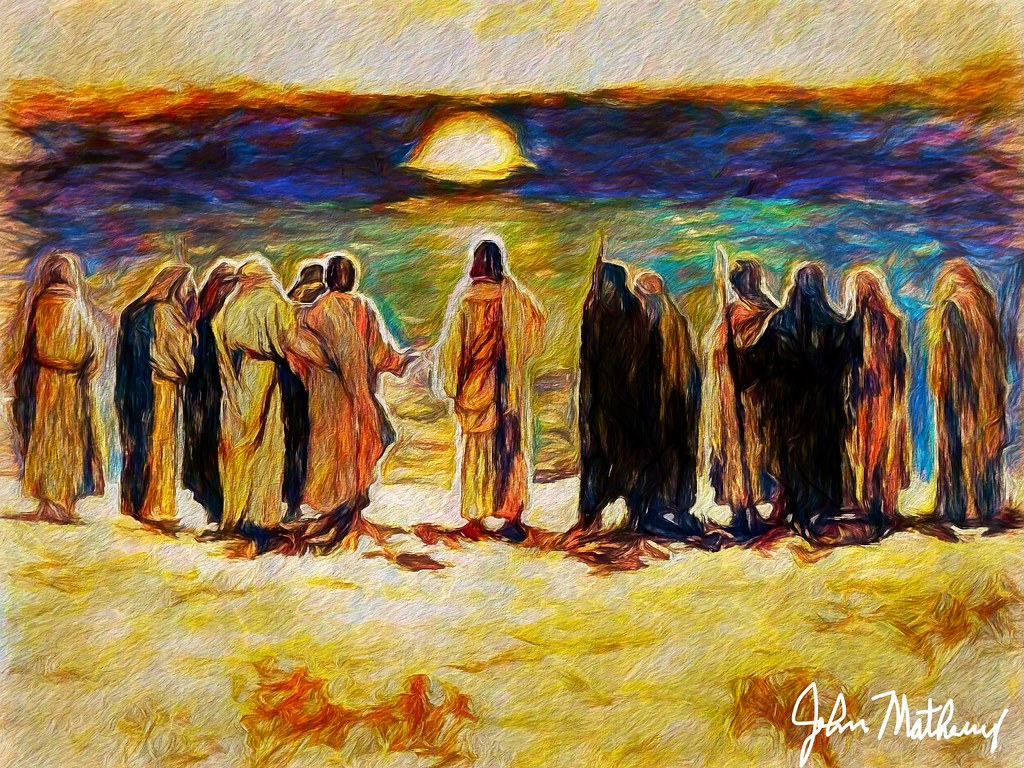
Digital painting of Jesus and the disciples by John Mathews

A dispute also arose among them as to which of them was considered to be greatest. Jesus said to them, “The kings of the Gentiles lord it over them; and those who exercise authority over them call themselves Benefactors. But you are not to be like that. Instead, the greatest among you should be like the youngest, and the one who rules like the one who serves. For who is greater, the one who is at the table or the one who serves? Is it not the one who is at the table? But I am among you as one who serves. You are those who have stood by me in my trials. And I confer on you a kingdom, just as my Father conferred one on me, so that you may eat and drink at my table in my kingdom and sit on thrones, judging the twelve tribes of Israel. (NIV)

Jesus is a different sort of leader.

While the kings of his day were concerned with power and using their authority to ensure even more power and privilege, Jesus went about things differently. In a world of patronage where it was necessary for the lower classes to connect with and suck-up to the higher classes, Jesus operated by a different system.

Jesus, Lord of the universe, King of creation, absolute Leader of the Church, and Ruler over God’s realm was and is a servant of the people.

“Follow my example: Even the Son of Man did not come for people to serve him. He came to serve others and to give his life to save many people.”

mark 10:45, erv

On the surface, striving to be the best might seem noble and good. Yes, working toward being the greatest might motivate us to do all things with excellence. It can solve a lot of problems and issues. On the other hand, it may also result in attitudes and behavior which fosters unhealthy competition and an inordinate focus on becoming the greatest.

Think about it. Not everyone can be the greatest. If everyone is, nobody is. This results in lower self-esteem for nearly everybody. And it creates ripe conditions for leadership paranoia in which the greatest is always looking over their shoulder worrying about being toppled from their lofty position. At the least, all this ballyhoo about greatness only takes away from caring for the people who most need our efforts – family members get the shaft from someone with an imbalanced life who is laser-focused on getting to the top and staying there.

It’s as if a person is living a one-dimensional existence in a three-dimensional world. It won’t work. Fortunately, we don’t have to live like that.

Jesus shows us a better way.

Jesus was present to his disciples. He is present to us in the person of the Holy Spirit. Christ encouraged relational connections and using one’s gifts, talents, and abilities for the common good of all people. For Jesus Christ, the dynamics of power and authority are not to be leveraged for personal greatness but for collective uplift. Authority is to be carefully applied for everyone’s benefit, including those we think don’t deserve it.

The disciples understood far too little about the community their leader was trying to build. Judas Iscariot is likely the one disciple who first realized what Jesus was truly up to. The greatest are the least and the least are the greatest. It wasn’t what Judas signed up for, so he cut his losses and betrayed Jesus.

True exaltation is a gift of grace. The kingdom of God turns on mercy and operates on the economy of grace. It is those who faithfully serve who will sit with Jesus, the ultimate Servant, at the table. Peacocks and pretenders will never realize their dream to be the center of attention.

In a great twist of irony, those who wish to compete and occupy a high standing will discover they have worked to obtain the lowest rung on the ladder leaning against the wall of Satan’s kingdom.

Jesus consistently, patiently, and carefully established the kingdom of God on earth. He went about his task in a manner none of us would even consider. He focused on character, not skills; willing hearts, not intelligent brains; new life, not reformed habits. On the job orientation involved following Jesus around everywhere.

Just shadow Jesus.

Here I am washing your feet. Do the same. Here I am being present to and serving the poor, the lonely, the outcast, the moral failure, and the lowest of society. Do the same. Here I am showing sacrificial self-emptying unconditional love. Do the same. Just shadow me. Do what I do, period.

An obsession with greatness will inevitably lead to petty kingdom building enterprises. Instead, we are to love the neighbor next to us. We make room at the committee table for somebody who looks, acts, and talks different than me. We freely let Jesus live through us, thus, giving the gift of him to those we encounter. We purposely look for ways to serve underprivileged communities rather than use the people living there in ways to make us look better.

Indeed, this following Jesus thing is subversive – even for many professing Christians.

What will you do?

Go in peace to love and serve the Lord, in the name of Christ. Amen.

Isaiah 60:15-22 – A Renewed Vision of Peace

Isaiah 60 by Margaret Nagib

Instead of being abandoned,
    hated, and forbidden,
    I will make you majestic forever,
    a joy for all generations.
You will suck the milk of nations,
    and nurse at royal breasts.
    You will know that I am the Lord, your savior
    and your redeemer, the mighty one of Jacob.
Instead of bronze I will bring gold;
    instead of iron I will bring silver;
    instead of wood, bronze;
    and instead of stones, iron.
I will make peace your governor
    and righteousness your taskmaster.
Violence will no longer resound throughout your land,
    nor devastation or destruction within your borders.
You will call your walls Salvation,
    and your gates Praise.
The sun will no longer be your light by day,
    nor will the moon shine for illumination by night.
The Lord will be your everlasting light;
    your God will be your glory.
Your sun will no longer set;
    your moon will no longer wane.
The Lord will be an everlasting light for you,
    and your days of mourning will be ended.
Your people will all be righteous;
    they will possess the land forever.
They are the shoot that I planted,
    the work of my hands, to glorify myself.
The least will become a thousand,
    and the smallest a powerful people.
I am the Lord; at the right moment, I will hurry it along. (CEB)

The people of ancient times typically had a love/hate relationship with prophets. After all, the Lord’s messengers gave verbal punches to the gut with bad news of judgment. But they also were bearers of good news, as well. So, it is important to hold both judgment and grace together. We need to always keep in mind that, despite human foibles, grace exists and is the grand operating force in God’s big world.

Good news turns to great news when there is a realization that judgment is deserved, yet it won’t have the last word. God’s grace always prevails in the end. God has a tenacious resolve to work out good for people, not ill. Although the Lord dispenses justice, sometimes with a firm hand, there is an unflagging commitment to divine love which will shine through the darkest of times.

God expertly knows how to make a reversal in people’s situations from hopeless despair to incredible fortune (and, I might add, vice versa). The Lord truly has plans of goodness and well-being for humanity. Humiliation and powerlessness will give way to exaltation and empowerment. Peace will eventually overcome both the human heart and human institutions.

Salvation and deliverance from the ills which plague both body and soul comes from the God who specializes in penetrating the blackest darkness with overwhelming light. And it is much more than personal well-being. Isaiah’s prophecy communicates a cosmic vision of peace which thoroughly works its way in all the shadowy places of the world. It is a vision of a new world and new life.

Because of God’s action in a broken and bruised world, we can make some bold and hopeful theological claims for God’s people:

  • God’s good grace and steadfast love are the superior forces in the church and the world. Because grace and love are pure gifts from the Lord, they are not dependent upon whether we deserve them, or not. The sheer fact that we need them is what prompts God to give generously and unsparingly. A new heaven and new earth are coming. Sin and death are not permanent.

Then I saw a new heaven and a new earth; for the first heaven and the first earth had passed away. (Revelation 21:1, NRSV)

  • God is the center of every good thing that was, is, and is coming. God’s world runs on God’s providence and power, and not on human agency. God is in control. All the Lord’s good promises shall not fail but will be realized. For the Christian, those promises are ultimately fulfilled in the person and work of Jesus Christ. When circumstances are at their worst, faith is at its best.

In everything we have won more than a victory because of Christ who loves us. I am sure that nothing can separate us from God’s love—not life or death, not angels or spirits, not the present or the future, and not powers above or powers below. Nothing in all creation can separate us from God’s love for us in Christ Jesus our Lord! (Romans 8:37-39, CEV)

  • God’s promises extend well beyond the “spiritual” to all of life. God’s peace will work its way into the fabric of the whole world, not just individual hearts. God’s benevolent kingdom and ethical will shall be done on earth as it is always done in heaven. Just as every human institution and all creation have been profoundly touched by sin, so everything will be touched by grace and renewed. Our prayers are to encompass this grand scope of God’s renewing vision for the world.

May your Kingdom come soon. May your will be done on earth, as it is in heaven. (Matthew 6:11, NLT)

God’s plans are more than good and gracious; they are cosmic in their scope and include an expansive realm of peace which is so incredible that the Lord’s glory will overwhelm all darkness and shall shine forever. Human sin might seem as though it is so pervasive as to win the day, yet it will not always be this way. God’s light will penetrate, overcome, and dispel guilt, shame, and disobedience. And it has already begun…

Almighty God give us a new vision of you, of your love, of your grace and power; and then, give us a new vision of what you would have us do as your people, and an awareness that in the strength of your Spirit we can do it to your glory, through Jesus Christ our Lord. Amen.