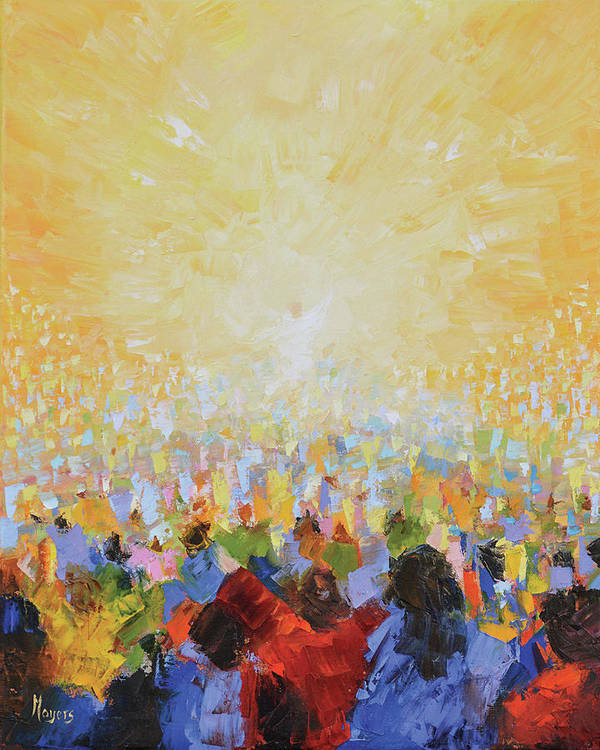
Ephesians 1:3-14 – We Are Blessed

Hallelujah by Mike Moyers

Praise be to the God and Father of our Lord Jesus Christ, who has blessed us in the heavenly realms with every spiritual blessing in Christ. For he chose us in him before the creation of the world to be holy and blameless in his sight. In love he predestined us for adoption to sonship through Jesus Christ, in accordance with his pleasure and will— to the praise of his glorious grace, which he has freely given us in the One he loves. In him we have redemption through his blood, the forgiveness of sins, in accordance with the riches of God’s grace that he lavished on us. With all wisdom and understanding, he made known to us the mystery of his will according to his good pleasure, which he purposed in Christ, to be put into effect when the times reach their fulfillment—to bring unity to all things in heaven and on earth under Christ.

In him we were also chosen, having been predestined according to the plan of him who works out everything in conformity with the purpose of his will, in order that we, who were the first to put our hope in Christ, might be for the praise of his glory. And you also were included in Christ when you heard the message of truth, the gospel of your salvation. When you believed, you were marked in him with a seal, the promised Holy Spirit, who is a deposit guaranteeing our inheritance until the redemption of those who are God’s possession—to the praise of his glory. (New International Version)

God has blessed us. The word “blessing” comes from the same word for “giving thanks.”  So, when, we consider the ways God has spiritually blessed us, it leads us to effusive gratitude and praise.  And this was exactly the case for the Apostle Paul.

In writing these words, Paul was so excited to share with the church at Ephesus about the blessings of God that he could not stop. In our English translations we have broken these verses up into several sentences and two paragraphs. But Paul originally penned this as one sentence!

More than anything, Paul wanted the church to know the wonderful blessings of God to them. Throughout the book of Ephesians, Paul’s constant theme to the church is reconciliation and restoration. In fact, that is the end game for God. God has cares about reconciling people to himself, and others. The Lord deeply cares about restoring the entire world to the lordship of Jesus Christ.

To accomplish this gigantic feat, God intervened into humanity by giving the church three main blessings: election, redemption, and inheritance.

Election 

The word “chose” and “chosen” in some English translations is the Greek word ἐκλεκτός (eklektos) or “election.” This is where it all begins for us. Even before the creation of the world, God had the end of the story in mind. Divine decisions were made about outcomes and results. 

This approach, by the way, is how we are to engage ministry in the church. That is, we begin with the end in mind of what we want to accomplish. Then, we gather the people and begin making the needed decisions to see that end purpose realized. Too often, churches begin with a group of people and wonder about what they should do – which is backwards from how God does it. 

In eternity past, in love, God predestined us to be adopted as his children. You and I are so loved by God that we were special to him before we were even ever born! Election means God has a purpose for us. On the human level, we elect candidates so that they may serve the common good and put their energies into accomplishing some noble cause. 

Likewise with God. We were not elected or chosen by God solely to go to heaven when we die.  Although that is true and shall happen, the reason we were chosen by God was for us to be holy and blameless, to be for the praise of God’s glory. We are not in some sort of holding pattern on earth, impatiently waiting for the afterlife. Rather, we are to be active in accomplishing God’s purposes for our election. And what is that purpose?

We are to participate with God in the grand scheme of reconciling and restoring all of creation back to the original design. Therefore, every act of forgiveness, grace, love, and kindness; every overture of faith and communication of the gospel to others; and all steps of obedience are small movements toward the great restoration story God is writing. 

For example, the book of Acts ends on a dramatic note with no resolution to it. That’s because the story is still being written. We are chosen to be a part of it.

Redemption 

To be redeemed means to be delivered by a payment of a price. In the ancient world, slavery was an entrenched part of the society. The picture of the slave market provided a means for Paul to communicate a spiritual blessing: We have been redeemed from the slave market of sin through the payment of Christ’s blood, and so now, we enjoy the freedom from and forgiveness of sin. 

This is not just redemption from something (sin, death, and hell); it is also redemption to reconciliation and restoration. God elected us to receive redemption so that the grand design of bringing all the earth under the lordship of Christ will happen. God has and is creating a new society, the community of the redeemed, that will realize the original design of unhindered connection with God and others. 

Inheritance

We are receiving an inheritance. It will be put into effect when God’s timing and purpose is accomplished – and Paul spells the purpose out: To bring all things in heaven and on earth together under one head, Jesus Christ. 

Here is how Paul envisions what is coming: The chosen and redeemed of God will one day die, then they will go to be with Christ. But that is not yet the end because the entire world still needs redemption. This is why the preacher of Hebrews could say about the great heroes of the faith:  

These were all commended for their faith, yet none of them received what had been promised.  God had planned something better for us so that only together with us would they be made perfect. (Hebrews 11:39-40, NIV)

There is not just life after death; there is life after life-after-death. All those people of faith, including our believing friends and relatives who have gone before us to be with Jesus, are waiting. They, along with us, have not yet received all the promised blessings of our inheritance. 

We are waiting for the reconciliation and restoration of all things, a new heaven and a new earth in which we will be together as sons and daughters in the kingdom of God with Jesus as King over us. The possession of the Holy Spirit is the guarantee that this is the case, and it will happen. 

Conclusion

Our blessings of election, redemption, and inheritance are all activated by faith. Belief is the switch that turns on the blessings to us in a real and actual way. The electricity is there in the person of the Holy Spirit. The light bulb is there, and it is us. 

So, the question for us today is: Are we turned on and shining brightly, or is the switch off?  We must access our blessings by belief in the Son of God who loved us and gave himself for us.

God is on a mission to reconcile and restore the world. Our salvation is part of God’s plan to make that happen. God is a missionary. The Lord has chosen us to be emissaries to a world that needs redemption and restoration. 

The church is like no other institution on earth – existing for the life of the world, and not for itself. Like a mighty army, we are to train ourselves for godliness so that we can engage an invisible enemy and see the kingdom of God come and the will of God done here on earth as it is always done in heaven. 

The camaraderie we enjoy as fellow soldiers is not the end purpose – restoring enemy territory back to its original government is. So, we care for our wounded and do everything we can for them. There are yet more spiritual battles to be won and hearts captured for King Jesus. 

May you and I, then, give thanks with grateful hearts for the great spiritual blessings of election, redemption, and inheritance so that God’s benevolent and merciful rule might spread everywhere to everyone.

God our Savior, you desire that none should perish, and you have taught us through your Son that there is great joy in heaven over every sinner who repents: Grant that our hearts may ache for a lost and broken world. May your Holy Spirit work through our words, deeds, and prayers, that the lost may be found and the dead made alive, and that all your redeemed may rejoice around your throne, through Jesus Christ our Lord. Amen.

Isaiah 11:1-9 – A Vision of Hope and Peace

The Peaceable Kingdom by Edward Hicks, 1826

A shoot will come up from the stump of Jesse;
    from his roots a Branch will bear fruit.
The Spirit of the Lord will rest on him—
    the Spirit of wisdom and of understanding,
    the Spirit of counsel and of might,
    the Spirit of the knowledge and fear of the Lord—
and he will delight in the fear of the Lord.

He will not judge by what he sees with his eyes,
    or decide by what he hears with his ears;
but with righteousness he will judge the needy,
    with justice he will give decisions for the poor of the earth.
He will strike the earth with the rod of his mouth;
    with the breath of his lips he will slay the wicked.
Righteousness will be his belt
    and faithfulness the sash around his waist.

The wolf will live with the lamb,
    the leopard will lie down with the goat,
the calf and the lion and the yearling together;
    and a little child will lead them.
The cow will feed with the bear,
    their young will lie down together,
    and the lion will eat straw like the ox.
The infant will play near the cobra’s den,
    and the young child will put its hand into the viper’s nest.
They will neither harm nor destroy
    on all my holy mountain,
for the earth will be filled with the knowledge of the Lord
    as the waters cover the sea. (New International Version)

In some quarters of Christianity, the church exists as a mere stump of its former existence. In many Christians’ daily experience the Spirit has been supplanted by individual ingenuity, hard work, and getting ahead through accumulation of more and more. Basic Christian spirituality is a mere shadow of its former influence. If Christians desire the Spirit of the Lord to rest upon them, they will seek Christ as of foremost importance.  

Indeed, it is when we are worn down to a stump and have no ability to grow or sustain life anymore that God enters, specializing in giving hope to the hopeless, justice for the poor, wisdom to the confused, and peace to all who desire a harmonious world.

In the awful feelings of helplessness and hopelessness, a faint sign of life can be seen. A fresh shoot becomes discernible. Could there be possibility amidst impossible circumstances? Can there be life again? Do I dare hope again? Will things really change, and do so for the better?

The answer is “yes.” For where the Spirit of the Lord blows there is the force of resurrection power, spiritual energy, and fresh courage. Where others see only the impossible, the believer has a capacity of faith to see the possible. The Spirit’s force generates possibility where none existed before. When the breath of God whispers to the sprout in the stump, pessimistic despair turns to optimistic hope, even joy.

Christ is the Christian’s hope. In Christ, there is security, well-being, and life. With Jesus, there is a vision of justice in which all persons receive what they need to live, thrive, and flourish in God’s world. Christ works for our benefit without the personal greed and indifference of so many earthly rulers. The weak and vulnerable have a champion in Jesus Christ. Renewal and restoration are possibilities.

I have taken a liking to a show called “The Repair Shop,” a British television series in which family heirlooms with sentimental value are restored by experts for their owners. What captivates me about the show is how a few people can take old broken-down items (and by all appearances now a piece of junk) and restore them to their once glorious newness.

Yet, there is more to my captivation. I am struck by the sheer pleasure the restorers take in handling the old object, enjoying the process. Just by the looks on their faces, I can tell they consider it a privilege to be restoring a precious object of the past.

I am sure this is precisely how God feels with us. Rather than envisioning the Lord as some reluctant deity who feels put out with having to rescue a bunch of dumb and wayward people, God is One who takes delight in taking this old stump of fallen damaged humanity and restoring people to their original luster and beauty.

Transformation is God’s specialty, and the Lord goes about the process of restoration with great care and delight.

The Peaceable Kingdom by Malcah Zeldis

The impossible possibility of God’s new creation is poetically described in Isaiah as the peaceful co-existence of animals who are inconceivably together without fear or violence. There is a time coming when death will be no more, and so, the necessity in this life of hunter and prey will be forever negated. No more snakes terrorizing women and children. No more big fishes eating little ones. No more human fat cats preying upon and striking poison on the small and vulnerable.

The presence of the godly Ruler means the world will be governed rightly, detoxified of its sinful impurities – a place where the poor, the weak, and the little lambs will indeed be safe and secure forever. There will be peace because of the Prince of Peace. All creation will be full of God, and so, free of all malice.

Isaiah envisions a deep, radical, limitless transformation in which there will be no more desire to injure another; no need to dominate another; and no motive for selfish power over others.

The Lord will bring about a metamorphosis of human hearts and institutions, a renovation of the animal kingdom, and a radical change down to every blade of grass in creation. The Apostle Paul had this grand prophetic vision of God in mind when he wrote to the Church at Rome:

I believe that the present suffering is nothing compared to the coming glory that is going to be revealed to us. The whole creation waits breathless with anticipation for the revelation of God’s sons and daughters. Creation was subjected to frustration, not by its own choice—it was the choice of the one who subjected it—but in the hope that the creation itself will be set free from slavery to decay and brought into the glorious freedom of God’s children. We know that the whole creation is groaning together and suffering labor pains up until now. And it’s not only the creation. We ourselves who have the Spirit as the first crop of the harvest also groan inside as we wait to be adopted and for our bodies to be set free. We were saved in hope. If we see what we hope for, that isn’t hope. Who hopes for what they already see? But if we hope for what we don’t see, we wait for it with patience. (Romans 8:18-25, CEB)

The implication for us as humanity was voiced by Paul to the Colossian Church:

Each of you is now a new person. You are becoming more and more like your Creator, and you will understand him better. It doesn’t matter if you are a Greek or a Jew, or if you are circumcised or not. You may even be a barbarian or a Scythian, and you may be a slave or a free person. Yet Christ is all that matters, and he lives in all of us.

God loves you and has chosen you as his own special people. So be gentle, kind, humble, meek, and patient. Put up with each other, and forgive anyone who does you wrong, just as Christ has forgiven you. Love is more important than anything else. It is what ties everything completely together.

Each one of you is part of the body of Christ, and you were chosen to live together in peace. So let the peace that comes from Christ control your thoughts. And be grateful. (Colossians 3:10-15, CEV)

The transformation is all-pervasive, thoroughly public, and intimately personal. It is a gift from God; it is the impossible made possible. And it is this precise thing which we acknowledge, celebrate, and long for in the season of Advent. When the angel came to Mary and communicated that Isaiah’s vision was coming to reality through her womb, Mary astonishingly retorted:

 “How will this be, since I am a virgin?”

The angel, with supreme confidence, answered Mary as a matter of fact:

“The Holy Spirit will come on you, and the power of the Most High will overshadow you. So, the holy one to be born will be called the Son of God…. For no word from God will ever fail.”

Mary’s response gives voice to our own desires and longings for the new order of things:

“I am the Lord’s servant. May your word to me be fulfilled.” (Luke 1:34-38, NIV)

This is our confession, too. We are the Lord’s servants.

May God’s word to us about the coming of Christ be fulfilled, just as Isaiah said. The hopes and fears of all the years are met in Jesus on a starry night so many years ago.

Soli Deo Gloria

Luke 7:18-30 – Use the Right Color

John’s disciples told him about all these things. Calling two of them, he sent them to the Lord to ask, “Are you the one who is to come, or should we expect someone else?”

When the men came to Jesus, they said, “John the Baptist sent us to you to ask, ‘Are you the one who is to come, or should we expect someone else?’”

At that very time Jesus cured many who had diseases, sicknesses and evil spirits, and gave sight to many who were blind. So, he replied to the messengers, “Go back and report to John what you have seen and heard: The blind receive sight, the lame walk, those who have leprosy are cleansed, the deaf hear, the dead are raised, and the good news is proclaimed to the poor. Blessed is anyone who does not stumble on account of me.”

After John’s messengers left, Jesus began to speak to the crowd about John: “What did you go out into the wilderness to see? A reed swayed by the wind? If not, what did you go out to see? A man dressed in fine clothes? No, those who wear expensive clothes and indulge in luxury are in palaces. But what did you go out to see? A prophet? Yes, I tell you, and more than a prophet. This is the one about whom it is written:

“‘I will send my messenger ahead of you,
    who will prepare your way before you.’

I tell you, among those born of women there is no one greater than John; yet the one who is least in the kingdom of God is greater than he.”

(All the people, even the tax collectors, when they heard Jesus’ words, acknowledged that God’s way was right, because they had been baptized by John. But the Pharisees and the experts in the law rejected God’s purpose for themselves, because they had not been baptized by John.) (New International Version)

For a short time in my life, I had a side business doing some painting. I once painted an interior apartment in a large beautiful Victorian house. When I was done, it looked great. However, there was a bit of a problem. The owner came to check on my progress only to find that I had painted with the wrong color! I was certain I had it right, but, alas, the job ended up taking twice as long as anticipated.

Sometimes, we can be so sure about our plans, only to discover our expectations were off. John the Baptist was sitting in jail, not for any crime other than offending the king. As he sat there, John began to doubt. He started wondering about Jesus. Maybe he had been wrong about him. Perhaps he was not the Messiah, after all. 

John had been doing ministry with the expectation that Jesus would beat up the Romans, usher in a renewed political Israel, and put down all threats to his Lordship. But that was not happening. John was now uncertain. So, he sent some of his disciples to Jesus to ask, “Are you the one who is to come, or shall we look for another?”

John reasoned that if Jesus were really a sovereign king, he would not be languishing in a prison and facing imminent death. Jesus responded to John’s uncertainty by quoting the prophet Isaiah and letting him know that the kingdom takeover was going exactly as planned. 

“Huh!?” John must have wondered. Maybe something was lost in translation. But no. The problem was that John had been using the wrong paint. John’s plans and expectations did not fully sync with Jesus.

It’s easy to doubt when unexpected and unwanted adversity strikes. When things don’t go according to our expected plans, then what? 

This is why it is so vitally important to continually seek the Scriptures and seek the Lord Jesus so that we might not only paint the right building but also use the paint Jesus expects us to use. 

The thing John got right was pursuing Jesus. When in doubt, he sought the Lord – and that is something we all can emulate.

As we paint the portrait of our lives, let’s be sure to use the colors Jesus gives us.

Lord Christ, you came into the world as one of us, and suffered as we do. As I go through the trials of life, help me to realize that you are with me at all times and in all things; that I have no secrets from you; and that your loving grace enfolds me for eternity. In the security of your embrace, I pray. Amen.

Jeremiah 33:14-16 – Longing for Justice and Righteousness

Jeremiah by Marc Chagall, 1956

The Lord said:

I made a wonderful promise to Israel and Judah, and the days are coming when I will keep it.

I promise that the time will come
when I will appoint a king
    from the family of David,
a king who will be honest
    and rule with justice.
In those days,
    Judah will be safe;
Jerusalem will have peace
and will be named,
   “The Lord Gives Justice.” (Contemporary English Version)

Jeremiah is known as “the weeping prophet.” From the very beginning of his prophetic ministry, Jeremiah was given a message that Jerusalem and Judah would experience God’s wrath and be exiled to a foreign country. 

The prophet Jeremiah was faithful to his calling. Yet, he loved his homeland, and it grieved his heart to know that everything familiar around him would be either altered or destroyed. All would change because God’s judgment was coming.

The Lord gave Jeremiah an unpopular message, especially since Judah was enjoying a time of abundance, economic stability, and relative freedom from war. No one took Jeremiah seriously. Initially, when Jeremiah began to spread his message of gloom and doom, he was perceived as a kook, and no one took him seriously. 

But Jeremiah did not let up. The eye-rolling turned into annoyance, and then, over time, contempt. Judah’s king and the governing officials tried to silence Jeremiah as being subversive and unpatriotic. As a result, Jeremiah was imprisoned several times.

Jeremiah, in today’s Old Testament lesson, is under house arrest. The city of Jerusalem is under siege by the Babylonian army. Jeremiah’s prophecy is knocking at the door….

But the people are not listening, believing they’ll be delivered by God for two reasons:

1) They see the Babylonians are evil pagans who do not recognize the One true God, so, obviously, God would never use such an ungodly army to overthrow the people of God, right!?

2) They have the temple and the true worship of God, and God would never let the temple be desecrated, right!? 

So, the people of Jerusalem felt immune from any kind of terrible judgment, as if being God’s people with God’s temple would ward-off any disaster.

The siege against Jerusalem lasted over two years. During that time, the people of Jerusalem went from cocky and confident to having a very rude awakening. Horrible disaster was upon them. At their lowest point, with barely any food, and atrocities occurring throughout the city, Jeremiah’s word from God was a message of grace. 

The people would not be delivered from their inevitable fate. Yet, God would not wipe them off the map and destroy them forever. There is coming a day when there will be a Deliverer, a just and right Savior from the line of the greatest Israelite king ever, David.

The hardest reality for Jerusalem’s people to accept was that their way of life would never be the same again. It would forever change. Although they continued to practice all the rituals of the temple system and worship, over the generations it had simply become a rabbit’s foot for them – as long as they did their duty, they could walk away and do whatever they wanted. And they did.

That approach got God’s attention. Divine wrath came through the most unlikely of instruments: the pagan Babylonians led by the arrogant King Nebuchadnezzar.

The transition from one way of life to another was excruciating. 

Oftentimes change happens and it’s out of our control. However, what is within our influence is how we make the transition from the previous reality to the new reality. 

A biblical way to deal with difficult changes and transitions is by focusing on God’s promises. There are two pairs of the promise we have within the prophecy of Jeremiah: judgment and grace; justice and righteousness. 

“Justice and righteousness was never meant to be the work of only one person, or one part of society. It should be the foundation of how everyone stewards their lives, as well as an integral, normal part of all of society. Every aspect of this world needs God’s justice and righteousness.”

Jessica Nicholas

By looking ahead with hope to the new future of what God is doing and will accomplish, we then come to grips with present troubles.

Judgment and Grace

All of the Old Testament prophetic books have a rhythm of judgment and grace. The promise God gave to the people through Jeremiah was that judgment was coming; and, that grace would follow on its heels.

Proclaiming only a message of judgment without grace brings despair, death, and hell; there is hopelessness. Conversely, only speaking of grace apart from judgment is oxymoronic – it doesn’t exist because there is no need for grace if there is no judgment; grace is an undeserved mercy given freely by God in the face of our sinful selves.

The siege of Jerusalem was terribly horrific. The details are too graphic to mention. Even the most pious of believers who believed Jeremiah’s message were completely aghast at the level of cruelty and violence done to God’s people.

At the people’s darkest hour, the message of grace came to them….

Justice and Righteousness

A safe, secure, just, and peaceful future will be provided by God. The Lord will not forget the people. Better days are coming. A king will arise. His rule will be just and right, providing protection, peace, and prosperity. God’s people were to keep their heads up looking toward that future in order to help them now in the present.

This requires patience. They must wait.

While waiting, the people need to live in the way God intended before all this terror happened. They are to uphold justice and live righteously because that’s what the coming king is all about.

Justice and righteousness are often paired together in the Old Testament. They’re really two sides of the same coin. We may often think of justice in the punitive sense of giving lawbreakers what they deserve. Yet, biblical justice has more to do with giving someone what they need and deserve to live and thrive as human beings. 

To act justly means to provide essentials like clean drinking water, a safe environment, food to eat, a place to sleep, etc. Righteousness is the relational element to justice. To be righteous means to have right relationships, to connect with people, to move toward them and provide them with all the relational things that people need like respect, dignity, friendship, hospitality, fellowship, etc.

Justice and righteousness go together. Justice without righteousness is at best, impersonal, and, at worst, condescending. Righteousness without justice is a dead faith that wishes well but never delivers. Together, however, justice and righteousness brings love, peace, harmony, well-being, and human flourishing because all the basic necessities of life, physical and relational, are met in abundance.

This is what is meant in the Old Testament when Israel is referred to as “a land of milk and honey.”

Conclusion

For Christians, the time of abundance is here, in Christ. Yet, it’s not here in its fullness. We anticipate, wait, and hope for the Second Coming of our Savior and King. While we exercise patience, we long for better days. A true Advent spirit is a deep longing for justice and righteousness because King Jesus is just and right.

So, what do you long for today? 

I long for justice.

I long for broken spirits to be made right, for people’s healing of both body and soul. I long for the day when children with epilepsy will have no more seizures. I long for the day when individuals and families will not have to contend with cancer anymore. I long for the day when there will be no more depression, anxiety, mental illness, or dementia. I long for the day when people will be free of addictions. I long for the day when there will be no more sex trafficking, death from malnutrition, grinding poverty, corrupt governments, whole families and communities torn by the ravages of diseases, refugees with no place to call home, and devastating natural disasters. 

I long for righteousness.

I long for the day when women and girls across the globe will not be abused and become the victims of disordered power. I long for the day when nations, ethnicities, races, and everyone everywhere will no longer hate each other. I long for every individual to know forgiveness. I long for people to experience the exhilaration of new life in Christ. I long for my community to hear and believe the gospel. I long for peace, harmony, unity, equity, and an egalitarian spirit.

I long for God’s benevolent rule to come in all its fullness, freedom, joy, prosperity, peace, and happiness. I long for Christ’s coming! And I long to be doing justice and righteousness when Jesus arrives!

Maranatha, come Lord Jesus!