

Luke 6:1-5 – Lord of the Sabbath

One Sabbath Jesus was going through the grainfields, and his disciples began to pick some heads of grain, rub them in their hands and eat the kernels. Some of the Pharisees asked, “Why are you doing what is unlawful on the Sabbath?”

Jesus answered them, “Have you never read what David did when he and his companions were hungry? He entered the house of God, and taking the consecrated bread, he ate what is lawful only for priests to eat. And he also gave some to his companions.” Then Jesus said to them, “The Son of Man is Lord of the Sabbath.” (New International Version)

We Christians tend to be rather hard on the Pharisees. Yet, most of them, much like us, were just trying to uphold their understanding of God’s commands. They wanted to do God’s will. And so did Jesus.

The problem in the New Testament Gospels is that Jesus and some of the Pharisees (not all of them, e.g., Nicodemus) were at loggerheads about how to view and interpret the Law. Jesus wanted them to see the purpose of the law, the heart and spirit of the law, and who was the lord of the law. For Jesus, many of the Pharisees were spiritually blind. They either would not or could not discern who Jesus was and what he was all about.

So, when we refer to spiritual blindness, let’s have a bit of humility about it. Although for the Apostle Paul, a dramatic event happened in which the scales of blindness (both physically and spiritually) fell from his eyes, most folks have a gradual ability to see, an awakening which requires a process of time and growing awareness. This was true of Christ’s original disciples. They believed, yet their faith was an extended process over three years. It wasn’t until after Christ’s resurrection and Pentecost that their faith became complete.
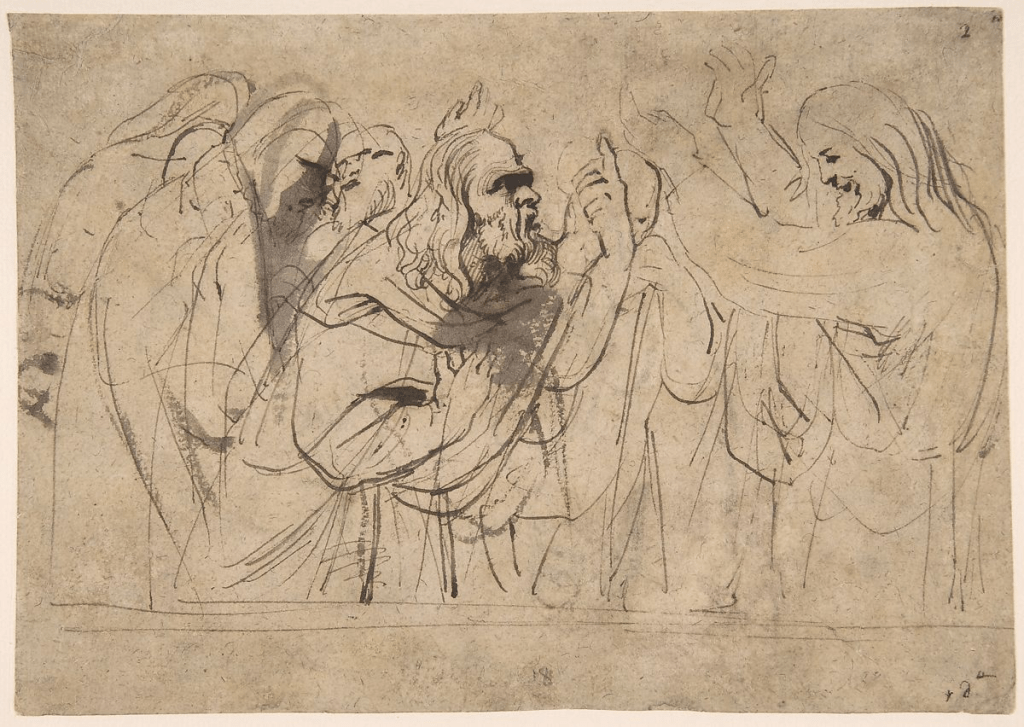
Christ and the Pharisees by Belgian artist Anthony van Dyck (1599-1641)

Jesus didn’t like it that those who should know better, those persons for whom the light of God’s truth ought to be clear and present, were in darkness. When leaders are blind, then we have the blind leading the blind, and nobody finds the door of God’s kingdom.

Many of the Pharisees in the New Testament, most of the heretics in the early church, and some of the spiritual phonies of today are actually not charlatans, that is, they are not deliberately trying to deceive or lead others astray; they are not trying to keep people out of God’s kingdom – they think they are doing the right thing when they are actually leading others astray. 

One of the eye-opening realities I discovered, when I first began studying church history, is that the early heresies condemned at the church councils were doctrines promoted and put forth by men who were not evil bad people – they were just sincerely misguided. They thought they were helping the church better understand the nature of God and Christ, when in fact they were promoting unhealthy doctrine – unintentionally closing the door of God’s kingdom to some people. 

And later when I worked on my master’s thesis in nineteenth century American religious history, I read hundreds of sermons from southern preachers before the American Civil War. I learned that they had a biblical defense for the institution of black chattel slavery. Many of them were pastors of large churches and led many people to Christ, that is, white people. They were slamming the door of God’s kingdom in the faces of African-Americans, and teaching others to do the same.
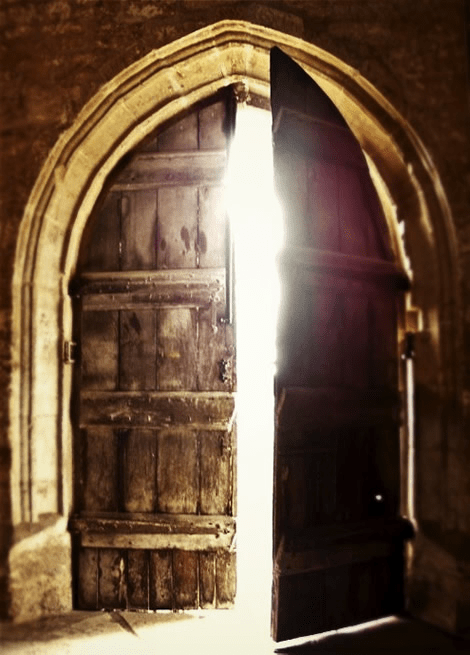
We can unwittingly slam the door of God’s kingdom in the faces of people when we say God’s grace is for all and then turn around and avoid particular people; or whenever we have explicit written statements or rules that exclude people from serving or being served; or when we bind people to human traditions and practices instead of Holy Scripture. 

The seven deadly words of the Church, believing it is doing the Lord’s will, is, “We’ve-never-done-it-that-way-before… We cannot have somebody out in the field picking heads of grain and rubbing them in their hands. That’s reaping; it’s work; and you can’t do that on the Sabbath.”

Never mind that there are people trying to eat or attempting to enter the kingdom of God. So, we lose sight that the Law was meant to benefit people, to help them thrive and flourish, to lead them into the grace and knowledge of God. The Law gets turned on its head by becoming a heavy burden to carry instead of an easy yolk which brings freedom.

No matter the issue, the last word to everything is grace, God’s grace in Jesus Christ.  

Just as the priest in David’s day was gracious in giving him and his men the consecrated bread meant only for the priests, so Jesus was gracious in giving himself, the Bread of Life, for the benefit of the whole world.

For the Christian, the Law points to Christ, who is the Law’s fulfillment. Now, we carry one another’s burdens, and in doing so, we fulfill the Law of Christ.

O God the Holy Spirit, Sanctifier of the faithful: Make us holy through your abiding divine presence. Enlighten the minds of your people more and more with the light of the everlasting Gospel. Bring erring souls to the knowledge of our Savior Jesus Christ; and those who are walking in the way of life, keep them steadfast in faith to the end.

Give patience to the sick and afflicted and renew them in body and soul. Guard those who are strong and prosperous from forgetting you. Increase in us your many gifts of grace and make us all fruitful in good works. This we ask, O blessed Spirit, whom with the Father and the Son we worship and glorify, one God, world without end. Amen.


2 Corinthians 13:5-10 – Examine Yourselves

Examine yourselves to see whether you are in the faith; test yourselves. Do you not realize that Christ Jesus is in you—unless, of course, you fail the test? And I trust that you will discover that we have not failed the test. Now we pray to God that you will not do anything wrong—not so that people will see that we have stood the test but so that you will do what is right even though we may seem to have failed. For we cannot do anything against the truth, but only for the truth. 

We are glad whenever we are weak, but you are strong; and our prayer is that you may be fully restored. This is why I write these things when I am absent, that when I come I may not have to be harsh in my use of authority—the authority the Lord gave me for building you up, not for tearing you down. (New International Version)

God is in the restoration business. Sometimes, we might lose sight of that reality.

In the Gospels, whenever Jesus miraculously healed a person, it was for far more than taking away a disease or correcting a disability. The Lord sought to restore a person’s life by including them in the community. For example:

  • Leprosy put a person on the outside, both literally and relationally. Ceasing to be a leper meant that a person now had no obstacles to full participation in communal life.
  • Blindness reduced a person to being a beggar in order to survive. Having sight restored meant that the person can now work with others, make a living, and contribute to the needs of others.
  • Incarceration was (and still is) a complete removal of a person from society. Being in prison severs much human connection. Release from jail opens the way to reconnection and an opportunity to have a different way of being with others.
  • Poverty encumbers a person and weighs them down so heavily that it limits their ability function socially and relationally. Without poverty, a person is able to establish healthy patterns of giving and receiving within the community.

Those who are physically whole, mentally sharp, emotionally satisfied, and spiritually redeemed are free of obstacles and impediments to communal life.

So, it is a travesty whenever the people who enjoy full inclusion in the community, turn around and separate themselves, keeping relational distance from certain persons, and do not participate in the common good of all.

The type of examination of faith the Apostle Paul was talking about was not to obsess over whether one is a true believer, or not. He was referring to the person who claims faith yet maintains separation from others. In other words, to exclude others is the kind of behavior that unbelievers do, not Christians.

Yet, there are many sections of Christianity and entire Protestant denominations who pride themselves on such separation. They believe they’re being holy and keeping themselves from impurity. However, far too many of them are really putting a sanctified spin on their own sinful predilections to avoid people they don’t like.

Paul has no tolerance for calling exclusion of others “holiness” and naming the maintenance of an insider/outsider status as “sanctification.” The Apostle knew this was all poppycock and wanted nothing to do with it.

Christ didn’t die on a cruel cross, take away the obstacles to faith, open the way to know God, and create peace through his blood for a pack of so-called Christians to then erect imaginary concrete border walls to keep others out of Christian community and fellowship.

In God’s upside-down kingdom, the privileged insiders are really the outsiders; and the underprivileged outsiders are actually the insiders.

The so-called privileged believers are in just as much need for restoration as the leper, the blind, the poor, and the prisoner. The path to their inclusion is solidarity with the entire community of the redeemed – rather than picking and choosing who is in and who is out.

All this, of course, is another way of stating that Christianity is as beset with cliques as anywhere else – with individual believers, local churches, and particular traditions following their pet theologians and pastors and not associating with others who follow a different sort of folks.

The ancient Corinthian church was a train wreck of opposing groups and clique-ish behavior. The Apostle Paul had had enough of it and called the people to do some serious self-examination. And he was careful not to degrade or discourage them but to try and encourage the church to tap into the Christ which dwells within them.

Restoration, for Paul, meant specific behaviors which intentionally include people. To be inclusive means we actively work toward grafting people into community, as well as discourage behaviors that create division. Here are three ways of doing that:

  • Practice hospitality. The word hospitality literally means, “love of stranger.” A hospitable believer goes out of their way to invite another into their life, to give them the gift of relationship and fellowship.

Take care of God’s needy people and welcome strangers into your home. (Romans 12:13, CEV)

Above all, show sincere love to each other, because love brings about the forgiveness of many sins. Open your homes to each other without complaining. And serve each other according to the gift each person has received, as good managers of God’s diverse gifts. (1 Peter 4:8-10, CEB)

  • Nip bitterness in the bud. In an ideal world, everyone holds hands and sings kumbaya together. We live, however, in a fallen world. Harmony, unity, and peace take copious amounts of energy. Like an attentive gardener, we must do the work of identifying weeds and uprooting them, so they don’t take over the garden.

Make every effort to live in peace with everyone and to be holy; without holiness no one will see the Lord. See to it that no one falls short of the grace of God and that no bitter root grows up to cause trouble and defile many. (Hebrews 12:14-15, NIV)

  • Seek to encourage and learn how to do it. Encouragement is both a gift and a skill to be developed. To encourage another is to come alongside and help someone with both affirming words and willing hands. It’s what Jesus did (and does) for us.

Christ died for us so that, whether we are dead or alive when he returns, we can live with him forever. So, encourage each other and build each other up, just as you are already doing. (1 Thessalonians 5:10-11, NLT)

Hospitality, harmony, and help are all forms of love. And love is to be the guiding principle and practice of church and community.

Lord, make us instruments of your peace. Where there is hatred, let us sow love; where there is injury, pardon; where there is discord, union; where there is doubt, faith; where there is despair, hope; where there is darkness, light; where there is sadness, joy. Grant that we may not so much seek to be consoled as to console; to be understood as to understand; to be loved as to love. For it is in giving that we receive; it is in pardoning that we are pardoned; and it is in dying that we are born to eternal life. Amen. – A prayer of St. Francis of

Psalm 93 – Ultimate Power Belongs to the Lord

Psalm 93 by Bernard C. Winter

Our Lord, you are King!
Majesty and power
    are your royal robes.
You put the world in place,
    and it will never be moved.
You have always ruled,
    and you are eternal.

The ocean is roaring, Lord!
    The sea is pounding hard.
Its mighty waves are majestic,
but you are even more majestic,
    and you rule over all.
Your decisions are firm,
and your temple will always
    be beautiful and holy. (Contemporary English Version)

God is bigger than any threat of chaos or destruction. That’s because the Lord is sovereign over all things. The Lord is King. From a Christian perspective, today’s psalm finds its ultimate fulfillment in the ascension of Jesus Christ.

When we talk about kings, there are a few things a ruler needs: a realm (a kingdom); and the ruled (the subjects) of the realm. In reflecting on Christ’s ascension, the three elements which make up a rule are: King Jesus as Ruler; God’s people as the ruled; and the entire world as the realm of Christ’s lordship.

Rule, glory, and kingship were given to him;
    all peoples, nations, and languages will serve him.
His rule is an everlasting one—
    it will never pass away!—
        his kingship is indestructible. (Daniel 7:14, CEB)

Now, as soon as I state that all the world is Christ’s realm, it is quite understandable to at least be curious about this, as well as perhaps be outright doubtful of it.

After all, this old fallen world is filled with all kinds of catastrophes like pandemics and natural disasters; myriad human vices; and potent spiritual foes. Sometimes, it appears that if Jesus were King, he is either sleeping on the job or just indifferent to our plight.

I’ll reframe this by putting it in military terms. The battle and the war has been won – there are, however, some clean-up or mop-up operations still taking place. Pockets of resistance to God’s rule and reign still very much exist. And they unfortunately lead to casualties.

Every Memorial Day weekend in the USA, Americans remember and pay homage to our fallen men and women in uniform. Many of those soldiers were lost from mopping up resistance after a battle achieved and a war won.

For example, the Battle for Okinawa in the Pacific theatre toward the end of World War II resulted in an American victory. However, in securing the island after the Japanese defeat, small groups of Japanese soldiers still mounted resistance resulting in hundreds of American deaths.

In a 1944 article from the Stars and Stripes, an interview of one patrol leader from the battle said, “It’s a tough, methodical grind, this mop-up operation. Here, the Japanese have gotten together, organized, and are carrying out a planned guerilla warfare, even though the battle is won…. I wish a mop-up was as easy as people think it is.”

We live between the two advents of Christ, his ascension to heaven and his coming again. That means we live in the already/not yet kingdom and realm of God. Deliverance from sin, death, and hell has been achieved through the cross of Christ – yet that achieved salvation will not be here in its complete fulfillment until Jesus comes again to judge the living and the dead.

Meanwhile, Christians everywhere continue to pray that God’s kingdom spreads and is realized in the hearts of humanity – the true place where war begins and ends.

There is no power in heaven or on earth which can circumvent or overcome the plans and purposes of an almighty God.

Ocean waves are a powerful force. The United States Energy Information Administration Ocean states that ocean waves contain one-thousand times more kinetic energy than wind. They estimate that the annual energy potential of waves off the east and west coasts of the United States to be as much as 2.64 trillion kilowatt hours. That’s about two-thirds of all American needs for electricity in a year. 

And yet, the incredible strength of ocean waves are no match for the might of God.

“Your rule is eternal, and you are king forever. The Lord is faithful to his promises; he is merciful in all his acts.”

Psalm 145:13, GNT

Even though we might worry about the power and influence of human governments, systems, and institutions, the actual weight they carry is infinitesimal compared to the glory of God. Since God has fixed the earth in place, there is no conglomeration of people who can move this planet off its axis, even a millionth of a degree.

The Most High God is firmly in control, even when it seems otherwise. The Christian tradition is consistent in proclaiming that the throne of Jesus Christ has been established forever. It shall not be moved. Love has won the day and will have the eternal day forevermore.

“Entry into the eternal kingdom of our Lord and Savior Jesus Christ will be richly provided for you.” (2 Peter 1:11, NRSV)

Sovereign God, you reign over all things! Robed in majesty and armed with strength, you hold our world and our lives securely. Your throne has been established. From everlasting to everlasting, you are God.

Even when waves of grief, disease, and hardship rise-up—when surging seas threaten to overwhelm me, and a pounding storm crashes around me—I know that you are mightier and more powerful than any threat. Wash over me with your own cleansing flood. Grace me with your mighty presence. Refresh me with the water of life, for I know, Holy God, that your decrees are firm and unshakeable and will last forever. Amen.

Revelation 11:15 – He Will Reign Forever

The seventh angel sounded his trumpet, and there were loud voices in heaven, which said:

“The kingdom of the world has become
    the kingdom of our Lord and of his Messiah,
    and he will reign for ever and ever.” (New International Version)

I am so looking forward to that day!

As an ordained Minister, I have done my share of weddings over the years. Working with engaged couples anticipating marriage is both exciting and awkward. It is, in some ways, a difficult time for the betrothed because they are committed to one another in a manner different from just dating. But they are not yet in a marriage relationship. 

The same is true for the Church. She is betrothed to the Lord Jesus. They are both quite committed to each other. But the marriage hasn’t yet happened. There is still this engagement period. We’re ready for permanent unending marital bliss.

The kingdom of God has been inaugurated, but not yet consummated. That’s a fancy way of saying that God’s rule and reign has come to this earth, but its fulfillment has not yet occurred. 

This present time we are now experiencing between the two advents of Christ – his incarnation and his coming again – is a weird and awkward time of engagement. We’re trying to figure out how to live in the world but not of it. 

Yet, there is a time coming at the consummation of the ages, at the end of time, when Christ will return to take his bride. Then, the Church will celebrate in a great wedding feast, the marriage supper of the Lamb. From then on, the kingdom of the world becomes the kingdom of our Lord, and he will reign forever and ever.

Just as marriage is designed for permanence, so our union with Jesus will last forever. His gracious and benevolent reign shall never end. Christ’s rule will be complete and extend over all the earth. 

Until then, however, believers must patiently persevere with fidelity to our Lord Jesus, who loved us and gave himself up for us.

Slow and steady is better than nothing at all.

We keep going, despite all obstacles, adversity, difficulty, and discouragement – without comparing ourselves to others or making everything a competition.

Let us throw off everything that hinders and the sin that so easily entangles. And let us run with perseverance the race marked out for us, fixing our eyes on Jesus, the pioneer and perfecter of faith. For the joy set before him he endured the cross, scorning its shame, and sat down at the right hand of the throne of God. Consider him who endured such opposition from sinners, so that you will not grow weary and lose heart. (Hebrews 12:1-3, NIV)

Persevering to the end is the goal, not being perfect all the time. Perfection is the sure road to depression and feeling defeated. Endurance, however, is able to focus on the small efforts of each day to get where it wants to go.

Even though we anticipate our eternal life, that very life has already begun, right now. So, we can live with confidence, knowing the Lord is with us.

Be strong and courageous; do not be frightened or dismayed, for the Lord your God is with you wherever you go. (Joshua 1:9, NRSV)

Perseverance can only happen with physical, mental, emotional, as well as spiritual health. We compromise our ability to keep going and remain encouraged with a lack of self-care.

We need to pay attention to our bodies because they are the vehicles by which we do the will of God.

We must attend to our minds because that is where we do battle with the enemy.

We have got to become comfortable with talking about feelings because we are emotional creatures, created by a God with deep feeling and emotion.

And we are to be disciplined with spiritual practices, just as we are with anything which requires our attention.

Exercise daily in God—no spiritual flabbiness, please! Workouts in the gymnasium are useful, but a disciplined life in God is far more so, making you fit both today and forever. You can count on this. Take it to heart. This is why we’ve thrown ourselves into this venture so totally. We’re banking on the living God, Savior of all men and women, especially believers. (1 Timothy 4:8-10, MSG)

In those times we are confused or just don’t know what the heck to do, we turn to the Lord.

With all your heart
you must trust the Lord
    and not your own judgment.
Always let him lead you,
and he will clear the road
    for you to follow. (Proverbs 3:5-6, CEV)

Keep moving. The Lord will direct you. The kingdom is coming in all its fullness.

Gracious heavenly Father, may we never lose the way through our self-will, and so end up in the far countries of the soul. May we never abandon the struggle, but endure to the end, and so be saved. May we never drop out of the race, but continually press forward to the goal of our high calling.

May we never choose the cheap and temporary things and let go the precious things that last forever. May we never take the easy way, and so leave the right way. May we never forget that sweat is the price of all things, and that without the cross, there cannot be the crown.

So, almighty and everlasting God, keep us and strengthen us by your grace so that no disobedience and no weakness and no failure may stop us from entering into the blessedness which awaits those who are faithful in all the changes and chances of life, through Jesus Christ our Lord. Amen.