Pray with Persistence (Luke 11:1-13)

He [Jesus] was praying in a certain place, and after he had finished, one of his disciples said to him, “Lord, teach us to pray, as John taught his disciples.” So he said to them, “When you pray, say:

Father, may your name be revered as holy.
    May your kingdom come.
    Give us each day our daily bread.
    And forgive us our sins,
        for we ourselves forgive everyone indebted to us.
    And do not bring us to the time of trial.”

And he said to them, “Suppose one of you has a friend, and you go to him at midnight and say to him, ‘Friend, lend me three loaves of bread, for a friend of mine has arrived, and I have nothing to set before him.’ And he answers from within, ‘Do not bother me; the door has already been locked, and my children are with me in bed; I cannot get up and give you anything.’ I tell you, even though he will not get up and give him anything out of friendship, at least because of his persistence he will get up and give him whatever he needs.

“So I say to you, Ask, and it will be given to you; search, and you will find; knock, and the door will be opened for you. For everyone who asks receives, and everyone who searches finds, and for everyone who knocks, the door will be opened. Is there anyone among you who, if your child asked for a fish, would give a snake instead of a fish? Or if the child asked for an egg, would give a scorpion? If you, then, who are evil, know how to give good gifts to your children, how much more will the heavenly Father give the Holy Spirit to those who ask him!” (New Revised Standard Version)

If we desire to see the power of prayer become a reality in our lives, we will have to avoid drive-by prayers in favor of sustained and focused prayers taught to us from the Lord Jesus.

Prayer empowered Jesus in his earthly ministry. His disciples saw this, and wanted it, too. So, Christ encouraged them in what to pray, and to keep persistently praying, despite the circumstances.

We are instructed by Jesus to approach the heavenly Father just as he himself did – in a straightforward and intimate manner. The content of our prayers ought to encompass the following five petitions:

  • Let God’s name be made holy. In other words, we are to let the Lord’s name be seen by others as holy within us in our daily lives. This is a petition for God to establish divine sovereignty and holiness in the heart of the believer. When this happens, the name of God is exalted and set apart as holy before a watching world.
  • Let God’s kingdom come. This is a prayer that asks for the reign of God to extend over the entire earth in a very practical way – to have God’s rule draw near to everyone and everything, including ourselves.
  • Let us have our daily bread. That is, pray that God will give us everything we need for life and godliness in this present evil age, including physical sustenance, mental acuity, emotional intelligence, and spiritual food. None of us lives by bread alone, but by every word that proceeds from the mouth of God.
  • Let forgiveness come. Sin is a reality. Therefore, every one of us needs forgiveness; and everyone needs to forgive others. Forgiveness is powerful; it releases us to freedom. And thus, we have the power to release others through the act of forgiving the egregious sins of others. The failure to do this is why the kingdom of God is so disestablished in this world.
  • Let us not become victims of the cosmic conflict. There is a continual struggle of unseen powers on this earth that no human is armed to deal with. Apart from God’s intervention, humanity gets caught in the crosshairs of the conflict. We are to pray that this trial does not overcome us.

These prayers are to be consistently and persistently prayed every day. Christ wants us to keep asking, seeking, and knocking.

Jesus, in his teaching ministry on earth, often used the lesser-to-greater argument in getting his point across. And that is precisely what he was doing with his disciples in today’s Gospel lesson by instructing them about the nature and motivation of prayer.

The lesser-to-greater argument implies a comparison of values. It’s grounded on a common sense and logical convention that if this lesser thing is true, then, of course, how much more is this greater thing!

If something less likely to happen is true, then something more likely to happen will probably be true as well. The technical phrase for this is an argument a fortiori – a Latin term meaning, “for a still stronger reason.”

Jesus wanted his followers to understand that prayer has value because God is a loving Father, not a begrudging friend. Whereas the friend in the story was badgered just so the person could get some real necessities, God needs no badgering to generously give good gifts that may or may not be considered as necessities by us.

Jesus desired to highlight that prayer has veracity because of whom those prayers are directed.

In the ancient world, it was common understanding you needed to get the local gods attention if you wanted something. Which is why, for example, in the prophet Elijah’s showdown with the prophets of Baal, that Baal’s worshipers were yelling, gesticulating, and even cutting themselves for hours. They fully expected to put a lot of work into getting Baal’s attention, maybe even needing to convince him of intervening in their ancient version of a wild West shootout.

In contrast to four-hundred prophets of Baal, a single prophet of the Lord utters one simple prayer, then fire comes rushing down from heaven. Much like the person who badgered the friend for bread, the prophets pestered Baal for hours. (1 Kings 18)

In Christ’s story, it all comes down to who really cares. The friend? Not enough to jump out of bed right away and meet a need. Baal? Not so much. God? Now we’re talking.

We typically don’t ask, seek, or knock, if we believe we will not get a response – or if it will take a lot of energy, time, and effort we don’t have. Yet, if we are confident of being heard and our requests taken seriously with care, then we are likely to have a habit of asking, seeking, and knocking.

If a friend begrudgingly gives to you because of persistent knocking, how much more will God graciously, generously, and with gaiety give you goodness when you ask?

Because God is good, God gives. The largess of the Lord is willing and ready to dispense grace from an infinite storehouse of mercy.

This is why Jesus encouraged people to not pray like those who don’t know God, babbling on because they think they’ll be heard because of the sheer volume of words. (Matthew 6:7-8)

Two misconceptions of prayer existed in Christ’s day (and today); they come from non-Christian sources:

  1. There must be a lot of prayer before prayer “works.” Although I believe repetition is important for forming good habits, praying the same prayers over and over again so as to be heard betrays an ignorance of God, not to mention an actual lack of faith. Many ancient religions were based in learning how to manipulate the spiritual forces out there to get what we need. It’s kind of like a divine version of hustling for love in all the wrong places. Christians need to know they don’t need to have thousands of people praying in order to get God’s attention to answer prayer.
  2. I must convince God of the need to answer my prayer. God is not a reluctant listener. The reason the Lord already knows what we need before we ask is because God has been paying close attention to us well before we got around to asking, seeking, and knocking on the divine door. God’s ear is already inclined to hear us – expectantly and anxiously awaiting our petitions. This is a tremendously freeing idea, that I can come to God openly and honestly, without drudgery, and without wondering if I am heard, or not.

May we be encouraged to pray, to truly connect with God, because the Lord is available without appointment, and is waiting for us to ask with bended ear.

Eternal God, by whose power we are created and by whose love we are redeemed: Guide and strengthen us by your Spirit so that we may give ourselves to your service and live today and every day in love to one another and to you, through Jesus Christ our Lord, in the strength of the Holy Spirit. Amen.

How Do You Want To Be Remembered?

Someday when I am dead and buried, I would be fine with my gravestone stating, “He was humble and wise.” For I have always sought (however imperfectly) to embrace and live a life characterized by poverty of spirit, largeness of heart, and a sage mind.

Yet, most of all, I’d like to be remembered by the phrase, “He loved God.” The Great Command of Jesus to love God and each other is something I pray and seek in my daily life. And I hope that at the end of my earthly life, the love of God within me has made the world a better place.

In saying this, it means I forsake a lot of other ambitions to be remembered by. I don’t really care if I am remembered for any other virtues or abilities other than love, humility, and wisdom.

For the times that I have unknowingly pursued other things above what is of concern to my Lord Jesus, I admit and renounce those things. Because that is what humility and love does. And it’s the wisest thing a person could do.

That is in direct contrast and opposition to worldly ambitions for wealth and financial resources, power and authority, attention and greatness. Such desires arise from pride, not humility. With arrogance, ignorance and hate are not far behind.

Such virtue is itself the good life. And it is not out of touch for any of us. For Christ himself repeatedly told and reminded his disciples that the kingdom of God is near, so near as to be within us.

“The time has come, and God’s kingdom is near. Change the way you think and act, and believe the Good News.” (Mark 1:15, God’s Word Translation)

“The Kingdom of God is near you now.” (Luke 10:9, New Living Translation)

And we are told to make God’s kingdom a priority. We are to humble ourselves before God and seek the reign of God and the values of how God operates, rather than putting all our equity into material possessions.

“Seek first the kingdom of God and his righteousness, and all these things (material resources) will be given to you as well.” (Matthew 6:33, New International Version)

The super-rich of this world have a super difficult time ever humbling themselves to anyone, including God, because they can so easily rely upon their vast earthly resources.

“Truly I tell you, it will be hard for a rich person to enter the kingdom of heaven. Again I tell you: It is easier for a camel to go through the eye of a needle than for someone who is rich to enter the kingdom of God.” (Matthew 19:23-24, New Revised Standard Version)

God’s kingdom is not something that is so far out of touch for us, or way out there somewhere, as if we could not, and therefore need not, pay much attention to it. No, it is much closer than any of us realize.

You and I have the light within us. For some people (maybe most people) this light has diminished to a tiny little flame or spark. They themselves either cannot or will not perceive there is something right and good that exists down deep in this soul created in the image and likeness of God.

Phrases such as “Let us rely upon our better angels,” and “Get in touch with our nobler instincts,” are more modern ways of expressing that there is inherent worth within us that we can tap into. It doesn’t even take a Christian or a religious person to recognize this reality.

We really do have a higher self, a conscience containing a moral compass, a given benevolent nature, altruistic impulses, and a compassionate side to us. Will we seek this part of ourselves? Will we tap into it? Will we allow it to come out into the world in order to bless it, not curse it?

Yet, as we know all too well, we also a have within us a depraved part which wants to rule over others and acquire as much wealth and power as possible. As with most things, we ourselves are a paradoxical conundrum of competing desires.

How do you want to be remembered? We can pursue the kingdom of God within us, or we can seek the kingdoms of this world outside of us. It’s your choice. But you will need help, if going after such things as humility, wisdom, and love as your way of life – not only help from God, but also help from others.

“Ask, and it will be given to you; search, and you will find; knock, and the door will be opened for you. For everyone who asks receives, and everyone who searches finds, and for everyone who knocks, the door will be opened. Is there anyone among you who, if your child asked for bread, would give a stone? Or if the child asked for a fish, would give a snake? If you, then, who are evil, know how to give good gifts to your children, how much more will your Father in heaven give good things to those who ask him!

“In everything do to others as you would have them do to you, for this is the Law and the Prophets. (Matthew 7:7-12, New Revised Standard Version)

What is true of you, that you would like engraved on your gravestone? How do you want to be remembered? That’s what we need in this world, for this time and for this place.

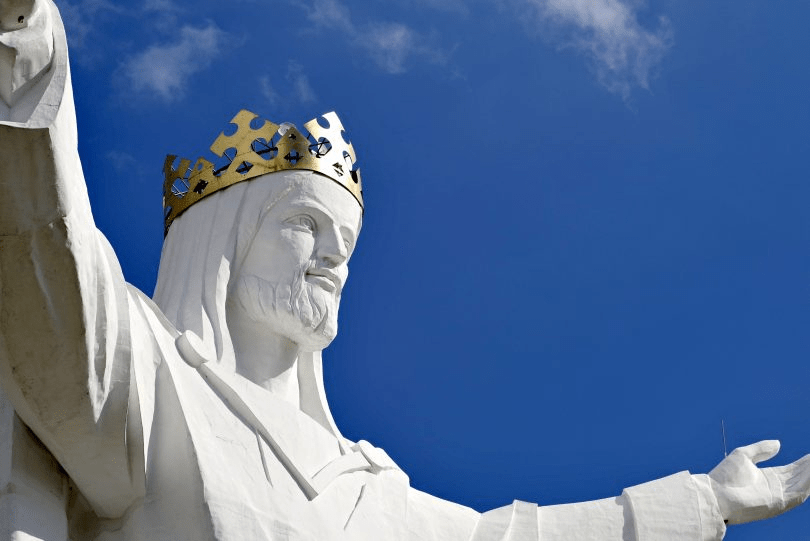
Christ the King Sunday (John 18:33-37)

Statue of Christ the King, in Świebodzin, Poland

Then Pilate entered the headquarters again, summoned Jesus, and asked him, “Are you the King of the Jews?” 

Jesus answered, “Do you ask this on your own, or did others tell you about me?” 

Pilate replied, “I am not a Jew, am I? Your own nation and the chief priests have handed you over to me. What have you done?” 

Jesus answered, “My kingdom does not belong to this world. If my kingdom belonged to this world, my followers would be fighting to keep me from being handed over to the Jews. But as it is, my kingdom is not from here.” 

Pilate asked him, “So you are a king?”

Jesus answered, “You say that I am a king. For this I was born, and for this I came into the world, to testify to the truth. Everyone who belongs to the truth listens to my voice.” (New Revised Standard Version)

Each year in the Christian Calendar, Christ the King Sunday is observed as the final Sunday in the liturgical year. It comes at this time, just before the beginning of Advent, in order to consider an important question.

Since Jesus came to this earth in his incarnation to be a king, we must ask, “What kind of a king was Jesus?”

Christ was not, and is not, a king, a ruler (or any other sort of title one wants to use for an authoritative leader) in the same way as was the Roman Emperor, King Herod, or the regional authority of the time, Pontius Pilate.

Jesus was also not like those in authority such as the Jewish High Priest, the Jewish ruling council of the Sanhedrin, or the local synagogue ruler. And Christ is most definitely not like any sort of present day President, Prime Minister, or petty dictator in any of the world’s nations.

Jesus was a king and a ruler who used his power and authority for those on the underbelly of society, that is, people without much, if any, power or authority.

That means Christ the King is concerned to effect a very different set of values from that of any politically dominant governmental system or society that was or is on this earth.

Whether a person or group of people are seeking to win an election, initiate a coup, or effect a change in government, they want their particular system of governing to be in power. They want to call all the shots in a particular place.

That means there will be winners and losers. There will be people in power, and others without it. Some people will benefit from the system, and others will not. Looking at kingship and/or leadership from that perspective, there is a built in failure rate.

The obsession with winning, at a national level, typically involves securing a strong military. Yet, despite military might, soldiers rarely secure any sort of political solution to anything. All it really does is strongarm others into doing what the powerful want done. It does nothing to change the hearts of people.

People in power can be enamored with their authority to do things. And they don’t like it whenever they are not in control of everything. The kings, rulers, and even religious leaders in Christ’s day, were used to controlling public discourse and even the daily lives of common people.

From that sort of worldly understanding of power, Jesus had no real authority. He was this pathetic person standing before a powerful person. Most people would have been begging for their lives. But not Jesus. Christ knew who was really in charge. And it was not Pilate.

Pilate was flummoxed by the presence of Jesus. From Pilate’s perspective, Jesus was not at all acting like a king ought to. Pilate, in his authoritative role, wanted answers about what was going on. But he didn’t realize that his authority was given to him from a power outside the Roman Empire.

Christ’s kingdom is not of this world. Therefore, the power politics and authority positions of that kingdom are nothing what people like Pilate were used to. There was no way that Pilate could use the typical tactics of manipulation, lies, corruption, and leveraging power to come to a satisfactory outcome for himself.

The values of God’s kingdom are quite different from any political government in this world, either past or present.

Jesus had no need to try and be at the top of Pilate’s system, or of the Roman world. So, he wasn’t even going to try and exercise that kind of authority within it. And neither were his disciples. Clubs and swords and pitched battles would not be happening. There was absolutely no need for it whatsoever.

For us today, that means we serve the interests of humility, gentleness, respect, righteousness, mercy, purity, and peace. We are not here on this earth to engage in the routine and typical ways of earthly power politics.

For the Christian, Jesus is King. But this king isn’t riding around in a chariot or a limousine; he comes to us on a jack ass and driving a Subaru.

Jesus is the king with all the power of the universe, and yet is tortured and killed by those with the local society’s authority. That happened not because of weakness or inability, but because of a completely different set of values which have to do with love defeating hate, instead of an army winning a victory.

A God who is crucified is diametrically different than any other deity or authority which has ever existed. The power of love is the ultimate power of doing what is right, just, and good; and letting truth have its way, no matter what.

Christians everywhere must be reminded, on this Christ the King Sunday, that we serve a sovereign king whose power and authority is used to be a humble servant who meets the needs of others.

All Christians, therefore, ought to embrace and engage in becoming gentle folk who bring humble service to others wherever they go. Seeking power, position, prestige, and pedigree is in direct opposition to the values of God’s kingdom, with Christ as King.

Any sort of Christendom, which seeks to control both government and society, or a Christian Nationalism which intends to ensconce personal agendas into society, ought to be rejected.

Christian Nationalism is nothing more than Grape Nuts; just as the cereal is neither grapes nor nuts, so the political movement is neither Christian nor concerned for national interests.

This is a day for the church to reassess what is most important, to affirm its true values, and to evaluate how it really ought to operate in society.

Almighty and everlasting God, whose will it is to restore all things in your well-beloved Son, the King of kings and Lord of lords: Mercifully grant that the peoples of the earth, divided and enslaved by guilt and shame, may be freed and brought together under his most gracious rule; who lives and reigns with you and the Holy Spirit, one God, now and forever. Amen.

You Are Not Far From the Kingdom of God (Mark 12:28-34)

One of the scribes came near and heard them disputing with one another, and seeing that he answered them well he asked him, “Which commandment is the first of all?” 

Jesus answered, “The first is, ‘Hear, O Israel: the Lord our God, the Lord is one; you shall love the Lord your God with all your heart and with all your soul and with all your mind and with all your strength.’ The second is this, ‘You shall love your neighbor as yourself.’ There is no other commandment greater than these.” 

Then the scribe said to him, “You are right, Teacher; you have truly said that ‘he is one, and besides him there is no other’; and ‘to love him with all the heart and with all the understanding and with all the strength’ and ‘to love one’s neighbor as oneself’—this is much more important than all whole burnt offerings and sacrifices.” 

When Jesus saw that he answered wisely, he said to him, “You are not far from the kingdom of God.” After that no one dared to ask him any question. (New Revised Standard Version)

Jewish religious leaders in the New Testament Gospels – high priests, scribes, Pharisees, Sadducees, the Sanhedrin – are typically portrayed in a negative light as opponents of Jesus. However, there are religious leaders in the Gospel accounts who genuinely engage Jesus, and are favorable to him.

Today’s Gospel lesson provides us with a wonderful conversation between Jesus and a scribe (that is, a professional handwriting copier of the Scriptures). This particular scribe is not mentioned by name.

The scribe was impressed by what he heard from Jesus. So, the man presented a question to him. The difference between this scribe and the other religious leaders is that the scribe asked a totally sincere question, with no alternative agenda to entrap Jesus. The guy just wanted to learn from him.

The Old Testament law contains 613 commands. Given the reality of so many instructions, which ones are priority? Are there commands which control other commands? What is the best way to look at the hundreds of divine instructions? The scribe’s question was really designed to discover how to best obey the law and be faithful to God.

There was no pondering or hesitation on Christ’s response. He went right to a foundational text for Jews. The passage serves as both a prayer and a succinct affirmation of faith:

“Hear, O Israel: The Lord is our God, the Lord alone. You shall love the Lord your God with all your heart and with all your soul and with all your might.”

Deuteronomy 6:4-5, NRSV

Yahweh is honored in this Scripture as the one true God. As such, Israel has an obligation to love and obey God. For Jesus, this is the cornerstone of faith and worship.

But that’s not all. Jesus provided a second commandment, on the same level of importance as the first:

“You shall love your neighbor as yourself: I am the Lord.”

Leviticus 19:18b, NRSV

I find it interesting that Jesus did not simply assume that everyone would understand that to love God is to love your neighbor. Christ intentionally gave the second command equal billing with the first.

To make it especially clear, Jesus emphasized that these two commands to love God and neighbor are the greatest commandments of all. In other words, every single command of Holy Scripture is tied to these two basic commands.

Indeed, the Ten Commandments are connected to them. The first four commands (you shall have no other gods; you shall not make yourself an idol and bow down to it; you shall not make wrongful use of God’s name; and remember the Sabbath) all have to do with loving God.

The next six commands (honor your father and mother; you shall not murder; you shall not commit adultery; you shall not steal; you shall not bear false witness; you shall not covet) all concern how to be loving to your neighbor.

Jesus intends for pious people to be concerned not only with their relation to God, but also with other people. Religious practices, for Jesus, must not only include devotion directed to God, but also commitments to the common good of all persons.

In order to truly love God, one must also love neighbor. The two are inextricably bound together.

Those who say, “I love God,” and hate a brother or sister are liars, for those who do not love a brother or sister, whom they have seen, cannot love God, whom they have not seen. (1 John 4:20, NRSV)

To the scribe’s credit, he affirmed the answer from Jesus concerning the commandments. And on top of this, the scribe added a beautiful paraphrasing of God’s law: The command to love God and neighbor “is much more important than all whole burnt offerings and sacrifices.”

This scribe was talking Christ’s language. Jesus delighted in his words. He commended and encouraged the man by saying, “You are not far from the kingdom of God.”

Christ’s statement is a positive one, not negative. Jesus was not trying to say that the scribe wasn’t yet in the kingdom, or that he needed to do more. He was affirming the scribe, and encouraging him with the reality that God’s kingdom is so close to us, that we can reach out and put our hand into it.

The kingdom of God is like a whole other world which can be found by some children in the back of a wardrobe; or like a different dimension beyond our three dimensional world. In other words, God’s kingdom is right here, right in front of our faces. The kingdom is here. It’s just a matter of whether we discern it’s presence, or not.

Jesus was right smack in front of the scribe. He could have literally reached out and touched Jesus. The man asked a good sincere question of Jesus, and got a good sincere answer. In addition, the man evidenced a good understanding of the spirit of God’s law.

I believe that Christ’s response concerning the kingdom to the scribe, opened his eyes to that otherworldly dimension:

Jesus is the logical and expected end of every search, and the answer to every question. The kingdom of God is among you.

Our Father in heaven,
    may your name be revered as holy.
    May your kingdom come.
    May your will be done
        on earth as it is in heaven. Amen.