Jeremiah 26:1-9, 12-15 – How to Use Our Voice

The Prophet Jeremiah by Marc Chagall (1887-1985)

Early in the reign of Jehoiakim son of Josiah king of Judah, this word came from the Lord: “This is what the Lord says: Stand in the courtyard of the Lord’s house and speak to all the people of the towns of Judah who come to worship in the house of the Lord. Tell them everything I command you; do not omit a word. Perhaps they will listen, and each will turn from their evil ways. Then I will relent and not inflict on them the disaster I was planning because of the evil they have done. Say to them, ‘This is what the Lord says: If you do not listen to me and follow my law, which I have set before you, and if you do not listen to the words of my servants the prophets, whom I have sent to you again and again (though you have not listened), then I will make this house like Shiloh and this city a curse among all the nations of the earth.’”

The priests, the prophets and all the people heard Jeremiah speak these words in the house of the Lord. But as soon as Jeremiah finished telling all the people everything the Lord had commanded him to say, the priests, the prophets and all the people seized him and said, “You must die! Why do you prophesy in the Lord’s name that this house will be like Shiloh and this city will be desolate and deserted?” And all the people crowded around Jeremiah in the house of the Lord….

Then Jeremiah said to all the officials and all the people: “The Lord sent me to prophesy against this house and this city all the things you have heard. Now reform your ways and your actions and obey the Lord your God. Then the Lord will relent and not bring the disaster he has pronounced against you. As for me, I am in your hands; do with me whatever you think is good and right. Be assured, however, that if you put me to death, you will bring the guilt of innocent blood on yourselves and on this city and on those who live in it, for in truth the Lord has sent me to you to speak all these words in your hearing.” (NIV)

Although much attention is given to Christmas Day, the Christian season of Christmas spans twelve days from December 25 through January 5. Celebrating Christmas as a season helps us immerse ourselves in Christ’s incarnation more fully than merely celebrating for one day.

Perhaps today’s Old Testament lesson is a curious choice for a Christmas season Scripture text. Yet, although we hold in one hand the joy and celebration of Christ’s birth, in the other hand we hold the deep sadness of recognizing that not everyone was or is excited about Jesus. For Christ is both the cornerstone of faith and the stone which causes people to stumble and fall. (1 Peter 2:8)

The fact of the matter is that God is not okay with cruel injustice, hollow worship, and an inattention to both the divine and human. Jesus came to make things right. But not everyone wants that. Systemic evil persists because there are always people who benefit from how power and resources are structured – and they care little about how it impacts those on the underbelly of their control.

Therefore, just as important it is to recognize the inbreaking of God into this world and celebrate the incarnation of Christ, it is equally necessary to acknowledge that the world is broken and that we must speak truth to power. This is no easy task because rarely are things simply black and white, all good or all bad.

Jeremiah by Marc Chagall, 1956

In Jeremiah’s day, it was not that his opponents were pure evil with no acknowledgment of God. Rather, the problem was that the power brokers in Judah tried to keep a strict separation of religion from everything else. In other words, they were perfectly fine with God, that is, if the Lord would stay in the temple where he belonged. But Jeremiah would have none of it. Keeping Yahweh out of matters of social justice, geopolitics, and institutional governance led to great humanitarian problems. Jeremiah became God’s voice to a generation of people who ignored the divine in everything but religious ritual.

Bifurcating worship and work disconnect daily life from divine resources. Without God infused in all of life, a lack of grace fills the empty places. What is more, the sovereign Lord of all can neither be silenced nor dismissed; God will find a way to accomplish peace and justice for the common good of everyone, and not just the few.

The heart of Jeremiah’s message was for king and people to be obedient in all of life, to recenter themselves around God’s law – not just the religious bits but the social ones, as well. Jeremiah did not proclaim something new. He was just calling the powers that be to Torah observance.

The true needs and interests of our communities can never be addressed and lifted-up in the narrow self-serving interests of persons in power who turn a blind eye to anyone unlike them. The needs and interests of our world lie in becoming who we were designed from the beginning to be: A people belonging to God, tapping into the deep reservoir of spirituality inside us.

For the Christian, we are to acknowledge the baby born as a king and follow in the way of grace and truth. There is to be no division between sacred and secular because Jesus is Lord of all. We are to continually use our voice for both praise and prophecy, for shouting celebration to God and speaking truth to power.

Holy God, Sovereign of all, we give you praise for sending your Son, our Savior, Jesus as a baby, a human just like us. Keep us grounded in humility, sensitive to sin, attentive to that which is just and right, merciful in all things, pure in worship, and peace-loving through Christ our Lord in the strength of your Spirit. Amen.

Malachi 2:10-3:1 – Remain Faithful

An Eastern Orthodox icon of the prophet Malachi

Don’t we all come from one Father? Aren’t we all created by the same God? So why can’t we get along? Why do we desecrate the covenant of our ancestors that binds us together?

Judah has cheated on God—a sickening violation of trust in Israel and Jerusalem: Judah has desecrated the holiness of God by falling in love and running off with foreign women, women who worship alien gods. God’s curse on those who do this! Drive them out of house and home! They’re no longer fit to be part of the community no matter how many offerings they bring to God-of-the-Angel-Armies.

And here’s a second offense: You fill the place of worship with your whining and sniveling because you don’t get what you want from God. Do you know why? Simple. Because God was there as a witness when you spoke your marriage vows to your young bride, and now you’ve broken those vows, broken the faith-bond with your vowed companion, your covenant wife. God, not you, made marriage. His Spirit inhabits even the smallest details of marriage. And what does he want from marriage? Children of God, that’s what. So, guard the spirit of marriage within you. Don’t cheat on your spouse.

“I hate divorce,” says the God of Israel. God-of-the-Angel-Armies says, “I hate the violent dismembering of the ‘one flesh’ of marriage.” So, watch yourselves. Don’t let your guard down. Don’t cheat.

You make God tired with all your talk.

“How do we tire him out?” you ask.

By saying, “God loves sinners and sin alike. God loves all.” And, by saying, “Judgment? God’s too nice to judge.”

“Look! I’m sending my messenger on ahead to clear the way for me. Suddenly, out of the blue, the Leader you’ve been looking for will enter his Temple—yes, the Messenger of the Covenant, the one you’ve been waiting for. Look! He’s on his way!” A Message from the mouth of God-of-the-Angel-Armies. (MSG)

Any reader of Holy Scripture must come to grips with sections of it which are difficult, harsh, and scathing. Since the Bible covers a complete range of the human condition, not all we find within it are bunnies and butterflies. The prophets of the Lord held back no punches when it came to delivering their message.

In today’s Old Testament lesson, the prophet Malachi squarely addressed the people’s issue of unfaithfulness. They were faithless to one another; faithless to their spouses; and, faithless to God.  God is described by the prophet as weary and exasperated with a lot of talk with no faithful presence and action. 

God hates divorce simply because it is so damaging for those involved. This is not a divine decree that divorce should never exist any more than God’s hatred for the people’s worship means that worship should never exist.

Both marriage and worship are to be meaningful experiences of devotion and dedication to the significant human and divine relationships in our lives.

God has no tolerance for half-hearted commitments which either opens another to violence or having verbal or physical violence perpetrated outright by the one who ought to be protecting and loving.

The solution to the two-faced problem of the people with their milquetoast obedience is that a messenger will be sent to prepare the way of the Lord.  He is coming, and it will be soon.

Keeping the end of our lives and of history in mind helps bring greater clarity and purpose to the present. The season of Advent reminds the faithful that since Jesus is coming soon, we must hold fast to our Christian allegiance. 

Faithfulness toward God also means having a faithful presence (albeit perhaps virtually) to the people close to us and near us.

Malachi exhorted the people to guard their spirits because a lack of personal awareness within causes a dearth of awareness without in simply seeing others but not really seeing them. Spousal abuse is not okay, and the God who sees all will rouse and act on behalf of the one stuck in a situation and pattern of neglect and/or exploitation.

It is necessary to monitor the condition of our souls and be in touch with the state of our spirits so that we remain faithful. We are to nurture our inner selves so that outward actions reflect faithful commitment without harming those closest to us.

Vulnerability with oneself and submission to basic accountability structures are important so that we are aware to strengthen the inner person.  Rather than embrace a rabid individualism, communal dedication is a primary way of pleasing God, serving others, and realizing divine blessing. It also is a necessary preventative to domestic abuse.

Everyone deserves healthy relationships.

If you or someone you know is the victim of spousal abuse, call the National Domestic Violence Hotline at 1-800-799-7233 or visit their website at https://www.thehotline.org/

Sovereign God, the One who sees and knows all, help me guard my spirit so that I will be faithful in all I do and in all my relationships with others, especially my own family and spouse.  Strengthen my soul to remain dedicated to seeing the coming of Jesus in all his glory.  Amen.

Joshua 20:1-9 – Asylum

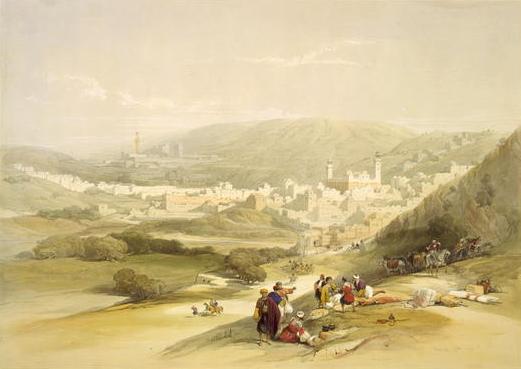
A painting of Hebron, one of the cities of refuge, 1839.

The Lord said to Joshua, “Now tell the Israelites to designate the cities of refuge, as I instructed Moses. Anyone who kills another person accidentally and unintentionally can run to one of these cities; they will be places of refuge from relatives seeking revenge for the person who was killed.

“Upon reaching one of these cities, the one who caused the death will appear before the elders at the city gate and present his case. They must allow him to enter the city and give him a place to live among them. If the relatives of the victim come to avenge the killing, the leaders must not release the slayer to them, for he killed the other person unintentionally and without previous hostility. But the slayer must stay in that city and be tried by the local assembly, which will render a judgment. And he must continue to live in that city until the death of the high priest who was in office at the time of the accident. After that, he is free to return to his own home in the town from which he fled.”

The following cities were designated as cities of refuge: Kedesh of Galilee, in the hill country of Naphtali; Shechem, in the hill country of Ephraim; and Kiriath-arba (that is, Hebron), in the hill country of Judah. On the east side of the Jordan River, across from Jericho, the following cities were designated: Bezer, in the wilderness plain of the tribe of Reuben; Ramoth in Gilead, in the territory of the tribe of Gad; and Golan in Bashan, in the land of the tribe of Manasseh. These cities were set apart for all the Israelites as well as the foreigners living among them. Anyone who accidentally killed another person could take refuge in one of these cities. In this way, they could escape being killed in revenge prior to standing trial before the local assembly. (NLT)

God is concerned for justice. The Lord made sure that as soon as the Israelites got into the Promised Land that the divine rule of law would be established concerning cities of refuge. God did not take the stance of saying, “Well, these guys need to get settled in after all this military campaigning. I don’t want to overwhelm them with having to deal with this issue.” No, the Lord considered it imperative to have the cities set up. It was important enough to not put off or wait for Joshua to get around to it, even though it was on his to-do list.

The six cities of refuge in Israel.

God made it clear to Moses what was to happen in the case of involuntary manslaughter:

When the Lord your God has destroyed the nations whose land he is giving you, and when you have driven them out and settled in their towns and houses, then set aside for yourselves three cities in the land the Lord your God is giving you to possess. Determine the distances involved and divide into three parts the land the Lord your God is giving you as an inheritance, so that a person who kills someone may flee for refuge to one of these cities.

This is the rule concerning anyone who kills a person and flees there for safety—anyone who kills a neighbor unintentionally, without malice aforethought. For instance, a man may go into the forest with his neighbor to cut wood, and as he swings his ax to fell a tree, the head may fly off and hit his neighbor and kill him. That man may flee to one of these cities and save his life. Otherwise, the avenger of blood might pursue him in a rage, overtake him if the distance is too great, and kill him even though he is not deserving of death, since he did it to his neighbor without malice aforethought. Therefore, I command you to set aside for yourselves three cities. (Deuteronomy 19:1-7, NIV)

A city of refuge is a place of safety where someone who murdered another unintentionally could seek asylum. Safeguarding life is a premium value for God. If one person is accidentally killed, the last thing the Lord wanted was even more innocent blood to be shed out of vengeance.

Law and grace are meant to exist together for the benefit of the entire nation.

Six cities are named, three on the west side of the Jordan River and three on the east side. No place in the land of Israel was more than one day’s journey from at least one of these cities, so God graciously provided ample opportunity for preserving the life of the one who killed without malicious forethought or intent.

Although sanctuary was given, there was a full investigation of the killing to ensure the innocence of the killer. If the killer was found to be guilty, then appropriate legal action was taken. If not, the person was only protected while within the bounds of the refuge city.

Therefore, it is important to approach God’s law and God’s grace not as an either/or but as a both/and. We are to show grace while obeying the law, and we are to maintain just laws when extending grace.

The crime should fit the punishment, and actions, even unintended ones, have consequences.

We need to continually work to uphold both law and grace together without forfeiting one for the other. Simplistic answers along with cut-and-dried approaches will not do when holding them together. Instead, issues of human life and death are to be given due diligence with examining the situation in all its complexity.

There is to be public respect for the sanctity of human life.

Showing such respect will come through both law and grace. By establishing cities of refuge, God was squelching generational feuds that go on and on and on. Justice will be done, yet it will be done with grace and not by family vendettas and blood feuds, like the Hatfield’s and McCoy’s.

God’s people are to live differently, with gracious respect for all life at the forefront of civil law.

Lord God, thank you for creating human life in your image and likeness, for the inherent worth you place on human existence. Help us to uphold the sanctity of life in our communities. Give us the strength to stand up to those forces that seek to destroy the lives of those most vulnerable. Today I commit myself never to be silent, never to be passive, never to be forgetful of respecting life. I commit myself to protecting and defending the sacredness of life according to your will, through Christ our Lord. Amen.

Numbers 12:1-9 – Against Racism

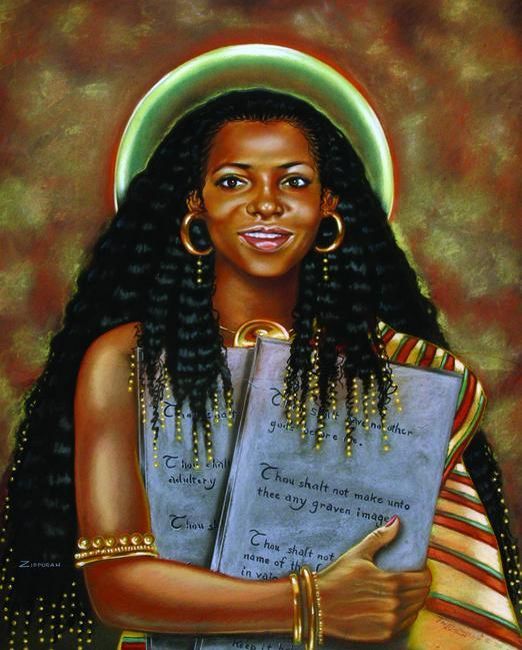
American artist Alan Jones depiction of Moses’ wife Zipporah

While they were at Hazeroth, Miriam and Aaron criticized Moses because he had married a Cushite woman. They said, “Has the Lord spoken only through Moses? Hasn’t he spoken through us, too?” But the Lord heard them. (Now Moses was very humble—more humble than any other person on earth.)

So immediately the Lord called to Moses, Aaron, and Miriam and said, “Go out to the Tabernacle, all three of you!” So, the three of them went to the Tabernacle. Then the Lord descended in the pillar of cloud and stood at the entrance of the Tabernacle. “Aaron and Miriam!” he called, and they stepped forward. And the Lord said to them, “Now listen to what I say:

“If there were prophets among you,
    I, the Lord, would reveal myself in visions.
    I would speak to them in dreams.
But not with my servant Moses.
    Of all my house, he is the one I trust.
I speak to him face to face,
    clearly, and not in riddles!
    He sees the Lord as he is.
So why were you not afraid
    to criticize my servant Moses?”

The Lord was very angry with them, and he departed. (NLT)

There are three observations about today’s Old Testament lesson I want to point-out and lift-up, and they are crucial observations for us in our present world.

First, the older siblings of Moses, Miriam the eldest and Aaron the other brother, had a problem with their sister-in-law (whose name was Zipporah). She was a Cushite. Cush was an ancient country which encompassed present day northern Sudan and much of Ethiopia in Africa. In other words, Zipporah was black, and Miriam and Aaron were critical of their little brother for marrying her.

Second, although having a black sister-in-law was the real issue, Miriam and Aaron confronted Moses not about this, but went after him concerning his role as a prophet. In other words, the siblings engaged in the age-old practice of ostensibly presenting a concern which was not really the matter on their hearts.

Third, the omniscient God knew what was happening. God was fully cognizant of Miriam and Aaron’s cloak-and-dagger attack at Zipporah through her husband Moses. In other words, God was incensed with this coup attempt because it was unjust, unfair, ungodly, and frankly, racist. And so, the text states that God, with divine anger aroused, “immediately” addressed the situation.

Racism is insidious. It tends to get expressed most often through the methods used by Miriam and Aaron on the level of criticizing another somewhat related issue. So, I offer the following questions with as much humility from Moses I can muster:

Are we aware of our own inheritance of centuries and even millennia of dominance language which keeps other human beings docile and subservient to another’s authority?

Have we chosen to challenge points of order and procedure in the attempt to marginalize certain persons?

Are we detached from our own needs and, so, unable to listen well?

Is there secret fear in our hearts, believing that we must maintain our hegemony, or else, there will be chaos?

Is the end game using whatever tools available for others to become like us, as if we were the Borg who talk about how resisting us is futile?

Are we willing to do the hard work of pulling out our own roots of racial segregation and injustice?

Do we want cheap diversity or true solidarity?

Will we work toward creating a new liberated humanity, championing equity in all things for all people, instead of attempting to sanitize existing systems?

For far too long, too many have relied upon individualism and anti-structuralism and it has not served us well in addressing our contemporary problems. Individualism sees only individual racist words and actions and is blind to systemic issues. It views social problems as merely a reflection of broken relationships, and, so, again, makes it impossible to see the systemic and nature of our racialized society.

Anti-structuralism, that is, not addressing racism as an organizing structure, is the assumption that racism is only individual racial prejudice and hatred. Thus, the approach in dealing with racism is to always be on the lookout for “bad racists.” This avenue, however, diverts attention from upholding biblical justice, forming policies of liberation, and establishing equitable care and opportunity for the common good of all persons.

As an historian, I tend to view things through historical lenses and, so, I resonate deeply with the late twentieth-century essayist James Baldwin when he said, “White people are still trapped in a history which they do not understand; and until they understand it, they cannot be released from it.”

I want my history to be with Moses and freedom. I want God to show up and put racism to an end. I want to be part of the solution, and not the problem. I want justice and fairness to flow like a river that never runs dry.

Lord, Jesus Christ, you reached across ethnic boundaries between Samaritan, Roman and Jew. In your earthly ministry you offered fresh sight to the blind and freedom to captives. Gracious Savior, help us to break down walls and barriers in our community; enable us to see the reality of racism and bigotry; and free us to challenge and uproot it from ourselves, our faith communities, our society, and our world. Amen.