Amos 8:1-12 – A Prophet’s Perspective on Power and Poverty

Miners’ wives carrying sacks of coal by Vincent Van Gogh, 1881

This is what the Sovereign Lord showed me: a basket of ripe fruit. “What do you see, Amos?” he asked.

“A basket of ripe fruit,” I answered.

Then the Lord said to me, “The time is ripe for my people Israel; I will spare them no longer.

“In that day,” declares the Sovereign Lord, “the songs in the temple will turn to wailing. Many, many bodies—flung everywhere! Silence!”

Hear this, you who trample the needy
    and do away with the poor of the land,

saying,

“When will the New Moon be over
    that we may sell grain,
and the Sabbath be ended
    that we may market wheat?”—
skimping on the measure,
    boosting the price
    and cheating with dishonest scales,
buying the poor with silver
    and the needy for a pair of sandals,
    selling even the sweepings with the wheat.

The Lord has sworn by himself, the Pride of Jacob: “I will never forget anything they have done.

“Will not the land tremble for this,
    and all who live in it mourn?
The whole land will rise like the Nile;
    it will be stirred up and then sink
    like the river of Egypt.

“In that day,” declares the Sovereign Lord,

“I will make the sun go down at noon
    and darken the earth in broad daylight.
I will turn your religious festivals into mourning
    and all your singing into weeping.
I will make all of you wear sackcloth
    and shave your heads.
I will make that time like mourning for an only son
    and the end of it like a bitter day.

“The days are coming,” declares the Sovereign Lord,
    “when I will send a famine through the land—
not a famine of food or a thirst for water,
    but a famine of hearing the words of the Lord.
People will stagger from sea to sea
    and wander from north to east,
searching for the word of the Lord,
    but they will not find it. (New International Version)

I’ve been in the church most of my life. I have listened to thousands of sermons, as well as preaching thousands of them myself. I can count on both hands how many times I’ve heard a sermon from one of the twelve minor prophets in the Bible. Although I personally have preached on them more times than that, it still pales in comparison with how many sermons I’ve preached from the New Testament gospels or epistles.

This, I believe, is an indictment on us, especially those with privilege and power. If you add the major prophets, we have sixteen books contained in Holy Scripture calling out powerful and influential people’s oppression of others. To overlook such a girth of text is to stick our fingers in our ears and refuse to listen to God.

Those with power, position, and privilege must continually be vigilant to use such influence for the benefit of all persons – not just themselves or people just like them.

The books of the prophets make it very clear that God cares about justice. God will uphold the needy. The Lord will stand with the oppressed. If we fail to share a divine sense of justice and injustice, there will be hell to pay.

God is longsuffering. The Lord patiently awaits us to pay attention. Yet, eventually, that patience will run its course. A prophet will be sent to voice God’s concerns. Like a basket of ripe fruit now finally ready to be eaten, so God’s justice is ripe and ready for action.

The prophet Amos delivered a scathing message to the ancient Israelites about their total disregard for the poor and needy in the land. The people in positions of authority and power only looked on the less fortunate as commodities – as pawns to be taken advantage of for the rich merchants. 

Because the wealthy never took the time to listen to the poor, God would not listen to them. Judgment was coming, and it would not go so well for the power brokers of society who only thought of their business and squeezing others for more money.      
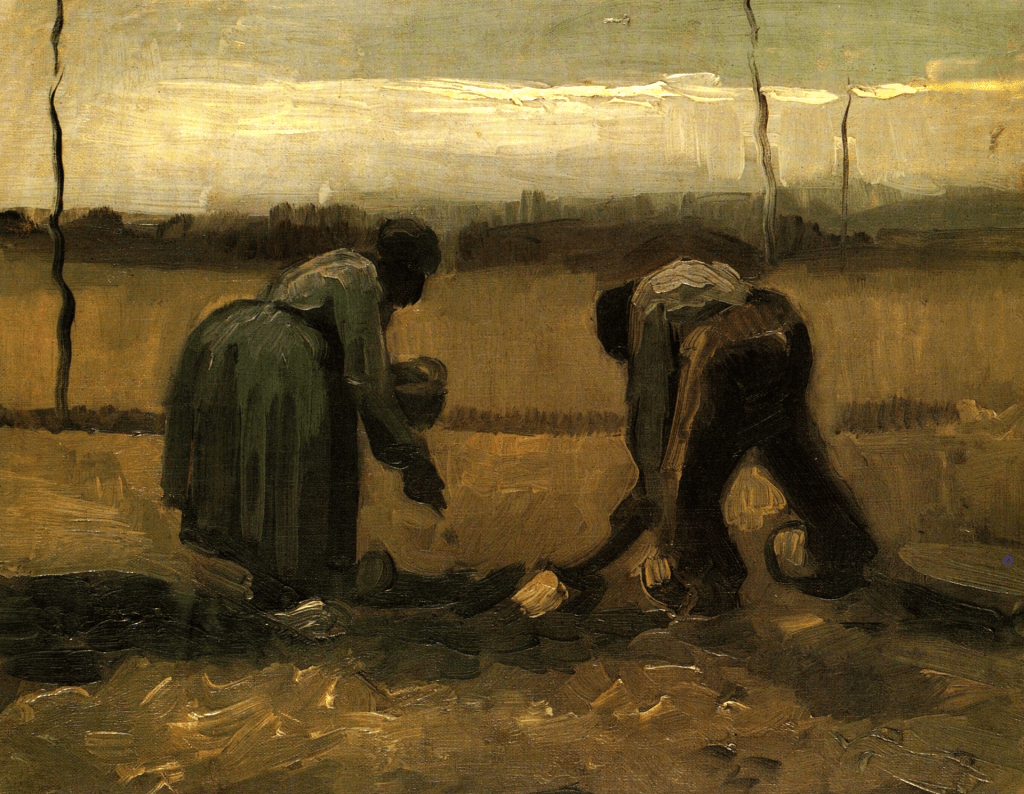
Peasants planting potatoes by Vincent Van Gogh, 1885

Few people rush to have poor folk as their friends. Those in poverty are often overlooked and disregarded. Either they are ignored altogether or are given hand-outs and services without ever having any significant human contact. Even when there is help, it comes from a distance.

In other words, those in authority rarely take the time to listen and get to know the real face of poverty. If there isn’t a photo opportunity, then encounters with the poor are not likely to happen with politicians, or anyone else. After all, so many are busy making money, checking stock portfolios, and considering how to get bigger market shares…. 

Perhaps we have an answer as to why there is no revival in the land. God shows such solidarity with the poor that to ignore them is to ignore him.  No matter our financial picture and outlook, every one of us can grace the poor with the gift of time and listening.  For in doing so we might just be listening to the voice of God.

Justice is the responsibility of everyone, not just a few.

God identifies closely with the poor, the distressed, the underprivileged, and the needy. The Lord listens to the lowly. So, we as God’s people, are to share this same concern. It is a theme throughout the entirety of Holy Scripture.

From the Old Testament:

God will rescue the needy person who cries for help
and the oppressed person who has no one’s help.
He will have pity on the poor and needy
and will save the lives of the needy. (Psalm 73:12-13, GW)

Those who mock the poor insult their Maker; those who rejoice at the misfortune of others will be punished. (Proverbs 17:5, NLT)

Those who are gracious to the poor lend to the Lord, and the Lord will fully repay them. (Proverbs 19:17, CEB)

If you close your ear to the cry of the poor, you will cry out and not be heard.

Proverbs 21:13, NRSV

Those who give to the poor will lack nothing, but those who turn a blind eye will be greatly cursed. (Proverbs 28:27, CEB)

Give your food to the hungry
    and care for the homeless.
Then your light will shine
    in the dark;
your darkest hour will be
    like the noonday sun. (Isaiah 58:10, CEV)

The Spirit of the Sovereign Lord is on me,
    because the Lord has anointed me
    to proclaim good news to the poor. (Isaiah 61:1, NIV)

From the New Testament:

“If you want to be complete, go, sell what you own, and give the money to the poor. Then you will have treasure in heaven.”

Jesus (Matthew 19:21, CEB)

Command those who are rich in this present world not to be arrogant nor to put their hope in wealth, which is so uncertain, but to put their hope in God, who richly provides us with everything for our enjoyment. Command them to do good, to be rich in good deeds, and to be generous and willing to share. (1 Timothy 6:17-18, NIV)

 If we are rich and see others in need, yet close our hearts against them, how can we claim that we love God? My children, our love should not be just words and talk; it must be true love, which shows itself in action. (1 John 3:17-18, GNT)

Poverty is not only an issue in some far away place; the poor are found everywhere, and they are always among us.

I believe an honest hearing of the prophet Amos would change the world. I’m not talking about angry ranting which works people into a frenzy of fear and suspicion. I am referring to giving Amos a serious hearing, just like we give the Apostle Paul our focused attention.

Just because poverty has always been with us, doesn’t mean we ought to only shrug our shoulders and say, “Meh, what’s a guy to do?” Instead, we can determine to address the issues which create a large class of poor people to begin with – including malevolence and materialism.

The moral compass of many of the earth’s nations is askew, even broken. It needs to be recalibrated to the true north of biblical justice. Back in the prophet’s day, bullying, bribery, and backstabbing were tools used for malevolent purposes. Those same implements are still being used by some today.

You must not pervert justice or show favor. Do not take a bribe, for bribes blind the eyes of the wise and distort the words of the righteous. (Deuteronomy 16:19, NET)

Those who plant injustice will harvest disaster,
    and their reign of terror will come to an end. (Proverbs 22:8, NLT)

But why would people be so unjust to other people? What would motivate someone to purposefully harm another in this way?… Materialism would.

Whenever people have an exorbitant amount of stuff, generosity is typically not their first impulse (Ecclesiastes 5:10). Rather, the extremely rich among us have an equally extreme temptation to hold on tight to their wealth – so much so that money and acquiring more stuff becomes their religion. That’s why Scripture is replete with warnings about money.

In short, poverty must be tackled, from a biblical perspective, on both the personal and systemic level. Individuals, families, churches, faith communities, organizations, corporations, and governments must all remove the obstacles which keep people in poverty. This is an appropriate use of power and authority.

What will you and I do?…

Gracious God, you are found everywhere – both the halls of power, and the back alleys of slums. As we seek you more and more, help us to see the face of Jesus in everyone we encounter, whether rich or poor, so that we might share the gift of life with them, through Jesus Christ our Lord, in the power of your Holy Spirit. Amen.

Psalm 52 – Deliver Us From Evil

The world’s oldest olive tree, 3,000 years, on the island of Crete

Hey, powerful person!
    Why do you brag about evil?
    God’s faithful love lasts all day long.
Your tongue devises destruction:
    it’s like a sharpened razor, causing deception.
You love evil more than good;
    you love lying more than speaking what is right.
You love all destructive words;
    you love the deceiving tongue.

But God will take you down permanently;
    he will snatch you up,
    tear you out of your tent,
    and uproot you from the land of the living!
The righteous will see and be in awe;
    they will laugh at those people:
“Look at them! They didn’t make God their refuge.
    Instead, they trusted in their own great wealth.
        They sought refuge in it—to their own destruction!”

But I am like a green olive tree in God’s house;
    I trust in God’s faithful love forever and always.
I will give thanks to you, God, forever,
    because you have acted.
In the presence of your faithful people,
    I will hope in your name because it’s so good. (Common English Bible)

Ideally, every person on planet earth would be safe to talk to and work with. But we know this is not true. That’s because we have our own experiences of persons in authority who used their power and influence for malevolent purposes – knowing exactly what kind of harm they’re doing.

This is precisely what once happened with David. Before he was king over all Israel and Judah, David was on the run from King Saul.

David had done nothing wrong. In fact, he had done everything right from a good heart. And yet, because of Saul’s jealousy and lust for power, he saw David as a threat and not an asset. So, he hunted him like an animal.

King Saul’s abuse of power was bad enough. But that abuse reached it’s evil height with Doeg the Edomite. (1 Samuel 22:6-23)

Doeg was a nasty guy. He wasn’t just bad; he enjoyed being bad. Saul was so obsessed with getting rid of his perceived rival, that he sought to kill anyone who aided and abetted David. And Doeg had such a lust for murder that he was willing to kill anyone.

And that’s what he did. When Saul found out that the priests in the village of Nob had helped David when he was on the run, the jealous king tried to use his authority to command the army to slaughter them all. However, being reasonable men, they could not do it.

Yet, Doeg stepped in and stepped up to single-handedly wipe out the priests. Sadly, he didn’t stop there…

Doeg the Edomite turned and attacked the priests; on that day he killed eighty-five who wore the linen ephod. Nob, the city of the priests, he put to the sword; men and women, children and infants, oxen, donkeys, and sheep, he put to the sword. (1 Samuel 22:18-19, NRSV)

It was after this horrific event that David crafted the psalm for today.

There is abuse, trauma, and oppression – and then there is the continual harming from another which goes unabated. The abuser, the oppressor, the murderer keeps going, unchecked. And we are powerless to stop it.

There is only One who can right such terrible wrongs.

Today’s psalm speaks of God’s constancy, the continual love which persists all day long. David lifted his grief and anger to the Lord concerning the misuse of power and authority by Saul and Doeg. In light of God’s justice and faithful love, David affirms and believes that the Lord will bring ruin on those who despise divine commands and ethical instruction.

We don’t know always know why evil continues, or how it will end. Those enduring questions out of our own human condition and experience of evil may persist. Yet, the believer knows with certainty, as follower of a righteous, just, and holy God, that the downfall of the wicked will be total, and it will be permanent.

There is a day coming when evil shall be finished forever. And it’s hard not knowing exactly when that’s going to happen.

Perhaps this sort of talk seems like a cop out. It may appear that if God is so loving and powerful that evil ought to be stopped this very second.

Yet, consider this: There is so much evil and injustice in this world that to forcefully and immediately pull up those nasty wicked weeds will end up taking out the good plants next to them. The cure ends up being the harm.

The Lord is presently, patiently, and meticulously moving all things toward an inexorable ending – and it must be done carefully so that the godly are preserved from annihilation.

Fortunately, most people on earth aren’t like Doeg the Edomite or King Saul. Unfortunately, having one of them in your life is likely to happen because of the world’s great evil. One wicked person is bad enough to foment hate, spread lies, create havoc, and outright murder people – both verbally and actually.

The biblical psalms exist to serve us well whenever we experience the wrath of a person like Doeg. The psalms let us know we aren’t alone and help give us a voice. This is highly important, especially when the wicked seek to silence us and squelch our voice.

Trusting in the Lord, day after day… week after week… month after month… year after year… decade after decade… with the same slow and deliberate plod of God, strengthens us like a big old thick olive tree. And the psalms are here to help that happen.

May the Lord Jesus Christ guard and deliver you from the snares of the devil, the assaults of evil spirits, the wrath of the wicked, all base passions, and the fear of the known and unknown. Amen.

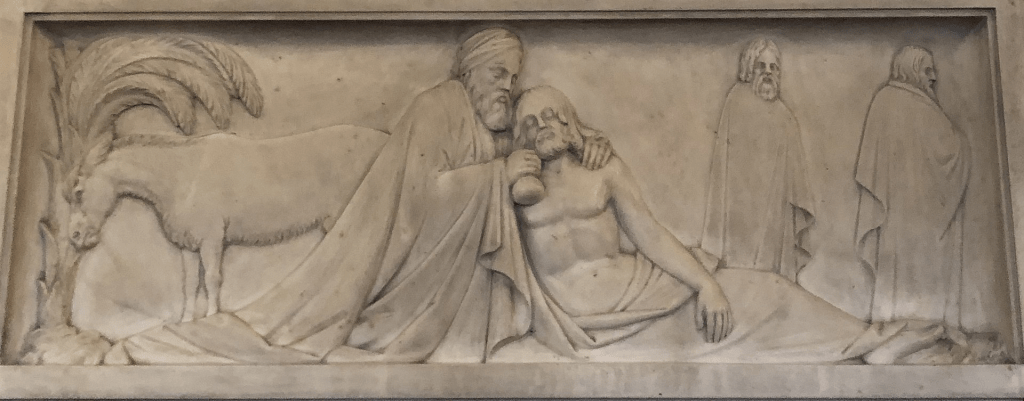
Luke 10:25-37 – The Parable of the Good Samaritan

The Good Samaritan by Samuel Nixon. St. Paul’s Church, Halifax, Nova Scotia, Canada

 On one occasion an expert in the law stood up to test Jesus. “Teacher,” he asked, “what must I do to inherit eternal life?”

“What is written in the Law?” he replied. “How do you read it?”

He answered, “‘Love the Lord your God with all your heart and with all your soul and with all your strength and with all your mind’; and ‘Love your neighbor as yourself.”

“You have answered correctly,” Jesus replied. “Do this and you will live.”

But he wanted to justify himself, so he asked Jesus, “And who is my neighbor?”

In reply Jesus said: “A man was going down from Jerusalem to Jericho, when he was attacked by robbers. They stripped him of his clothes, beat him and went away, leaving him half dead. A priest happened to be going down the same road, and when he saw the man, he passed by on the other side. So too, a Levite, when he came to the place and saw him, passed by on the other side. 

But a Samaritan, as he traveled, came where the man was; and when he saw him, he took pity on him. He went to him and bandaged his wounds, pouring on oil and wine. Then he put the man on his own donkey, brought him to an inn and took care of him. The next day he took out two denarii and gave them to the innkeeper. ‘Look after him,’ he said, ‘and when I return, I will reimburse you for any extra expense you may have.’

“Which of these three do you think was a neighbor to the man who fell into the hands of robbers?”

The expert in the law replied, “The one who had mercy on him.”

Jesus told him, “Go and do likewise.” (New International Version)

Who do you relate to in the story? Which character most resonates with you in your life right now?

The Lawyer (an expert in the Old Testament Law)

The Gospel writer, Luke, gives us insight into the thought process of the person for whom Jesus told the parable to. That man sought to justify himself. In Christianity, no one justifies themselves. The kingdom of God turns on grace, and not with us working more or harder. 

Christ’s mercy is not dependent on what kind of people we are but is simply based on need. God graciously gives us the gift of faith and the mercy of deliverance. By Christ’s wounds we are healed. 

As Christians, we already possess justification by grace alone apart from human effort.

Each individual must realize they are in a theological ditch. We are all unable to get out of our predicament. Everyone needs the compassion of Christ.

But now God’s way of putting people right with himself has been revealed. It has nothing to do with law, even though the Law of Moses and the prophets gave their witness to it. God puts people right through their faith in Jesus Christ. God does this to all who believe in Christ, because there is no difference at all: everyone has sinned and is far away from God’s saving presence. But by the free gift of God’s grace all are put right with him through Christ Jesus, who sets them free. (Romans 3:21-24, GNT)

We do not need to justify ourselves.

The Priest and the Levite (experts in the Law)

The shock that hits closes to home, from Christ’s parable, is how frequently we are the ones who pass by and ignore the other. The command to “Go and do likewise,” extends about as far as the end of the story for modern hearers, landing us in the ditch between knowing the Samaritan and his compassionate generosity are set forth as an example and our tendency to ignore the cries of the downtrodden and disenfranchised.

Do not seek revenge or bear a grudge against anyone among your people but love your neighbor as yourself. I am the Lord…. When a foreigner resides among you in your land, do not mistreat them. The foreigner residing among you must be treated as your native-born. Love them as yourself, for you were foreigners in Egypt. I am the Lord your God. (Leviticus 19:18, 33-34, NIV)

The Lord defends the cause of the fatherless and the widow, and loves the foreigner residing among you, giving them food and clothing. And you are to love those who are foreigners, for you yourselves were foreigners in Egypt. (Deuteronomy 10:18-19, NIV)

We are to go and do likewise.

The Samaritan

The Samaritan, the Christ figure in the story, comes and shows the man mercy. This grace was free, lacked any sort of favoritism, and was full of sheer kindness. Without the Samaritan’s actions of binding up the man’s wounds and getting him to a safe place, the victim would have died.  

It is no coincidence that there are many hospitals throughout the country named “Good Samaritan.” Christians were at the forefront of establishing hospitals because of this very parable of Jesus. It was a significant way of living into the values of God’s kingdom.

Mercy is at the heart of all Christian ministry.

Jesus, responding to those who questioned his acts of mercy toward questionable people, said:

“Those who are well have no need of a physician, but those who are sick. Go and learn what this means, ‘I desire mercy, not sacrifice.’ For I have not come to call the righteous but sinners.” (Matthew 9:12-13, NRSV)

I appeal to you therefore, brothers and sisters, on the basis of God’s mercy, to present your bodies as a living sacrifice, holy and acceptable to God, which is your reasonable act of worship. (Romans 12:1, NRSV)

Do justice. Love mercy. Walk humbly. (Micah 6:8)

The Victim

The wounded hapless man was left for dead. In the story, we know he would die apart from help – the kind of help the man could not do for himself. He was completely dependent on someone to rescue him from his plight.

The victim in the ditch reminds us of what it feels like to be forgotten by others — and perhaps even by God. The feeling of loneliness and forsakenness invites compassion and empathy for all who experience it.

Victimization needs a voice and a champion. There are powerless people who either cannot speak or who are not heard by others. There are people, victims of abuse, who cannot get out of their traumatic ditch – overwhelmed by what another did to them.

God stands for the victim and against the robbers.

You will never again
    make victims of others
or send messengers to threaten
    everyone on this earth. (Nahum 2:13, CEV)

God will send help.

When the righteous cry out, the Lord listens;
    he delivers them from all their troubles.
The Lord is close to the brokenhearted;
    he saves those whose spirits are crushed.

The righteous have many problems,
    but the Lord delivers them from every one of them. (Psalm 34:17-19, CEB)

By his wounds we are healed.

Conclusion

The victim in the ditch is worthy of help because he carries the divine image of God.

The one who showed compassion and mercy, the Samaritan, reflected God’s likeness through his actions.

Those who passed by, the priest and the Levite, also bear the indelible mark of their Creator, yet chose to ignore their gut and got lost in their heads.

Maybe God — through Christ — comes to us as the one in the ditch or maybe as the one who shows compassion and mercy; perhaps God even comes to us as a reminder that the call to care for others frequently goes unheeded as we pass by the cries of those in need of help.

Lord God, heavenly Father, you did not spare your only Son, but gave him up for us all to be our Savior, and along with him you have graciously given us all things. We thank you for your precious, saving gospel, and we pray that you would help us to believe in the name of our Savior faithfully and steadfastly, for he alone is our righteousness and wisdom, our comfort and peace, so that we may stand on the day of his appearing, through Jesus Christ, your dear Son, our Lord. Amen.

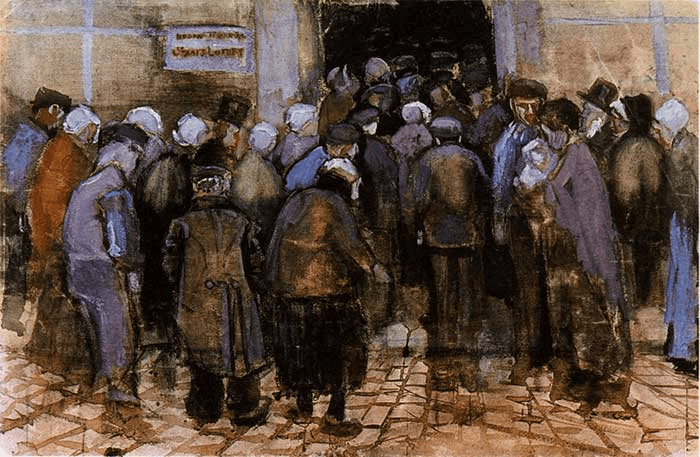
Amos 2:4-11 – Pay Attention to the Poor

The Poor and Money by Vincent van Gogh, 1882

This is what the Lord says:

“For three sins of Judah,
    even for four, I will not relent.
Because they have rejected the law of the Lord
    and have not kept his decrees,
because they have been led astray by false gods,
    the gods their ancestors followed,
I will send fire on Judah
    that will consume the fortresses of Jerusalem.”

This is what the Lord says:

“For three sins of Israel,
    even for four, I will not relent.
They sell the innocent for silver,
    and the needy for a pair of sandals.
They trample on the heads of the poor
    as on the dust of the ground
    and deny justice to the oppressed.
Father and son use the same girl
    and so profane my holy name.
They lie down beside every altar
    on garments taken in pledge.
In the house of their god
    they drink wine taken as fines.

“Yet I destroyed the Amorites before them,
    though they were tall as the cedars
    and strong as the oaks.
I destroyed their fruit above
    and their roots below.
I brought you up out of Egypt
    and led you forty years in the wilderness
    to give you the land of the Amorites.

“I also raised up prophets from among your children
    and Nazirites from among your youths.
Is this not true, people of Israel?”
declares the Lord. (New International Version)

It’s not a sin to be poor. It is a sin to oppress, take advantage of, or exploit the poor.

Social justice isn’t something fabricated in the minds of progressive Christians. Social justice is biblical and at the heart of all sixteen prophetic books of Holy Scripture’s Old Testament.

The reason the prophets address poverty so often is that God hates injustice. God is not okay with an entire group of disadvantaged people having needed resources beyond arm’s reach – and the Lord’s ire is especially roused whenever the wealthy and powerful extort what little the poor have to begin with.

Even if there are some who tend to believe the poor are poor because of laziness or an unwillingness to work hard, you will not find that idea amongst the biblical prophets. You will, in fact, find just the opposite: fat cats who lie around with their privileged lives, not lifting a finger to help the underprivileged.

The Church does have a role in combating systemic oppression of the poor and needy, and the prophet Amos wants those who claim the name of the Lord to know it.

Amos not only harangued the nations who surrounded Israel and Judah of their sinful stances toward the poor, he leveled the very same message at God’s people who did the same things. Although the Israelites enjoyed a special status with God, that did not mean the Lord had a different set of values or expectations for them when it came to basic human justice.

Mistreating one another is a universal sin and all nations everywhere will be held accountable by God for how they treat the least persons among them. There is such a thing as universal human rights – and the godly person will care about this, at the least, because God cares.

Amos almost exclusively hones-in on the economic sins of the wealthy: taking away needed clothing from those who default on loans; assessing unnecessary and exorbitant fines; taking levies of grain; and living a lavish lifestyle on the backs of the less fortunate.

It was these continually repeated sins against one another which eventually led to both Israel and Judah being conquered by pagan nations and carried into exile.

Today, you will still easily find people being used by others, as if they were mere inhuman machines, here on this earth to make money for those who already have plenty of it. They’d sell their own grandmother if they could get a good price on her. Extortion and oppression are like eating and drinking to them.

Yet, such persons, groups, even entire governments are only stockpiling judgment upon themselves for the God whom they must eventually give an account in how they lived their lives on this earth.

Instead, intentionally paying attention to the poor and treating them with equity will involve the following:

  1. Donating to charitable causes, such as church denominational relief funds, and respected international organizations who can make your contributions count.
  2. Agitating politicians for better policies toward the poor. Writing letters, sending emails, and making phone calls are simple ways of letting your voice be heard in a democratic society.
  3. Learning about worldwide and local poverty. It’s hard not to be involved whenever there is pertinent information. Putting names and faces to struggling people is a must, as well as understanding some of the dynamics that go into poverty.
  4. Raising awareness of significant issues related to poverty and how it impacts the poor. Find others who care about this and share insights and understanding about how to educate others.
  5. Volunteering at a local organization who works with the poor.

There are many more ways to make a difference. As biblically informed people, care of the poor and being concerned for issues of poverty is a must, because the Lord is a Just God with a heart of justice for the disadvantaged, underprivileged, and needy among us.

Now if there are some poor persons among you, say one of your fellow Israelites in one of your cities in the land that the Lord your God is giving you, don’t be hard-hearted or tightfisted toward your poor fellow Israelites. To the contrary! Open your hand wide to them. You must generously lend them whatever they need. (Deuteronomy 15:7-8, CEB)

Just and merciful God, you give honor to the least, the forgotten, the overlooked, and the misjudged.

You give first place to the last, the left behind, the misunderstood, and the undervalued.

You give a warm welcome to the lost, the orphaned, the abandoned, and the destitute.

Help us, your people, to be your ears in listening to their cries.

Help us to be your voice speaking words of encouragement, affirmation, and acceptance.

Help us to be your feet walking beside those in need; and your hands to clothe, feed and shelter them.

You came for the least, the lost and last of this world. Lord, in your mercy, hear our prayer. Amen.