Psalm 52 – Deliver Us From Evil

The world’s oldest olive tree, 3,000 years, on the island of Crete

Hey, powerful person!
    Why do you brag about evil?
    God’s faithful love lasts all day long.
Your tongue devises destruction:
    it’s like a sharpened razor, causing deception.
You love evil more than good;
    you love lying more than speaking what is right.
You love all destructive words;
    you love the deceiving tongue.

But God will take you down permanently;
    he will snatch you up,
    tear you out of your tent,
    and uproot you from the land of the living!
The righteous will see and be in awe;
    they will laugh at those people:
“Look at them! They didn’t make God their refuge.
    Instead, they trusted in their own great wealth.
        They sought refuge in it—to their own destruction!”

But I am like a green olive tree in God’s house;
    I trust in God’s faithful love forever and always.
I will give thanks to you, God, forever,
    because you have acted.
In the presence of your faithful people,
    I will hope in your name because it’s so good. (Common English Bible)

Ideally, every person on planet earth would be safe to talk to and work with. But we know this is not true. That’s because we have our own experiences of persons in authority who used their power and influence for malevolent purposes – knowing exactly what kind of harm they’re doing.

This is precisely what once happened with David. Before he was king over all Israel and Judah, David was on the run from King Saul.

David had done nothing wrong. In fact, he had done everything right from a good heart. And yet, because of Saul’s jealousy and lust for power, he saw David as a threat and not an asset. So, he hunted him like an animal.

King Saul’s abuse of power was bad enough. But that abuse reached it’s evil height with Doeg the Edomite. (1 Samuel 22:6-23)

Doeg was a nasty guy. He wasn’t just bad; he enjoyed being bad. Saul was so obsessed with getting rid of his perceived rival, that he sought to kill anyone who aided and abetted David. And Doeg had such a lust for murder that he was willing to kill anyone.

And that’s what he did. When Saul found out that the priests in the village of Nob had helped David when he was on the run, the jealous king tried to use his authority to command the army to slaughter them all. However, being reasonable men, they could not do it.

Yet, Doeg stepped in and stepped up to single-handedly wipe out the priests. Sadly, he didn’t stop there…

Doeg the Edomite turned and attacked the priests; on that day he killed eighty-five who wore the linen ephod. Nob, the city of the priests, he put to the sword; men and women, children and infants, oxen, donkeys, and sheep, he put to the sword. (1 Samuel 22:18-19, NRSV)

It was after this horrific event that David crafted the psalm for today.

There is abuse, trauma, and oppression – and then there is the continual harming from another which goes unabated. The abuser, the oppressor, the murderer keeps going, unchecked. And we are powerless to stop it.

There is only One who can right such terrible wrongs.

Today’s psalm speaks of God’s constancy, the continual love which persists all day long. David lifted his grief and anger to the Lord concerning the misuse of power and authority by Saul and Doeg. In light of God’s justice and faithful love, David affirms and believes that the Lord will bring ruin on those who despise divine commands and ethical instruction.

We don’t know always know why evil continues, or how it will end. Those enduring questions out of our own human condition and experience of evil may persist. Yet, the believer knows with certainty, as follower of a righteous, just, and holy God, that the downfall of the wicked will be total, and it will be permanent.

There is a day coming when evil shall be finished forever. And it’s hard not knowing exactly when that’s going to happen.

Perhaps this sort of talk seems like a cop out. It may appear that if God is so loving and powerful that evil ought to be stopped this very second.

Yet, consider this: There is so much evil and injustice in this world that to forcefully and immediately pull up those nasty wicked weeds will end up taking out the good plants next to them. The cure ends up being the harm.

The Lord is presently, patiently, and meticulously moving all things toward an inexorable ending – and it must be done carefully so that the godly are preserved from annihilation.

Fortunately, most people on earth aren’t like Doeg the Edomite or King Saul. Unfortunately, having one of them in your life is likely to happen because of the world’s great evil. One wicked person is bad enough to foment hate, spread lies, create havoc, and outright murder people – both verbally and actually.

The biblical psalms exist to serve us well whenever we experience the wrath of a person like Doeg. The psalms let us know we aren’t alone and help give us a voice. This is highly important, especially when the wicked seek to silence us and squelch our voice.

Trusting in the Lord, day after day… week after week… month after month… year after year… decade after decade… with the same slow and deliberate plod of God, strengthens us like a big old thick olive tree. And the psalms are here to help that happen.

May the Lord Jesus Christ guard and deliver you from the snares of the devil, the assaults of evil spirits, the wrath of the wicked, all base passions, and the fear of the known and unknown. Amen.

Luke 10:25-37 – The Parable of the Good Samaritan

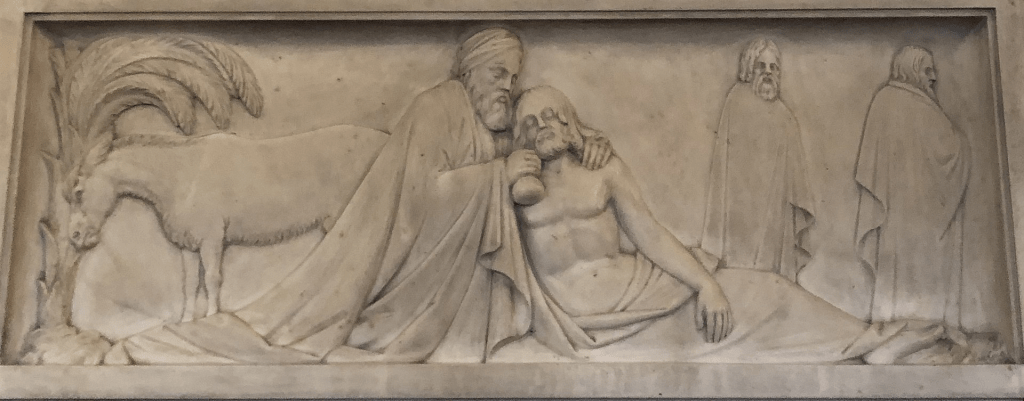
The Good Samaritan by Samuel Nixon. St. Paul’s Church, Halifax, Nova Scotia, Canada

 On one occasion an expert in the law stood up to test Jesus. “Teacher,” he asked, “what must I do to inherit eternal life?”

“What is written in the Law?” he replied. “How do you read it?”

He answered, “‘Love the Lord your God with all your heart and with all your soul and with all your strength and with all your mind’; and ‘Love your neighbor as yourself.”

“You have answered correctly,” Jesus replied. “Do this and you will live.”

But he wanted to justify himself, so he asked Jesus, “And who is my neighbor?”

In reply Jesus said: “A man was going down from Jerusalem to Jericho, when he was attacked by robbers. They stripped him of his clothes, beat him and went away, leaving him half dead. A priest happened to be going down the same road, and when he saw the man, he passed by on the other side. So too, a Levite, when he came to the place and saw him, passed by on the other side. 

But a Samaritan, as he traveled, came where the man was; and when he saw him, he took pity on him. He went to him and bandaged his wounds, pouring on oil and wine. Then he put the man on his own donkey, brought him to an inn and took care of him. The next day he took out two denarii and gave them to the innkeeper. ‘Look after him,’ he said, ‘and when I return, I will reimburse you for any extra expense you may have.’

“Which of these three do you think was a neighbor to the man who fell into the hands of robbers?”

The expert in the law replied, “The one who had mercy on him.”

Jesus told him, “Go and do likewise.” (New International Version)

Who do you relate to in the story? Which character most resonates with you in your life right now?

The Lawyer (an expert in the Old Testament Law)

The Gospel writer, Luke, gives us insight into the thought process of the person for whom Jesus told the parable to. That man sought to justify himself. In Christianity, no one justifies themselves. The kingdom of God turns on grace, and not with us working more or harder. 

Christ’s mercy is not dependent on what kind of people we are but is simply based on need. God graciously gives us the gift of faith and the mercy of deliverance. By Christ’s wounds we are healed. 

As Christians, we already possess justification by grace alone apart from human effort.

Each individual must realize they are in a theological ditch. We are all unable to get out of our predicament. Everyone needs the compassion of Christ.

But now God’s way of putting people right with himself has been revealed. It has nothing to do with law, even though the Law of Moses and the prophets gave their witness to it. God puts people right through their faith in Jesus Christ. God does this to all who believe in Christ, because there is no difference at all: everyone has sinned and is far away from God’s saving presence. But by the free gift of God’s grace all are put right with him through Christ Jesus, who sets them free. (Romans 3:21-24, GNT)

We do not need to justify ourselves.

The Priest and the Levite (experts in the Law)

The shock that hits closes to home, from Christ’s parable, is how frequently we are the ones who pass by and ignore the other. The command to “Go and do likewise,” extends about as far as the end of the story for modern hearers, landing us in the ditch between knowing the Samaritan and his compassionate generosity are set forth as an example and our tendency to ignore the cries of the downtrodden and disenfranchised.

Do not seek revenge or bear a grudge against anyone among your people but love your neighbor as yourself. I am the Lord…. When a foreigner resides among you in your land, do not mistreat them. The foreigner residing among you must be treated as your native-born. Love them as yourself, for you were foreigners in Egypt. I am the Lord your God. (Leviticus 19:18, 33-34, NIV)

The Lord defends the cause of the fatherless and the widow, and loves the foreigner residing among you, giving them food and clothing. And you are to love those who are foreigners, for you yourselves were foreigners in Egypt. (Deuteronomy 10:18-19, NIV)

We are to go and do likewise.

The Samaritan

The Samaritan, the Christ figure in the story, comes and shows the man mercy. This grace was free, lacked any sort of favoritism, and was full of sheer kindness. Without the Samaritan’s actions of binding up the man’s wounds and getting him to a safe place, the victim would have died.  

It is no coincidence that there are many hospitals throughout the country named “Good Samaritan.” Christians were at the forefront of establishing hospitals because of this very parable of Jesus. It was a significant way of living into the values of God’s kingdom.

Mercy is at the heart of all Christian ministry.

Jesus, responding to those who questioned his acts of mercy toward questionable people, said:

“Those who are well have no need of a physician, but those who are sick. Go and learn what this means, ‘I desire mercy, not sacrifice.’ For I have not come to call the righteous but sinners.” (Matthew 9:12-13, NRSV)

I appeal to you therefore, brothers and sisters, on the basis of God’s mercy, to present your bodies as a living sacrifice, holy and acceptable to God, which is your reasonable act of worship. (Romans 12:1, NRSV)

Do justice. Love mercy. Walk humbly. (Micah 6:8)

The Victim

The wounded hapless man was left for dead. In the story, we know he would die apart from help – the kind of help the man could not do for himself. He was completely dependent on someone to rescue him from his plight.

The victim in the ditch reminds us of what it feels like to be forgotten by others — and perhaps even by God. The feeling of loneliness and forsakenness invites compassion and empathy for all who experience it.

Victimization needs a voice and a champion. There are powerless people who either cannot speak or who are not heard by others. There are people, victims of abuse, who cannot get out of their traumatic ditch – overwhelmed by what another did to them.

God stands for the victim and against the robbers.

You will never again
    make victims of others
or send messengers to threaten
    everyone on this earth. (Nahum 2:13, CEV)

God will send help.

When the righteous cry out, the Lord listens;
    he delivers them from all their troubles.
The Lord is close to the brokenhearted;
    he saves those whose spirits are crushed.

The righteous have many problems,
    but the Lord delivers them from every one of them. (Psalm 34:17-19, CEB)

By his wounds we are healed.

Conclusion

The victim in the ditch is worthy of help because he carries the divine image of God.

The one who showed compassion and mercy, the Samaritan, reflected God’s likeness through his actions.

Those who passed by, the priest and the Levite, also bear the indelible mark of their Creator, yet chose to ignore their gut and got lost in their heads.

Maybe God — through Christ — comes to us as the one in the ditch or maybe as the one who shows compassion and mercy; perhaps God even comes to us as a reminder that the call to care for others frequently goes unheeded as we pass by the cries of those in need of help.

Lord God, heavenly Father, you did not spare your only Son, but gave him up for us all to be our Savior, and along with him you have graciously given us all things. We thank you for your precious, saving gospel, and we pray that you would help us to believe in the name of our Savior faithfully and steadfastly, for he alone is our righteousness and wisdom, our comfort and peace, so that we may stand on the day of his appearing, through Jesus Christ, your dear Son, our Lord. Amen.

Amos 2:4-11 – Pay Attention to the Poor

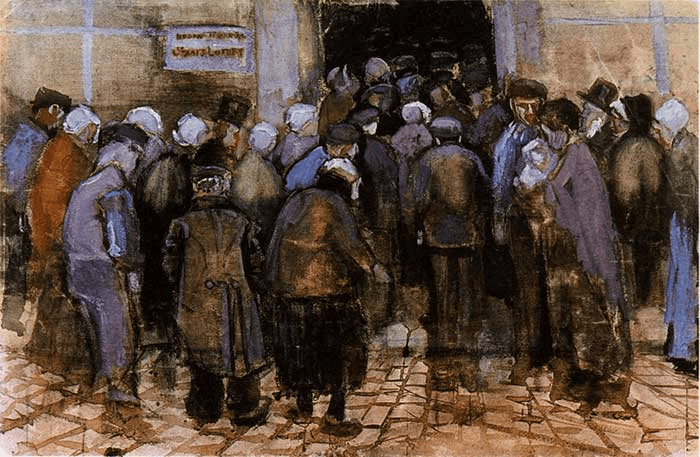
The Poor and Money by Vincent van Gogh, 1882

This is what the Lord says:

“For three sins of Judah,
    even for four, I will not relent.
Because they have rejected the law of the Lord
    and have not kept his decrees,
because they have been led astray by false gods,
    the gods their ancestors followed,
I will send fire on Judah
    that will consume the fortresses of Jerusalem.”

This is what the Lord says:

“For three sins of Israel,
    even for four, I will not relent.
They sell the innocent for silver,
    and the needy for a pair of sandals.
They trample on the heads of the poor
    as on the dust of the ground
    and deny justice to the oppressed.
Father and son use the same girl
    and so profane my holy name.
They lie down beside every altar
    on garments taken in pledge.
In the house of their god
    they drink wine taken as fines.

“Yet I destroyed the Amorites before them,
    though they were tall as the cedars
    and strong as the oaks.
I destroyed their fruit above
    and their roots below.
I brought you up out of Egypt
    and led you forty years in the wilderness
    to give you the land of the Amorites.

“I also raised up prophets from among your children
    and Nazirites from among your youths.
Is this not true, people of Israel?”
declares the Lord. (New International Version)

It’s not a sin to be poor. It is a sin to oppress, take advantage of, or exploit the poor.

Social justice isn’t something fabricated in the minds of progressive Christians. Social justice is biblical and at the heart of all sixteen prophetic books of Holy Scripture’s Old Testament.

The reason the prophets address poverty so often is that God hates injustice. God is not okay with an entire group of disadvantaged people having needed resources beyond arm’s reach – and the Lord’s ire is especially roused whenever the wealthy and powerful extort what little the poor have to begin with.

Even if there are some who tend to believe the poor are poor because of laziness or an unwillingness to work hard, you will not find that idea amongst the biblical prophets. You will, in fact, find just the opposite: fat cats who lie around with their privileged lives, not lifting a finger to help the underprivileged.

The Church does have a role in combating systemic oppression of the poor and needy, and the prophet Amos wants those who claim the name of the Lord to know it.

Amos not only harangued the nations who surrounded Israel and Judah of their sinful stances toward the poor, he leveled the very same message at God’s people who did the same things. Although the Israelites enjoyed a special status with God, that did not mean the Lord had a different set of values or expectations for them when it came to basic human justice.

Mistreating one another is a universal sin and all nations everywhere will be held accountable by God for how they treat the least persons among them. There is such a thing as universal human rights – and the godly person will care about this, at the least, because God cares.

Amos almost exclusively hones-in on the economic sins of the wealthy: taking away needed clothing from those who default on loans; assessing unnecessary and exorbitant fines; taking levies of grain; and living a lavish lifestyle on the backs of the less fortunate.

It was these continually repeated sins against one another which eventually led to both Israel and Judah being conquered by pagan nations and carried into exile.

Today, you will still easily find people being used by others, as if they were mere inhuman machines, here on this earth to make money for those who already have plenty of it. They’d sell their own grandmother if they could get a good price on her. Extortion and oppression are like eating and drinking to them.

Yet, such persons, groups, even entire governments are only stockpiling judgment upon themselves for the God whom they must eventually give an account in how they lived their lives on this earth.

Instead, intentionally paying attention to the poor and treating them with equity will involve the following:

  1. Donating to charitable causes, such as church denominational relief funds, and respected international organizations who can make your contributions count.
  2. Agitating politicians for better policies toward the poor. Writing letters, sending emails, and making phone calls are simple ways of letting your voice be heard in a democratic society.
  3. Learning about worldwide and local poverty. It’s hard not to be involved whenever there is pertinent information. Putting names and faces to struggling people is a must, as well as understanding some of the dynamics that go into poverty.
  4. Raising awareness of significant issues related to poverty and how it impacts the poor. Find others who care about this and share insights and understanding about how to educate others.
  5. Volunteering at a local organization who works with the poor.

There are many more ways to make a difference. As biblically informed people, care of the poor and being concerned for issues of poverty is a must, because the Lord is a Just God with a heart of justice for the disadvantaged, underprivileged, and needy among us.

Now if there are some poor persons among you, say one of your fellow Israelites in one of your cities in the land that the Lord your God is giving you, don’t be hard-hearted or tightfisted toward your poor fellow Israelites. To the contrary! Open your hand wide to them. You must generously lend them whatever they need. (Deuteronomy 15:7-8, CEB)

Just and merciful God, you give honor to the least, the forgotten, the overlooked, and the misjudged.

You give first place to the last, the left behind, the misunderstood, and the undervalued.

You give a warm welcome to the lost, the orphaned, the abandoned, and the destitute.

Help us, your people, to be your ears in listening to their cries.

Help us to be your voice speaking words of encouragement, affirmation, and acceptance.

Help us to be your feet walking beside those in need; and your hands to clothe, feed and shelter them.

You came for the least, the lost and last of this world. Lord, in your mercy, hear our prayer. Amen.

Acts 2:1-21 – The Day of Pentecost

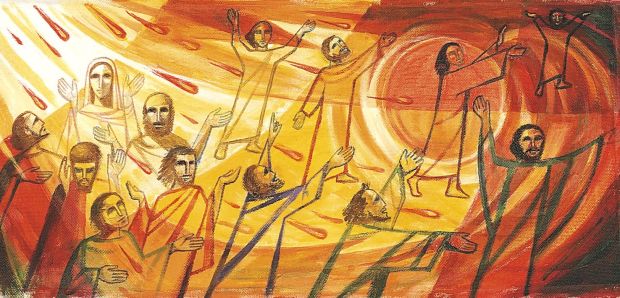
When Pentecost Day arrived, they were all together in one place. Suddenly a sound from heaven like the howling of a fierce wind filled the entire house where they were sitting. They saw what seemed to be individual flames of fire alighting on each one of them. They were all filled with the Holy Spirit and began to speak in other languages as the Spirit enabled them to speak.

There were pious Jews from every nation under heaven living in Jerusalem. When they heard this sound, a crowd gathered. They were mystified because everyone heard them speaking in their native languages. They were surprised and amazed, saying, “Look, aren’t all the people who are speaking Galileans, every one of them? How then can each of us hear them speaking in our native language? Parthians, Medes, and Elamites; as well as residents of Mesopotamia, Judea, and Cappadocia, Pontus and Asia, Phrygia and Pamphylia, Egypt and the regions of Libya bordering Cyrene; and visitors from Rome (both Jews and converts to Judaism), Cretans and Arabs—we hear them declaring the mighty works of God in our own languages!” They were all surprised and bewildered. Some asked each other, “What does this mean?” Others jeered at them, saying, “They’re full of new wine!”

Peter stood with the other eleven apostles. He raised his voice and declared, “Judeans and everyone living in Jerusalem! Know this! Listen carefully to my words! These people aren’t drunk, as you suspect; after all, it’s only nine o’clock in the morning! Rather, this is what was spoken through the prophet Joel:

In the last days, God says,
I will pour out my Spirit on all people.
    Your sons and daughters will prophesy.
    Your young will see visions.
    Your elders will dream dreams.
    Even upon my servants, men and women,
        I will pour out my Spirit in those days,
        and they will prophesy.
I will cause wonders to occur in the heavens above
    and signs on the earth below,
        blood and fire and a cloud of smoke.
The sun will be changed into darkness,
    and the moon will be changed into blood,
        before the great and spectacular day of the Lord comes.
And everyone who calls on the name of the Lord will be saved. (Common English Bible)

The Holy Spirit is the distinguishing mark of the believer in Jesus Christ.

Therefore, since the Spirit is given, the main responsibility of Christians is to receive. 

Christianity is distinctive in this sense – it is primarily a religion of receiving. The Christian life is lived by the power of the Holy Spirit, and not in our own strength. The function of faith is to receive what grace offers. 

We are saved and sanctified by grace alone through faith. God lives in and through us by means of the Spirit. The miraculous and the supernatural cannot, obviously, be done by any human person.  It can, however, be accomplished through the power of the Holy Spirit.

People tend to put a lot of pressure on themselves to be a certain way and to do certain things. The result? Tiredness. Discouragement. Imbalance. Lots of giving. Little receiving.

Christianity is not chiefly about giving but receiving. The Christian life is about putting oneself in a position to receive through prayer and humility. In Christianity, the opposite of receiving is not giving – it’s pride. 

Maybe this kind of talk makes you uncomfortable. I’m not talking about being passive or lazy. I’m highlighting the need of receiving grace from God by means of the Holy Spirit. Then, the Spirit to work in and through us. 

Jesus said we would do greater works than even he himself with the advent of the Spirit! (John 14:12-14)

The question then becomes: Will we let God be God? Will we allow the Spirit to do work in us?

The Spirit is elsewhere described in Holy Scripture as a gentle presence, an encourager, counselor, and comforter. Yet, not here at Pentecost – the Spirit is portrayed like a violent wind and an unusual fire.

The Holy Spirit on the Day of Pentecost was not some gentleman caller entering politely when invited. Instead, the Spirit appears more like a drunken sailor who bursts into the room and causes a big ruckus. There’s nothing subtle about the Spirit at Pentecost. The Spirit is electric, bombastic, and volcanic, causing a huge scene and upheaving the status quo.

Because of Pentecost, Christians are marked and defined by God’s Spirit living within them and being full of the Spirit. God wants to pour out the Spirit on all kinds of people to overflowing so that what comes out of them is “prophecy.” 

The prophet Joel and the Apostle Peter do not intend the word “prophecy” to mean predicting the future. Rather, they are referring to inspired speech coming from a heart overflowing with the Spirit. 

Just as an inebriated person says and does things they would not typically say or do because they are filled with alcohol, so the person filled with God’s Spirit says things and does things they would not typically say or do because their inspiration and courage come as a result of God within them.

Thus, we must cast off the unholy spirits of inebriation and receive the Holy Spirit of God.

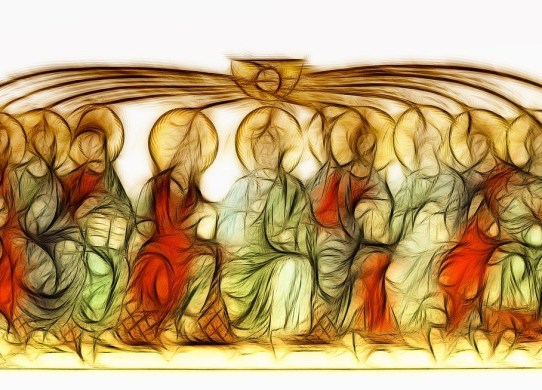
Descent of the Holy Spirit at Pentecost mosaic by Anna Wyner

God sobered-up the little band of Christ followers from learners to practitioners, sending them into the world with a mission.

Being on a mission from God is not really about ability; it’s about being filled and sent. 

First time parents may read and learn all they can about parenting before their child is born. Yet, when that little bundle comes into the world, and the hospital puts this kid in your arms and sends you out, you feel inadequate for the task. Parenting becomes a kind of supernatural affair where you pray and learn on the fly, finding out that you need something beyond yourself to get anywhere in raising this screaming, pooping, sleeping person who depends completely on you for everything. 

God sends us into the world to make disciples. And we may feel very inadequate for the task. However, this has more to do with receiving the Spirit. The Spirit comes looking to turn our lives upside-down with new life in Jesus Christ. 

Pentecost means that the Spirit came to shake things up and accomplish among God’s people what they could never do on their own.

Everyone who calls on the name of the Lord will be saved. 

The Church in the New Testament was not a country club for people to simply enjoy the perks of membership.  The community of the redeemed, the Church, is actually more like a place where the people seem drunk because they are all talking with inspired speech from the Holy Spirit. 

Maybe we don’t need to be saved in the sense that we have already called on the name of the Lord concerning forgiveness in Christ. Yet, maybe we need to call on the name of the Lord to be delivered from our misguided attempts to see the Christian life as a pleasant affair.

Perhaps we need deliverance from disordered priorities and misguided loves. We may need to be saved from ourselves so that we are open to the Holy Spirit with palms up receiving from God whatever it is the Spirit wants to do in and through us, rather than telling God how we think things ought to go. 

Prayer, then, is more about receiving the Spirit and God’s purposes for us rather than giving God an earful and expecting the Lord to bless our plans.

Pentecost is the launching pad of the church’s mission – it was explosive because the Spirit is a kind of wild man who fills people up to overflowing so that what comes out of them is inspired speech and missional actions.

If a language barrier cannot stop the Spirit from operating, then how much more can God transform us and use us in the lives of those around us?

Joel’s prophecy, quoted by Peter, is only partially fulfilled. Events have been set in motion by Pentecost for the complete fulfillment of God’s justice. So, there’s some urgency for people to fill their vacuous souls with the grace freely offered to them in Christ.

The outpouring of the Spirit is a sign: The end is near. And the generous giving of the Spirit is inclusive – there is room for all kinds of people. Through the Spirit, God saves all who call on the name of the Lord.

Today is not just another day on the calendar. It is the Day of Pentecost! 

Just as marriages occasionally need a spark and a fire and a fresh wind, so we need the Holy Spirit to breathe on us, comfort us, and inspire us.

May we be filled with the Spirit as we anticipate what our God will do now, and in the years to come.

Spirit of the living God, through the reading and proclamation of the Word, may you refresh our spirits, reshape our desires, recreate our hearts, and reform our ways so that we will shine with your enduring glory, through Jesus Christ, our risen and ascended Lord. Amen.