How To Handle Trouble (Psalm 94)

Lord, you are a God who punishes;
    reveal your anger!
You are the judge of us all;
    rise and give the proud what they deserve!
How much longer will the wicked be glad?
    How much longer, Lord?
How much longer will criminals be proud
    and boast about their crimes?

They crush your people, Lord;
    they oppress those who belong to you.
They kill widows and orphans,
    and murder the strangers who live in our land.
They say, “The Lord does not see us;
    the God of Israel does not notice.”

My people, how can you be such stupid fools?
    When will you ever learn?
God made our ears—can’t he hear?
    He made our eyes—can’t he see?
He scolds the nations—won’t he punish them?
    He is the teacher of us all—hasn’t he any knowledge?
The Lord knows what we think;
    he knows how senseless our reasoning is.

Lord, how happy are those you instruct,
    the ones to whom you teach your law!
You give them rest from days of trouble
    until a pit is dug to trap the wicked.
The Lord will not abandon his people;
    he will not desert those who belong to him.
Justice will again be found in the courts,
    and all righteous people will support it.

Who stood up for me against the wicked?
    Who took my side against the evildoers?
If the Lord had not helped me,
    I would have gone quickly to the land of silence.
I said, “I am falling”;
    but your constant love, O Lord, held me up.
Whenever I am anxious and worried,
    you comfort me and make me glad.

You have nothing to do with corrupt judges,
    who make injustice legal,
    who plot against good people
    and sentence the innocent to death.
But the Lord defends me;
    my God protects me.
He will punish them for their wickedness
    and destroy them for their sins;
    the Lord our God will destroy them. (Good News Translation)

Courageous, brave, bold, and strong – it seems most people do not characterize themselves this way, especially when they are in the throes of overwhelming circumstances.

Whenever one feels crushed under the weight of adverse situations caused by evil, it can be hard for them to see their resilience and strength.

I suppose it makes sense as to why we lose sight of this, because we can all readily recall times and events in which we wilted with fear; did not speak up; or were not assertive.

The many conversations we have in our heads for which will never take place, are testament to our supposed withdrawal in the face of adversity. We have far too many discussions with ourselves of how something should have gone; and too many brave retorts for someone whom we really have no intention of saying those words toward.

If this all sounds like the convoluted musings of a wimpy kid, that’s not far off the mark. When we get bullied, even as adults, it can be easy to wilt, or to take it, or to simply find a way to avoid the bully. With some folks, we even create elaborate internal reasons why it’s our fault someone is upset with us. In such times, bravery and courage seem a long way from our true selves.

Faced with a daunting task or an ornery person at work, home, or school, we may wonder if we really have the internal stuff to deal with it. We feel that maybe someone else would be better suited to handle the trouble. 

Yet, what if I told you that you are, indeed, brave, strong, and confident?

What if I insisted that courage resides within you, even if you yourself cannot see it right now?

And, what if I told you that bravery isn’t something you must go on a quest to find, but that it’s been in you all along? 

If you are already enough, then you only need to be aware of it, acknowledge it, and let it out.

You intuitively know I’m on to something here. After all, the most common exhortation and assurance in the entirety of Holy Scripture is to not be afraid because God is with us:

So do not fear, for I am with you;
    do not be dismayed, for I am your God.
I will strengthen you and help you;
    I will uphold you with my righteous right hand. (Isaiah 41:10, NIV)

God has said, “Never will I leave you; never will I forsake you.” So, we say with confidence, “The Lord is my helper; I will not be afraid. What can mere mortals do to me?” (Hebrews 13:5-6, NIV)

In the great litany of fear, we face every day, spiritual confidence and personal bravery is not so much commanded by God, as it is a calling forth of something which is already within you.

Now, before you go thinking I’m some looney-tune, hear me out. From the beginning of the world, in God’s creative activity, the Lord did it all by calling forth creation from within himself. What I mean is this: God did not simply command everything into being; instead, he said, “Let there be…”  God let out what was already there in God’s very Being. It was almost as if God belched-out from the great depth of his Being and let out all this wondrous creation.

Concerning our fear and bravery, God does not so much command us to be courageous but wants us to draw from the great reservoir within. The Lord has already created us strong, as creatures in the divine image. We just need to get in touch with what is already there. 

“Do not let your hearts be troubled,” said Jesus to his disciples, because he knew his followers had it in them to walk in his way without fear. (John 14:6, NRSV)

“Let not your heart faint, and be not fearful,” said God to the prophet Jeremiah, in the face of a terrible destruction that was about to unfold against Jerusalem, because the Lord knew that Jeremiah could face what was going to happen. (Jeremiah 51:46, ESV)

Christians can act with boldness because Jesus is the pioneer of our salvation. He is the One which enables us to draw from the deep well of courage:

So then, since we have a great High Priest who has entered heaven, Jesus the Son of God, let us hold firmly to what we believe. This High Priest of ours understands our weaknesses, for he faced all of the same testing we do, yet he did not sin. So let us come boldly to the throne of our gracious God. There we will receive his mercy, and we will find grace to help us when we need it most. (Hebrews 4:14-16, NLT)

I insist that you are brave, you are strong, and you are good. Those are not words meant to make you believe something which may or may not be true, as if I were trying to convince you to take some panacea to feel better.  No, I say it because it is true. 

You really can face the immense mountain in front of you and climb it. You can surmount the adversity you are in the middle of – not because of some words I say, but because you were created for courage.

So, how do you let out the bravery and let the boldness shine? 

You already know the answers to your own questions. You have all the knowledge you need to face your problems. So, the real question is:

Will you let your bravery come out to play, or will you keep it hidden beneath layers of insecurity?

It’s a whole lot easier to let me tell you what to do than to draw from what you already know, deep down, how to handle that troublesome something. 

I’m not going to give you a simple three-step process out of fear and into courage. That’s because you already have been endowed with the process. 

This certainly isn’t a sexy way to end a blog post, but it just might be the most effective and lasting.

Psalm 10 – Backstabbers

Why are you far away, Lord?
Why do you hide yourself
    when I am in trouble?
Proud and brutal people
    hunt down the poor.
But let them get caught
    by their own evil plans!

The wicked brag about
    their deepest desires.
Those greedy people hate
    and curse you, Lord.
The wicked are too proud
to turn to you
    or even think about you.
They are always successful,
though they can’t understand
    your teachings,
and they keep sneering
    at their enemies.

In their hearts they say,
    “Nothing can hurt us!
We’ll always be happy
    and free from trouble.”
They curse and tell lies,
and all they talk about
    is how to be cruel
    or how to do wrong.

They hide outside villages,
waiting to strike and murder
    some innocent victim.
They are hungry lions
    hiding in the bushes,
hoping to catch
    some helpless passerby.
They trap the poor in nets
    and drag them away.
They crouch down and wait
    to grab a victim.
They say, “God can’t see!
    He’s got on a blindfold.”

Do something, Lord God,
and use your powerful arm
    to help those in need.
The wicked don’t respect you.
In their hearts they say,
    “God won’t punish us!”

But you see the trouble
and the distress,
    and you will do something.
The poor can count on you,
    and so can orphans.
Now break the power
    of all merciless people.
Punish them for doing wrong
    and make them stop.

Our Lord, you will always rule,
but every godless nation
    will vanish from the earth.
You listen to the longings
    of those who suffer.
You offer them hope,
and you pay attention
    to their cries for help.
You defend orphans
    and everyone else in need,
so that no one on earth
    can terrify others again. (Contemporary English Version)

Nobody can go through life without having to deal with evil in the form of two-faced people. It’s just part of the human condition to experience it. 

The O’Jays sang about such persons in their 1972 song, Backstabbers: 

(What they do!)
(They smile in your face)
All the time they want to take your place
The back stabbers (back stabbers)
(They smile in your face)
All the time they want to take your place.

The psalmist knew first-hand about such people, all too well. He experienced their lies and their constant thoughts about cruelty to others and doing wrong. He watched their schadenfreude, that is, their delight in seeing others harmed and hurt. Outwardly, such devious people feign friendship; but meanwhile, they inwardly sneer and plot how to destroy. 

Schadenfreude: satisfaction or pleasure felt at someone else’s misfortune.

However, there is a God who sees all of it, both the outward calloused deeds, as well as the inward plotting of insidious works. And, what’s more, God will act.

The problem for most of us, the victims of the backstabber’s blade, is that the time between God seeing and God acting is sometimes far too long. We cry out for justice, and rightly so. God sees and hears. And God acts when it is time to act, without being on our schedule to do it.

Meanwhile, during this awkward in-between time, until God dispenses the divine will on both the evil and the good, the righteous person remains hopeful and confident that their cries are being heard and that divine protection will prevail. The psalmist assures us that the Lord listens to the longings of those who suffer. God offers them hope and pays attention to their cries for help.

Don’t let evil get the best of you; get the best of evil by doing good.

Romans 12:21, MSG

The way to face down the presence of hard-hearted people is to be both active and passive in the right ways: 

  • Actively cry out to God in prayer
  • Actively work for good
  • Take a pass on exacting revenge
  • Take a pass on nursing grudges and hate

If we can encourage one another to persevere in being consistently good, even while in the teeth of evil, it will go a long way toward spreading God’s benevolent and gracious kingdom and seeing God’s moral and ethical will done in our families, communities, and world.

Unfortunately, backstabbers will always be with us, no matter where we go, this side of heaven. Stay calm, don’t let the evil stick to your soul, and step back to see the big picture that vengeance belongs to the Lord… and maybe listen to some O’Jays while you’re at it.

God of justice and righteousness, you defend those who are vulnerable and in need. You will act so that no one on earth can terrify and harm others again. Shoo the bullying and belligerent ways of Satan away so that your heavenly kingdom may take root in the church and the world for the sake of Jesus our Savior. Amen

Jeremiah 7:1-15 – Holding People Accountable

The prophet Jeremiah, Basilica of St Vitalis, Ravenna, Italy—Photo by mountainpix

The word that came to Jeremiah from the Lord: Stand in the gate of the Lord’s house, and proclaim there this word, and say, Hear the word of the Lord, all you people of Judah, you who enter these gates to worship the Lord. Thus says the Lord of hosts, the God of Israel: Amend your ways and your doings and let me dwell with you in this place. Do not trust in these deceptive words: “This is the temple of the Lord, the temple of the Lord, the temple of the Lord.”

For if you truly amend your ways and your doings, if you truly act justly one with another, if you do not oppress the alien, the orphan, and the widow or shed innocent blood in this place, and if you do not go after other gods to your own hurt, then I will dwell with you in this place, in the land that I gave to your ancestors forever and ever.

Here you are, trusting in deceptive words to no avail. Will you steal, murder, commit adultery, swear falsely, make offerings to Baal, and go after other gods that you have not known and then come and stand before me in this house, which is called by my name, and say, “We are safe!”—only to go on doing all these abominations? Has this house, which is called by my name, become a den of robbers in your sight? I, too, am watching, says the Lord. Go now to my place that was in Shiloh, where I made my name dwell at first, and see what I did to it for the wickedness of my people Israel. 

And now, because you have done all these things, says the Lord, and when I spoke to you persistently, you did not listen, and when I called you, you did not answer, therefore I will do to the house that is called by my name, in which you trust, and to the place that I gave to you and to your ancestors just what I did to Shiloh. And I will cast you out of my sight, just as I cast out all your kinsfolk, all the offspring of Ephraim. (New Revised Standard Version)

One of the dangers of the religious life is slipping into the view that possessing a certain thing protects us from all harm – sort of like a talisman or rabbit’s foot.

Today’s Old Testament lesson is a classic example of succumbing to just such a danger. The ancient Jews in Jerusalem, in the days of the prophet Jeremiah, sincerely believed that because they had God’s temple in their city that this would protect them from any kind of attack from the outside. 

What is more, since they viewed the temple as an incredibly powerful good-luck-charm, the people thought that they could do whatever they wanted; they were covered and protected. So, they had no sense of accountability to the holy God whose temple overlooked Jerusalem and saw all of their unjust ways.

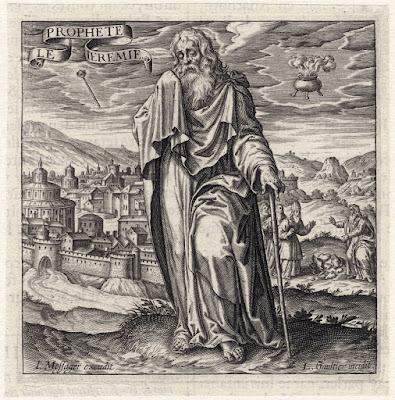
An engraving of the prophet Jeremiah by Léonard Gaultier (1561-1641)

Separated by a few millennia, we might see the folly with this magical type of thinking. Yet, it is just as easy for us to slip into the same mentality. 

Whenever we Americans think that our nation is so great that no one will ever take us over; or when we sincerely believe that because we are a missionary-sending nation that God will protect us; or when we buy into the notion that we can live however we want, but God would never judge us!; after all, we aren’t as bad as other nations!; well, then, we have come under the same condemnation as the Jews of old, we need to hear God’s Word for us today.

Jeremiah’s message was uncompromising. He clearly let the people know that while they have been living their hedonistic lives, God has been trying to talk them. But the people refused to listen. The prophet insisted that having the temple in the city is not some inoculation from keeping enemies at bay.

The prophet Jeremiah asserted that the people must change their ways, start living right, and be fair and honest with each other. They need to stop taking advantage of foreigners, orphans, and widows. They cannot kill innocent people and worship other gods, then turn around and invoke the temple as God’s presence and sanction on their security.

Justice is the responsibility of everyone; there are no favorites with God. The Lord does not favor particular people, ethnicities, or nations above others. Because one is an American, or not, makes no difference. Race and gender don’t come into view.

The sovereign God will hold all people culpable for their violent speech and behavior, no matter who they are or where they are from. Oppression, injustice, and spiritual gerrymandering will be dealt with by Judge Jesus, for both Jew and Gentile, man and woman, Westerner and Easterner, young and old.

For whom God has given much, much will be required. The Lord holds all people accountable for their actions.

Holy God, you still speak today through your Holy Word. Help me to listen well and pay attention to what you are saying so that I might honor you through humility and obedience for the sake of Jesus. Amen.

Isaiah 5:1-7 – A Parable of the Vineyard

I will sing for the one I love
    a song about his vineyard:
My loved one had a vineyard
    on a fertile hillside.
He dug it up and cleared it of stones
    and planted it with the choicest vines.
He built a watchtower in it
    and cut out a winepress as well.
Then he looked for a crop of good grapes,
    but it yielded only bad fruit.

“Now you dwellers in Jerusalem and people of Judah,
    judge between me and my vineyard.
What more could have been done for my vineyard
    than I have done for it?
When I looked for good grapes,
    why did it yield only bad?

Now I will tell you
    what I am going to do to my vineyard:
I will take away its hedge,
    and it will be destroyed;
I will break down its wall,
    and it will be trampled.

 I will make it a wasteland,
    neither pruned nor cultivated,
    and briers and thorns will grow there.
I will command the clouds
    not to rain on it.”

The vineyard of the Lord Almighty
    is the nation of Israel,
and the people of Judah
    are the vines he delighted in.
And he looked for justice, but saw bloodshed;
    for righteousness, but heard cries of distress. (New International Version)

God is the owner of the vineyard. Israel and Judah are the beloved. The Lord graciously chose them, gave them divine promises, and set his steadfast love upon them. God sang over them with affection and took care of them.

The Lord God put time, effort, and love into the relationship. God anticipated good things, looked forward to a bright future, and expected a flowering of justice and righteousness from the people.

It didn’t happen. The relationship went sour. Nothing but rotten grapes.

God builds. God gives. God sustains…. And God destructs. God takes away. God ends what he begins.

The Lord didn’t put all that work into the people to have them perpetuate injustice toward the poor and disadvantaged. God didn’t choose Israel so that they would then neglect God’s law by mistreating others and ignoring the right.

The bloodshed of the people was that they squeezed and bled the poor to death. The cries and anguished responses of the needy were ignored. There was no mercy. So, God was not about to idly stand by and let such rotten grapes abuse and ruin the good, the just, and the right.

The relationship between and God and God’s people was an ancient love song that went off key and struck a minor chord. The Lord has extreme love and patience… until he doesn’t. There’s no way the just and right God is going to put up with abusive, ignorant, and bad folks forever.

Jesus had this allegorical image of Isaiah in mind when he spoke in parables about the impossibility of good fruit coming from bad vines and trees, and the necessity of removing dead branches. (Luke 6:43-45; John 15:1-17)

If the grapes are bad, the vine is bad. If the words are hateful, sarcastic, passive-aggressive, manipulative, conniving, racist, hurtful, mean, foolish, and either subtly or overtly abusive, then the person has a dark heart and is need of redemption, not excuses.

Every tree that does not bear good fruit will be cut down and thrown into the fire. The wicked heart will not be able to speak ill of others and act hatefully with impunity forever. They will be called to account for their abusive words and actions, whether overtly violent, or subtly undermining.

The righteous heart, however, shall experience divine pleasure and reward, as if the careful construction of helpful and building up words with loving deeds wins first-prize at the great heavenly fair.

The good person loves and does not hate. They are so far from harming anyone that they even pray and wish well for their enemies. They pray for blessings on those who curse them. There is an honest striving to speak good words to everyone, regardless of who they are.

The upright heart thinks the best of everyone and holds nothing over someone else’s head. Such a good heart condemns no one, leaving all judgment to God alone. It is patient with the most exasperating of people, praying they might come to their senses and become spiritually healthy.

The righteous are able to use their speech to admonish their neighbor with care and affection. They freely forgive, happily give, liberally encourage, and use their tongue to speak words of life. Indeed, their speech is wise, humble, full of grace, and above all, loving.

The just and right person uses their hands and feet to build good things for others, especially the most vulnerable and needy among us. They willingly meet needs without bitterness or with a begrudging heart.

If there is a problem with words, it will not do to simply change the speech. That’s because it is a heart issue. And the heart must be willing to change and be transformed by sheer mercy.

If there is an issue with actions, it will not do to merely enforce a change in behavior. That’s because it’s a heart problem. And the heart desperately needs to acknowledge sin and repent from evil.

Fortunately, God is the expert on renovating dilapidated hearts and performing effective heart transplants.

Oftentimes something needs to be destroyed for a building to be erected. There always needs to be a death before there can be a resurrection. New life cannot occur without forsaking an old life.

Believers in Jesus are mindful that our life of faith, hope, and love comes from a death. So, we journey with Jesus along the road of suffering, up Calvary, and are crucified with him so that we might rise with him.

This is the way.

It is the way of repentance, of genuine change, of new habits, of Christianity. So now, let’s go to him outside the camp, bearing his shame. We don’t have a permanent city here, but rather we are looking for the city that is still to come. (Hebrews 13:13-14)

May justice, righteousness, and peace be yours in abundance through him who gave himself for us and for our salvation.

Merciful Father, we pray that violence will be overcome by the power of love; that opposition and division give way to reconciliation; and that the desire for power and control be transformed into the desire for forgiveness, justice, and peace.

May peace be in our hearts so that they are open to the action of your divine grace.

May all humanity – especially the poor, the needy, the least among us, and the lost – feel the warmth of your steadfast love and the love of your people toward them.

May the fruit of love, joy, peace, patience, kindness, goodness, faithfulness, gentleness, and self-control be our breakfast, lunch, and dinner; and may your divine abundance of mercy and justice be scattered throughout our city, our nation, and our world, through Jesus Christ our Lord, in the strength of your Holy Spirit.

Amen.