Restoration (Jeremiah 30:1-11a)

This is the word that came to Jeremiah from the Lord: “This is what the Lord, the God of Israel, says: ‘Write in a book all the words I have spoken to you. The days are coming,’ declares the Lord, ‘when I will bring my people Israel and Judah back from captivity and restore them to the land I gave their ancestors to possess,’ says the Lord.”

These are the words the Lord spoke concerning Israel and Judah: 

“This is what the Lord says:

“‘Cries of fear are heard—
    terror, not peace.
Ask and see:
    Can a man bear children?
Then why do I see every strong man
    with his hands on his stomach like a woman in labor,
    every face turned deathly pale?
How awful that day will be!
    No other will be like it.
It will be a time of trouble for Jacob,
    but he will be saved out of it.

“‘In that day,’ declares the Lord Almighty,
    ‘I will break the yoke off their necks
and will tear off their bonds;
    no longer will foreigners enslave them.
Instead, they will serve the Lord their God
    and David their king,
    whom I will raise up for them.

“‘So do not be afraid, Jacob my servant;
    do not be dismayed, Israel,’
declares the Lord.
‘I will surely save you out of a distant place,
    your descendants from the land of their exile.
Jacob will again have peace and security,
    and no one will make him afraid.
I am with you and will save you,’
    declares the Lord.” (New International Version)

The cry of Jeremiah the prophet, by Slovakian artist, 1937

To be restored is a beautiful thing, namely because it presupposes that someone or a group of people were dilapidated and in need of healing. Restoration implies that something was lost, but now is found.

If you have lost things like finances, a home, a car, precious memorial items, a job; or relationships such as a marriage, a friendship, estrangement from family members; or your health to disease or disaster; or even lost your mind or your soul – you can completely understand the longing for restoration and wholeness.

The Jews lost their homeland, their property, their temple, and their dignity to the invading Babylonians. Babylon took everything from Judea. The people became exiled in a strange land. Only some poor folk were left behind in a land that was ravaged.

This was the place that was once referred to as a land of milk and honey, a good home of abundance and blessing. But in the prophet Jeremiah’s day, it was becoming a thing of the past. Would the people ever recover what they had lost? Is restoration even a possibility? Could they learn to hope again?

Into a time of distress and despair, God spoke, and said that yes, it is possible; yes, restoration can and will happen. The people will not be in captivity forever.

Things can get so bad that you become physically sick, emotionally spent, mentally fearful, and spiritually disheartened – as if your life has been ripped from you without mercy and with malice. Yet, what is true of us today is not necessarily going to be true of us tomorrow.

Oppression is a terrible thing. To be constantly harassed by others or by chronic pain or by adverse situations is draining; it sucks the life out of us. Into these sorts of circumstances, God says to us, “I am with you, and I will save you.”

Perhaps tomorrow comes and nothing changes. The pain is still there. The mean-spirited people haven’t gone anywhere. The lost things are not found. And yet, there is something primal and universal which has always been here and shall never go away, no matter the circumstances: God is with us, and God loves us.

If we have the spiritual eyes to see, we will notice that God is alongside us, weeping with us. God knows a thing or two about the sort of suffering and pain that is unimaginable.

“Why does not God do something sooner, if God is so loving and powerful?” you may ask. If you are a parent, you have likely had a child ask you why you are doing something to them that feels awful. You know that emotion of feeling hurt alongside them. You also know that there is sometimes no way you can adequately explain to them what’s going on.

You commit yourself to being there, being present, and assuring the child that you aren’t going anywhere. So, when it comes to us, why is it so hard to understand that God is not a divine Santa or a cosmic Genie granting our every wish? If we want kids to understand, then perhaps we ought to first understand our own relationship as God’s children.

There will be times of trial and tribulation, even divine judgment. Yet there shall also be deliverance from evil, and salvation from sin, death, and hell. The yoke of oppression won’t last because there is the promise of restoration.

No matter how nasty, misguided, or sinful the political leadership and governmental system, none of those rulers or politicians have the last word – God does, not them. Grace has the final say, utilizing a restorative mercy which cannot be undone.

The days are coming when there will be a new future, based in the resolve of God to accomplish it. Fortunes shall be restored. Rehabilitation and renewal are ahead for the faithful. Healing will happen, whether it be in this life, or the next.

Things may seem impossibly hopeless now, but God can and will overrule the present evil machinations of oppressive rulers. Terror may be on every side, yet the Lord will break the bonds of oppression; God will burst the unjust practices. Indeed, God will save.

Therefore, we need not fear, for God is with us; and divine intervention is nearly here.

O God of heavenly powers, by your holy might, be present to us in your goodness and grace; banish all injustice and unrighteousness and restore your people in the strength of faith. Amen.

With Great Power Comes Great Responsibility (1 Kings 16:1-7)

This message from the Lord was delivered to King Baasha by the prophet Jehu son of Hanani: “I lifted you out of the dust to make you ruler of my people Israel, but you have followed the evil example of Jeroboam. You have provoked my anger by causing my people Israel to sin. So now I will destroy you and your family, just as I destroyed the descendants of Jeroboam son of Nebat. The members of Baasha’s family who die in the city will be eaten by dogs, and those who die in the field will be eaten by vultures.”

The rest of the events in Baasha’s reign and the extent of his power are recorded in The Book of the History of the Kings of Israel. When Baasha died, he was buried in Tirzah. Then his son Elah became the next king.

The message from the Lord against Baasha and his family came through the prophet Jehu son of Hanani. It was delivered because Baasha had done what was evil in the Lord’s sight (just as the family of Jeroboam had done), and also because Baasha had destroyed the family of Jeroboam. The Lord’s anger was provoked by Baasha’s sins. (New Living Translation)

“With great power there must also come great responsibility.” Uncle Ben to Peter Parker, Spiderman

That’s one of those popular modern proverbs that resonate with us because we readily acknowledge the truth of it. No matter the culture, ethnicity, or place, we all have an inherent sense of justice and what is right.

And that makes sense to me, since we are created in the image of the Lord who is a God of justice and cares about what is right and good. So, whenever a person or a people buck their conscience, and practice injustice, it will raise the ire of both other people, as well as God.

Anger, at its core, is a response to injustice. Whenever we are treated unfairly in some way and are denied what we need to survive and thrive in this life, it makes us mad! Not only that, but it also makes God mad, too.

The use and abuse of power is a vital issue. Power must not be accumulated simply for someone (or a particular group of people) to enjoy its privileges. Power is given by God to individuals and groups so that they will use their position and authority for the common good of everyone.

To possess power is to possess a great moral responsibility for making good and just decisions. If the people in power fail to do this, then they shall be held accountable by a sovereign God who has ultimate authority over everyone and everything.

King Baasha of Israel was given a solemn responsibility by God to ensure the proper worship of God and to provide for the needs of everyone in the kingdom. In a theocratic society such as ancient Israel, the king served as the person who was responsible for knowing the commands of God and making sure that they were fulfilled. And that meant that justice for all should be ensconced throughout the land, and injustice should be eradicated wherever it is found.

By discarding the proper worship of God, and instead following other gods who engaged in injustice, Baasha was shirking his responsibility and setting up the nation for the misuse and abuse of power. So, God was determined to uproot the evil so that it didn’t destroy the whole nation.

“Whoever has been given much will be responsible for much. Much more will be expected from the one who has been given more.”

Jesus (Luke 12:48, ERV)

We all possess some level of power – whether it be small or great. Everyone is held responsible for what they have. If we have been blessed with talent, wealth, knowledge, time, position – or whatever it is – it’s expected that we benefit others. With whatever we have received, we are, in turn, to give for the sake of another.

Each of you has been blessed with one of God’s many wonderful gifts to be used in the service of others. So use your gift well. (1 Peter 4:10, CEV)

It’s not a matter of how much or how little power you have been given, but how faithful you are with the power you actually possess. Those who are trusted with something valuable must show they are worthy of that trust by stewarding their resources and their decision-making well. (1 Corinthians 4:2)

God’s anger serves the purpose of fueling God’s great purposes in justice for all people everywhere. And if we channel our own anger into love for all humanity, then we are rightly ordering our own power in good, redemptive, and responsible ways.

Almighty and eternal God, empower us all by your Spirit to be good, just, and faithful stewards of the power and authority you have given to us. Help us to live conscientiously, to bless others graciously and generously with the grace and generosity given to us by your goodness. May the very life of Christ be manifested in us and through us to your glory and honor. Amen.

Against Injustice (Jeremiah 19:1-15)

This is what the Lord says: “Go and buy a clay jar from a potter. Take along some of the elders of the people and of the priests and go out to the Valley of Ben Hinnom, near the entrance of the Potsherd Gate. There proclaim the words I tell you, and say, ‘Hear the word of the Lord, you kings of Judah and people of Jerusalem. This is what the Lord Almighty, the God of Israel, says:

Listen! I am going to bring a disaster on this place that will make the ears of everyone who hears of it tingle. For they have forsaken me and made this a place of foreign gods; they have burned incense in it to gods that neither they nor their ancestors nor the kings of Judah ever knew, and they have filled this place with the blood of the innocent. 

They have built the high places of Baal to burn their children in the fire as offerings to Baal—something I did not command or mention, nor did it enter my mind. So beware, the days are coming, declares the Lord, when people will no longer call this place Topheth or the Valley of Ben Hinnom, but the Valley of Slaughter.

“‘In this place I will ruin the plans of Judah and Jerusalem. I will make them fall by the sword before their enemies, at the hands of those who want to kill them, and I will give their carcasses as food to the birds and the wild animals. I will devastate this city and make it an object of horror and scorn; all who pass by will be appalled and will scoff because of all its wounds. I will make them eat the flesh of their sons and daughters, and they will eat one another’s flesh because their enemies will press the siege so hard against them to destroy them.’

“Then break the jar while those who go with you are watching, and say to them, ‘This is what the Lord Almighty says: I will smash this nation and this city just as this potter’s jar is smashed and cannot be repaired. They will bury the dead in Topheth until there is no more room. This is what I will do to this place and to those who live here, declares the Lord. I will make this city like Topheth. The houses in Jerusalem and those of the kings of Judah will be defiled like this place, Topheth—all the houses where they burned incense on the roofs to all the starry hosts and poured out drink offerings to other gods.’”

Jeremiah then returned from Topheth, where the Lord had sent him to prophesy, and stood in the court of the Lord’s temple and said to all the people, “This is what the Lord Almighty, the God of Israel, says: ‘Listen! I am going to bring on this city and all the villages around it every disaster I pronounced against them, because they were stiff-necked and would not listen to my words.’” (New International Version)

When God wants to get someone’s full attention, the Lord engages the people’s full senses in order to communicate an important message. Through the prophet Jeremiah, we get symbolic action that does just that.

The symbolism, in this case, is a judgment speech, visually and viscerally depicted through the breaking of a pottery jug. The point of the action, and the words, was meant to convey a singular message: God will bring disaster and destruction against Jerusalem and its surrounding towns.

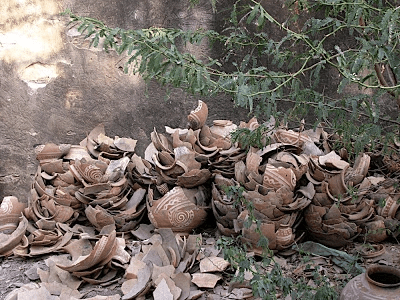
The act of breaking the pottery took place at the entrance to the Potsherd Gate – which was also known as the Dung Gate because that is where the garbage and refuse came out of the city to a dump located in the Valley of Ben Hinnom. It just so happened that this valley was also the location of altars to false gods other than Yahweh. Idolatrous practices – including child sacrifice – were carried on there.

In the ancient Near East, smashing pottery was a ritual act that depicted the destruction of enemies.

I will proclaim the Lord’s decree:

He said to me, “You are my son;
    today I have become your father.
Ask me,
    and I will make the nations your inheritance,
    the ends of the earth your possession.
You will break them with a rod of iron;
    you will dash them to pieces like pottery.” (Psalm 2:7-9, NIV)

The prophet Jeremiah was going to make his oracle against the people both unforgettable and irreversible. He wanted to be clear about what God truly thinks about harming children in religious rituals. But more than that, that it’s absolutely unacceptable for people who worship Yahweh to let it happen, just outside their own city gates, and to even participate in it.

The pottery jar represented Jerusalem. And when a piece of pottery is broken and smashed, there is no opportunity of remaking it from all that destruction. That’s what it would be like for the city who turned their backs on the Lord’s holiness.

Sometimes contemporary people may struggle with the reality that God gets angry – even angry to the point of pouring out wrath on a city. Yet, perhaps we fail to notice the gross and terrible injustice that has been done in the name of religion. The anger of God is always a reflection of God’s love. For love cannot contend with evil perpetrated on innocent people, especially children.

Love is purely subversive. It declares that harming others and hurting people by means of religious violence is not to be accepted nor tolerated. Love is an absolute refusal to settle for the injustice that exists in the world.

Today, and every day, is our opportunity, purpose, and privilege to put love where love is not – to upset the status quo of injustice and establish love as the supreme ethic of God’s commands.

Grant us, Lord God, a vision of your world as your love would have it:
a world where the weak are protected, and none go hungry or poor;
a world where the riches of creation are shared, and everyone can enjoy them;
a world where different races and cultures live in harmony and mutual respect;
a world where peace is built with justice, and justice is guided by love.
Give us the inspiration and courage to build it, through Jesus Christ our Lord. Amen.

Struggling to Accept (Habakkuk 2:1-5)

The prophet Habakkuk cries out to God, by Unknown 19th century artist

I will stand at my guard post.
I will station myself on the wall.
I will watch to see what he will say to me
and what answer I will get to my complaint.

Then the Lord answered me,
“Write the vision.
Make it clear on tablets
so that anyone can read it quickly.
The vision will still happen at the appointed time.
It hurries toward its goal.
It won’t be a lie.
If it’s delayed, wait for it.
It will certainly happen.
It won’t be late.

“Look at the proud person. He is not right in himself.
But the righteous person will live because of his faithfulness.
Also because wine is treacherous
he is arrogant and never rests.
He has a large appetite like the grave.
He is like death—never satisfied.
He gathers all the nations to himself.
He collects all the people to himself. (God’s Word Translation)

The prophet Habakkuk is unique among the prophetic books of the Old Testament. It is more an account of the prophet’s own wonderings and questions before God, than it is bringing a specific word from God to the people.

The book of Habakkuk revolves around the prophet’s queries to the Lord; the Lord’s responses; and the prophet’s struggles to wrap both his head and his heart around those answers.

Habakkuk struggled with the rampant sins of injustice and unrighteousness amongst his own people. He contended with God about how long all this was going to go on. Today’s Old Testament lesson is something of a lament – grieving the loss of justice and righteousness, and longing for God’s salvation from the nation’s troubles. Habakkuk was determination to name the evil, bring it before God, and wait with a determined spirit for a divine response.

The prophet asked a question, and waited for an answer. His complaint is an age old one. He was weary of seeing injustice day after day, of observing the arrogant and the wicked exploit the poor and the needy. He wanted to hear from God; and when the awaited response finally came, it wasn’t what Habakkuk was expecting.

Habakkuk’s first question is one that many today can relate to:

How long, O Lord, am I to cry for help,
but you will not listen?
I cry out to you, “There’s violence!”
yet you will not come to the rescue.
Why do you make me see wrongdoing?
And why do you watch wickedness? (Habakkuk 1:2-3, GW)

God answered the prophet’s question. And Habakkuk didn’t like the answer, at all:

I am going to send the Babylonians,
that fierce and reckless nation.
They will march throughout the earth
to take possession of lands that don’t belong to them. (Habakkuk 1:6, GW)

The problem with this answer, is that, even though the prophet’s own people were unjust and violent, the Babylonians were an even worse lot of people. It was nonsense to Habakkuk that God would use an evil nation to judge God’s own people. So, the prophet asked yet another question of God:

Why do you keep watching treacherous people?
Why are you silent when wicked people swallow those
who are more righteous than they are? (Habakkuk 1:13, GW)

There are many persons who freely admit they are sinful. There is a problem, however, when a person points to others whom they believe are more sinful than they are. Habakkuk, like many contemporary believers, essentially says, “Well, I’m a sinner. I’m not perfect. But I’m not like the Babylonians! They don’t even worship God! And they do a lot worse things than I do!”

If one wants divine judgment, then one must be content with whom it comes from, and how it is done. Otherwise, the person seeks to be the judge, instead of letting the Lord handle the trouble.

We all struggle with navigating the injustice of this world. People of faith will discern that they must trust the Lord by viewing God’s deliverance and actions with a big picture perspective. They remember that God has acted with faithfulness and justice in the past; and the Lord can do it again.

Believers may have to endure some dark valleys, hard circumstances, and plenty of suffering; yet they trust that God will show up. They only need to wait patiently for divine deliverance. Eventually, we all need to conclude with the prophet, after waiting and wrestling over God’s divine plan for the situation we don’t like:

Though the fig tree does not bud
    and there are no grapes on the vines,
though the olive crop fails
    and the fields produce no food,
though there are no sheep in the pen
    and no cattle in the stalls,
yet I will rejoice in the Lord,
    I will be joyful in God my Savior.

The Sovereign Lord is my strength;
    he makes my feet like the feet of a deer,
    he enables me to tread on the heights. (Habakkuk 3:17-19, NIV)

The prophet finally accepted the words of God; and, despite the circumstances, this willingness to receive those words opened to him the possibility to take joy and confidence yet again in the Lord.

God grant me the serenity to accept the things I cannot change; courage to change the things I can; and wisdom to know the difference. Living one day at a time; enjoying one moment at a time; accepting hardships as the pathway to peace; taking, as He did, this sinful world as it is, not as I would have it; trusting that He will make all things right If I surrender to His will; so that I may be reasonably happy in this life, and supremely happy with Him forever in the next. Amen.