Psalm 90 – Of God and Humanity

Lord, you have been our help,
    generation after generation.
Before the mountains were born,
    before you birthed the earth and the inhabited world—
    from forever in the past
    to forever in the future, you are God.

You return people to dust,
    saying, “Go back, humans,”
    because in your perspective a thousand years
    are like yesterday past,
    like a short period during the night watch.
You sweep humans away like a dream,
    like grass that is renewed in the morning.
True, in the morning it thrives, renewed,
    but come evening it withers, all dried up.
Yes, we are wasting away because of your wrath;
    we are paralyzed with fear on account of your rage.
You put our sins right in front of you,
    set our hidden faults in the light from your face.
Yes, all our days slip away because of your fury;
    we finish up our years with a whimper.
We live at best to be seventy years old,
    maybe eighty, if we’re strong.
But their duration brings hard work and trouble
    because they go by so quickly.
    And then we fly off.
Who can comprehend the power of your anger?
    The honor that is due you corresponds to your wrath.
Teach us to number our days
    so we can have a wise heart.

Come back to us, Lord!
    Please, quick!
    Have some compassion for your servants!
Fill us full every morning with your faithful love
    so we can rejoice and celebrate our whole life long.
Make us happy for the same amount of time that you afflicted us—
    for the same number of years that we saw only trouble.
Let your acts be seen by your servants;
    let your glory be seen by their children.
Let the kindness of the Lord our God be over us.
    Make the work of our hands last.
    Make the work of our hands last! (Common English Bible)

The Bible is first and foremost a collection of books about God. Even though Scripture’s pages are filled with the fame and foibles of humans, nevertheless, the biblical drama unfolds because of the Lord. Holy Scripture is, indeed, a self-revelation of God.

There are times we get too focused on ourselves – our fears, inadequacies, weaknesses, failures – and lose sight of just how huge God really is. Today’s psalm helps reorient us back toward the grand Sovereign of the universe. There is a decidedly theistic worldview espoused and embedded in the psalm. It is a cosmology dominated by the immensity and largeness of a Creator God who is pictured as completely in control of all creation.

Let’s face it: Our lives are a weird and complex concoction of fear and joy that can combust at any time. We swing from high to low, and low to high. If we are on an even keel, its only because we are currently in the middle of swaying to one extreme or the other. Even introverts are familiar with this – it just happens to take place mostly inside their vast inner world, instead of on the outside for all to see.

So, we all need the grand vision of God in this psalm to anchor us through the unpredictable vicissitudes of life. Before the mountains were brought forth, or the earth was formed, from everlasting to everlasting the Lord is God. 

The transcendent God, although high and above everything in all creation, is not at all aloof from humanity; the Lord of the universe is also imminently close. God is near enough to know both our outward iniquities as well as our secret sins. Nothing gets by God. The Lord always knows the score.

The proper and appropriate response to such a God is to exclaim along with the psalmist to teach us to number our days so that we may get a heart of wisdom. Whenever we appropriate a biblical worldview, we learn to measure our days and live consistently moral lives with wholeness and integrity. 

This is why a regular regimen of the psalms is important to us, so that we will continually have before us the basic nature and character of God. And, as we do so, we cannot help but reflect God’s glory and contribute to human flourishing on this earth and the care of all creation.

Lord God, almighty and everlasting Father, we rejoice in your greatness and power, your gentleness and love, your mercy and justice. Enable us by your Spirit to honor you in our thoughts, words, and actions, and to serve you in every aspect of our lives, through Jesus Christ our Lord. Amen.

2 Samuel 6:16-23 – Shameless Worship

As the Ark of the Lord came into the city, Saul’s daughter Michal looked out the window. When she saw David jumping and dancing in the presence of the Lord, she hated him.

David put up a tent for the Ark of the Lord, and then the Israelites put it in its place inside the tent. David offered whole burnt offerings and fellowship offerings before the Lord. When David finished offering the whole burnt offerings and the fellowship offerings, he blessed the people in the name of the Lord All-Powerful. David gave a loaf of bread, a cake of dates, and a cake of raisins to every Israelite, both men and women. Then all the people went home.

David went back to bless the people in his home, but Saul’s daughter Michal came out to meet him. She said, “With what honor the king of Israel acted today! You took off your clothes in front of the servant girls of your officers like one who takes off his clothes without shame!”

Then David said to Michal, “I did it in the presence of the Lord. The Lord chose me, not your father or anyone from Saul’s family. The Lord appointed me to be over Israel. So, I will celebrate in the presence of the Lord. Maybe I will lose even more honor, and maybe I will be brought down in my own opinion, but the girls you talk about will honor me!”

And Saul’s daughter Michal had no children to the day she died. (New Century Version)

“God wants worshipers before workers; indeed the only acceptable workers are those who have learned the lost art of worship.”

A.W. Tozer

A true celebration of God was underway, enjoying the blessing of God. The sacrifices before God were sweet smelling because they were done in a spirit of obedience and humility, and according to the specifications of worship with the Ark of God’s Covenant.

However, David’s wife, Michal, the daughter of the former king, Saul, did not worship. She critically observed David and the others and evaluated the worship service by how it appeared to her. Michal was not with everyone else giving herself to the true worship of God. She did not like how her husband went about worship. 

The acceptable worship of God was not acceptable to her, and she gave David an earful about it. Yet, David was undaunted. He had his focus where it ought to be.

We get a cryptic last note on Michal, describing that she was barren to the day of her death – it is a note on her meant to convey both a physical reality of her body, and a spiritual reality of her soul.

So, how are we to worship God? In the New Testament Gospels, Jesus said about worship: 

“Indeed, the time is coming, and it is now here, when the true worshipers will worship the Father in spirit and truth. The Father is looking for people like that to worship him. God is a spirit. Those who worship him must worship in spirit and truth.” (John 4:4:23-24, GW) 

Neither good intentions alone (in spirit) nor appropriate actions alone (in truth) constitute acceptable worship.  We must possess both. The worship Jesus talked about was literally “to prostrate oneself before God.”  In other words, it is to embrace both the disposition and the attitude of submission and humility toward God, seeking to obey the Lord as rightful Ruler, rather than superimpose our desires on him. 

Furthermore, God is both near to us and far away from us, all at the same time. God is close to us through the person and work of Jesus Christ, and now in the person of the Holy Spirit. God exists supreme and far above us, calling the shots of how we ought to be living our lives.

We must appreciate both divine transcendence and divine immanence.

The presence of God is both comforting and dangerous. God’s holiness is like a fire, giving us light and warmth – get too close to the flame and you will get burned, even destroyed. We do not get to tell God what we are to be doing and how to go about it. We have collective promises and blessings given to us as God’s people. Yet, at the same time, we have a responsibility to know God’s will and to do it in God’s way.

God cares about worship. If we worship any old way we want without consideration of how God wants it done, or if we just critically watch worship without engaging in it, then we ought not to expect blessing. However, if pay attention to God and are careful to do what God wants in God’s way, then we will enjoy God’s approval.

The Church is first and foremost a worshiping community of redeemed persons through the blood of Christ, which are given to the world in order to glorify God:

Everyone on this earth,
    sing praises to the Lord.
Day after day announce,
    “The Lord has saved us!”
Tell every nation on earth,
“The Lord is wonderful
    and does marvelous things!
The Lord is great and deserves
    our greatest praise!
He is the only God
    worthy of our worship.
Other nations worship idols,
but the Lord created
    the heavens.
Give honor and praise
    to the Lord,
whose power and beauty
    fill his holy temple.”

Tell everyone of every nation,
“Praise the glorious power
    of the Lord.
He is wonderful! Praise him
and bring an offering
    into his temple.
Worship the Lord,
    majestic and holy. (1 Chronicles 16:23-29, CEV)

The text in 1 Chronicles, a restatement of our Old Testament lesson for today, goes on to say:

David left Asaph and his coworkers with the Chest of the Covenant of God and in charge of the work of worship; they were responsible for the needs of worship around the clock.

He also assigned Obed-Edom and his sixty-eight relatives to help them. Obed-Edom son of Jeduthun and Hosah were in charge of the security guards. The priest Zadok and his family of priests were assigned to the Tent of God at the sacred mound at Gibeon to make sure that the services of morning and evening worship were conducted daily, complete with Whole-Burnt-Offerings offered on the Altar of Burnt Offering, as ordered in the Law of God, which was the norm for Israel.

With them were Heman, Jeduthun, and others specifically named, with the job description: “Give thanks to God, for his love never quits!” Heman and Jeduthun were also well equipped with trumpets, cymbals, and other instruments for accompanying sacred songs. The sons of Jeduthun formed the security guard. (1 Chronicles 16:37-42, MSG)

David exerted his kingly authority by instituting that in Israel the worship of God was to take place every day – not just one day a week. He hired hundreds of musicians, singers, and worship leaders to minister before the Lord every single day, twice a day. 

“I must take time to worship the One whose name I bear.”

Oswald Chambers

Many believers bemoan the morality and lack of spirituality in our world. Yet, if God’s people are not first and foremost a worshiping community, then we have nowhere else to look to institute the change which is needed.

In addition, every conceivable instrument and voice was used to praise God in worship. New songs were written continually by David, and arranged by Asaph, the worship leader. 

While we make plans and conceive of ideas for our lives, God is waiting for us to worship. It would be good to spend some time each morning when we arise, and each evening at bedtime, in worship following the example of David: remembering God, and who we are; singing to the Lord; confessing sin; claiming forgiveness; reading Scripture; and, praying. 

If we all devoted ourselves to worship without shame, then we might begin to imagine God opening to us blessing upon blessing.

*Above sketches of King David dancing before the Lord, by Rebecca Brogan

Psalm 115 – The Living God Is Both Far and Near

Not to us, O Lord, not to us, but to your name give glory,
    for the sake of your steadfast love and your faithfulness.
Why should the nations say,
    “Where is their God?”

Our God is in the heavens;
    he does whatever he pleases.
Their idols are silver and gold,
    the work of human hands.
They have mouths, but do not speak;
    eyes, but do not see.
They have ears, but do not hear;
    noses, but do not smell.
They have hands, but do not feel;
    feet, but do not walk;
    they make no sound in their throats.
Those who make them are like them;
    so are all who trust in them.

O Israel, trust in the Lord!
    He is their help and their shield.
O house of Aaron, trust in the Lord!
    He is their help and their shield.
You who fear the Lord, trust in the Lord!
    He is their help and their shield.

The Lord has been mindful of us; he will bless us;
    he will bless the house of Israel;
    he will bless the house of Aaron;
he will bless those who fear the Lord,
    both small and great.

May the Lord give you increase,
    both you and your children.
May you be blessed by the Lord,
    who made heaven and earth.

The heavens are the Lord’s heavens,
    but the earth he has given to human beings.
The dead do not praise the Lord,
    nor do any that go down into silence.
But we will bless the Lord
    from this time on and forevermore.
Praise the Lord!
(New Revised Standard Version)

Theology 101 Syllabus:

  • The earth belongs to God, not us.
  • Humanity stewards the earth, not depletes it.
  • Glory belongs to God, not us.
  • Humanity gives glory, not seeks glory.
  • God is mindful of us with blessing, not cursing.
  • Humanity is mindful of God with praise, not idolatry.
  • God is eternal, not finite, alive, and not dead.
  • Humanity is finite, not infinite. Dead people don’t steward the earth and give glory and praise to God. Mortal humans have a privilege and responsibility on this earth while they are still alive.

Any questions?

When it comes to knowing God, we learn as much or more about Divine attributes and actions in the psalms as anywhere else in Holy Scripture. This is one reason why the Lectionary has a psalm for every day – and why the same psalm is repeated three days in a row. It is the consistent, repeated, and continual reading and recitation of the psalms which provides us with the robust theology we need for practical daily living.

God speaks. Idols do not. We have the privilege of God’s Word. There are no words from idols. People become like the objects of their worship. Worshiping a mute inanimate object leads to being silent on the great problems and issues of our day. Idol worship has nothing substantive to offer. It’s worthless.

Conversely, the worship of God (a deity who has words for the immense needs of the world) brings a sense and application of humility, justice, and mercy to the very real and present situations surrounding us.

“The believer trusts in the name of the Lord to show steadfast love – to put love where love is not.”

Mit Tdrahrhe

Evil will not be perpetrated with impunity. That is, the person of violent speech and/or actions will not be able to victimize continually and without consequence. Their wicked words and deeds are held accountable by a God who cares about such things. An idol is unable to hear the cries of victims. And an idol is neither able to proclaim justice nor words of assurance. Idolatry has no ability to stop the ravaging of the earth and its people.

The Lord is both far and near – far enough and high enough to see the big picture and act accordingly – yet near enough to bring true comfort and solace. I was once speaking with a friend about this, discussing the simultaneous transcendence and immanence of God. He listened and then said, “So, it sounds like God is a loving hard-ass!” Well, yes. Not quite the way I would frame it, but he certainly picked up on the spirit of what I was saying.

It is important to hold together and maintain both God’s intimacy and distance. Because they each work together to provide the worshiper with what is needed. The Lord both infinitely observes from afar as well as gets his hands dirty working on behalf of finite humanity. This is the view of God the psalms give us. A God who cares in the total sense of the word – caring with comforting words and confident action.

A vision of God in the psalms inevitably leads to prayer, trust, praise, and worship. The Lord might be invisible, yet the evidence of this immense deity is everywhere in the blessings we have, both big and small. Deep within our personhood is firm epistemic proof that we belong to God.

May the Lord who created heaven and earth give you divine blessing.

May all people everywhere praise the Lord now and forevermore! Amen.

Exodus 19:16-25 – An Awesome God

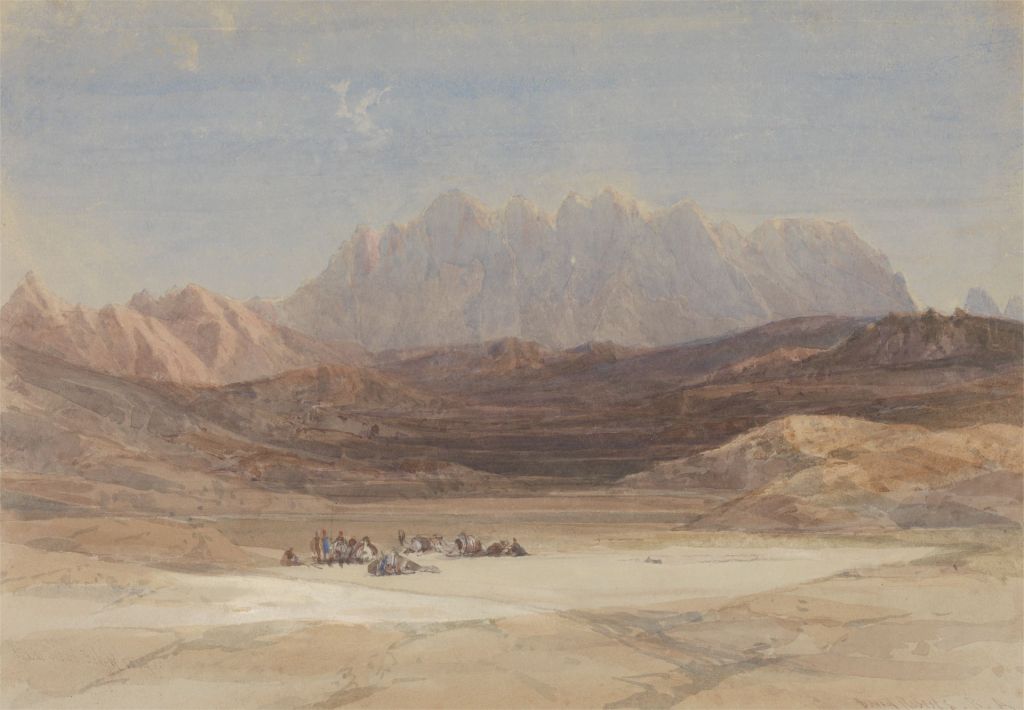
Mount Sinai by Scottish painter David Roberts (1796-1864)

On the morning of the third day, thunder roared, and lightning flashed, and a dense cloud came down on the mountain. There was a long, loud blast from a ram’s horn, and all the people trembled. Moses led them out from the camp to meet with God, and they stood at the foot of the mountain. All of Mount Sinai was covered with smoke because the Lord had descended on it in the form of fire. The smoke billowed into the sky like smoke from a brick kiln, and the whole mountain shook violently. As the blast of the ram’s horn grew louder and louder, Moses spoke, and God thundered his reply. The Lord came down on the top of Mount Sinai and called Moses to the top of the mountain. So, Moses climbed the mountain.

Then the Lord told Moses, “Go back down and warn the people not to break through the boundaries to see the Lord, or they will die. Even the priests who regularly come near to the Lord must purify themselves so that the Lord does not break out and destroy them.”

“But Lord,” Moses protested, “the people cannot come up to Mount Sinai. You already warned us. You told me, ‘Mark off a boundary all around the mountain to set it apart as holy.’”

But the Lord said, “Go down and bring Aaron back up with you. In the meantime, do not let the priests or the people break through to approach the Lord, or he will break out and destroy them.”

So, Moses went down to the people and told them what the Lord had said. (NLT)

As Christians await Easter and the resurrected Christ, the Revised Common Lectionary reminds us of another great anticipation from the Old Testament. The ancient Israelites were amazingly delivered from Egyptian slavery, miraculously walked through the Red Sea, and traveled with wondrous anticipation to Mount Sinai. Now, in today’s reading, they are about to meet with God!

The scene of this meeting is not exactly the romantic highland encounter of the Man from Snowy River (my wife’s all-time favorite movie). The landscape is much more akin to the dark and volcanic Mount Doom from The Lord of the Rings. The picture appears more foreboding than loving. The thing about mountain top experiences is that they are not all monolithic one-size-fits-all encounters with bright rainbows and happy skipping unicorns.

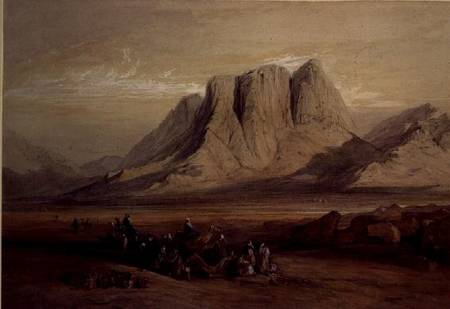
Mount Sinai by English painter Edward Lear (1812-88)

Mountain Top Experiences

Holy Scripture is replete with mountain experiences. Mountains serve as symbols for significant encounters with a mighty God. Whether it is Christ’s transfiguration on a mountain, or the giving of the law on a mountain, the awesome mountain serves as a tangible symbol of divine majesty, strength, and sovereignty. And, I might add, conversely, valleys in Scripture are symbolic of difficulty and suffering. Our God is Lord of both mountain and valley. The God of the Bible is both transcendent and immanent, ruling with power and might high above us on the holy mountain. Yet, the Lord also comes near to us in the valley of the shadow of death.

Leading up to the giving of the Ten Words (Commandments) in Exodus 20, Exodus 19 portrays an awesome scene of God in transcendent holiness and power. In fact, the experience was so otherworldly that the people were afraid to even come near the mountain. The Israelites needed limits placed on themselves because of God’s holy presence. Just like coming too near the immense power of the sun will destroy us, so getting near to God can ruin us if we do not respect divine holiness.

The Lord of the Mountain

Respecting God’s power and transcendence brings the reality of the Lord’s immanence into greater appreciation. God has gone to extreme lengths of self-revelation to people. For the Christian, it all culminates through the incarnation of Christ, the sending of the Son. In Jesus, the transcendence and immanence of God meet perfectly to bridge the chasm between humanity and the divine. Because of Jesus, the awesome sounds of thunder and trumpet do not lead to fear; they announce grace to those who approach God by faith.

You have not come to a mountain that can be touched and that is burning with fire; to darkness, gloom and storm; to a trumpet blast or to such a voice speaking words that those who heard it begged that no further word be spoken to them, because they could not bear what was commanded: “If even an animal touches the mountain, it must be stoned to death.” The sight was so terrifying that Moses said, “I am trembling with fear.” But you have come to Mount Zion, to the city of the living God, the heavenly Jerusalem. You have come to thousands upon thousands of angels in joyful assembly, to the church of the firstborn, whose names are written in heaven. You have come to God, the Judge of all, to the spirits of the righteous made perfect, to Jesus the mediator of a new covenant….

See to it that you do not refuse him who speaks. If they did not escape when they refused him who warned them on earth, how much less will we, if we turn away from him who warns us from heaven? At that time, his voice shook the earth, but now he has promised, “Once more I will shake not only the earth but also the heavens.” The words “once more” indicate the removing of what can be shaken—that is, created things—so that what cannot be shaken may remain. Therefore, since we are receiving a kingdom that cannot be shaken, let us be thankful, and so worship God acceptably with reverence and awe, for our “God is a consuming fire.” (Hebrews 12:18-29, NIV)

Our God is an awesome God. The divine dramas of God’s victory over Egypt and Christ’s victory over sin, death, and hell, have provided God’s people with spiritual power. Both the deliverance of the Israelites from Egyptian slavery by God and the deliverance secured on Mount Zion from spiritual slavery by Jesus are meant to free us to do the will of God. With God’s Word and God’s Spirit given to us, we are emancipated from an empty way of life to experience the fullness of Christ.

May the peace of God which surpasses all understanding, keep your hearts and minds in the knowledge and love of God, and of the Son, Jesus Christ, our Lord, and the blessing of God almighty. May Father, Son, and Spirit be among you and remain with you always. Amen.