Lord, you have been our help, generation after generation. Before the mountains were born, before you birthed the earth and the inhabited world— from forever in the past to forever in the future, you are God.
You return people to dust, saying, “Go back, humans,” because in your perspective a thousand years are like yesterday past, like a short period during the night watch. You sweep humans away like a dream, like grass that is renewed in the morning. True, in the morning it thrives, renewed, but come evening it withers, all dried up. Yes, we are wasting away because of your wrath; we are paralyzed with fear on account of your rage. You put our sins right in front of you, set our hidden faults in the light from your face. Yes, all our days slip away because of your fury; we finish up our years with a whimper. We live at best to be seventy years old, maybe eighty, if we’re strong. But their duration brings hard work and trouble because they go by so quickly. And then we fly off. Who can comprehend the power of your anger? The honor that is due you corresponds to your wrath. Teach us to number our days so we can have a wise heart.
Come back to us, Lord! Please, quick! Have some compassion for your servants! Fill us full every morning with your faithful love so we can rejoice and celebrate our whole life long. Make us happy for the same amount of time that you afflicted us— for the same number of years that we saw only trouble. Let your acts be seen by your servants; let your glory be seen by their children. Let the kindness of the Lord our God be over us. Make the work of our hands last. Make the work of our hands last! (Common English Bible)
The Bible is first and foremost a collection of books about God. Even though Scripture’s pages are filled with the fame and foibles of humans, nevertheless, the biblical drama unfolds because of the Lord. Holy Scripture is, indeed, a self-revelation of God.
There are times we get too focused on ourselves – our fears, inadequacies, weaknesses, failures – and lose sight of just how huge God really is. Today’s psalm helps reorient us back toward the grand Sovereign of the universe. There is a decidedly theistic worldview espoused and embedded in the psalm. It is a cosmology dominated by the immensity and largeness of a Creator God who is pictured as completely in control of all creation.
Let’s face it: Our lives are a weird and complex concoction of fear and joy that can combust at any time. We swing from high to low, and low to high. If we are on an even keel, its only because we are currently in the middle of swaying to one extreme or the other. Even introverts are familiar with this – it just happens to take place mostly inside their vast inner world, instead of on the outside for all to see.
So, we all need the grand vision of God in this psalm to anchor us through the unpredictable vicissitudes of life. Before the mountains were brought forth, or the earth was formed, from everlasting to everlasting the Lord is God.
The transcendent God, although high and above everything in all creation, is not at all aloof from humanity; the Lord of the universe is also imminently close. God is near enough to know both our outward iniquities as well as our secret sins. Nothing gets by God. The Lord always knows the score.
The proper and appropriate response to such a God is to exclaim along with the psalmist to teach us to number our days so that we may get a heart of wisdom. Whenever we appropriate a biblical worldview, we learn to measure our days and live consistently moral lives with wholeness and integrity.
This is why a regular regimen of the psalms is important to us, so that we will continually have before us the basic nature and character of God. And, as we do so, we cannot help but reflect God’s glory and contribute to human flourishing on this earth and the care of all creation.
Lord God, almighty and everlasting Father, we rejoice in your greatness and power, your gentleness and love, your mercy and justice. Enable us by your Spirit to honor you in our thoughts, words, and actions, and to serve you in every aspect of our lives, through Jesus Christ our Lord. Amen.
God made my life complete when I placed all the pieces before him. When I got my act together, he gave me a fresh start. Now I’m alert to God’s ways; I don’t take God for granted. Every day I review the ways he works; I try not to miss a trick. I feel put back together, and I’m watching my step. God rewrote the text of my life when I opened the book of my heart to his eyes.
The good people taste your goodness, The whole people taste your health, The true people taste your truth, The bad ones can’t figure you out. You take the side of the down-and-out, But the stuck-up you take down a notch.
Suddenly, God, you floodlight my life; I’m blazing with glory, God’s glory! I smash the bands of marauders, I vault the highest fences.
What a God! His road stretches straight and smooth. Every God-direction is road-tested. Everyone who runs toward him Makes it. (The Message)
I confess I’m tired a lot. Maybe it’s the rigors of pastoral ministry and hospital chaplaincy. It might be from the daily grind of household chores and family responsibilities. It could be because my mind is always a beehive of activity and doesn’t shut down easily at night. Perhaps it’s due to not enough self-care. More than likely, it is a bit of all that.
I perked up, though, when I read today’s psalm and heard David say that by means of God he can vault the highest fences. Back in the day, I certainly did my share of hopping over high fences. But it’s been a long while since I’ve leapt over a fence. I’m old enough to know better than try something like leaping over anything. I can clearly imagine pulled hamstrings and a messed-up back doing a feat like that.
David was really no spring chicken himself when he wrote this. Psalm 18 is a psalm of praise to God for rescuing David from Saul and all his enemies. This deliverance did not happen overnight; it came over years of David running from the king and being pursued by others. Yet the day finally came, and David was not shy in proclaiming his praise to God.
If God’s deliverance from earthly enemies can energize David so much, how much more can I be invigorated by the reality that I’m delivered from sin, death, and hell through the blood of Jesus Christ?
Maybe you, like me sometimes, think too much about adverse circumstances and ornery people – which makes the biblical Psalms a great place to go when fixating on personal injustice. They help give voice to our contemporary situations.
So, today, I’m taking my own advice by reading and meditating on this psalm and getting a leg up on letting gratitude set the tone for my life and ministry. I probably won’t go out and vault myself over a fence, but I suspect my soul will be renewed and energized by contemplating the goodness and guidance of a loving God who always has my back.
Accept, O Lord, our thanks and praise for all that you have done for us. We thank you for the splendor of the whole creation, for the beauty of this world, for the wonder of life, and for the mystery of love. We thank you for the blessing of family and friends, and for the loving care which surrounds us on every side. We thank you for setting us at tasks that demand our best efforts, and for leading us to accomplishments that satisfy and delight us. We thank you also for those disappointments and failures that lead us to acknowledge our dependence on you alone.
Above all, we thank you for your Son Jesus Christ; for the truth of his Word and the example of his life; for his steadfast obedience, by which he overcame temptation; for his dying, through which he conquered death; and for his rising to life again, in which we are raised to the life of your kingdom. Grant us the gift of your Spirit, that we may know Christ and make him known; and through him, at all times and in all places, may give thanks to you in all things. Amen.
I will praise the Lord at all times. I will constantly speak his praises. I will boast only in the Lord; let all who are helpless take heart. Come, let us tell of the Lord’s greatness; let us exalt his name together.
I prayed to the Lord, and he answered me. He freed me from all my fears. Those who look to him for help will be radiant with joy; no shadow of shame will darken their faces. In my desperation I prayed, and the Lord listened; he saved me from all my troubles. For the angel of the Lord is a guard; he surrounds and defends all who fear him.
Taste and see that the Lord is good. Oh, the joys of those who take refuge in him! (New Living Translation)
Gratitude and praise are more than a nice thing. They have the power to spiritually form us, emotionally buoy us, and mentally change our brain chemistry for the better – not to mention connecting us with divine help.
Today’s psalm is a song of thanksgiving. The psalmist intentionally recalls being delivered by G-d from trouble and hardship. And he invites us to experience G-d’s salvation, as well.
Desperate people who are between a rock and a hard place need divine help. The Lord is able to intervene in both small and large ways. David, the psalmist, crafted this psalm in a time when he had no resources available to him. He was alone with nothing but the Lord. And that was plenty. Even a little bit of G-d is enough to thoroughly rescue.
Take note of the verbs used to describe G-d’s activity in helping David: “answered” “freed” “listened” “saved” “surrounds” and “defends.” These multiple actions of the Lord were all activated through David’s initiative with one single verb of his own: “prayed.”
It is one thing to pray because of expectation or routine. It is altogether a different thing to pray out of desperation from the depths of your gut.
So, when David encourages us to taste and see that the Lord is good and to take refuge in G-d, he is calling us to pray – to know something of God’s promises, presence, provision, and power and to actively ask, seek, and knock for help.
David, the psalmist, really wants us to experience prayer. He desires us to cry out on behalf of ourselves, as well as lifting up others to G-d. Yet, truth be told, helping those with afflictions and sickness through prayer is something we don’t always handle well.
We might too quickly and reflexively dispense our homespun opinions and ideas, as if we are experts on another’s situation, rather than hurrying to G-d in prayer. In our pride, we believe that if folks will just follow our recommendations that all will be well.
And then there are the silly and even hurtful things we say to others in their distress, rather than interceding for them before G-d. We may toss out a flippant and simplistic statement like, “God will heal — just pray.” Then, we leave them to do that alone. And sometimes, even after prayer, medicine, and doing the right thing, change doesn’t happen, and nobody knows quite what to do.
We can also be guilty of reducing trouble to only the physical when the trouble might be emotional, mental, relational, or any combination thereof. These are the hurts and troubles plaguing us all, because we live in a broken world where everyone needs redemption.
Many times, we have no problem believing G-d will work on behalf of others. We trust the Lord for deliverance and the miraculous for them. Yet, when it comes to us, we harbor serious doubts of whether G-d will rescue us, or even wants to.
There are a lot of things we just don’t know. However, what we do know is that the God of David promises help in Psalm 34, and to redeem lives from desperate situations. And this is why David could boldly invite us to tell of the Lord’s greatness, and call us to praise G-d’s name together.
May the risen and ascended Christ, mightier than the hordes of hell, more glorious than the heavenly hosts, be with you in all your ways.
May the cross of the Son of God protect you by day and by night, at morning and at evening, at all times and in all places.
May Christ Jesus guard and deliver you from the snares of the devil, from the assaults of evil spirits, from the wrath of the wicked, from all base passions and from the fear of the known and unknown.
May the blessing of God almighty – Father, Son, and Spirit – be upon you and remain with you always. Amen.
For the word of God is alive and active. Sharper than any double-edged sword, it penetrates even to dividing soul and spirit, joints and marrow; it judges the thoughts and attitudes of the heart. Nothing in all creation is hidden from God’s sight. Everything is uncovered and laid bare before the eyes of him to whom we must give account.
Therefore, since we have a great high priest who has ascended into heaven, Jesus the Son of God, let us hold firmly to the faith we profess. For we do not have a high priest who is unable to empathize with our weaknesses, but we have one who has been tempted in every way, just as we are—yet he did not sin. Let us then approach God’s throne of grace with confidence, so that we may receive mercy and find grace to help us in our time of need. (New International Version)
Church Persecution and Christian Suffering
The book of Hebrews was originally a sermon preached to a group of believers who had come to Christ out of Judaism. From the book of Acts, we know there were thousands of Jewish Christians who were dispersed from Jerusalem when Stephen was martyred. A great persecution broke out, and many believers fled west to places like Galatia, Ephesus, Greece and Rome.
The Jewish believers were immigrants in a foreign land, looking to practice their faith without harm. Yet, their experience was anything but ideal. These followers of Christ found fellow ethnic Jews in the places where they went, yet those Jews had no use for these people that they believed were in some sort of aberrant cult.
What is more, the surrounding Gentile culture did not understand Christianity, at all, and many of those who held to pagan religions bought into rumors, such as, that Christians were cannibals who ate at what’s called the Lord’s Table.
So, here we have a situation where these displaced Christians had no respect from both Jews and Gentiles. As a result, they had a difficult time carrying out business because no one trusted them. They were essentially alone in the world.
Losing Their Grip
Initially, they embraced their identity as Christians and held up quite well under the stress. However, over time, their resolve began to slowly erode. The followers of Jesus began to question their adverse situation.
They began listening to their fellow Jews throw doubts on their faith. The hard life was not improving, maybe even becoming worse. Eventually, the church came to a point where they began re-considering their whole way of life as Christians, and their faith commitment started slipping. The Christians actually considered leaving the Church and Christianity and going back to their old life in Judaism.
The Message of Hebrews
It was at this point that a vigorous believer in Jesus came to town, saw the situation of the church, and preached a spirited message to them. The preacher called them to hold tight to their commitment – to see Jesus afresh and anew as superior over all the Old Testament, as the fulfillment of all the promises of God.
So, then, throughout the book of Hebrews we have this wonderful explanation and exposition of how to make sense of Jesus and the Old Testament, and of what Jesus really means to the church. Throughout his sermon, the preacher occasionally paused his teaching and gave the people a stiff warning about falling away from Christ. He called the church to be bold and confident in Christ, to stand up to the suffering, and to confront their temptations so that they would persevere in their commitment to Jesus Christ for the rest of their lives.
God’s Word and Work
We pick up the teaching and the exhortation in chapter four. Hebrews 4:12-16 is composed of two distinct sections that are paired together for a reason. Verses 12-13 give us a graphic visual of the penetrating work of God’s Word, of the reality that God can get deep inside us. The next section, verses 14-16, lays out God’s response to our being under divine scrutiny – that there is grace and mercy available because of Jesus, our great high priest who is superior to every priest of the Old Testament to the point of being the last and permanent priest forever!
These verses are bound together because we all need to struggle with the tension between God’s Word to us, and our words to God; between God’s judgment that opens our souls on a spiritual operating table, and God’s grace which jumpstarts our broken hearts. Our most fundamental need is for God’s mercy in Jesus Christ.
The Christian Life
It is important that our outer lives and our inner lives match each other. Whenever the two are out of sync, we come under the judgment of God’s Word. These early Hebrew Christians had slowly drifted from the truth so that their inner and outer lives did not line up well.
Some of them still performed the outward duties of being a Christian yet were inwardly despising their hard situation. A growing vacuum developed on their insides as they slowly started letting go of Jesus as their object of devotion. Their hearts began to harden because of their hard lives.
On the other hand, there were other Hebrew Christians who began drifting in a different way. Inwardly, they tried to maintain their devotion and commitment to Christ. Yet these believers began compromising their outward life to match the culture around them. In both cases of hardening inwardly, and of compromising outwardly, they each shared the situation of drifting away from their original commitment to Christ.
Even today, it is a real temptation to try and avoid suffering, to grow weary of our present circumstances and look for a way to get out from under the pain and find a quick fix. Whenever we find ourselves in such a situation, the remedy is to be reminded that we must continue to hold firmly to the faith we profess because of who Jesus is.
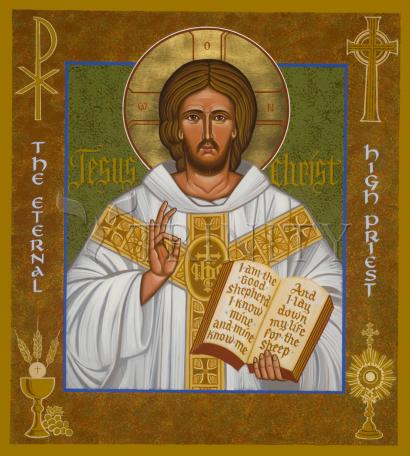
15th Century Orthodox icon of Christ the Great High Priest
Jesus As Permanent High Priest
Jesus is our great high priest. In the Old Testament, among the twelve tribes of the ancient Israelites, the tribe of Levi made up the class of priests. One of those Levites, always a descendent of the original Levite priest, Aaron, had the task of once a year entering a place called the Holy of Holies, which was at the center of the Temple, to offer a bloody sacrifice on behalf of the people, to atone for their sins from the previous year.
Jesus is our great and ultimate high priest. He did not enter the temporary sacrificial system to deal with sins for only a year. Jesus not only took on the role of high priest, but became the sacrifice, as well. As a result, we now have a thorough and permanent forgiveness of sins through Christ. So, the Hebrew Christian who considered going back to an old outdated system needed to be brought back to his senses and embrace again the once-for-all sacrifice of Jesus.
As they considered Jesus, the believers needed to remember that Christ was not so far removed from them that the church could not relate to Jesus. Rather, Jesus is able to sympathize with each and every trouble, trial, and temptation we face because he faced the very same kind of sufferings.
The only difference between Christ and his followers is that Jesus did not succumb to the trouble, but persevered and secured for us deliverance from sin, death, and hell. Jesus is the One who deserves every bit of our commitment, allegiance, and devotion. Christ is the One whom we are to worship inside and out.
Approaching God with Boldness
Let us then approach Jesus with confidence, with boldness, knowing that with him there is mercy and grace. Jesus not only suffered for us in the past; he also suffers with us now, in the present. We, as believers, are in union with Jesus. Christ is our great high priest, the One intimately involved in every nook and cranny of our lives. He knows what you and I are going through and is ready to give grace to help right now.
Approaching Jesus has nothing to do with being good enough to do so. Coming to Jesus is about grace. Whenever we drift from Jesus and are confronted with God’s Word cutting us to the heart, the end result is not wrath or judgment; the result is mercy and grace.
Like the early Hebrew Christians, we all face situations out of our control that wear us down and cause us to become weary. In our tired state, we can be tempted to let our commitment to Christ slide in some small way. Over time, the small compromises of faith can snowball into a big slide away from God.
Yet, Jesus is not sitting in heaven frustrated or confounded. God is not looking for a reason to punish people. It is just the opposite. Jesus, the Son of God, our great high priest, is looking for a reason to give grace and help us in our time of need. Christ is waiting for us to approach the throne of grace with confidence. Right now, Jesus is alive. He is scanning the world and the church, looking to extend mercy to those who need it.
Asking for Help
We must avoid a spiritual hardening of heart which estranges us from approaching Jesus. Every one of us needs help. We are not God. We have weaknesses. We have confusion. We have limitations of all kinds. We need help. And every one of us has something else: guilt and shame. At the bottom of our hearts, we feel undeserving, and so, avoid coming to Jesus. Yet, we need with family, loneliness, work, health, finances.
So, what to do? I can try to deny it all and be a superman who doesn’t need any help. I can try to drown it all with alcohol. I can be obsessive and compulsive about controlling events and/or people. I can simply succumb to discouragement. Here is what God declares: Jesus Christ became a High Priest to shatter despair with hope, to rescue that drowning person and that anxious individual.
God planned for a High Priest, a Savior, a Redeemer, and a gracious Helper. You and I are not trapped. We have Jesus.
The book of Hebrews is all about a call to commitment – an invitation to come to Jesus. And it is the most important invitation you will ever receive. Let us approach the throne of grace with confidence….
This is the confidence we have in approaching God: That if we ask anything according to his will, he hears us. And if we know that he hears us – whatever we ask – we know that we have what we asked of him. Spirit of God, lead us into your will. Help us in all things. Fill our hearts and lives to overflowing with divine mercy and grace so that what comes out of our mouths and the actions we do are compassionate, kind, and good, through our great High Priest, Jesus Christ. Amen.







 Rev. Tim Ehrhardt