All I Want for Christmas Is Hope

The Presentation by John August Swanson

On the eighth day, when it was time to circumcise the child, he was named Jesus, the name the angel had given him before he was conceived.

When the time came for the purification rites required by the Law of Moses, Joseph and Mary took him to Jerusalem to present him to the Lord (as it is written in the Law of the Lord, “Every firstborn male is to be consecrated to the Lord”), and to offer a sacrifice in keeping with what is said in the Law of the Lord: “a pair of doves or two young pigeons.”

Now there was a man in Jerusalem called Simeon, who was righteous and devout. He was waiting for the consolation of Israel, and the Holy Spirit was on him. It had been revealed to him by the Holy Spirit that he would not die before he had seen the Lord’s Messiah. Moved by the Spirit, he went into the temple courts. When the parents brought in the child Jesus to do for him what the custom of the Law required, Simeon took him in his arms and praised God, saying:

“Sovereign Lord, as you have promised,
    you may now dismiss your servant in peace.
For my eyes have seen your salvation,
  which you have prepared in the sight of all nations:
a light for revelation to the Gentiles,
    and the glory of your people Israel.”

The child’s father and mother marveled at what was said about him. Then Simeon blessed them and said to Mary, his mother: “This child is destined to cause the falling and rising of many in Israel, and to be a sign that will be spoken against, so that the thoughts of many hearts will be revealed. And a sword will pierce your own soul too.”

There was also a prophet, Anna, the daughter of Penuel, of the tribe of Asher. She was incredibly old; she had lived with her husband seven years after her marriage, and then was a widow until she was eighty-four. She never left the temple but worshiped night and day, fasting and praying. Coming up to them at that very moment, she gave thanks to God and spoke about the child to all who were looking forward to the redemption of Jerusalem.

When Joseph and Mary had done everything required by the Law of the Lord, they returned to Galilee to their own town of Nazareth. And the child grew and became strong; he was filled with wisdom, and the grace of God was on him. (Luke 2:21-40, NIV)

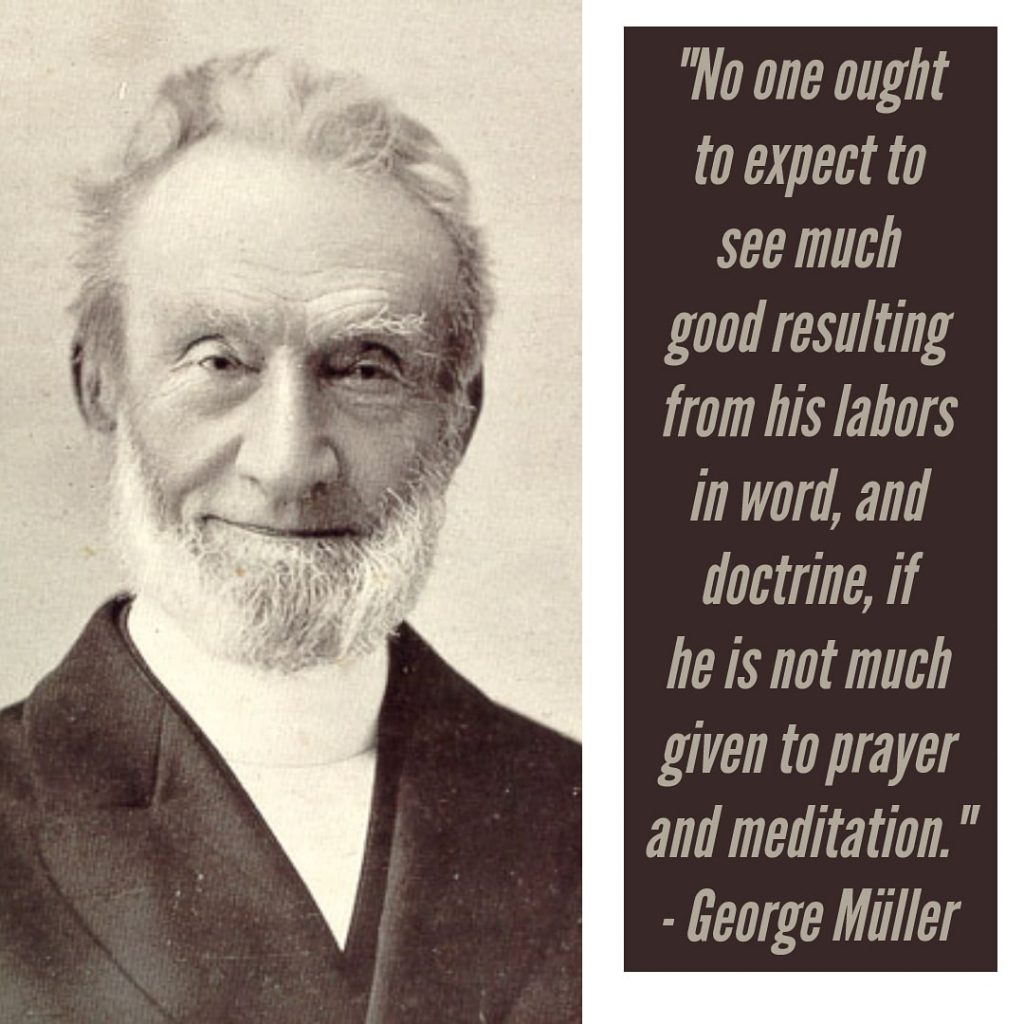
George Mueller (1805-1898) was a man full of hope in God.  For sixty-six years he preached in a small chapel in Bristol, England, yet what he is best known for is his orphanage. 

After being in ministry for a few years, Mueller became deeply concerned for the street children of the city and decided to start an orphanage.  The problem was he had no money.  So, with nothing but his hope in Christ he prayed God would provide. For the next sixty-four years, that was how George Mueller operated.

In that course of time, he built an orphanage, where he cared for and educated over eighteen-thousand children; educated over one-hundred-thousand more children in other schools at the Orphanage’s expense; distributed hundreds of thousands of Bibles and tens of millions of religious tracts; supported one-hundred-fifty missionaries; travelled over two-hundred-thousand miles as a missionary himself; and proclaimed the Gospel to over three million people around the world.

In all that time, Mueller never asked for one penny from anyone, his children never missed a meal, and he never had a debt.

We are not all called to be like George Mueller, or even like Simeon and Anna in our Gospel story.  However, all of us are called to grab hold of God’s promises with such faith and hope that, even though we may not yet see it realized, we live as though it has already happened.  This is what it means to participate with God. 

When George Mueller had a need, he pleaded to God and banked on the promise of God. Mueller prayed for more than money; he prayed for individuals, as well. Sometimes he prayed for someone for as long as fifty years. He never stopped praying for anyone or anything until he got his request. That is how convinced George Mueller was that God would answer his prayers.
All the promises of Holy Scripture revolve around Jesus Christ.  Jesus is the fulfillment of hope for persons of every nation and ethnicity. Christ is our Redeemer, and his salvation is limitless and includes all kinds of people.  Simeon and Anna, despite their age, despite the fact they lived their entire lives without seeing the Deliverer, never lost hope in the promise of God and never gave up praying and looking for the Savior.

Hope in the Bible is not wishful thinking but confident expectation which is grounded in the promises of God. Since all those promises have not yet been fully realized, we must have a quiet confidence and a patient spirit to anticipate the light at the end of the tunnel. Listen to what the Roman church needed to hear about this: 

We groan inside as we wait to be adopted and for our bodies to be set free. We were saved in hope. If we see what we hope for, that is not hope. Who hopes for what they already see? But if we hope for what we do not see, we wait for it with patience. (Romans 8:23-25, CEB)

Simeon and Anna gave testimony about the hope of all the earth.  We have a moving scene of the old man, Simeon, being led by the Spirit of God to enter the temple and take hold of the baby Jesus and cradle him in his arms.  Simeon’s hope is being realized as he declared that this little baby will be the means of salvation for all people.

This salvation comes at a great cost – and all of history hinges on this little child in Simeon’s arms.  Will people move toward or away from God?  Anna came along and, as the George Mueller of the ancient world, devoted herself constantly to prayer and anticipated the coming of the Messiah.  Anna confirmed the testimony of Simeon that this baby is the hope of Israel, the Redeemer of both Jew and Gentile.

Presentation in the Temple by British artist Sylvia Lauder

Today you decided to be here and join me; yet it was more than your own consideration.  The Holy Spirit of God, like Simeon of old, led you and I to this place of virtual meeting, perhaps because we long to see our hope realized – to find in the Christ child all we have longed for and have been waiting to see happen in our lives. 

God wants us to see Jesus. So, close your eyes, because the hope of all life cannot be seen with human eyes…

See him as a little baby…

See him as he grows with wisdom and favor with both God and others…

See him as he teaches, ministers, and heals the outcast and loves the common person…

See him as he is arrested, beaten, and taken outside of the city…

See them take the hammer and nail his hands and feet to a cross…

See him as you kneel before a terrible cross and watch him die, not for himself, not because he deserved it, but because of the world’s great sin and because humanity has lost their way…

See him as he is placed in the grave…

See him rise from death…

See him ascend to heaven…

See the Lord Jesus Christ in all his glory…

See that he has done all of this for you!  Do not lose hope!  Do not give up!  Search the Scriptures for the promises of God. Grab hold of them and rely on them as if your life depended on it – and it does!

Why did Simeon and Anna not lose hope?  How could they remain so devout?  Why, over the years and the decades when all seemed dark and despondent, did they not give up searching for the Christ of God? 

Because we become just like who we worship. 

If we spend all our time, thoughts, and energy on money, we will live and die with whatever the markets are doing… 

If we spend all our time, thoughts, energy on our job and our work, we will live and die with our ability to produce and get things done… 

If we spend all our time, thoughts, and energy on watching out for ourselves because we believe no one cares, then we will live and die lonely and dejected… 

But if we spend our time, use our thoughts, and expend our energy in the hope of all the earth, Jesus, the Savior of the world, then we will experience the deepest needs of our lives being met – we will become like Jesus, showing love, giving grace, and enjoying unhindered relationship with God.

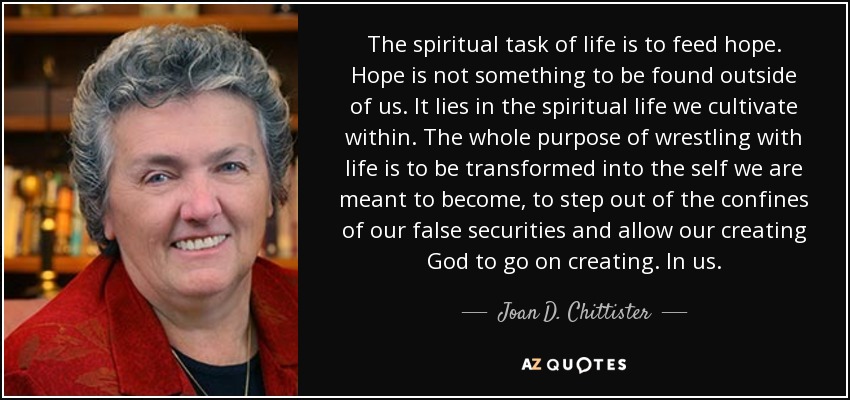
No tragedy can dim the hope that comes from knowing God will walk with you through the valley. Hope is neither cheap, nor easy. Genuine hope typically arises from the ash heap of unfulfilled dreams, messed-up plans, and broken hearts. We often need to experience hopelessness before we can realize hope itself. It is the absence of hope that holds the invitation to forsake old ways and strike out on a new path to find our heart’s truest desire. Author Joan Chittester has wisely said:

“The challenge of hopelessness is the challenge to re-enter humanity, to take our part in it knowing that the lack of hope has much within it to shape our life. Losing hope leads us to understand that misfortune is not failure. It is at most simply a digression through life intended to make us reassess our course, our goals, and our aspirations.”

Indeed, hopelessness need not lead to despair. The profound lack of hope is ironically what reawakens and rekindles hope within us. It is the process of reassessment that is the opportunity to hope again with a sharper and a greater assurance of hope – to create space in becoming fully alive to the hope that has always been there – maybe just underneath all of life’s accumulated stuff.
For me, hope rekindles when I withdraw to a quiet place, either sitting down in my favorite chair or walking along a secluded wooded path. I allow and encourage the sixth sense of faith and imagination to inform my other five senses. This helps my heart to enlarge, the empty places of my soul to be filled with the hope of Christ. It is in this inner place, where our hearts join the heart of God, that we find an alternative way to the true hope for which we have been striving for so long to realize.

For the grace of God has appeared that offers salvation to all people. It teaches us to say “No” to ungodliness and worldly passions, and to live self-controlled, upright and godly lives in this present age, while we wait for the blessed hope—the appearing of the glory of our great God and Savior, Jesus Christ, who gave himself for us to redeem us from all wickedness and to purify for himself a people that are his very own, eager to do what is good. (Titus 2:11-14, NIV)

We have a sure and certain hope which presently now shapes our lives as we wait patiently. Just as we await a coming vaccine and deliverance from COVID-19 which presently now forms our living with masking, social distancing, and sheltering in place – so we look forward to the coming of our glorious Savior and the realization of our salvation in its fullness. Meanwhile, much like Simeon and Anna, we presently now devote our lives to prayer and wait….


Ezekiel 36:24-28 – I Will Give You A New Heart

New Heart by Ginnie Johansen Johnson

I will take you from the nations, I will gather you from all the countries, and I will bring you to your own fertile land. I will sprinkle clean water on you, and you will be cleansed of all your pollution. I will cleanse you of all your idols. I will give you a new heart and put a new spirit in you. I will remove your stony heart from your body and replace it with a living one, and I will give you my spirit so that you may walk according to my regulations and carefully observe my case laws. Then you will live in the land that I gave to your ancestors, you will be my people, and I will be your God. (CEB)

Every time I read these Old Testament verses from the prophet Ezekiel I am reminded of my time as chaplain on two cardiac intensive care units. I had several occasions to follow patients through the process of a heart transplant. I sat with them as they wondered if they would ever get a new one, as their own heart could no longer sustain the rest of their life. Would they die before receiving one? What would happen to their families?

Then, finally the day came for many (unfortunately, not all) there is a heart for them. After the incredible transplant surgery, joy abounds, knowing there is a new lease on life, a fresh experience. Through weeks or months of waiting and flirting with the Grim Reaper of death, hope is realized. Their old useless heart now replaced with a vibrant one, full of life!

However, the process is not yet over. Typically, about two or three days into possessing this new heart, a new realization comes along with it: Someone else had to die so that I could live….

He personally carried our sins
    in his body on the cross
so that we can be dead to sin
    and live for what is right.
By his wounds
    you are healed. (1 Peter 2:24, NLT)

Life comes from death. Resurrection can only happen when there is a crucifixion. Gaining a new spiritual heart has been achieved at the greatest of costs. “I will” is uttered nine times by God in five verses of Ezekiel’s prophecy. In gracious acts of determination to restore fallen people, God makes promises and has the authority and power to back them up. Our new heart is waiting to be animated by God’s Spirit so that our observance of God’s law is infused with divine might. Our consent to surgery is all that is needed.

Consider just a few of the great “I will” statements of Holy Scripture:

“I will instruct you and teach you in the way you should go; I will counsel you with my loving eye on you.” (Psalm 32:8, NIV)

“If someone trusts me, I will save them.
    I will protect my followers who call to me for help.
When my followers call to me, I will answer them.
    I will be with them when they are in trouble.
    I will rescue them and honor them.
I will give my followers a long life
    and show them my power to save.” (Psalm 91:14-16, ERV)

“I will strengthen you; I will help you; I will uphold you with my victorious right hand.” (Isaiah 41:10, NRSV)

“Call to me and I will answer you and tell you great and unsearchable things you do not know.” (Jeremiah 33:3, NIV)

“I will never leave you nor forsake you.” (Hebrews 13:5, NKJV)

May Christ make his home in your heart as you trust in him.

May your spiritual roots grow down deep into God’s love and keep you strong.

May you have the power to grasp, along with all God’s people, how wide, how long, how high, and how deep is the love of God.

May you experience the love of Christ, though it is too great to understand fully.

May you be made complete with all the fullness of life and power that comes from God.

May your new heart pump with the grace of Jesus Christ, the love of God, and the encouragement of the Spirit. Amen.

Hosea 6:1-6 – “I Desire Mercy!”

By Brazilian street artist Edward Kobra, building in New York City, 2018

Come, let us return to the Lord.
He has torn us to pieces
    but he will heal us;
he has injured us
    but he will bind up our wounds.
After two days he will revive us;
    on the third day he will restore us,
    that we may live in his presence.
Let us acknowledge the Lord;
    let us press on to acknowledge him.
As surely as the sun rises,
    he will appear;
he will come to us like the winter rains,
    like the spring rains that water the earth.

“What can I do with you, Ephraim?
    What can I do with you, Judah?
Your love is like the morning mist,
    like the early dew that disappears.
Therefore I cut you in pieces with my prophets,
    I killed you with the words of my mouth—
    then my judgments go forth like the sun.
For I desire mercy, not sacrifice,
    and acknowledgment of God rather than burnt offerings.” (NIV)

My favorite word in all Holy Scripture is the Hebrew word chesed.  It is such a rich word that no one English word can capture its depth.  So, chesed is translated in various ways across English translations of the Bible as mercy, grace, steadfast love, covenant loyalty, kindness, compassion and more. It is no wonder, then, that since chesed marks the character and activity of God, the Lord very much desires people to reflect this same stance toward others. 

In today’s Old Testament lesson, God was calling and wooing wayward people to return to a divine life of closeness with the Lord. God demonstrated chesed by not putting the people away, like a spouse outright divorcing an unfaithful partner, but committed to loving the Israelites even when they were unlovely.

At all times, the response God wants is not simply going through the motions of outward worship. Ritual practices mean little if there is no heart behind them. The Lord longs for people to demonstrate both fidelity and fealty through mercy and a steadfast love to God and neighbor. Both our work and our worship are to be infused with divine mercy. 

Chesed by Havi Mandell

God deeply desires a close relationship with humanity and is profoundly pained when people whore after other gods to meet their needs and love them. Hosea’s prophecy is an impassioned plea for all persons to find their true fulfillment and enjoyment in a committed loving divine/human union, like a marriage.

In Christian readings of Hosea’s prophecy, repentance means accepting God’s chesed through Jesus Christ. The believer is to allow the character of God to rule and reign in their heart so that love and commitment come flowing out in words, actions, thoughts, and dispositions. Mercy finds its highest expression in the person and work of Jesus. Thus, Advent is a season of anticipating the great love and mercy of God through the incarnation of Christ.

It is no wonder, then, that Jesus lifted Hosea’s prophecy as a treasured principle of operation when asked why he deliberately made connections with “questionable” people:

While Jesus was having dinner at Matthew’s house, many tax collectors and sinners came and ate with him and his disciples. When the Pharisees saw this, they asked his disciples, “Why does your teacher eat with tax collectors and sinners?” On hearing this, Jesus said, “It is not the healthy who need a doctor, but the sick. But go and learn what this means: ‘I desire mercy, not sacrifice.’ For I have not come to call the righteous, but sinners.” (Matthew 9:10-12, NIV)

And when confronted about “questionable” activities Jesus appealed to the same source of Hosea’s prophecy:

“Look! Your disciples are doing what is unlawful on the Sabbath.” Jesus answered, “Haven’t you read what David did when he and his companions were hungry? He entered the house of God, and he and his companions ate the consecrated bread—which was not lawful for them to do, but only for the priests. Or haven’t you read in the Law that the priests on Sabbath duty in the temple desecrate the Sabbath and yet are innocent? I tell you that something greater than the temple is here. If you had known what these words mean, ‘I desire mercy, not sacrifice,’ you would not have condemned the innocent.” (Matthew 12:2-7, NIV)

One can never go wrong with mercy and grace. If in doubt between whether to judge another or show mercy, the Christian’s choice is clear. Grace and love create connections – reconnecting the disconnected. The heart of true Christian spirituality is a deep kinship with the divine. Whenever that relation is broken or severed, it is vital to restore it. The means of doing so is not judgment but mercy.

Chesed is more than a word; it is a way of life. God wants mercy. Grace is the Lord’s divine will. So, let us today receive the forgiveness of Jesus and devote ourselves to prayer and works of love which come from a heart profoundly touched by grace.  May the result be healing of that which has been broken, and reconciled relationships with others.

Merciful and loving God, the One who shows amazing grace, forgive us for our wanderings away from the divine life. Return us, again, to the grace of Jesus Christ our Savior so that our hearts will be renewed and aflame with love for others.  In the Name of the Father, Son, and Spirit, the Great Three in One.  Amen.

2 Timothy 2:8-13 – The Hound of Heaven

Remember Jesus Christ, raised from the dead, descended from David. This is my gospel, for which I am suffering even to the point of being chained like a criminal. But God’s word is not chained. Therefore, I endure everything for the sake of the elect, that they too may obtain the salvation that is in Christ Jesus, with eternal glory.

Here is a trustworthy saying:

If we died with him,
    we will also live with him;
if we endure,
    we will also reign with him.
If we disown him,
    he will also disown us;
if we are faithless,
    he remains faithful,
    for he cannot disown himself. (NIV)

C.S. Lewis once described God as the Hound of Heaven.  By that phrase he meant that God doggedly pursued him and would not let go.  Lewis came into Christian faith, in his own words, “kicking and screaming” as God’s faithful pursuit won out in his life. 

The Apostle Paul reminded his young protégé Timothy of some basic theology to keep him on track and encouraged in a tough ministry.  Paul gave Timothy a trustworthy saying that he could easily remember and say to himself day after day, especially when the going got tough: 

If we died with Christ,
    we will live with him.
If we don’t give up,
    we will rule with him.
If we deny
    that we know him,
he will deny
    that he knows us.
If we are not faithful,
    he will still be faithful.
Christ cannot deny
    who he is. (CEV)

The beauty, wonder, and distinction of God is his amazing grace. There is no ambiguity with God. The Lord is not fickle but loves and holds tight even when we are unlovely and practice avoidance. When God pursues, God finds; when God holds on, there is no letting go.

This trustworthy saying of Scripture is a good, short, solid expression of theological truth to memorize, meditate upon, and say to ourselves repeatedly.  We belong to Jesus Christ.  God is with us.  The Hound of Heaven will always sniff us out and bring us to himself.

Lewis likely got his phrase “Hound of Heaven” from an English poem of the same name by Francis Thompson (1859-1907). Thompson was a tortured soul who flirted in and out of depression, opium addiction, and suicidal thoughts for much of his adult life. Yet, he understood, perhaps better than most, that a loving God never stops pursuing a wayward heart. The poem’s beginning and end says this:

I fled Him, down the nights and down the days;
I fled Him, down the arches of the years;
I fled Him, down the labyrinthine ways
Of my own mind; and in the mist of tears
I hid from Him, and under running laughter….

How hast thou merited—
Of all man’s clotted clay the dingiest clot?
Alas, thou knowest not
How little worthy of any love thou art!
Whom wilt thou find to love ignoble thee,
Save Me, save only Me?
All which I took from thee I did but take,
Not for thy harms,
But just that thou might’st seek it in My arms.
All which thy child’s mistake
Fancies as lost, I have stored for thee at home:
Rise, clasp My hand, and come.
Halts by me that footfall:
Is my gloom, after all,
Shade of His hand, outstretched caressingly?
Ah, fondest, blindest, weakest,
I am He Whom thou seekest!
Thou dravest love from thee, who dravest Me.

Theology is not an impersonal affair. Personal religion still exists. The individual’s wax and wane between faith and faithlessness shall never negate divine grace. The Lord of the universe loves you. There is a deep Divine desire to shower grace upon you, to shelter and protect you. There is no need to run. Yet, if you do, God remains steadfast in his dogged pursuit. The hunt will continue….

Thank you, O God, for your great faithfulness, even to me.  I believe. Help me in my unbelief! I give unceasing praise and undying devotion to you for your grace of being the One who never lets up, through Jesus Christ my Lord.  Amen.