Matthew 2:1-12 – Epiphany of the Lord

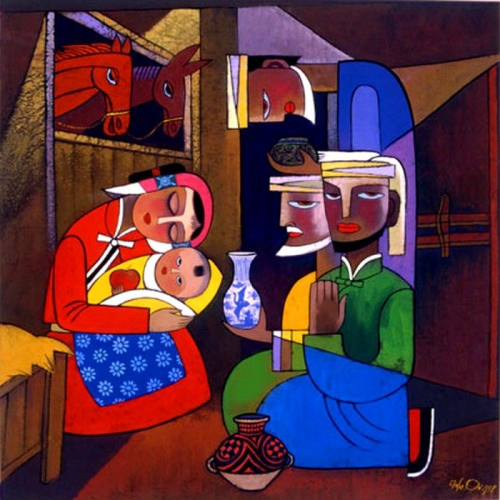
The Three Wise Men by He Qi

In the time of King Herod, after Jesus was born in Bethlehem of Judea, wise men from the East came to Jerusalem, asking, “Where is the child who has been born king of the Jews? For we observed his star at its rising and have come to pay him homage.” When King Herod heard this, he was frightened, and all Jerusalem with him; and calling together all the chief priests and scribes of the people, he inquired of them where the Messiah was to be born. They told him, “In Bethlehem of Judea; for so it has been written by the prophet:

‘And you, Bethlehem, in the land of Judah,
    are by no means least among the rulers of Judah;
for from you shall come a ruler
    who is to shepherd my people Israel.’”

Then Herod secretly called for the wise men and learned from them the exact time when the star had appeared. Then he sent them to Bethlehem, saying, “Go and search diligently for the child; and when you have found him, bring me word so that I may also go and pay him homage.” When they had heard the king, they set out; and there, ahead of them, went the star that they had seen at its rising, until it stopped over the place where the child was. When they saw that the star had stopped, they were overwhelmed with joy. On entering the house, they saw the child with Mary his mother; and they knelt down and paid him homage. Then, opening their treasure chests, they offered him gifts of gold, frankincense, and myrrh. And having been warned in a dream not to return to Herod, they left for their own country by another road. (New Revised Standard Version)

“Truth, by which the world is held together, has sprung from the earth, in order to be carried in a woman’s arms.”

St. Augustine

Each year on January 6 in the Church Calendar, after the twelve days of Christmas, is the celebration of Epiphany. Christ’s coming to this earth as a child and becoming like us is much more than a baby in a manger.  Epiphany helps to bring a vision and understanding of God’s glory to all kinds of people of the world.

Epiphany means “manifestation” or “appearance.”

The event associated with this season is the visit of the Magi to Jesus. The season of Epiphany has a special emphasis on the teaching and healing ministry of Jesus. The great celebration and focus of these weeks is that salvation is not limited to Israel but extends to the Gentiles, as well.

Every season in the Christian Year has its unique angle of grace. With Epiphany, we see that one of the most scandalous truths of Christianity is that God graces common ordinary people who seem far from God with the gift of Jesus. 

God grants repentance that leads to life for all kinds of people no matter their race, ethnicity, gender, class, or background. It is a wondrous and astounding spiritual truth that God’s gracious concern is not limited to a certain type of person or a particular group of people.

Grace is and ought to be the guiding factor in how we interact with people. 

Losing sight of grace leads to being critical and defensive. Like King Herod of old, a graceless person becomes enamored with earthly power and control. But embracing grace leads to the humility of seeing the image of God in people quite different from ourselves. 

Like the Apostle Peter, who learned in a vision to bring the gospel to non-Jews, old legalisms begin to wear away so that people from all walks of life can have access to Jesus and his gracious saving and healing ministry. (Acts 10-11:18)

Grace brings down barriers and causes us to do away with unnecessary distinctions between others. Our appropriate response to such a grace is to glorify God for his marvelous and amazing work.

It is a merciful reality that the Magi, or Wise Men, pagan astrologers, were directed to the Messiah. A light was provided to lead them to Jesus. Apart from God’s care and intervention they would have remained in darkness. 

Adoration of the Magi by He Qi

It is still true for people today. This old broken world is wrapped in darkness. All kinds of people have no light at the end of the tunnel of their lives for hope and new life. The gospel of Jesus Christ brings that light to those unable to see. Jesus, in his teaching ministry, exhorted his followers not to hide their light but to let it shine for all to see. (Matthew 5:14-16)

Sometimes, maybe oftentimes, the best way to bring resolution to our own troubles and problems is through helping others make sense of their lives through the gracious light of Christ. Then, they can see an appearance, an epiphany, of what their lives could be in the gracious rule of the kingdom of God. 

As we celebrate Epiphany and journey with Jesus through his earthly upbringing and into his gracious ministry to people, let us keep vigilance to not let our light grow dim. Instead, let us hunger and thirst after Christ’s righteousness so that our joy is full, and our light is bright.

God of mercy, Lord of all, you have gifted the Church through the goodness of your grace to be your hands and do your work, to be your voice and share your words, to bring healing to broken lives. You have graciously gifted your people with the blessings of your Spirit, the power to transform lives and make all things new.

Now may our hearts receive, our mouths proclaim, our hands prepare for compassionate service so that the love we have may overflow into the hearts of others. May they receive your grace, your renewing Spirit, and your love, through Jesus Christ our Savior. Amen.

Luke 1:46b-55 – Mary’s Magnificat

Mary’s Magnificat by Br. Mickey McGrath

Mary responded,

“Oh, how my soul praises the Lord.
    How my spirit rejoices in God my Savior!
For he took notice of his lowly servant girl,
    and from now on all generations will call me blessed.
For the Mighty One is holy,
    and he has done great things for me.
He shows mercy from generation to generation
    to all who fear him.
His mighty arm has done tremendous things!
    He has scattered the proud and haughty ones.
He has brought down princes from their thrones
    and exalted the humble.
He has filled the hungry with good things
    and sent the rich away with empty hands.
He has helped his servant Israel
    and remembered to be merciful.
For he made this promise to our ancestors,
    to Abraham and his children forever.” (New Living Translation)

Mary’s great song of praise grasps the reality of being pregnant with the Messiah. Mary affirmed that the all-powerful God “has done great things for me.” Indeed, the Lord shows mercy to everyone who worships and adores such mighty acts.

It strikes me that Mary, instead of being full of worry and afraid of the future, and as an unmarried teen with child, is full of the Spirit and faith. Mary neither complained nor fretted for the nine months of her pregnancy; she praised God and was clear-headed about the grace shown to her.

Mary’s canticle gives us insight into the mystery of the incarnation: God chooses the weak, those of low esteem, and the powerless.

Mary was rather ordinary. She had no wealth. She possessed nothing which would cause anyone to pick her out of a crowd. Yet, she is the one chosen by God. And her wonderful response to grace demonstrated that there is so much more to any person than what we can see with our eyes and perceive through our earthly glasses of high positions and strength of personalities.

The mother of Jesus had the wisdom to discern that her situation typified the Lord’s egalitarian work of leveling the field. Mary’s pregnancy normalized the needs of all people. Her son, the Deliverer, would carry this understanding into his own life and ministry – declaring good news to the poor, comforting the brokenhearted, proclaiming freedom for captives, telling those who mourn that the time of the Lord’s favor has come.

God is full of grace, mercy, and power to the powerless and the needy. The Lord has our backs. Perhaps if we all, both individually and corporately, continually used our words to identify and declare the great things God has done we would realize the consistent blessing of the Lord. 

As we near the night of our Lord’s birth, take some time to reflect on the ways God has been good to you in this Advent season, and like Mary, offer praise for each act of mercy. Mary exhibited no helplessness but had her heart calibrated to detect the grace of God when it was present.

Great and mighty God, I will praise you with all my heart.  You care for me and always show mercy to those who worship you.  Fulfill all your good promises in me, and in all your people, for the sake of your Son, the Lord Jesus.  Amen.

Isaiah 12:2-6 – Grace Changes Us

The Prophet Isaiah by Marc Chagall, 1968

“Surely God is my salvation;
    I will trust and not be afraid.
The Lord, the Lord himself, is my strength and my defense;
    he has become my salvation.”
With joy you will draw water
    from the wells of salvation.

In that day you will say:

“Give praise to the Lord, proclaim his name;
    make known among the nations what he has done,
    and proclaim that his name is exalted.

Sing to the Lord, for he has done glorious things;
    let this be known to all the world.
Shout aloud and sing for joy, people of Zion,
    for great is the Holy One of Israel among you.”
(New International Version)

The large Old Testament book of Isaiah is thick with a message of judgment for both Israel and the surrounding nations. The sins of ancient Israel, seven-hundred years before the birth of Christ, were many. The primary offenses were injustice toward the needy; the have’s taking advantage of the have-not’s; and empty worship rituals toward God.

Social and spiritual corruption was rampant. God pleaded with the people through the prophets to stop doing wrong and start doing right by encouraging the oppressed and defending the powerless. (Isaiah 1:10-17)

Although God’s judgment was imminent, via the powerful Assyrian Empire, God would not annihilate the people. God promised a Righteous Branch would grow from the seemingly dead stump of Israel. A child will be born, a Messiah given. There will be hope in Israel. Heartfelt praise, and proclamation of God’s great name, will again fill the air.

For me, what is so remarkable about all this is the grace of God. The Lord made promises to Israel not based upon what they would or would not do; God made promises to the people by God’s own radically free love. This wasn’t a matter of playing Let’s Make a Deal with God saying, “If you get your act together, then I will be good to you.” No, before Israel even had a chance to return to the Lord, God was already choosing to be merciful.

I am absolutely convinced with the firmest conviction possible that the Scriptures of the Old and New Testaments are all about God and God’s own unbounded, unfettered, free, crazy, illogical, and wildly wonderful grace. Because God is love, the Lord constantly goes out of the way to be gracious so that we will be together and enjoy our divine/human relationship.

If we miss the message of God’s grace in the Holy Scriptures, we have missed salvation – because only grace can save us. Without grace, we are lost. Today’s Old Testament lesson is full of praise because it’s a response to the undeserved grace which God freely gives. 

Any Christian preacher worth their salt is a preacher of grace. Grace is the very thing that is distinctive about Christianity. Grace is love that seeks you out when you have nothing to give in return. Grace is recklessly generous. Grace does not use carrot sticks, scorecards, or power politics. Grace never demands – it only gives. 

Grace is unconditional acceptance given to an undeserving person by an unobligated giver. 

That is what God did for Israel… and for us. And when we get a hold of this truth, even a little bit, our hearts become bubblers of praise.

The prophecy of Isaiah is an adventure of God’s reckless love toward unlovable people, which is why it is one of the most quoted books of the Old Testament by Jesus. Jesus came because of grace. 

Jesus came to release us from our obsessive need to be right, our compulsion to be rewarded, and our demands to be respected. 

Because Jesus came to set sinful captives free, life does not have to be a joyless effort to justify and validate ourselves before others. The grace of God in Christ is a game-changer. And with but a glimpse of it, we are forever undone by its mercy.

Grace causes us to praise God.

There was once a pastor who had a three-year old daughter who was going around the house singing the chorus “We Exalt Thee” except that she kept mispronouncing one of the words: “I exhaust thee, I exhaust thee, I exhaust thee, O Lord!” Perhaps she was right. Maybe too many folks are exhausting God with folded arms instead of hands raised in praise and worship.

Grace causes us to trust God.

Grace alleviates our fears. For, if God is for us, who can be against us? God takes care of us despite our weaknesses and failures. 

Grace causes us to have joy in God.

With joy we draw water from the wells of salvation. Jesus is the Living Water we can continually draw from and drink. Grace keeps giving without an end in sight. We get to keep coming to God with an inexhaustible supply of fresh grace.

Grace causes us to give thanks to God in prayer.

Gratitude to God ought to characterize our corporate gatherings. Expressing thanks is more than for the individual in their prayer closet – it is to be offered in the gathered assembly of believers. Grace eliminates self-consciousness altogether because there is nothing to be self-conscious about with God. The Lord has seen you at your worst, and still loves you.

What’s more, we need not be self-conscious about appearing ignorant, looking silly, or not having all the answers in making known among the nations what God has done. If we are influenced by grace, then we can freely speak of God to all kinds of people we encounter. 

“God forbid that I should travel with anybody a quarter of an hour without speaking of Christ to them.”

George Whitefield (1714-1770)

Grace causes us to sing together to God. 

When grace takes hold of a congregation, there is no mumbling of songs – there are loud shouts and singing for joy because God is good! God wants some noisy worship! 

Grace brings such gladness that we don’t care how we appear to other people; we are going to shout, sing, and express our joy! Yes, there is an important place for contemplative, reverent, and reflective worship. And there is also a place for letting go, becoming unhinged, and dancing before Jesus!

The world mostly ignores God. Even some Christians take God’s grace for granted.  Israel’s greatest sin was assuming everything was fine. But it wasn’t. There was no grace. And with no grace there is no God. Eventually, Israel found joy in the most unlikely of places – in exile. God’s grace would transform a terrible time of trouble into raising of voices in song.

Isaiah’s prophecy is about returning to the Lord. The season of Advent is all about God’s relentless pursuit of wayward people – the anticipation of grace coming in the form of an infant – and the bringing of grace to a people living in darkness.

Let us, then, return to the Lord. Let us be captivated by grace. Let us renew our love for Jesus. Let us lose ourselves in praise and adoration of the One who gave everything for us. Let us worship Christ the King. Let us proclaim the name of Jesus as exalted over everything.

Great God of grace, be merciful to us as we limp to you with all of our wounds and brokenness. We have made such a mess of our lives with our bad attitudes, ugly words, selfish actions, and our ignoring of you through it all. So, we come to you with nothing but ourselves in all of our sin. Forgive us, cleanse us, renew us, revive us, refresh us, and reform us according to the ways of Jesus Christ. Thank you for your undeserved grace. We give you praise for the lengths you went to secure our forgiveness. With a joy too deep for words, we humbly offer to you our lives so that the name of Jesus will be exalted in us individually and corporately. Amen.

Amos 9:8-15 – Grace Has the Last Word

The eyes of the Lord God are upon the sinful kingdom,
    and I will destroy it from the face of the earth
    —except that I will not utterly destroy the house of Jacob,
says the Lord.

For lo, I will command,
    and shake the house of Israel among all the nations
as one shakes with a sieve,
    but no pebble shall fall to the ground.
All the sinners of my people shall die by the sword,
    who say, “Evil shall not overtake or meet us.”

On that day I will raise up
    the booth of David that is fallen,
and repair its breaches,
    and raise up its ruins,
    and rebuild it as in the days of old;
in order that they may possess the remnant of Edom
    and all the nations who are called by my name,
    says the Lord who does this.

The time is surely coming, says the Lord,
    when the one who plows shall overtake the one who reaps,
    and the treader of grapes the one who sows the seed;
the mountains shall drip sweet wine,
    and all the hills shall flow with it.
I will restore the fortunes of my people Israel,
    and they shall rebuild the ruined cities and inhabit them;
they shall plant vineyards and drink their wine,
    and they shall make gardens and eat their fruit.
I will plant them upon their land,
    and they shall never again be plucked up
    out of the land that I have given them,
says the Lord your God. (New Revised Standard Version)

Doom and hope. Judgment and grace. Suffering and glory. These are the movements and rhythms of the Old Testament prophets. 

There was injustice aplenty in ancient Israel way back in the eighth-century B.C.E. Not only were the poor and needy in the land trampled upon, but the people in power saw nothing wrong with building their wealth and status by taking advantage of the less fortunate. 

Yet, God was not okay with this state of affairs. Thus, the time was imminent when God would deal with the situation by destroying an inequitable and exclusive way of life in which the privileged enjoyed a lifestyle on the backs of the unprivileged.

The Lord clearly communicated that the people will be sent away to a place with no chance to oppress others. Death would come to many. The oppressors shall die by the sword, even though, in their arrogant inebriation of power, they actually believed disaster wouldn’t ever happen to them.

However, it did. And history shows that the prophecy of Amos came to pass. The Assyrians, a powerful people who had their own egregious sins to deal with before the Almighty, were the instruments of divine judgment upon God’s people. Israel was conquered, the people deported, and the proud oppressors became the lowly oppressed.

Even in such a terrible time for Israel as that, judgment doesn’t have the last word – grace does. God would not completely destroy forever. Restoration, renewal, and fruitful times will come as a result of God’s mercy toward a wayward people. 

The Lord spoke a promise that it will not forever be this way. Rebuilding and restoration will eventually happen. God chooses to act with mercy and demonstrate grace because that is what God does. 

We may often get the wrongheaded notion in our creaturely pea-brained heads that God executes judgment to teach people a lesson or make a point, like some capricious schoolmaster who wraps kids on the knuckles with a ruler when they act up in class. But God acts out of holiness, justice, and grace. The Lord maintains righteous decrees while showing mercy to the undeserving.  

Israel deserved only judgment, not grace. God would have been completely justified to destroy rich and powerful oppressors and never restore or renew them. Yet, be that as it may, this is not how the Lord of the universe operates. God’s grace overwhelms human sin. Grace always has the last word.

Try and understand grace and you will be befuddled. Some things just defy comprehension. Sometimes it’s just best to observe and appreciate. Grace is wildly illogical, nonsensical, and unconditionally free. Grace shows radical acceptance where there ought to be only hell.  

God’s grace is downright scandalous. Whereas we might have a stick-it-to-the-man mentality, God is much bigger than petty petulant posturing. The Lord doesn’t sit in heaven and scheme clever ways to irritate sinners and put them in their place, like some belligerent divine bully.

Rather the Lord of all continually conspires within perfect Love how to guide folks mercifully and gently to Truth – utilizing incredibly diverse tools of divine kindness to woo people to the source of amazing grace.

The height of grace, the pinnacle of restoring the fortunes of Israel, came through a baby, by a humble birth in the small village of Bethlehem. 

Jesus came to save the people from their sins. God acted by entering humanity with free divine love so that there could be new life and fresh hope. Therefore, let grace wash you clean. Allow mercy to renew your life. Let worship of the newborn king shape your season and the New Year.

Gracious God, although you are careful to uphold your great holiness, your mercy extends from everlasting to everlasting. May the gospel of grace form all of my words and actions so that true righteousness reigns in my life through Jesus, your Son, my Lord, who with you and the Holy Spirit are one God, now and forever. Amen.