Be Merciful (Jonah 4:1-11)

Jonah was really upset and angry. So he prayed:

Our Lord, I knew from the very beginning that you wouldn’t destroy Nineveh. That’s why I left my own country and headed for Spain. You are a kind and merciful God, and you are very patient. You always show love, and you don’t like to punish anyone.

Now let me die! I’d be better off dead.

The Lord replied, “What right do you have to be angry?”

Jonah then left through the east gate of the city and made a shelter to protect himself from the sun. He sat under the shelter, waiting to see what would happen to Nineveh.

The Lord made a vine grow up to shade Jonah’s head and protect him from the sun. Jonah was very happy to have the vine, but early the next morning the Lord sent a worm to chew on the vine, and the vine dried up. During the day the Lord sent a scorching wind, and the sun beat down on Jonah’s head, making him feel faint. Jonah was ready to die, and he shouted, “I wish I were dead!”

But the Lord asked, “Jonah, do you have the right to be angry about the vine?”

“Yes, I do,” he answered, “and I’m angry enough to die.”

But the Lord said:

You are concerned about a vine that you did not plant or take care of, a vine that grew up in one night and died the next. In that city of Nineveh there are more than 120,000 people who cannot tell right from wrong, and many cattle are also there. Don’t you think I should be concerned about that big city? (Contemporary English Version)

Fear and anger go hand in hand. The fear of what sort of evil might happen often leads a person toward angry vitriol, even violence.

I once dealt with a woman who was so upset with her husband that she was literally shaking with anger. There was a time when her husband had been abusive, but thankfully, he gave his life to God, changed, and became a loving person. 

The thing that was so upsetting for the wife is that God saved her husband without punishing him for all the abuse he had dished out. She wanted some divine payback! The woman was actually furious about God showing grace and compassion.

This is not a novel or new experience. In the ancient world, the Assyrians were notorious for their brutality toward conquered peoples. They thought up forms of torture as a creative past-time. It was a violent culture, full of inhumane practices, and soldiers who were the scourge of the Middle East.

The violent ways of the Assyrians caught the notice of God. Divine judgment was hanging over the capital of the Assyrian Empire, Nineveh. So, God told the prophet Jonah to go and give the powerful empire a message of impending doom. (Jonah 1:2)

Jonah did not immediately obey God. However, he eventually went to Nineveh (after the infamous being in the belly of a great fish for three days and nights). The result was a great repentance of sin from the Assyrian people. 

The entire city turned from their evil ways. God saw this mass repentance and relented from sending disaster. Instead of destroying the city, with all its inhabitants and animals, the Lord was merciful and spared them. After all, God delights in seeing humility and the courage to admit evil and turn from it.

But Jonah had a serious problem with God’s grace toward the Assyrians. He was so upset and angry about the whole affair, that he wanted to die. Jonah was actually annoyed and greatly displeased by God’s goodness. Jonah wanted justice; he was looking for judgment. The last thing he wanted was divine mercy toward the very people who were experts at killing Jews. 

Yet, we must come to grips with the reality that God’s grace is so massive that it even extends to some of the most evil people in history. And Jonah wanted no part of that sort of theology.

God asked Jonah twice, “Do you have a right to be angry?” Jonah wanted destruction and pay-back for all the sin of the Assyrians. But God searches our hearts and exposes our expectations. Often, when those expectations do not happen, we are disappointed and become angry, even livid over the lack of retribution from God.

God wanted Jonah to share the same heart of mercy. And God still desires God’s people to have a heart that has grace and compassion, even in the face of terrible evil. Sometimes, God calls us to do what we least want to do in order to reveal what is really in our own hearts.  

Hating people to the point of wanting nothing but destruction upon them does nothing to bring about the righteous life that God desires. In Christian understandings, the blood of Jesus Christ has the power to bring healing and hope, even to the worst of sinners.

Whenever our fears turn to anger and we believe that God should bomb evil people off the face of the earth… or if we think our neighbors might be harboring ill-intent just because they are of a different race, ethnicity, or religion… or if we harbor bitterness because of real evil present in this world and want at least a little payback; then, we are no better than Jonah.

We end up looking just as ridiculous as Jonah, sitting at the edge of the city, pouting like a little kid.

Let’s grow up and rise above the current rancor that exists in so many places. Be concerned for the billions of people on this earth who need a merciful divine intervention and the grace of repentance that leads to new life. 

Pray for your enemies. Do good works for those who oppose you. Gain a bigger for the nations of the world. Remember what is really important in life. 

Any fool can rant and rave with anger against another; but the wise and gracious follower of God patiently and carefully prays and acts in ways that brings mercy and grace to others.

Merciful God, your presence of love in this world is truly amazing. Despite the real existence of evil on this earth, your grace cuts through it all and has the last word. Work in my life in such a way that fear is done away with and sinful anger vanishes, to be replaced with the love of Jesus Christ. Amen.

Jesus Is Better (Hebrews 8:1-7)

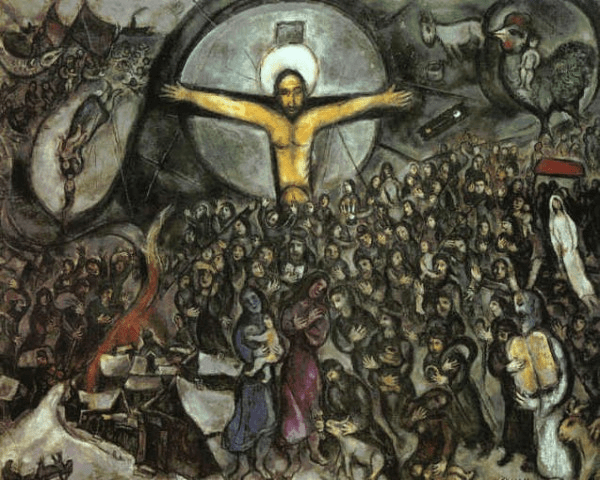
Exodus by Marc Chagall, 1952

Now the main point of what we are saying is this: We do have such a high priest, who sat down at the right hand of the throne of the Majesty in heaven, and who serves in the sanctuary, the true tabernacle set up by the Lord, not by a mere human being.

Every high priest is appointed to offer both gifts and sacrifices, and so it was necessary for this one also to have something to offer. If he were on earth, he would not be a priest, for there are already priests who offer the gifts prescribed by the law. They serve at a sanctuary that is a copy and shadow of what is in heaven. This is why Moses was warned when he was about to build the tabernacle: “See to it that you make everything according to the pattern shown you on the mountain.” But in fact the ministry Jesus has received is as superior to theirs as the covenant of which he is mediator is superior to the old one, since the new covenant is established on better promises.

For if there had been nothing wrong with that first covenant, no place would have been sought for another. (New International Version)

Jesus Christ is superior to everyone and everything – that is the overarching theme of the New Testament book of Hebrews. Jesus is above the angels, over Moses, and the great high priest of a new covenant. In Christ, the sin issue has been taken care of, once and for all.

Through Jesus, every good promise of God is fulfilled. Christ’s priesthood and intercessory ministry is permanent. His sacrifice for sin is thorough and complete. Jesus lives forever. He saves completely. Christ meets our need. He has been made perfect forever. (Hebrews 7:23-28). 

Frankly, these bold statements from the author of Hebrews are some audacious claims. In fact, they’re downright radical. And yet, say any of those statements in the typical church, and hardly an eyebrow gets raised – they almost seem ho-hum. Our blank affect testifies that we have lost a great deal of the original force and impact of Christianity.

In the first century, to have one sacrifice to end all sacrifices was unthinkable. Every ancient person understood that sacrifices were temporary; you had to keep offering them over and over again. 

Christianity, however, asked the world to have a new understanding of sacrifice. No longer would there be any sacrifice – no grain sacrifice; no offerings of first fruits; no animal sacrifices; no sacrifices, period. There was no longer any need for them because Jesus himself is the sacrifice to end all sacrifices. 

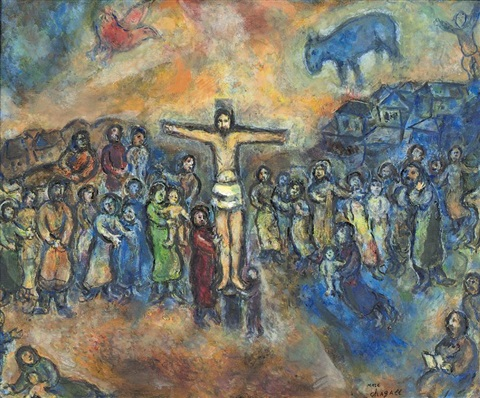
Crucifixion by Marc Chagall, 1966

This was such a ridiculous notion for so many people that they mocked Christians for it. Both Jews and pagans could barely wrap their minds around such a progressive idea. It would be like saying to us today that there is no longer any need for money because somebody just became the underwriter for everything everybody does.

Despite this incredible spiritual reality, we in the contemporary church sometimes go back to the old sacrificial system, not by physically offering animal sacrifices, but treating Christ’s finished work as if it were just too good to be true. 

We reason that we need to do something to help save ourselves. However, Jesus has not just saved us partially, but fully. Grace has always been scandalous, and so, we try to tone it down a bit, mitigate it’s actual force:

  • Church attendance can subtly be looked upon as a sacrifice to appease God, as if he needed to be soothed into not becoming angry at us. 
  • Giving can become a non-bloody sacrifice that is meant to satisfy God’s furrowed brow against us. 
  • Service can degenerate into a sacrifice to assuage our guilty conscience. 

In all these kinds of instances, and more, we go back to an old sacrificial system that is obsolete. Nonetheless, the biblical and theological truth is that Jesus has thoroughly saved us from our sin, and, so, has cleansed us from all guilt, including a guilty conscience. 

Jesus meets our need and has completely satisfied God’s wrath against the power and deceit of sin. 

Jesus is our mediator and intercedes for us as we come to God’s throne of grace. That means we do not need to try and get God’s attention with performing spiritual cartwheels or some incredible sacrifice that will somehow obligate him to take notice of us. That’s because there is never a time in which we lack attention from God.

Since we have been justified by faith in Jesus, we need not worry anymore about being good enough. Since Jesus is perfect, his work is made complete in us. A constant anxiety of feeling like we don’t measure-up does not come from God. Jesus is sufficient and has taken our place so that we can live in the freedom and joy of a complete deliverance from sin, death, and hell. There is no longer any necessary sacrifice to make!

“Well,” I have been told by some, “if everybody in the church believed that then nobody would ever do anything!” No, it is just the opposite. When we feel like we don’t measure up, we do less, not more. A low level discouragement sets in and we do nothing because we intuitively know it will never be enough. We do just enough to squeak by, never quite knowing if it is doing anything. 

In such a state, we may consider giving up because Christianity doesn’t work for us (which was the state of the believers in the book of Hebrews). But when we grasp the New Covenant of Christ’s sacrifice to end all sacrifices, and are overwhelmed by grace, then everything we do in the Christian life is a “thank you” with our life and our lips. 

It is the grace, and not the wrath, of God that teaches us to say “no” to ungodliness and worldly passions and to live upright and godly lives (Titus 2:11-12).

We are justified and made right by faith in Jesus Christ, and not by our own accomplishments, pedigree, or effort.  Trusting in our heritage, relying on our family’s faith, or believing our hard work gives us a leg-up toward heaven will only end in despair. 

But if we trust in Christ’s perfect sacrifice, then a whole new world of mercy opens before us. Because the grace of God in Christ is superior to everything.

Soli Deo Gloria

On Divorce (Matthew 19:1-12)

When Jesus had finished saying these things, he left Galilee and went into the region of Judea to the other side of the Jordan. Large crowds followed him, and he healed them there.

Some Pharisees came to him to test him. They asked, “Is it lawful for a man to divorce his wife for any and every reason?”

“Haven’t you read,” he replied, “that at the beginning the Creator ‘made them male and female,’and said, ‘For this reason a man will leave his father and mother and be united to his wife, and the two will become one flesh’? So they are no longer two, but one flesh. Therefore what God has joined together, let no one separate.”

“Why then,” they asked, “did Moses command that a man give his wife a certificate of divorce and send her away?”

Jesus replied, “Moses permitted you to divorce your wives because your hearts were hard. But it was not this way from the beginning. I tell you that anyone who divorces his wife, except for sexual immorality, and marries another woman commits adultery.”

The disciples said to him, “If this is the situation between a husband and wife, it is better not to marry.”

Jesus replied, “Not everyone can accept this word, but only those to whom it has been given. For there are eunuchs who were born that way, and there are eunuchs who have been made eunuchs by others—and there are those who choose to live like eunuchs for the sake of the kingdom of heaven. The one who can accept this should accept it.” (New International Version)

It’s interesting that the compilers of the Revised Common Lectionary chose this Gospel lesson the day after Valentine’s Day. Not sure I would do that, but here we are, so let’s deal with it….

I grew up in an era in which not many couples divorced. Frankly, that probably was a bad thing, because there was plenty of hanky-panky going on, and far too much domestic violence that didn’t get dealt with. Women, mostly, tended to put up with an awful lot from abusive men.

Today, of course, divorce is common. And that’s probably a bad thing, too. A whole lot of couples aren’t working through their communication issues – and that’s because many individual persons have done precious little in addressing their own background experiences of trauma and/or abuse.

In short, divorce is not the ideal – but it’s necessary. And Jesus understood this more than most people of his day. It isn’t supposed to be this way, all this interpersonal crud, heartache, and pain. Yet here we are, having to navigate broken relationships, busted marriages, and bewildered children.

No married couple, on their wedding day, anticipates a divorce in their future. Nobody anticipates having a debilitating illness or to be locked into poverty. Instead, we are optimistic, believing that we’ll fall more on the side of better than worse, richer than poorer, healthier than sick, and cherishing the other more than irked by them.

As of this writing, my dear wife and I have been married nearly 38 years. A lot of blood, sweat, and tears have gone into being together for all that time. We have weathered many experiences with one another. Yet, I’m under no illusions; there’s nothing particularly special about me or my spouse. There are plenty of couples who have put in as much work as we have, and their marriages still dissolved in an ocean of disappointment.

I’d like to think I am not speaking as one above others, but as a fellow guy just trying to do his best with what he currently knows – and grateful that I have a partner and friend who sticks with me and lives life alongside me.

The last thing any divorced folks need is a bunch of condescending gobbledygook from a pious simpleton who likely doesn’t have a clue about what’s going on.

God heals the brokenhearted
    and bandages their wounds.

Psalm 147:3, CEB

The truth is that we all need to continually come back to what Jesus encouraged us to do: Avoid hardness of heart, embrace humility, and seek oneness and unity above all else. A marriage that has two people living under the same roof like roommates, isn’t really a marriage, at all; they may have the legal document to prove it, but they don’t have the relational practices to back it up.

Divorce is a major change of life. Put that together with the reality that life is always progressing and never stays the same, we all undergo many new beginnings throughout the course of our lives. 

Thankfully, there is another reality that will forever stay the same: You were created in the image of God, both male and female, and that divine likeness can never be taken from you. Wherever you go, whatever you do, God is with us. One is never outside the Lord’s reach.

The self-righteous person who belittles any and all divorcees is unaware that even God has experienced divorce and knows precisely what it feels like:

I [God] gave faithless Israel her certificate of divorce and sent her away because of all her adulteries. Yet I saw that her unfaithful sister Judah had no fear; she also went out and committed adultery. Because Israel’s immorality mattered so little to her, she defiled the land and committed adultery with stone and wood. (Jeremiah 3:8-9, NIV)

Perhaps your frame of mind right now is that you can barely see beyond today and cannot even imagine what will happen tomorrow. No matter the circumstance, regardless of who you are, where you have been, or where you are going, there is a God who exists on heaven and earth who completely knows and understands your situation. 

And the Lord stands ready to help you begin again and start something new.

Where hearts are broken, grant your healing.
Where trust is eroded, restore good faith.
Where bitterness has taken root, plant seeds of forgiveness.
Do not let anger destroy us, O God,
but teach us to love as Christ loved us. Amen.

Get a Different Perspective (Isaiah 29:1-12)

Woe to you, Ariel, Ariel,
    the city where David settled!
Add year to year
    and let your cycle of festivals go on.
Yet I will besiege Ariel;
    she will mourn and lament,
    she will be to me like an altar hearth.
I will encamp against you on all sides;
    I will encircle you with towers
    and set up my siege works against you.
Brought low, you will speak from the ground;
    your speech will mumble out of the dust.
Your voice will come ghostlike from the earth;
    out of the dust your speech will whisper.

But your many enemies will become like fine dust,
    the ruthless hordes like blown chaff.
Suddenly, in an instant,
    the Lord Almighty will come
with thunder and earthquake and great noise,
    with windstorm and tempest and flames of a devouring fire.
Then the hordes of all the nations that fight against Ariel,
    that attack her and her fortress and besiege her,
will be as it is with a dream,
    with a vision in the night—
as when a hungry person dreams of eating,
    but awakens hungry still;
as when a thirsty person dreams of drinking,
    but awakens faint and thirsty still.
So will it be with the hordes of all the nations
    that fight against Mount Zion.

Be stunned and amazed,
    blind yourselves and be sightless;
be drunk, but not from wine,
    stagger, but not from beer.
The Lord has brought over you a deep sleep:
    He has sealed your eyes (the prophets);
    he has covered your heads (the seers).

For you this whole vision is nothing but words sealed in a scroll. And if you give the scroll to someone who can read, and say, “Read this, please,” they will answer, “I can’t; it is sealed.” Or if you give the scroll to someone who cannot read, and say, “Read this, please,” they will answer, “I don’t know how to read.” (New International Version)

Reading the Bible may sometimes feel like a weird Catch-22. We’re supposed to read, observe, and obey the contents of Holy Scripture; yet there is so much within it that we often just plain don’t understand – and even are not going to understand, at least on this side of heaven.

For many people, this is maddening. It may even cause them to throw up their hands and say that God is some mad scientist who merely tinkers and experiments with people like mice in laboratory.

I understand how some could think that way. The Lord comes along and does a mysterious dance of proclaiming judgment, then pivoting quickly around to assure deliverance. Reading through any prophetic book of the Old Testament is likely to make our heads spin with questions and our hearts to reel. No matter how you slice it, there are a lot of difficult passages in Holy Scripture.

So, I invite you to take a few differing perspectives.

First, if God is a Being who is infinitely higher and greater – the Creator who has made all things – then we are the creatures who are neither privy to all God’s reasonings nor even able to understand such a Being who is other than us.

Second, it seems we rarely even attempt to try and see things from God’s angle. We see our own situations, many of them confusing, and we wonder why the Lord doesn’t just step in and fix all the crud. However, none of us has the full picture, as God does – which is why we are continually invited to pray for wisdom, to see our life, relationships, and circumstances from a divine perspective. (James 1:2-5)

The prophet Isaiah, along with the other prophets, proclaims a double message of judgment and deliverance. Indeed, it appears there is a continual rhythm of identifying guilt and giving grace throughout a large chunk of the Old Testament.

And that is perhaps where we need to pay attention. People have a great predilection for saying and doing things (or failing to say and do things) which bring guilt. Our guilty actions and inactions are not okay; they cannot simply be dismissed as stuff that people do, as if we were just silly folks who don’t know any better.

Maybe we would like to view God as some geriatric grandfather who lets everyone do what they want, but that’s not the God we get in the Bible.

No, our words and actions have real impact and consequences for others. And the Lord is a real force to contend with, for whom we cannot escape nor ignore for long.

In Isaiah’s day, the people were called to account for their abject callousness toward their fellow humanity. God’s commands all have to do with living in harmony with creation. Chaos, disorder, and systemic evil result whenever the creature rebels against the Creator by trying to be a little god of their own making – taking the perspective of using people rather than serving them.

The Lord will have none of it; God will intervene. Hence, the judgment portions of Scripture. Yet, because God is gracious and loving, the judgment doesn’t last forever; mercy takes hold and overwhelms the guilty sinner.

If we could understand everything God does or doesn’t do, then God wouldn’t be God. But the very fact that God is mysterious, and in some ways unknowable, tells us that there is indeed a God.

Our task is not to take over God’s job because the Lord isn’t doing what we want. Our mandate is to reflect the image of God placed within us by loving the Lord and loving our neighbor as ourselves.

Yes, we are all guilty of a great many things. Yet, grace always has the last word, and not judgment. This, then, gives way to a life of gratitude that has learned to sync one’s heart with the heart of God.

Catch-22’s are certainly maddening… if we are truly in one to begin with. It could be that we just haven’t yet gained a different perspective on our situation, learned to accept it, and made the choice to live in harmony with the world as it is, rather than the world as we think it ought to be.

Most merciful God, we confess that we have sinned against you in thought, word, and deed, by what we have done, and by what we have left undone. We have not loved you with our whole heart; we have not loved our neighbors as ourselves. We are truly sorry and we humbly repent. For the sake of your Son Jesus Christ, have mercy on us and forgive us; that we may delight in your will, and walk in your ways, to the glory of your Name. Amen.