Impatience and Grumbling Are Poisonous (Numbers 21:4-9)

Moses and the Serpent on the Rod

The Israelites left Mount Hor and went on the road toward the Red Sea, in order to go around the country of Edom. But the people became impatient on the way and grumbled at God and Moses. They said, “Why did you bring us out of Egypt to die in this desert? There is no bread and no water, and we hate this terrible food!”

So the Lord sent them poisonous snakes; they bit the people, and many of the Israelites died. The people came to Moses and said, “We sinned when we grumbled at you and the Lord. Pray that the Lord will take away these snakes.” So Moses prayed for the people.

The Lord said to Moses, “Make a bronze snake, and put it on a pole. When anyone who is bitten looks at it, that person will live.” So Moses made a bronze snake and put it on a pole. Then when a snake bit anyone, that person looked at the bronze snake and lived. (New Century Version)

Impatience and irritability. Grumbling and complaining. Show me a person with ants-in-their-pants and I will show you a person who bellyaches and squawks like an old chicken. The antsy person sticks their hand in the glove of criticism, loudly griping about missed expectations for all to hear. Little do they realize that venomous snakes are slithering toward them, attracted by the continual vibrations of complaint.

The ancient Israelites were miraculously delivered from Egyptian bondage by the mighty hand of God. But the celebration soon turned sour. Millions of people were out in the desert, discovering they had no food or water.

There is no account of the people using their spiritual connection with God to ask for help. Instead, their reflexive response was to grumble against God and God’s appointed leader Moses.

God had enough of their constant complaints. The Lord had repeatedly shown mercy and committed love to the people over-and-over again. Yet, they kept putting on their grumpy faces any time something didn’t go their way.

God kept showing patience toward the people, but the people kept demonstrating impatience toward God.

A mosaic of the serpent in the desert in All Saints Church, London, England, by Matthew Digby Wyatt (1820-1877)

If you stop and think about the pathology of our own impatience and complaining (which we all do – come on, admit it) you’ll likely discover that at the heart of it all is a picture in your mind of how you think circumstances ought to go for you to be happy. 

The Israelites expected a nice clean break from Egypt with a smooth transition into the Promised Land. They didn’t sign up for hard circumstances and a bunch of adversity and trouble getting there.

We aren’t so different. Believers go to faith gatherings expecting to be fed and encouraged. Students expect that school will be enjoyable and that they’ll get a good paying job after graduation. Employees expect to go to work and have healthy working relationships and a good boss. Parents expect their kids to listen and obey. You expect your friend or spouse to give you focused attention, the weather to be better, the drivers on the road to be respectful, the little plastic things on the end of your shoelaces to last for the life of your shoes….

And it doesn’t happen, or at least fails to go as planned. So, what happens when all those expectations aren’t realized? 

In a perfect world, we would always respond in a reasoned, wise, and healthy manner. But if we’re feeling like we’re in an emotional place of insecurity out in the desert, our response is more likely to be an impatient and complaint-filled litany about how things are all screwed up.

A great deal of disobedience, bad behavior, angry speech, and poor decision-making has its origins in impatience.

The minute you become impatient, take a long deep breath before you make your next mental decision. Check-in with yourself. Be mindful of what your real expectations are for the circumstance or person in the present moment of becoming upset. Make the decision, from the very beginning, not to complain or argue. Instead, choose to say what you want without grumbling.

It is truly possible to stand for holiness, live for righteousness, and uphold the words and ways of Jesus without being a jerk about it through impatient sighs, annoying facial expressions, and terse words of carping at another person who is made in God’s image.

Monitor yourself throughout the day today. Notice the times you become annoyed. Stop and take a minute to analyze what you are expecting to unfold throughout the day. Instead of grumbling, ask God to strengthen your faith through your upcoming events and encounters. 

God is there to help you, and not to pick on you. If you find yourself having made a poor decision and are suffering the consequences of it, the way of dealing with it isn’t to avoid it. One of the reasons God instructed Moses to make a snake is to clearly demonstrate to the people that they must go through their problems and not try and get around them.

Fortunately, in Christianity, Jesus becomes our bronze snake of deliverance:

In the same way that Moses lifted the serpent in the desert so people could have something to see and then believe, it is necessary for the Son of Man to be lifted up—and everyone who looks up to him, trusting and expectant, will gain a real life, eternal life. (John 3:14-15, MSG)

Holy God, your patience is incredible in the face of human impatience. Yet, your boundaries are firm, and you will not put up with our petulant ways forever. Help me to live into the model of your Son, the Lord Jesus, who with you and the Holy Spirit are attentive to come alongside me to your own glory and honor. Amen.

Learn to Live Well (Micah 7:18-20)

The Prophet Micah exhorting the Israelites to repent by Gustave Doré (1832-1883)

Who is a God like you, pardoning iniquity
    and passing over the transgression
    of the remnant of his possession?
He does not retain his anger forever
    because he delights in showing steadfast love.
He will again have compassion upon us;
    he will tread our iniquities under foot.
You will cast all our sins
    into the depths of the sea.
You will show faithfulness to Jacob
    and steadfast love to Abraham,
as you have sworn to our ancestors
    from the days of old. (New Revised Standard Version)

In a world obsessed with constant and rapid change, it is refreshing to know that there is a God whose essential character, attributes, and way of being in the world never changes.

The Lord is a God who is faithful, always keeping divine promises to people. God is pleased to show steadfast love and kindness through extending forgiveness. And because the Lord values pardoning human transgressions, God always looks sin square in the eye – not ever sugarcoating iniquities – and puts it down like a rabid animal.

In the prophet Micah’s day, the social and communal sins of the people were legion, leading to a great deal of injustice. Wealthy landowners creatively and unjustly seized property in order to feed their continual greed for more; false prophets went about preaching a positive future of peace, even though the poor became poorer through no fault of their own; and the nation’s leaders abused their power by fleecing the people of what little they had to begin with.

In short, dishonest business practices, dressed up by leadership as the path to prosperity, stirred up the just and right indignation of God. An assurance of pardon comes, yet only after there is confession of sin.

In this present contemporary era, we have our own legion of social sins which must be identified, confronted, confessed, expiated, and replaced with virtues that foster life and happiness.

Today’s way of doing business – whether in the corporate world and even in many faith communities – is to embrace an unholy ethic of more, faster, and better.

“Wait,” you may push back, “that doesn’t sound to me like anything bad.” And I would respond by saying that this is evidence of how far into our sin we have become, that we cannot distinguish our unjust practices from legitimate just practices.

Behind many contemporary business “ethics” are compulsions to beat the competition at all cost, obsessions with more money, and a lust for power and control. These are not practices helping people to live well.

More

In ancient Egypt, Pharaoh’s massive industrial complex was built on more – more pyramids and buildings, more wealth, more power and influence. Behind the “more” is usually old-fashioned greed. We want more market share, more numbers, more options and opportunities, more control.

Yet, what if the people doing the “more” are already tired, weary, and have given what they can? Like the Israelite slaves in Egypt, making more bricks translated to more wealth. And if it takes a literal whip to make them do more, then so be it.

Many modern workers put up with the “more” mantra only because they need their jobs and fear losing them if they don’t keep a ridiculously high level of production. And if anybody complains about it, they immediately get labeled (by the people in power) as not being grateful.

Faster

I once worked a job where a manager would occasionally and literally stand over my shoulder and time me with a stopwatch… sheesh… and I worked another job in which there was a quota for every day; we had to keep pace because production was king.

You don’t need to be in a factory for the clock to be the taskmaster. I don’t know of anyone who is hounded by a boss about time to experience contentment, peace, and rest. Speeding up to meet a quota or deadline only promises to create the necessity for more change, done faster.

None of this makes for a good life; and I would argue that it doesn’t make for good business either. It only produces empty and vacuous people who sacrifice themselves on the altar of work.

We are finite creatures with finite time and resources. We are not inanimate machines without a soul.

Better

One of the manifestations of valuing speed and productivity is also expecting fewer mistakes – because imperfection slows the wheels of progress. This is where people begin to be treated like machines instead of humans. And they become expendable; if they don’t do better, they get replaced with someone else.

Furthermore, this push to do better is often why workers are told to keep their problems at home and not bring them to the job. This has had a terrible impact on individuals, their families, and their relationships.

Forced compartmentalization has the effect of breaking down integrity and creating disparities. People’s very normal struggles cannot be shared with anyone but a professional counselor, therapist, or pastor. Their feelings and emotions become privatized.

Giving someone a list of resources might make management feel better, but it does little to actually help a grieving person who is right under their nose. Depression sets in because the person’s experience and emotions have been implicitly invalidated, leaving them with a sense that they’re meaningless and are a burden on others.

More, faster, and better – continually pumped into society’s bloodstream – is only making the world anxious, depressed, and with no energy to keep being yourself, that is, if you even know who you are anymore after such a pace of work.

What If?

Instead of more, faster, better, what if we…

  1. Embrace an unforced rhythm of life which recognizes the values of slowness, simplicity, and satisfaction?

2. Ask people to be themselves, to live life at a pace that’s doable and enjoyable?

3. Expect workers and people everywhere are to rest and adopt Christ’s easy yoke?

4. Take up the mantle as God’s people to be a counter-cultural movement of relationships which emphasize grace, love, mercy, patience, peace, joy, and spiritual support?

5. Put our energies into the careful construction of souls, instead of draining the spirits of people through unrealistic expectations?

6. Sought to live a simple life, without the need for more?

7. Learn to be satisfied with what we already have?

8. Rid ourselves of financial language to communicate with one another? (e.g. “invest in eternity,” “be an asset, not a liability,” “pay your debt to society,” etc.)

For the Christian, transformation isn’t dependent upon praying more, reading more, giving more, or serving more. Spiritual growth isn’t realized overnight; it takes time, in fact, a lifetime. And change isn’t about trying to be better, since our identity is already firmly in Christ.

My friends, you and I are enough. Transformation of life is the result of becoming open and receiving the grace of God in Christ. If we want forgiveness, we must face the sin of our world in all of its deceit, degradation, and damage.

Let’s not find ourselves on the other end of God’s ire because of unsound practices which dehumanize others. But let us accept and adopt rhythms of life that are consistent with being human and caring for others. That’s what the prophet Micah was looking for.

May it be so, to the glory of God.

Be Merciful (Jonah 4:1-11)

Jonah was really upset and angry. So he prayed:

Our Lord, I knew from the very beginning that you wouldn’t destroy Nineveh. That’s why I left my own country and headed for Spain. You are a kind and merciful God, and you are very patient. You always show love, and you don’t like to punish anyone.

Now let me die! I’d be better off dead.

The Lord replied, “What right do you have to be angry?”

Jonah then left through the east gate of the city and made a shelter to protect himself from the sun. He sat under the shelter, waiting to see what would happen to Nineveh.

The Lord made a vine grow up to shade Jonah’s head and protect him from the sun. Jonah was very happy to have the vine, but early the next morning the Lord sent a worm to chew on the vine, and the vine dried up. During the day the Lord sent a scorching wind, and the sun beat down on Jonah’s head, making him feel faint. Jonah was ready to die, and he shouted, “I wish I were dead!”

But the Lord asked, “Jonah, do you have the right to be angry about the vine?”

“Yes, I do,” he answered, “and I’m angry enough to die.”

But the Lord said:

You are concerned about a vine that you did not plant or take care of, a vine that grew up in one night and died the next. In that city of Nineveh there are more than 120,000 people who cannot tell right from wrong, and many cattle are also there. Don’t you think I should be concerned about that big city? (Contemporary English Version)

Fear and anger go hand in hand. The fear of what sort of evil might happen often leads a person toward angry vitriol, even violence.

I once dealt with a woman who was so upset with her husband that she was literally shaking with anger. There was a time when her husband had been abusive, but thankfully, he gave his life to God, changed, and became a loving person. 

The thing that was so upsetting for the wife is that God saved her husband without punishing him for all the abuse he had dished out. She wanted some divine payback! The woman was actually furious about God showing grace and compassion.

This is not a novel or new experience. In the ancient world, the Assyrians were notorious for their brutality toward conquered peoples. They thought up forms of torture as a creative past-time. It was a violent culture, full of inhumane practices, and soldiers who were the scourge of the Middle East.

The violent ways of the Assyrians caught the notice of God. Divine judgment was hanging over the capital of the Assyrian Empire, Nineveh. So, God told the prophet Jonah to go and give the powerful empire a message of impending doom. (Jonah 1:2)

Jonah did not immediately obey God. However, he eventually went to Nineveh (after the infamous being in the belly of a great fish for three days and nights). The result was a great repentance of sin from the Assyrian people. 

The entire city turned from their evil ways. God saw this mass repentance and relented from sending disaster. Instead of destroying the city, with all its inhabitants and animals, the Lord was merciful and spared them. After all, God delights in seeing humility and the courage to admit evil and turn from it.

But Jonah had a serious problem with God’s grace toward the Assyrians. He was so upset and angry about the whole affair, that he wanted to die. Jonah was actually annoyed and greatly displeased by God’s goodness. Jonah wanted justice; he was looking for judgment. The last thing he wanted was divine mercy toward the very people who were experts at killing Jews. 

Yet, we must come to grips with the reality that God’s grace is so massive that it even extends to some of the most evil people in history. And Jonah wanted no part of that sort of theology.

God asked Jonah twice, “Do you have a right to be angry?” Jonah wanted destruction and pay-back for all the sin of the Assyrians. But God searches our hearts and exposes our expectations. Often, when those expectations do not happen, we are disappointed and become angry, even livid over the lack of retribution from God.

God wanted Jonah to share the same heart of mercy. And God still desires God’s people to have a heart that has grace and compassion, even in the face of terrible evil. Sometimes, God calls us to do what we least want to do in order to reveal what is really in our own hearts.  

Hating people to the point of wanting nothing but destruction upon them does nothing to bring about the righteous life that God desires. In Christian understandings, the blood of Jesus Christ has the power to bring healing and hope, even to the worst of sinners.

Whenever our fears turn to anger and we believe that God should bomb evil people off the face of the earth… or if we think our neighbors might be harboring ill-intent just because they are of a different race, ethnicity, or religion… or if we harbor bitterness because of real evil present in this world and want at least a little payback; then, we are no better than Jonah.

We end up looking just as ridiculous as Jonah, sitting at the edge of the city, pouting like a little kid.

Let’s grow up and rise above the current rancor that exists in so many places. Be concerned for the billions of people on this earth who need a merciful divine intervention and the grace of repentance that leads to new life. 

Pray for your enemies. Do good works for those who oppose you. Gain a bigger for the nations of the world. Remember what is really important in life. 

Any fool can rant and rave with anger against another; but the wise and gracious follower of God patiently and carefully prays and acts in ways that brings mercy and grace to others.

Merciful God, your presence of love in this world is truly amazing. Despite the real existence of evil on this earth, your grace cuts through it all and has the last word. Work in my life in such a way that fear is done away with and sinful anger vanishes, to be replaced with the love of Jesus Christ. Amen.

Jesus Is Better (Hebrews 8:1-7)

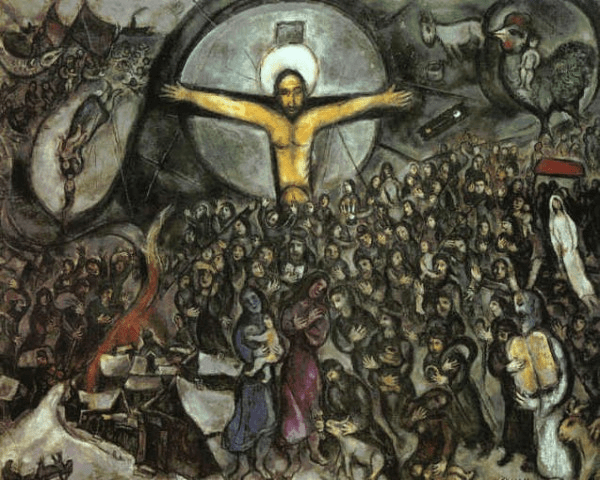
Exodus by Marc Chagall, 1952

Now the main point of what we are saying is this: We do have such a high priest, who sat down at the right hand of the throne of the Majesty in heaven, and who serves in the sanctuary, the true tabernacle set up by the Lord, not by a mere human being.

Every high priest is appointed to offer both gifts and sacrifices, and so it was necessary for this one also to have something to offer. If he were on earth, he would not be a priest, for there are already priests who offer the gifts prescribed by the law. They serve at a sanctuary that is a copy and shadow of what is in heaven. This is why Moses was warned when he was about to build the tabernacle: “See to it that you make everything according to the pattern shown you on the mountain.” But in fact the ministry Jesus has received is as superior to theirs as the covenant of which he is mediator is superior to the old one, since the new covenant is established on better promises.

For if there had been nothing wrong with that first covenant, no place would have been sought for another. (New International Version)

Jesus Christ is superior to everyone and everything – that is the overarching theme of the New Testament book of Hebrews. Jesus is above the angels, over Moses, and the great high priest of a new covenant. In Christ, the sin issue has been taken care of, once and for all.

Through Jesus, every good promise of God is fulfilled. Christ’s priesthood and intercessory ministry is permanent. His sacrifice for sin is thorough and complete. Jesus lives forever. He saves completely. Christ meets our need. He has been made perfect forever. (Hebrews 7:23-28). 

Frankly, these bold statements from the author of Hebrews are some audacious claims. In fact, they’re downright radical. And yet, say any of those statements in the typical church, and hardly an eyebrow gets raised – they almost seem ho-hum. Our blank affect testifies that we have lost a great deal of the original force and impact of Christianity.

In the first century, to have one sacrifice to end all sacrifices was unthinkable. Every ancient person understood that sacrifices were temporary; you had to keep offering them over and over again. 

Christianity, however, asked the world to have a new understanding of sacrifice. No longer would there be any sacrifice – no grain sacrifice; no offerings of first fruits; no animal sacrifices; no sacrifices, period. There was no longer any need for them because Jesus himself is the sacrifice to end all sacrifices. 

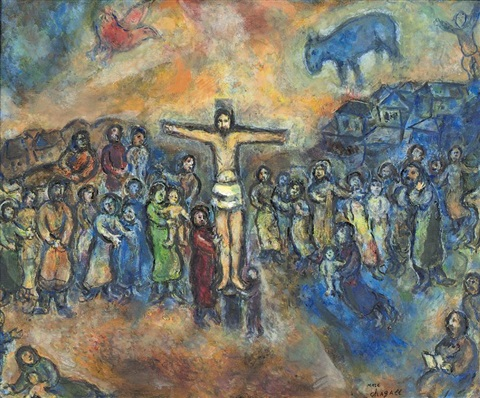
Crucifixion by Marc Chagall, 1966

This was such a ridiculous notion for so many people that they mocked Christians for it. Both Jews and pagans could barely wrap their minds around such a progressive idea. It would be like saying to us today that there is no longer any need for money because somebody just became the underwriter for everything everybody does.

Despite this incredible spiritual reality, we in the contemporary church sometimes go back to the old sacrificial system, not by physically offering animal sacrifices, but treating Christ’s finished work as if it were just too good to be true. 

We reason that we need to do something to help save ourselves. However, Jesus has not just saved us partially, but fully. Grace has always been scandalous, and so, we try to tone it down a bit, mitigate it’s actual force:

  • Church attendance can subtly be looked upon as a sacrifice to appease God, as if he needed to be soothed into not becoming angry at us. 
  • Giving can become a non-bloody sacrifice that is meant to satisfy God’s furrowed brow against us. 
  • Service can degenerate into a sacrifice to assuage our guilty conscience. 

In all these kinds of instances, and more, we go back to an old sacrificial system that is obsolete. Nonetheless, the biblical and theological truth is that Jesus has thoroughly saved us from our sin, and, so, has cleansed us from all guilt, including a guilty conscience. 

Jesus meets our need and has completely satisfied God’s wrath against the power and deceit of sin. 

Jesus is our mediator and intercedes for us as we come to God’s throne of grace. That means we do not need to try and get God’s attention with performing spiritual cartwheels or some incredible sacrifice that will somehow obligate him to take notice of us. That’s because there is never a time in which we lack attention from God.

Since we have been justified by faith in Jesus, we need not worry anymore about being good enough. Since Jesus is perfect, his work is made complete in us. A constant anxiety of feeling like we don’t measure-up does not come from God. Jesus is sufficient and has taken our place so that we can live in the freedom and joy of a complete deliverance from sin, death, and hell. There is no longer any necessary sacrifice to make!

“Well,” I have been told by some, “if everybody in the church believed that then nobody would ever do anything!” No, it is just the opposite. When we feel like we don’t measure up, we do less, not more. A low level discouragement sets in and we do nothing because we intuitively know it will never be enough. We do just enough to squeak by, never quite knowing if it is doing anything. 

In such a state, we may consider giving up because Christianity doesn’t work for us (which was the state of the believers in the book of Hebrews). But when we grasp the New Covenant of Christ’s sacrifice to end all sacrifices, and are overwhelmed by grace, then everything we do in the Christian life is a “thank you” with our life and our lips. 

It is the grace, and not the wrath, of God that teaches us to say “no” to ungodliness and worldly passions and to live upright and godly lives (Titus 2:11-12).

We are justified and made right by faith in Jesus Christ, and not by our own accomplishments, pedigree, or effort.  Trusting in our heritage, relying on our family’s faith, or believing our hard work gives us a leg-up toward heaven will only end in despair. 

But if we trust in Christ’s perfect sacrifice, then a whole new world of mercy opens before us. Because the grace of God in Christ is superior to everything.

Soli Deo Gloria