Praise and Prayer (Psalm 86:11-17)

Teach me your way, Lord,
        so that I can walk in your truth.
    Make my heart focused
        only on honoring your name.
I give thanks to you, my Lord, my God,
    with all my heart,
    and I will glorify your name forever,
    because your faithful love toward me is awesome
    and because you’ve rescued my life
        from the lowest part of hell.

The arrogant rise up against me, God.
    A gang of violent people want me dead.
    They don’t give a thought for you.
But you, my Lord,
    are a God of compassion and mercy;
    you are very patient and full of faithful love.
Come back to me! Have mercy on me!
    Give your servant your strength;
    save this child of your servant!
Show me a sign of your goodness
    so that those who hate me will see it and be put to shame—
        show a sign that you, Lord,
        have helped me and comforted me. (Common English Bible)

Psalms are prayers. And today’s prayer is from David, a guy who knew what it was like to have evil men hate him and pursue taking his life, through no fault of his own. 

I don’t know about you, but, although I have never faced adversity to such a degree as David, I do know something about people who, to put it bluntly, just flat-out hate my guts. It is not a good feeling, and it can be terribly draining emotionally and even spiritually. 

Having disrespectful and rude people who talk behind your back (and sometimes even to your face) is in direct contrast to who God is.

Who is God? What is God’s character?

God is described by David as merciful and gracious, slow to anger and abounding in steadfast love and faithfulness. Whereas insolent people objectify others and do not seek their best interests, God always acts in accord with a basic divine character of love and grace. 

Based upon the nature of God, we can choose to cry out, just like David did, to show us a sign of God’s favor. We can pray for God to provide us with some tangible communication of divine love, given on our level, so that we can grasp and understand it.

For we all, at various points in our life, need help and comfort through hardship and adversity.

Be assured that God hears the cries of the godly. The Lord notices ungodliness and injustice, and will do something about it. 

At the same time we are receiving divine guidance and help, we can trust God to address the insolence that exists around us and toward us.

Why can we trust God? What is the basis of such faith?

Seven times in the psalm, David refers to Yahweh as my Lord. And three times David refers to himself as your servant. This is a relationship – Lord to servant, Creator to creature – and it means the servant can cry out to his Lord and can confidently expect a positive response to his cry.

It is the nature and character of God to be attentive and answer God’s people.

The Lord is merciful and gracious,
    slow to anger and abounding in steadfast love.

Psalm 103:8, NRSV

Because of the divine/human relationship, David can call boldly to God, confident of God’s will and of God’s power to help. The gang of violent people who had it out for David also have no regard for God. So, David is emboldened to pray for divine favor, while at the same time, praying against those that despise him.

Yahweh, the God of David, can deliver us from the lowest parts of hell itself, because God is the expert on deliverance from the worst places that humanity finds themselves in. And so, the Lord is the One who is worthy of praise. Eventually, this reality will ultimately be recognized by all nations.

“Great and amazing are your deeds,
    Lord God the Almighty!
Just and true are your ways,
    King of the nations!
Lord, who will not fear
    and glorify your name?
For you alone are holy.
    All nations will come
    and worship before you,
for your judgments have been revealed.” (Revelation 15:3-4, NRSV)

Praise and petition go together like a hand in a glove. David freely praises God with thanksgiving for the divine character and saving actions – while at the same time, he offers fervent prayer, based upon the understanding that God is good.

David’s impassioned petition is this: Teach me your way, Lord, so that I will walk in truth; and give me an undivided heart to keep on honoring and praising your name. David longed for a completely focused heart on God and God’s will for his life.

“Hear, O Israel: The Lord is our God, the Lord alone. You shall love the Lord your God with all your heart, and with all your soul, and with all your might.” (Deuteronomy 6:4-5, NRSV)

In those times when we feel as if we are between a rock and a hard place, wanting to remain positive, yet also acknowledging life’s crud, we can come to Psalm 86 and adopt it as our own prayer for the day…

Train me, God, to walk straight;
    then I’ll follow your true path.
Put me together, one heart and mind;
    then, undivided, I’ll worship in joyful fear.
From the bottom of my heart I thank you, dear Lord;
    I’ve never kept secret what you’re up to.
You’ve always been great toward me—what love!
    You snatched me from the brink of disaster!
God, these bullies have reared their heads!
    A gang of thugs is after me—
    and they don’t care a thing about you.
But you, O God, are both tender and kind,
    not easily angered, immense in love,
    and you never, never quit.
So look me in the eye and show kindness,
    give your servant the strength to go on,
    save your dear, dear child!
Make a show of how much you love me
    so the bullies who hate me will stand there slack-jawed,
As you, God, gently and powerfully
    put me back on my feet. (The Message)

What is Your View of God? (Psalm 33:1-12)

God’s Love… by Hope G. Smith

Rejoice in the Lord, O you righteous.
    Praise befits the upright.
Praise the Lord with the lyre;
    make melody to him with the harp of ten strings.
Sing to him a new song;
    play skillfully on the strings, with loud shouts.

For the word of the Lord is upright,
    and all his work is done in faithfulness.
He loves righteousness and justice;
    the earth is full of the steadfast love of the Lord.

By the word of the Lord the heavens were made
    and all their host by the breath of his mouth.
He gathered the waters of the sea as in a bottle;
    he put the deeps in storehouses.

Let all the earth fear the Lord;
    let all the inhabitants of the world stand in awe of him,
for he spoke, and it came to be;
    he commanded, and it stood firm.

The Lord brings the counsel of the nations to nothing;
    he frustrates the plans of the peoples.
The counsel of the Lord stands forever,
    the thoughts of his heart to all generations.
Happy is the nation whose God is the Lord,
    the people whom he has chosen as his heritage. (New Revised Standard Version)

One of the reasons I adore the biblical psalms is that they present a majestic God who is full of goodness and steadfast love. The Lord’s very character is disposed toward justice and righteousness. Every word of God comes from this place of control and compassionate care.

I agree with the psalmist’s view of God because it resonates with my own experience. I have found that the God of the Psalms is high above all creation as the sovereign ruler, as well as intimately close as a friend.

The words, then, which proceed from the mouth of God are always just, right, good, fair, and loving. If God’s basic character is love, then everything God says and does comes from love. And that is precisely why I am completely devoted to this Lord.

Believers can sing a new song and revel in the Lord’s presence because they discern that everything comes down to God. That is, the way we view God is the way we will live our lives. 

For example, if we tend to see God as a stern Being whose main activity is to continually rebuke and punish people for their sin, then we will live with a constant sense of guilt and anxiety for fear of angering such a God. We will invariably live a performance-based life trying to pull ourselves up by our spiritual bootstraps in order to please or placate such a God who is always looking over our shoulder to make sure that we do not mess up.

That’s a miserable life, indeed! This is why many people internally say to themselves, “To hell with it!” and live in outright rebellion against a God who seems not to care a wit about their happiness. 

The cruelties of this world seem only to be God mocking their abysmal failure at being decent people. It would be like telling my grandson with epilepsy to stop having seizures, as if my love for him is dependent on him being seizure-free. Most people would consider it abusive for a parent or grandparent to yell at a kid for having seizures. With that kind of view of God, I wouldn’t want to know him either. And if that’s the sort of god you’re buying into, you need a new god.

But, on the other hand, if we understand God as a loving parent who is pained by the damage guilt and shame has done to the souls of people, then we are open to seeing the grace of God coming to set broken spirits right again.

With Christianity, the death of Christ is the ultimate act of love in taking care of the sin issue once for all. God in Christ did for us what we could do for ourselves; he gave his life so that we could live as we were intended to live: enjoying God and God’s creation forever.

In this view of God, the task of spiritual formation is one of constantly replacing destructive understandings of God with the kind of thoughts of God that filled the mind of Jesus himself. 

And the only good way of doing that is through the basic spiritual disciplines of Scripture reading and prayer, hearing the words of God. In order to listen well, we engage in practices of silence and solitude, as well as praise and celebration, that helps us connect with God’s Word. 

The grand redemptive story of the Bible is that the steadfast love of God has found its apex and fulfillment in the incarnation, life, death, resurrection, and ascension of the Lord Jesus. Therefore, all of Holy Scripture is to be viewed through these lenses of the grace of God in Christ. It is a very different picture than the one of an indifferent God.

Seeing God from the perspective of grace brings a joyous way to live because it views God as generous and hospitable. From such an angle, the logical and appropriate response is one of gratitude. 

All false gospels have at their core a kind of you-are-bad-try-harder approach. Preachers of such an ilk only rail against people as being scum buckets of sin and offer no real hope of transformation in Christ. It promotes a grace-less religion, and it is nothing less than biblical malpractice.

I take heart that if we have trouble seeing God as we ought, or experience difficulty viewing life as it is meant to truly be lived, we can ask God to give us wisdom. And the promise connected to that encouragement to pray is that God will give generously to all without finding fault and it will be given to them. (James 1:5)

In the psalmist’s view of God, prayer is not a chore but a delight; service is not drudgery but a willing response; reading Scripture is not a mandatory exercise but a wonderful practice of knowing God better; and praise organically erupts from the depths of our being, because we have spiritual eyes to see that everywhere we look, the whole earth is filled with the steadfast love of God.

Bless us with Love, O Merciful God;
That we may Love as you Love!
That we may show patience, tolerance,
Kindness, caring and love to all!
Give me knowledge; O giver of Knowledge,
That I may be one with my Creator and all creation!
O Compassionate One, grant compassion to us;
That we may help all people in need!
Bless us with your Love, O Lord.
Bless us with your Love. Amen.

The Spirit’s Ministry (John 14:25-26)

Jesus said:

“I have spoken these things to you while I am with you. The Companion, the Holy Spirit, whom the Father will send in my name, will teach you everything and will remind you of everything I told you.” (Common English Bible)

“These things I have spoken to you while I am still with you. But the Helper, the Holy Spirit, whom the Father will send in my name, he will teach you all things and bring to your remembrance all that I have said to you.” (English Standard Version)

“I’m telling you these things while I’m still living with you. The Friend, the Holy Spirit whom the Father will send at my request, will make everything plain to you. He will remind you of all the things I have told you.” (The Message)

“All this I have spoken while still with you. But the Advocate, the Holy Spirit, whom the Father will send in my name, will teach you all things and will remind you of everything I have said to you.” (New International Version)

“These things have I spoken unto you, while yet abiding with you. But the Comforter, even the Holy Spirit, whom the Father will send in my name, he shall teach you all things, and bring to your remembrance all that I said unto you.” (American Standard Version)

“These things I have spoken to you, while I am still with you. But the Counselor, the Holy Spirit, whom the Father will send in my name, he will teach you all things, and bring to your remembrance all that I have said to you.” (Revised Standard Version)

“The Holy Spirit is the bond by which Christ unites us to himself.”

John Calvin

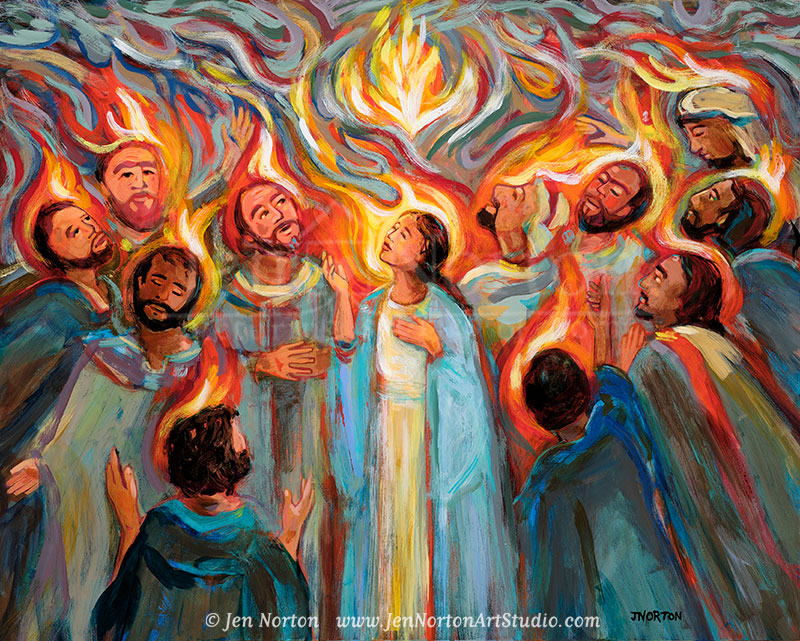
We are now in the season of “Ordinary Time” or “Proper Time” in the Church Year. It is “ordinary” in the sense that the Holy Spirit has been given to do the “proper” ongoing work of growing believers in Christ and helping them live into his directives.

The Spirit is our Teacher, cultivating and stirring-up within us all that we need for the Christian life.

As you can see from a few of the various English translations of today’s Gospel verses, there is no uniform rendering of the original Greek word, “Paraclete.” That’s because this word for the Spirit is so rich and full that it’s difficult to encompass what it means with a single English word.

A straightforward literal translation of “Paraclete” needs a phrase rather than a word: “Called alongside for encouragement,” fairly-well translates it. All the various words used in the different versions of the New Testament are accurate – yet they merely bring out one dimension to the understanding of the Holy Spirit’s ministry.

Our needs as followers of Jesus are many – thus requiring a multi-faceted mentoring ministry by the Spirit.

The Spirit was sent to be with Christians continually as their Teacher, reminding them of all Jesus has said and done as the ultimate witness to Christ’s life and ministry.

The role of the Holy Spirit is to provide comfort and aid for Christians, especially in difficult situations; the Spirit helps in a time of need.

The force of “Paraclete” is even more than this because there’s also the dimension of the Spirit being our close companion. Indeed, it is a special friend who stands up for us, advocates on our behalf, gives us remedial teaching, and brings comfort.

The Holy Spirit is motivated (just like the Father and the Son) with love for us, to give whatever we need to live a successful, abundant, and full Christian life.

In whatever situation we face, the Holy Spirit is something of a divine concierge in the middle of adversity who is attentive to every need.

The true difficulty in describing the Spirit’s ministry with us is that the Spirit is God – and no amount of description will adequately get our minds around the Spirit. God is much too big for that. All metaphors, images, and words fall short of genuinely expressing the Spirit’s immense work.

Perhaps a story will better illustrate the Spirit’s nature and work. When my girls were small and I was a financially struggling seminarian, we were one evening down to our last bit of food. Although they thought it was a privilege to eat Wheaties for supper, my wife and I knew the cupboard was now bare. So, we prayed.

As we got up from our knees and started off for bed, there was a knock at our patio back door. We looked at each other wondering who in the world it could be at such a late hour. When I drew the shades, one of our neighbors, a little Puerto Rican woman, was outside holding what appeared to be more than her own body weight in overflowing grocery bags.

I ushered her in and before I could say a word, she said, “I went to bed and had just fallen into a deep sleep. But the Holy Spirit woke me up and told me to take as many groceries as I could carry to you. So, here I am.” In that moment, I knew in my head and felt in my heart a ministry of the Spirit which transcends language.

The next morning our girls learned something about God that they would never get from listening to their Dad’s teaching and preaching. This is a story which gets retold often because it reminds us of how God meets us in our need and how much God cares.

Through such encounters with the Spirit (and I have mercifully been granted many of them!) I begin to understand and appreciate the wisdom of the saints throughout the ages:

“When the grace of the Holy Spirit enters a soul and is established there, it gushes forth more powerfully than any other spring; it neither ceases, dries up, nor is exhausted. And the Savior, to signify this inexhaustible gift of grace, calls it a spring and a torrent; He also calls it gushing water, to indicate its force and impetus.”

St. John Chrysostom

“Trying to do the Lord’s work in your own strength is the most confusing, exhausting, and tedious of all work. But when you are filled with the Holy Spirit, then the ministry of Jesus just flows out of you.”

Corrie Ten Boom

May you know the ministry of the Spirit, inside and out, in all ways and in all circumstances.

A Prayer of St. Augustine:

Breathe in me, O Holy Spirit,
That my thoughts may all be holy.
Act in me, O Holy Spirit,
That my work, too, may be holy.
Draw my heart, O Holy Spirit,
That I love only what is holy.
Strengthen me, O Holy Spirit,
To defend all that is holy.
Guard me, then, O Holy Spirit,
That I always may be holy. Amen.

God of the Living (Ezekiel 39:7-8, 21-29)

I will make sure that my people Israel know my holy name, and I will not let my name be disgraced any more. Then the nations will know that I, the Lord, am the holy God of Israel.”

The Sovereign Lord said, “The day I spoke about is certain to come….

The Lord said, “I will let the nations see my glory and show them how I use my power to carry out my just decisions. The Israelites will know from then on that I am the Lord their God. And the nations will know that the Israelites went into exile because of the sins which they committed against me. I turned away from them and let their enemies defeat them and kill them in battle. I gave them what they deserved for their uncleanness and their wickedness, and I turned away from them.”

The Sovereign Lord said, “But now I will be merciful to Jacob’s descendants, the people of Israel, and make them prosperous again. I will protect my holy name. When they are once more living in safety in their own land, with no one to threaten them, they will be able to forget how they were disgraced for having betrayed me. In order to show to the many nations that I am holy, I will bring my people back from all the countries where their enemies live. Then my people will know that I am the Lord their God. They will know this, because I sent them into captivity and now gather them and bring them back into their own land, not leaving even one of them behind. I will pour out my spirit on the people of Israel and never again turn away from them. I, the Sovereign Lord, have spoken.” (Good News Translation)

“God is trying to sell you something, but you don’t want to buy. This is what your suffering is: Your fantastic haggling, your manic screaming over the price!”

Hafiz, 14th century Persian mystic poet

A lot of folks struggle with their relationship with God in trying to make sense of the hard things they go through. Some interpret their troubles as a punishment from God. Others resign themselves to the difficulty and, at best, believe there must be some purpose to it all; and, at worst, simply state in defeat, “It is what it is.”

God most certainly does allow some awful things to happen. Although the Lord is not the author of the evil, God providentially bends all circumstances for the divine glory and for our benefit.

We may still cry out and insist, “But why must God do it this way? Isn’t there another path than the one I’m on?” It’s not bad to ask those questions. After all, the Lord Jesus himself cried out, “My Father, if it is possible, may this cup [of suffering] be taken from me. Yet not as I will, but as you will.” And, “My God, my God, why have you forsaken me?” (Matthew 26:39, 27:46, NIV)

In many ways, life is about detaching from all that hinders us from attaching to God. If we are mindful of this project, it’s likely we will realize a fulfilling connection with the divine. If, however, we lose sight of this, and become unaware of the vital relationship between God and humanity, then the Lord loves us enough to work on bringing us back into healthy relations.

It takes a lifetime of practice to let go and die to self.

And God will use every circumstance – both good and bad – to help us do that.

The Lord is glorified and shown forth as holy when we detach from all that is unhealthy and attach to everything that is just, right, and good.

God’s own Holy Spirit is the very person we need to guide us through each situation of our lives.

Typically, it is we ourselves who need to change, and not necessarily our circumstances. Yet, we too often fear change. The ego – the false self – hates change because it has bought into the belief that the outward projection of oneself to the world is the real thing (which it is not). Therefore, the ego tends to interpret each negative situation as an attack, rather than discerning that this might be the Lord getting at the inner heart of the person.

We must come to grips with the reality that one must change in order to love, and to love in order to change. Anytime we love someone or something else, we have died on some level; we let go of something so that we can grab hold of something else. The monkey who refuses to let go of the banana is trapped; the one who releases it grabs hold of freedom.

“Sin” is much less about moralistic religion, and much more about mistaking ourselves for someone we aren’t and not knowing to whom we belong. The ancient Israelites, whom the prophet Ezekiel addressed, had lost touch with who they are and whose they are. So, the Lord was determined to clarify it for them.

The realization of our true selves comes through love. And since God is love, knowing God enables us to regain our true essence.

The ego, although the necessary scaffolding for the emerging construction of the soul, must eventually be jettisoned. It would be weird if you erected a building, then kept up the façade. God is alive and deals with the living, and not the dead things around us.

Jesus said, “He’s not the God of the dead but of the living. In God’s sight all people are living.” (Luke 20:38, GW)

O Holy One, we call to you and name you as eternal, ever-present, and boundless in love. Yet there are times, O God, when we fail to recognize you in the dailyness of our lives. Sometimes shame clenches tightly around our hearts, and we hide our true feelings. Sometimes fear makes us small, and we miss the chance to speak from our strength. Sometimes doubt invades our hopefulness, and we degrade our own wisdom.

Holy God, in the daily round from sunrise to sunset, remind us again of your holy presence hovering near us and in us. Free us from shame and self-doubt. Help us to see you in the moment-by-moment possibilities to live honestly, to act courageously, and to speak wisdom. Amen.