The Penitent Soul Changes the World (Hosea 5:15-6:6)

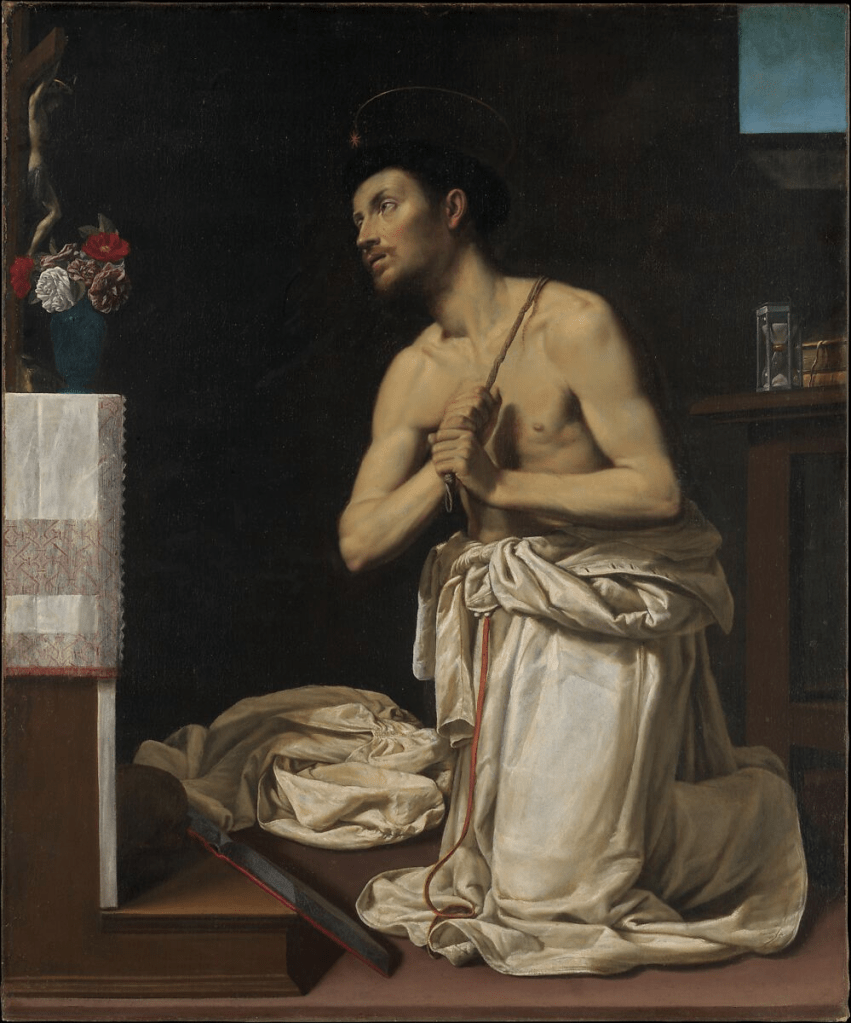
Saint Dominic in Penitence, by Filippo Tarchiani, c.1607

I will return again to my place
    until they acknowledge their guilt and seek my face.
    In their distress they will beg my favor:

“Come, let us return to the Lord,
    for it is he who has torn, and he will heal us;
    he has struck down, and he will bind us up.
After two days he will revive us;
    on the third day he will raise us up,
    that we may live before him.
Let us know, let us press on to know the Lord;
    his appearing is as sure as the dawn;
he will come to us like the showers,
    like the spring rains that water the earth.”

What shall I do with you, O Ephraim?
    What shall I do with you, O Judah?
Your love is like a morning cloud,
    like the dew that goes away early.
Therefore I have hewn them by the prophets;
    I have killed them by the words of my mouth,
    and my judgment goes forth as the light.
For I desire steadfast love and not sacrifice,
    the knowledge of God rather than burnt offerings. (New Revised Standard Version Update Edition)

We are meant for righteousness, not wickedness. So, whenever we fail to do what is right, we will suffer pain. This is because wicked attitudes, words, and behavior go against how we were designed and created as humans.

There are times when we all transgress what is right by either doing outright wrong, or by failing to do what is good, right, and just when we have the opportunity to do so. Therefore, repentance is vital and necessary. That is, to practice something that seems to be lost in our contemporary language: penitence.

Penitence simply means to have regret over wrongdoing. When we are penitent, we seek to repent (turn from what is wrong and do what is right). God has no interest in those who offer the forms of repentance without any penitence. That’s why God told the ancient Israelites that love and knowledge are what’s important, more than sacrifices and offerings.

What’s more, penitence is necessary for spiritual maturation and growth. The penitent soul finds that one’s faults and wrongs can be transformed into assets – such is the power of God through one’s penitent repentance.

And even more, the individual who experiences penitence and repents of wrongdoing, is forgiven, leading the whole world to be forgiven along with them.

Just one penitent and repentant person will intercede and confess the sins of the world; and that can change everything. So, imagine when a community of forgiven persons are motivated to bring about humanity’s greatness and nobility through penitent prayer.

I want you to think this thought: Any sort of moral misdeed committed by an individual weakens the soul of the entire community, and indeed, all the world.

Every attitude and action has a consequence, whether good or bad. Penitence, repentance, and forgiveness are the mandatory practices to restoring and renewing a life-giving dynamic to everyone.

Thus, penitence brings healing to the world; the individual who repents is forgiven; and the whole world is forgiven with him.

The powers of evil want to keep us ignorant of such things – which is why knowledge of God is so very important. Ignorance inevitably leads to sin and to the construction of a false self, which then encrusts itself upon the soul.

Penitence and repentance remain as lights deep within a person, even if they are buried beneath all sorts of arrogance and bravado of the ego.

Change of our world and transformation of our lives will not come apart from a vigorous and popular education of God and God’s Word. With so much ignorance all around us, it is imperative that individuals and communities become familiar with how spiritual realities work.

Although it appears that sinister darkness is spreading across the world and into the depths of humanity, the hope and promise of light discerns that evil can and will be overcome.

Penitence is the key to the healing presence this world needs.

For those who have experienced the renewal and reformation of a forgiven life, the steadfast love of God’s grace is very much needed for those still stuck in the mud of wickedness.

In truth, the meanness of a person betrays how much anguish of soul they are actually experiencing. Their estrangement of God is such that they are in great spiritual pain.

So, every situation designed by God to evoke penitence and repentance within such a mean person leads not only to a struggle in the soul, but also to outward conflicts with others in the forms of bullying, arrogance, and hardness of heart.

Not only do we suffer because of another’s grotesque sin, so does God. The pain of the wicked person unfortunately works to bring others pain, including God.

The Lord observed the extent of human wickedness on the earth, and he saw that everything they thought or imagined was consistently and totally evil. So the Lord was sorry he had ever made them and put them on the earth. It broke his heart. (Genesis 6:5-6, NLT)

Both humanity and God are in anguish when the dark powers take hold within an individual, and in the community.

We must have the grace to bear with others and hold our ground, giving the Spirit of God time to bring about penitence and repentance. For our part, continual learning of divine things and a commitment to steadfast love becomes the hands and feet of our prayers.

When one suffers, we all suffer, because there is an inextricable connection between all people.

Regret, remorse, and sorrow over wrongdoing are the prerequisites for goodness to become ensconced in the world. Penitence serves both the individual and the community, preventing any poisonous root of bitterness to grow up and corrupt many people.

See to it that no one falls short of the grace of God and that no bitter root grows up to cause trouble and defile many. (Hebrews 12:15, NIV)

God and humanity are meant to be united. And the Lord will create whatever conditions are necessary for divisions to be healed, and for people to love one another and love God will all their hearts, souls, minds, and energy.

Almighty God, my heavenly Father: I have sinned against you, through my own fault, in thought, and word, and deed, and in what I have left undone. For the sake of your Son our Lord Jesus Christ, forgive me all my offenses; and grant that I may serve you in newness of life, to the glory of your Name. Amen.

Remember Your Baptism (Matthew 3:13-17)

Then Jesus came from Galilee to John at the Jordan, to be baptized by him. John would have prevented him, saying, “I need to be baptized by you, and do you come to me?” But Jesus answered him, “Let it be so now, for it is proper for us in this way to fulfill all righteousness.” Then he consented. And when Jesus had been baptized, just as he came up from the water, suddenly the heavens were opened to him and he saw God’s Spirit descending like a dove and alighting on him. And a voice from the heavens said, “This is my Son, the Beloved, with whom I am well pleased.” (New Revised Standard Version)

Today is the Sunday on the Christian Calendar in which the baptism of Jesus is annually remembered. It also marks the first Sunday of the season of Epiphany – a celebration of God’s salvation being extended not only to Jews, but also to Gentiles. In other words, everyone on planet earth is within the scope of Christ’s work of deliverance.

Baptism is important. Remembering is important. Put together, remembering our baptism is highly important. Here’s why….

Baptism is important to Jesus

Baptism is the distinguishing mark or symbol of being a Christian. 

The New Testament knows nothing of an unbaptized Christian – it’s biblically oxymoronic. That’s because baptism is tied to our identity as believers. Each individual baptism is based in the baptism of the Lord who, in his Great Commission, told us to baptize in the name of the Father, Son, and Spirit. 

The absence of baptism is like a bride without a wedding ring; or a football player not wearing a uniform; or a motorcycle gang without tattoos; or like an Iowa farmer without a Pioneer seed corn hat!

Baptism is the outward sign that we belong to God. It is the distinguishing symbol that we have been adopted by God and will receive all the promises of salvation in Christ.

Christ’s baptism fulfilled all righteousness through identification with repentant people

John the Baptist was understandably hesitant to baptize Jesus; he knew Jesus had no need of repentance. Although Jesus had no sin to confess, his baptism is a powerful symbol of his humility. It anticipates his ministry to people who recognize their need for God. 

It was necessary for Jesus to be baptized in order to communicate solidarity with people who are coming to God. “Righteousness” means having a right relationship with both God and other people. By being baptized, Jesus is proclaiming that a renewed and right relationship with God will become a reality through himself.

Baptism is the sign that we belong to God and that our righteousness is tied to our union with Jesus.

It was important for Jesus to identify with sinners; and so, it is important for us, as well. We remember our baptism – that we belong to God – by identifying with “sinners.” We do this by:

  1. Practicing hospitality (love of strangers)
  2. Using our spiritual gifts of speaking and serving on their behalf
  3. Getting to know people very different from ourselves
  4. Meeting people on their turf (not just ours)
  5. Showing respect and upholding dignity
  6. Asking thoughtful and caring questions
  7. Listening with focused attention

It isn’t what we “do” for people that’s as important as affirming our shared humanity with them. We thus lead folks to the ultimate person who can address the needs of their heart: Jesus.

Christ’s baptism fulfilled all righteousness through the affirmation of witnesses

Before Jesus began his ministry, it was necessary to receive validation of what he was about to teach and do. In ancient Judaism, one of the protections guaranteeing that Scripture would be taught according to the way of God, was through an ordination, of sorts. In order for a new rabbi to become a new rabbi, he needed the laying on of hands from two other rabbis who had authority to do so. 

That’s why Christ’s baptism is important. John the Baptist was a powerful teacher and prophet who was recognized by the people as such. John publicly said he wasn’t worthy to carry Jesus’s sandals, that Jesus is the Lamb of God that takes away the sin of the world. So, a baptism by John validated Jesus and inaugurated his ministry. 

And a second voice – another witness from heaven – affirmed Jesus: “This is my Son, the Beloved, with whom I am well pleased.” Then, the Holy Spirit, in the form of a dove, came upon Jesus. This further affirmed that Jesus would save people, not through arm-twisting and great shows of power, but through humility and gentleness.

Baptism was Christ’s first recorded act as an adult. In some ways, it was his first miracle – the miracle of humility in identifying with sinners.

Remember your baptism

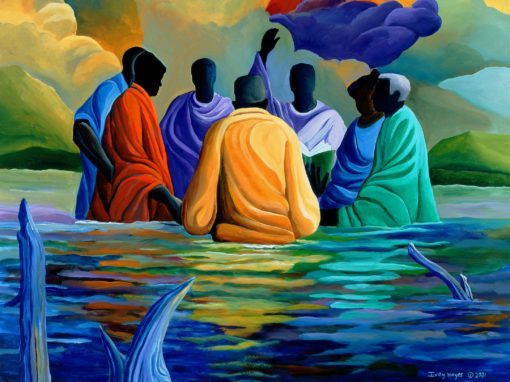
Baptism” by American artist Ivey Hayes (1948-2012)

Baptism is a sign and a seal of God’s grace. Just as Christ’s baptism focused all the promises of God in salvation as being fulfilled in one person, so in our baptism we claim all the promises of God as found in Jesus. Water symbolizes new life, God identifying with us – Immanuel, God with us.

In baptism, God promises and seals to us our union with Jesus so that identity is not found in my past and my profession of faith, but in Christ’s past of bringing redemption to us. Baptism does not so much express faith as call one to a life of faith and sets us apart as belonging to God.

Baptism is a visible declaration of an invisible reality: union with Christ. Just as circumcision was the outward visible sign of the old covenant, so baptism is the sign of the new covenant in Christ – available to both male and female – thus opening the way for women to participate fully in the ministry of the gospel.

In particular, infant baptism confirms that salvation is not initiated by us, but by God. It affirms that one is betrothed to God. As a child, then an adult, grows into the faith, it is our task to remember our baptism, to be reminded that God’s mark is upon us, that we belong to the Lord. 

God has set us apart to be a holy people, given to Jesus to live as he did. We must never forget that baptism is God’s identifying mark upon us; that our union and solidarity with Jesus is affirmed through this practice.

We are not solitary Christians; we belong to Christ and to one another. Baptism is the initiation rite that takes a lifetime to complete. Therefore, we must struggle together in working out our salvation.

Because of our union with Jesus Christ, we must remember:

  • I do not belong to the world. So, I will not live selfishly, only seeking my own comfort agenda. Instead, I will give and serve others from a pure and humble heart.
  • I do not belong to sin. So, I will not give myself over to shameful words or actions, to bullying or manipulating people, to throwing fits and pity parties to get my way, nor using my tongue to speak gossip, slander, or suck-up to others. Instead, I will use my speech wisely, building up others through thoughtful and heartfelt encouragement.
  • I do not belong to the devil. So, I will not seek his agenda of lying, cheating, stealing, and being bitter. 

I belong to Jesus, so therefore:

  • I will uphold biblical justice by championing the cause of the fatherless and the widow, the poor and the needy, the least and the lost among us.
  • I will love others with all the grace God gives me.
  • I will forgive others because Christ has forgiven me.
  • I will consider others better than myself by embracing the humility of Christ.
  • I will hunger and thirst for righteousness by seeking and maintaining right relations with others.
  • I will seek peace and pursue it.
  • I will, give myself to my Lord and Savior Jesus Christ my Savior and Lord – completely and thoroughly, unabashedly and unreservedly.
  • I will live into my baptism and remember it always, because I belong to Jesus!

Creator God, our soul’s delight, your voice thunders over the waters, liberating the future from the past. In the Spirit’s power and the waters of rebirth, Jesus was declared your blessed and beloved Son; may we recall our baptism, and be disciples of the Anointed One. Amen.

Called To a Way of Being – Fourth Sunday of Advent (Romans 1:1-7)

Paul, a servant of Christ Jesus, called to be an apostle, set apart for the gospel of God, which he promised beforehand through his prophets in the holy scriptures, the gospel concerning his Son, who was descended from David according to the flesh and was declared to be Son of God with power according to the spirit of holiness by resurrection from the dead, Jesus Christ our Lord, through whom we have received grace and apostleship to bring about the obedience of faith among all the gentiles for the sake of his name, including you who are called to belong to Jesus Christ,

To all God’s beloved in Rome, who are called to be saints:

Grace to you and peace from God our Father and the Lord Jesus Christ. (New Revised Standard Version)

To be a Christian is to be a servant of Jesus, called to a specific way of being in the world, and set apart for the gospel of God.

Concerning this gospel, this good news, it is all about God the Son, Jesus Christ, who is also fully human. Jesus is the singular person – both God and human at the same time, all the time. His human credentials are linked to the genealogy of the ancient King David, who was promised by God that one of his descendants would sit on throne forever. And as for Christ’s divinity, it was confirmed and established through his resurrection from death.

It is through Christ that we are called to belong to him; we have received the grace to be called children of God; and we are called to holiness for God. We all, therefore, have a calling. Every one of us is important. All of us receive the grace of God to fulfill that calling in this world.

In our contemporary society, we put a lot of stock into what we do, to the point of identifying ourselves primarily by our job titles and positions. But in God’s society, our primary identification is that we belong to God, and specifically to Jesus Christ.

Belonging to Christ means we are to have a certain way of being – not just doing – on this earth. We are first and foremost human beings, and not human doings. What we do is to flow from our being, and not the other way around. We do not gain identity through actions and accomplishments.

Our way of being has a lot to do with the Advent season. Christ’s coming into this world as a vulnerable baby was a deliberate way of being for Jesus in this world. He would go through all the human travails and trials that we do. He would know both joy and suffering, and would know them as coming together into one:

For the joy set before him he endured the cross, scorning its shame, and sat down at the right hand of the throne of God. (Hebrews 12:2, NIV)

It’s normal for us to wonder about the nature of our own personal sufferings. Its hard for us to make sense out of all the nonsensical things in this world, especially when it pertains to us personally.

Indeed, it is hard for us to accept the reality that humble suffering is not only a part of living in this world, but is also an important part of being a Christian who belongs to Jesus.

Whenever we lose something or someone important to us, we struggle with why. We may wonder where God was. We might think there is something wrong with us, as if God is punishing us for some unknown sin we’ve done in the past.

But we would be barking up the wrong tree. Methinks we wrestle so much with adversity and hardship because of our predilection for doing instead of being.

Perhaps our life situations are more about our way of being in this world, rather than what we do on this earth.

Maybe my life is meant primarily to be about being a person who is always loving, kind, compassionate, just, good, righteous, and holy – a saint, set apart as one who belongs to God.

Maybe it has a lot less to do with our vocations and only seeing things through what I’m able to do, or not do.

It could be that I am meant to see God’s grace operating through me by means of love, not hate; kindness, not meanness; compassion and comfort, not indifference and annoyance; justice, not injustice; goodness, not bad attitudes; and holiness, not unrighteousness.

It is quite possible that today (and every day) my Christian life has been about, is about, and will continue to be about my suffering for the sake of Jesus, who suffered for me.

“Why be disturbed of things that do not succeed according to your plans and desires? Who gets everything according to his likes? Neither I, nor you, nor anyone else on this earth. No one in this world is without some trial or illness or affliction, not even a king or a pope. Who, then, has it the best? The one who is willing to suffer for God’s sake.” Thomas à Kempis, The Imitation of Christ

The believers in the Roman Church, for whom the Apostle Paul wrote his letter, were focused primarily on what they had and what they did as Jews and as Gentiles. Because of their understanding of identity, they kept wrangling with each other and looking down on one another – namely, because they failed to each other as belonging equally to God as the one people of God. Jews were too hung up on how they kept the Law for centuries without any Gentiles. And Gentiles were too myopic to see that they were not replacing Jews out of some superior activity.

To love one another, and to simply love, is to suffer. Apart from love there is no suffering. Without love, there is no peace, no grace; and there is no belonging to God and having a way of being in the world which pleases God.

Furthermore, one can never have possessions or wealth without a great deal of anxiety and apprehension. Our happiness does not consist in temporal things, but in the permanence of relationships, because relationships are the only things we take with us in the end.

In the spirit and practice of the Lord Jesus whom the Christian serves, we must pass through the fire before we arrive at redemption and be at peace with God and humanity.

To reach the joy of Christmas, we must endure the weeks of Advent, of anticipating the hope to come, of waiting to see the Christ child who humbly comes into the world for us and for our salvation. And that means we may likely have to endure any current adverse and hard circumstances.

We are called – not for selfish gain, and not to look down on others who are different – but for a way of being in this world which emulates the Lord whom we serve, Jesus Christ our Savior.

Shepherd of Israel: May Jesus, Emmanuel and son of Mary, be more than just a dream in our hearts. With the apostles, prophets, and saints, save us, restore us, and lead us in the way of grace and peace, so that we may bear your promise into the world. Amen.

Christ the King Sunday (Luke 23:33-43)

The 118 feet high Christ the King statue in Świebodzin, Poland

When they came to the place that is called The Skull, they crucified Jesus there with the criminals, one on his right and one on his left. Then Jesus said, “Father, forgive them, for they do not know what they are doing.” And they cast lots to divide his clothing. And the people stood by watching, but the leaders scoffed at him, saying, “He saved others; let him save himself if he is the Messiah of God, his chosen one!” The soldiers also mocked him, coming up and offering him sour wine and saying, “If you are the King of the Jews, save yourself!” There was also an inscription over him, “This is the King of the Jews.”

One of the criminals who were hanged there kept deriding him and saying, “Are you not the Messiah? Save yourself and us!” But the other rebuked him, saying, “Do you not fear God, since you are under the same sentence of condemnation? And we indeed have been condemned justly, for we are getting what we deserve for our deeds, but this man has done nothing wrong.” Then he said, “Jesus, remember me when you come in your kingdom.” He replied, “Truly I tell you, today you will be with me in paradise.” (New Revised Standard Version)

I’m glad that the Gospel text on this Christ the King Sunday is the story of Christ on the cross with the two criminals on each side also crucified. Why?

Because our cultural contexts tend to associate power and authority with high level earthly positions. But, in reality, Christianity is a paradoxical religion full of truths which seem antithetical to each other; yet they are not.

Many people (including many Christians) believe that, in order to influence the culture, Christians must have prominent positions in society. This leaves the majority of Christians feeling as if they have nothing to offer the world. After all, they have no important title at their job, in the government, or within the church.

But nothing could be further from the truth. Christ, in the lowest earthly position possible by being nailed to a cross, was a king who had the highest heavenly position in the universe. One will never come to grips with Jesus apart from understanding that Christianity is an inherently paradoxical religion.

The Sanctuary of Christ the King in Almada, Portugal

One of the criminals crucified with Christ discerned this reality well; the other criminal did not understand at all. One demonstrated the reality that humility is the powerful key to all things, whereas the other criminal remained full of himself.

The scene portrayed for us on Golgotha’s hill shows us what the kingly reign of Jesus Christ truly looks like: It is characterized by the power of humility and sacrifice. It highlights Christ’s authority by giving mercy to those hanging on a cross alongside himself.

True power is not found in the halls of earthly political power, but rather in the elevating power of God’s grace and Christ’s self-sacrifice. Therefore, Christians can best demonstrate their own power and authority by extending grace and mercy toward others, even when it’s hard to do.

It can be difficult to wrap both our heads and our hearts around this reality of possessing power without actually having positions and titles of authority in the world and the church.

Many a church pastor bemoans the fact that a number of their parishioners fail to be active servants in the wrongheaded notion that the clergy are supposed to do all the work. The laity may believe that the clergy are the ones with the educational, experiential, and positional power to influence culture and society.

What’s more, it can be even harder for those who once had positions of power to believe they themselves can no longer effectively work for the good, because they are now nobodies. They may ask, “Who would listen to me?”

The answer is: A lot of people. God uses all sorts of persons in all sorts of places and situations. What we all need, whether clergy or laity, is the willingness to be humble and to sacrifice one’s time or talent in showing mercy to another.

Christians must take their cues from the Lord Jesus. In the setting of the interaction between Christ and the other two crucified men in today’s story, Jesus is the innocent one sandwiched between two guilty persons. Christ’s humiliation is on full public display. The crowd of onlookers mock him, along with one of the criminals. Because of the apparent incongruence between being ‘King of the Jews’ yet not freeing himself from his awful situation.

Whereas most of us might avoid being humiliated in public at any cost, Jesus embraced the rejection and the suffering, knowing that he was offering a sacrifice for the benefit of the whole world.

Even though Jesus was extremely vulnerable, and in emotional, spiritual, and physical pain which we can only imagine, he nonetheless chose to use his kingly power and authority on behalf of others – including those who blatantly rejected and mocked him.

Grace and mercy were demonstrated by submitting to an ignominious death, and by willingly acting to be the bridge connecting others to God. Relationship is at the very heart of the divine will; God would do anything to restore broken relations with his fallen people. No one is beyond the reach of grace.

In a contemporary culture of polarized relations and angry vitriol toward one another, the ordinary Christian without earthly title or authority is in the best position to provide basic human kindness by extending mercy to “enemies” and demonstrating humility in all things.

Christ embodied love and forgiveness. He used his power for mercy, not judgment;  and for grace, not revenge.

Jesus demonstrated for us how grace is the greatest operative force in the universe.

To love and forgive another is the best demonstration of power and authority that anyone could ever show.

God’s action in Christ through the cross is what can move us to true acts of love and selflessness. We participate in Christ by giving grace through acts of mercy in comforting, encouraging, and helping others.

The only way we can give grace is to receive grace. It is God’s action in Christ through the Spirit that moves us to true acts of love and selflessness.

Personally, I am encouraged with the image of Christ as King – the One who is both sovereign over all creation, and yet is with me and knows my every need, giving grace and mercy and unconditional love.

For me, the idea of both God’s transcendence and God’s immanence is the perfect lead-in for the Advent season.

Earthly leaders can be capricious, petty, enamored with earthly power, and wield authority only in ways that serve themselves and not the common good of all. No wonder there is so much corruption and injustice in this old fallen world of ours.

Such hateful leadership has no problem leaving us beaten, bruised, and hanging on a cross. In our pain and our suffering, what will we do?

Hopefully, we will let Jesus transform our understanding of power and authority.

Ideally, in our worst situations of suffering and confusion, we will remember Jesus lifted-up on the cross, lifted-up as sovereign over all things. We will find our own true power in self-giving-love to a world which appears it has given itself to hate and selfish judgment of people they don’t like.

A participation in Christ’s rule and reign over all things means that his crucified power has given us grace and forgiveness, so that we might pass it on, pay it forward, and work for that which is just, right, and good.

May it be so, to the glory of God.

Almighty God, you rescue us from our enemies, so that we may serve you without fear. Strengthen us, that we might share in the inheritance of the saints in your kingdom of light. Amen.