Healing the Outsiders (Matthew 8:1-13)

Jesus Healing, by Arthur Robins, 2020

When Jesus came down from the mountainside, large crowds followed him. A man with leprosy came and knelt before him and said, “Lord, if you are willing, you can make me clean.”

Jesus reached out his hand and touched the man. “I am willing,” he said. “Be clean!” Immediately he was cleansed of his leprosy. Then Jesus said to him, “See that you don’t tell anyone. But go, show yourself to the priest and offer the gift Moses commanded, as a testimony to them.”

When Jesus had entered Capernaum, a centurion came to him, asking for help. “Lord,” he said, “my servant lies at home paralyzed, suffering terribly.”

Jesus said to him, “Shall I come and heal him?”

The centurion replied, “Lord, I do not deserve to have you come under my roof. But just say the word, and my servant will be healed. For I myself am a man under authority, with soldiers under me. I tell this one, ‘Go,’ and he goes; and that one, ‘Come,’ and he comes. I say to my servant, ‘Do this,’ and he does it.”

When Jesus heard this, he was amazed and said to those following him, “Truly I tell you, I have not found anyone in Israel with such great faith. I say to you that many will come from the east and the west, and will take their places at the feast with Abraham, Isaac and Jacob in the kingdom of heaven. But the subjects of the kingdom will be thrown outside, into the darkness, where there will be weeping and gnashing of teeth.”

Then Jesus said to the centurion, “Go! Let it be done just as you believed it would.” And his servant was healed at that moment. (New International Version)

On a few occasions, my computer picked up a nasty virus that hijacked every file and function I have. The most frustrating thing about those events is that there was nothing I could do by myself to fix it or make it better.

I had to humble myself and ask a computer geek to get into my system and take care of the problem. It’s a weird feeling to look at my screen and have a stranger work inside my personal computer. But if I failed to get help, my computer was worthless – unless I let someone with authority fix the blasted thing.

Kingdom Values

Jesus is Lord of all. Since Christ has authority over everything, we are to live our lives in submission to his will and way. Only through humble resignation to Christ can we experience the healing and deliverance we seek.

Jesus preached his famous Sermon on the Mount (Matthew 5-7) and taught the people as one who had authority. In that Sermon, Jesus laid out the values of God’s kingdom: humility, sorrow over sin, meekness, purity, mercy, and peacemaking. In today’s Gospel lesson, we see the power of those values evidenced and expressed in two stories of healing and deliverance. 

The world needs saving, and that’s exactly what Jesus is up to. Christ’s authority is total – coming from his moral authority – as the very embodiment of the Beatitudes he taught. Grace always has the last word, as Jesus healed showing neither favoritism nor discrimination.  

Healing a Leper
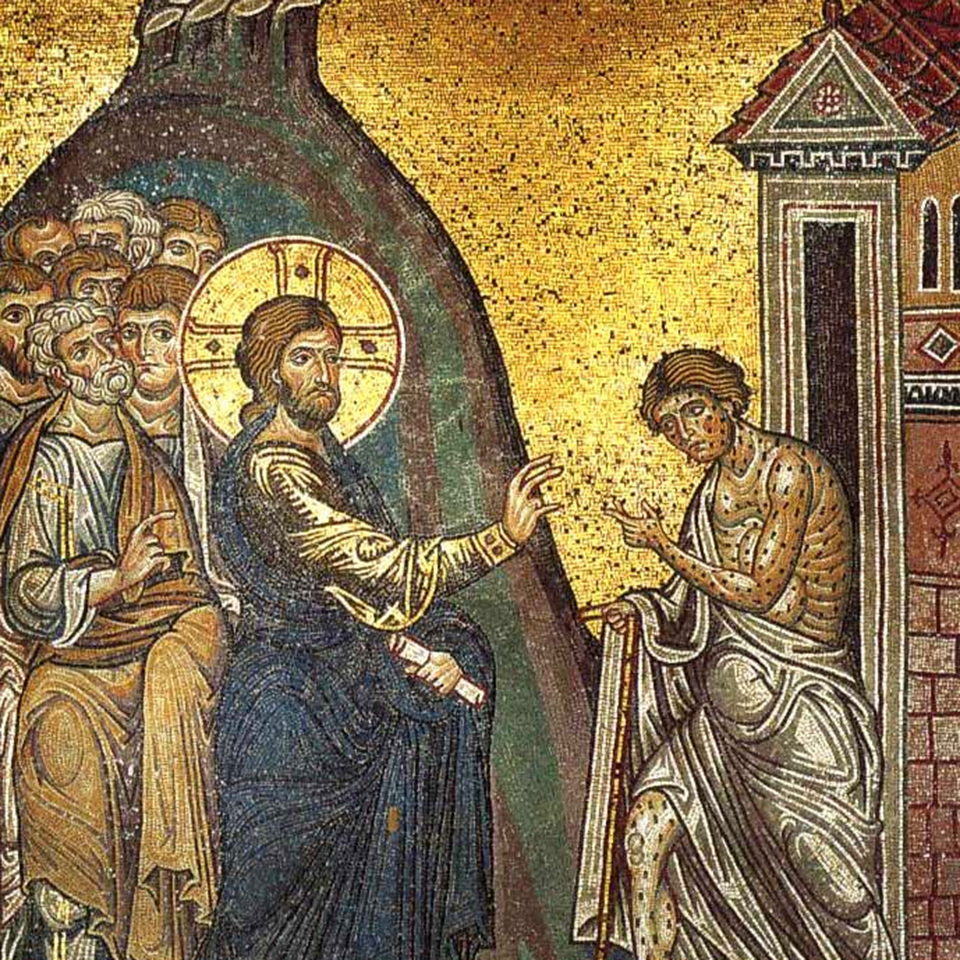
Jesus healing a leper, Cathedral of Santa Maria Nuova, Florence, Italy

In the first story, Jesus used his authority to heal and transform a leper. Leprosy was a feared disease in the ancient world. There was no known cure, and lepers were forced to live apart from everyone else. The Old Testament book of Leviticus says that a leper must wear torn clothes, let his hair be unkempt, cover the lower part of his face and cry out “unclean! unclean!” (Leviticus 13:45-46).  Lepers were the ultimate outsiders.

A leper came to Jesus with a humble profession of faith: “Lord, if you want to, you can make me clean.” It was a clear case of genuine need, and poverty of spirit. Jesus responded by doing the unthinkable: He touched him.  In a great and wonderful reversal, Jesus did not become unclean by touching the leper; but instead, the leper was made clean. 

Still today, the world needs to be touched. It’s an important way of following Jesus and changing the world. This requires us, God’s people, to get up-close and personal with outsiders and marginalized persons and groups. Christian service requires Christian touch.

Authentic Christian ministry communicates love through contact and identification with others. A thousand years after Christ’s earthly ministry, St. Francis of Assisi met a leper on the road:

“Though the leper caused him no small disgust and horror, he nonetheless, got off the horse and prepared to kiss the leper. But when the leper put out his hand as though to receive something, he received money along with a kiss”

Life of St. Francis, by Thomas of Celano

Francis did what seemed humanly impossible because he was filled with the love and compassion of Christ. The love of Jesus allows us to touch others with compassionate care, especially to those who have been rejected and mistreated.

Healing a Roman Officer’s Servant
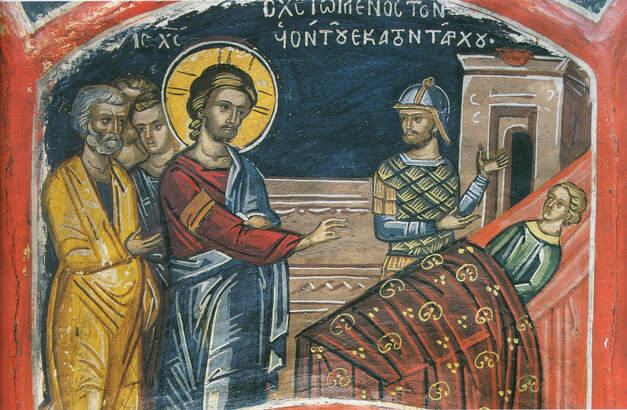
Fresco of Jesus healing the Centurion’s servant, Dionysiou Monastery, Mount Athos, Greece

The second story was equally eye-popping and unbelievable to the people in Christ’s day. Jesus used his authority to heal and transform a Gentile – and what’s more – a hated Roman army officer.

We see the values of the Beatitudes expressed in a Roman Centurion who felt unworthy to even have the Lord Jesus come into his house. The Centurion’s profession of faith amazed even Jesus: “Just say the word,” he said in recognition of Christ’s authority, which is big enough to heal without even being present. 

Although Centurions were the backbone of the Roman military machine and hated by the Jews, yet Jesus responded to the Centurion’s request, and he also affirmed his faith as greater than any Jew.

Grace answers to need, and not to smug self-confidence.

The Roman Centurion requested healing. Jesus listened and answered. The Centurion did not use his position to order Jesus or demand healing; he came in a spirit of humility and asked with confidence that Jesus could heal his servant if he wanted to. The Centurion threw himself on God’s mercy. So, Jesus upheld the Centurion as a model of faith for us all.

Healing Doesn’t Happen with the Independent

In affirming the Roman officer’s faith, Jesus also gave a solemn warning to the self-righteous: Their lack of humility and genuine faith would land them outside the kingdom. In another great reversal, the insiders will become the outsiders, and the outsiders become the insiders.

Independently proud folk do not experience healing and transformation because they don’t even know they are sin sick. They see no need for an intervention by Jesus because they already have their righteous deeds to boast about. Such persons are more concerned about looking good and saving face, than perceiving their own unworthiness. 

The self-righteous and self-sufficient approach to handling problems and difficult situations is to come up with good ideas and clever strategies, relying on sheer personal effort and willpower. Prayer may or may not happen; there is no honest beseeching of God. 

Delusional thoughts of personal autonomy only separate us from the grace of God that we so desperately need. 

There is a spiritual dimension to every situation and trouble we face – including sickness. If we only examine the medical and biological end of physical problems, we may be dealing with symptoms instead of the root issue that plagues us.

Are you hurting? Pray. Do you feel great? Sing. Are you sick? Call the church leaders together to pray and anoint you with oil in the name of the Master. Believing-prayer will heal you, and Jesus will put you on your feet. And if you have sinned, you will be forgiven—healed inside and out. Make this your common practice: Confess your sins to each other and pray for each other so that you can live together whole and healed. (James 5:13-16, MSG)

Conclusion

Jesus healed and transformed outsiders. Followers of Christ, dependent upon God, ask themselves:

  • Who are the outsiders among us?
  • Where are the strangers? 
  • How can we get close enough to touch aliens and immigrants? 
  • Will you help us intercede in prayer for foreigners? 
  • When can we search for and pursue those on the periphery of society? 

Believe that the risen and ascended Jesus can and will heal, deliver, and transform people of all kinds.

Jesus cannot be domesticated into some figurehead that suits our desires and conforms to our ideas about how things ought to be. Jesus is portrayed in these stories as eager to heal, wanting to show grace to the least and the lowly among society.

So, let us participate in the world’s healing, beginning with the Lord’s Prayer:

Our Father in heaven,
    may your name be kept holy.
May your Kingdom come soon.
May your will be done on earth,
    as it is in heaven.
Give us today the food we need,
and forgive us our sins,
    as we have forgiven those who sin against us.
And don’t let us yield to temptation,
    but rescue us from the evil one. Amen. (Matthew 6:9-13, NLT)

On the Lam(b) (Genesis 31:1-21)

Jacob Flees Laban, illustration from Bible Pictures and What They Teach Us, by Charles Foster, 1897

Jacob heard that Laban’s sons were complaining, “Jacob is now a rich man, and he got everything he owns from our father.” Jacob also noticed that Laban was not as friendly as he had been before. One day the Lord said, “Jacob, go back to your relatives in the land of your ancestors, and I will be with you.”

Jacob sent for Rachel and Leah to meet him in the pasture where he kept his sheep, and he told them:

“Your father isn’t as friendly with me as he used to be, but the God my ancestors worshiped has been on my side. You know that I have worked hard for your father and that he keeps cheating me by changing my wages time after time. But God has protected me. When your father said the speckled sheep would be my wages, all of them were speckled. And when he said the spotted ones would be mine, all of them were spotted. That’s how God has taken sheep and goats from your father and given them to me.

Once, when the flocks were mating, I dreamed that all the rams were either spotted or speckled. Then God’s angel called me by name. I answered, and he said, “Notice that all the rams are either spotted or speckled. I know everything Laban is doing to you, and I am the God you worshiped at Bethel, when you poured olive oil on a rock and made a promise to me. Leave here at once and return to the land where you were born.”

Rachel and Leah said to Jacob:

There’s nothing left for us to inherit from our father. He treats us like foreigners and has even cheated us out of the bride price that should have been ours. So do whatever God tells you to do. Even the property God took from our father and gave to you really belongs to us and our children.

Then Jacob, his wives, and his children got on camels and left northern Syria for the home of his father Isaac in Canaan. Jacob took along all his flocks, herds, and other property.

Before Rachel left, she stole the household idols while Laban was out shearing his sheep.

Jacob tricked Laban the Aramean by not saying that he intended to leave. When Jacob crossed the Euphrates River and headed for the hill country of Gilead, he took with him everything he owned. (Contemporary English Version)

Moving and changing are a part of life. Change and movement are built into all creation, from the seasons of the year to our physical bodies over time. Some changes and moves we deem as good, and others, not so much. Yet, whether good or bad, any switch or shift in life can be difficult to cope with.

Whatever the circumstance, God stands behind everything, working out good and divine purposes. There are times and seasons in our lives where we can get lost in our own stories. Ultimately, however, our transitions from one place to another are really about our individual stories fitting into the larger story of God.

Whenever we are unable to see how our own story and the story of God fit together, it’s an opportunity to exercise faith and trust in God. Listening to God, and responding to God’s call to move and change, will at times be difficult, due to the uncertainty of our future.

Jacob Urges Leah and Rachel to Flee from Laban, by Pieter Symonsz Potter, 1638

In today’s Old Testament lesson, Jacob has served his father-in-law Laban for twenty years. Now, he hears the call of God to move – and that move is both good and fraught with anxiety. Jacob and his family are on the lam, literally moving their lambs and sheep and everything they own to avoid pursuit and confrontation.

The principal actor and center of the story is not Jacob, but God. The narrative is primarily about God, with Jacob as the supporting actor in the story.

God was watching over and protecting Jacob. The Lord was following through on a promise of land and descendants given to Jacob’s grandfather, Abraham – to make him into a great nation so that all people-groups on earth would be blessed. 

So then, the story of Jacob is merely one piece in the grand unfolding drama of God’s redemption. This drama would eventually and ultimately find its fulfillment in the person and work of Jesus.

Jacob had in-law issues. His relationship with his father-in-law had always been tenuous, and was morphing into trouble. Laban’s attitude had changed toward his son-in-law, probably due to Jacob’s increasing wealth, and Laban’s decreasing assets.

So, God showed up and told Jacob to return to the land of his fathers. Along with the call to make a change came a promise of God’s continued presence with Jacob. The grace given to Abraham when calling him out of Ur was renewed with more grace when calling Jacob back to the land of his father and grandfather.  It is in God’s nature to be gracious and to heap grace upon grace.

Jacob heeded call of the Lord and began laying plans to move back to Canaan. But how to tell his family about this? What are his wives going to say? After all, he’s talking about moving away with teenagers still in the tent.

With some anxiety, Jacob called his wives, Rachel and Leah, out to the fields to talk. Jacob laid out the story of himself and Laban, which he framed more as a contrasting story between God and Laban:

  • Laban’s attitude changed, whereas God’s attitude does not change. God is not fickle.
  • Laban was unreliable, reneging on promises, but God is reliable and trustworthy, keeping divine promises.
  • Laban kept changing his mind, yet God stays the same, yesterday, today, and forever.
  • Laban saw only self-interest; however God sees everyone and shows solidarity with the oppressed.

This same God is concerned for us and will not renege on promises. God is providentially working out a good  agenda and concern for this earth, and we can bank on it.

The response from Jacob and Rachel to Laban was some tricky thievery. Jacob stealthily took his family and ran away from the situation. Rachel straight up stole Laban’s household gods.

(Note: Old Testament narratives do not usually tell us whether something is bad or good but instead allows the story to unfold and speak for itself so that we can see the ethics working out). 

Jacob and Rachel had a less than stellar response to God’s grace. We do not know exactly what the household gods are, or why Rachel stole them. What we do know is that there was a bit of pagan practice mixed in with worship of the one, true God.

Our circumstances will forever be changing, and God may ask us to move and go do something somewhere else. Yet, no matter the situation, and how different our surroundings may become, God does not change, and is here with us; and, at the same time, is continually moving to accomplish good purposes.

Loving God, you have made the whole of human life in your image; each one of us shaped in love. Your goodness is ever-present within us all. Yet, there is so much evil and pain in our world; it comes at us from every direction.

Teach us how to rediscover your love within us and to use that love as a force for good. Help us to turn our hearts toward the world in hope, praying for each other and regarding each other as a treasure, so that we might be the light which darkness can never overcome, through Jesus Christ our Lord. Amen.

Justice for All (Matthew 12:15-21)

When Jesus became aware of this [a plot to kill him] he departed. Many followed him, and he cured all of them, and he ordered them not to make him known. This was to fulfill what had been spoken through the prophet Isaiah:

“Here is my servant, whom I have chosen,
    my beloved, with whom my soul is well pleased.
I will put my Spirit upon him,
    and he will proclaim justice to the gentiles.
He will not wrangle or cry aloud,
    nor will anyone hear his voice in the streets.
He will not break a bruised reed
    or quench a smoldering wick
until he brings justice to victory.
    And in his name the gentiles will hope.” (New Revised Standard Version)

Saying the words, “I love you” is important. And it’s also significant how we say it. If our tone of voice is monotone and our affect flat, then the incongruence between the words and the manner in which they are said will leave our love unrequited. If, however, our tone is soothing and excited and our face beaming as if starstruck, then the love expressed will likely be received, and stick.

Christians have a message of love to the world. It’s a message of Jesus Christ and his love for humanity. Both the content of our message and the way we communicate it are vitally significant.

For if the words we don’t match our tone of voice and affect, then love is not what we convey. Yet, if we have been profoundly and meaningfully touched by the love of God in Christ, then that love will not be constrained; it shall find a way to express itself with appropriate mannerisms.

The way in which Christ proclaimed his message, testified that he was, indeed, the promised Savior and the rightful Ruler for God’s world.

The message of Jesus was proclaiming justice to the nations. The disciple Matthew used a quote from the prophet Isaiah to explain the reason why Jesus withdrew, and told people not to make him known. This was a curious act for a Messiah, to say the least. 

After all, we might believe Jesus should loudly proclaim who he is and what he is doing. Human ingenuity might say he ought to be advancing, not retreating – getting his name out with some notoriety in a slick marketing message so that people will come running into the kingdom of God! 

But Jesus goes a different direction. Matthew (quoting the prophet Isaiah) made it clear who Jesus is and what he is all about. Jesus is God’s servant. Jesus is God’s beloved Son with whom he is well-pleased. The Holy Spirit came on him in his baptism. Jesus became a teacher of justice to the nations, that is, to gentiles, to all kinds of people – even the ones we do not like. 

I personally find it strange that some Christian folk think justice is something which is not part of the Gospel, as if it were nice, but optional. They might believe it’s important to engage in some sort of social justice toward the downtrodden, but want to put it on a secondary shelf. Speaking the message is primary to them, as if we could or should separate the message from the messenger.

Yet, we can no more divide the good news of forgiveness in Christ from social justice any more than we can neatly separate the cross and resurrection. All of it is redeeming work; it all goes together.

In the kingdom of God, all things and all people are to be redeemed and come under the Lordship of Christ. And the practice of justice is central to making redemption a reality for humanity.

He has told you, O mortal, what is good,
    and what does the Lord require of you
but to do justice and to love kindness
    and to walk humbly with your God? (Micah 6:8, NRSV)

Mercy and justice go together like corn on the cob and butter, and like pork ribs with barbeque sauce (I’m from Iowa, after all!). Kindness and mercy refers to God’s unconditional grace and compassion. Justice treats all people with equity, without any favoritism.

Biblical justice is not primarily punishment for wrongdoing; it gives people their rights – and this concept is overwhelmingly taught in Holy Scripture – over 200 times in the Old Testament alone. Jesus Christ’s back to the Bible movement rightly emphasized justice.

God loves and defends the weak, the poor, and the powerless:

He gives justice to the oppressed
    and food to the hungry.
The Lord frees the prisoners.
    The Lord opens the eyes of the blind.
The Lord lifts up those who are weighed down.
    The Lord loves the godly.
The Lord protects the foreigners among us.
    He cares for the orphans and widows,
    but he frustrates the plans of the wicked. (Psalm 146:7-9, NLT)

We, as God’s people, are to share the Lord’s passion for justice:

Speak out on behalf of the voiceless,
    and for the rights of all who are vulnerable. (Proverbs 31:8, CEB)

“Cursed is anyone who obstructs the legal rights of immigrants, orphans, or widows.” All the people will reply: “We agree!” (Deuteronomy 27:19, CEB)

Since believers are justified by faith in Christ, we bring justice to our communities, in both word and deed, by advocating for the least, the lost, the last, and anyone else without social or economic power in this world.

We are to use our voice for both us and for those who have no voice. The voice of justice is the voice of action.  To be concerned for the justice of God is to actively work for God’s rule and reign to enter every inch of this world, to penetrate every nook and cranny of our homes, neighborhoods, and schools. 

“If you are a Christian, and you refrain from committing adultery or using profanity or missing church, but you don’t do the hard work of thinking through how to do justice in every area of your life – you are failing to live justly and righteously” Tim Keller, Generous Justice

The Christian life is much more than avoiding sin; it’s about actively pursuing God’s will through words and acts of justice on behalf of the needy. Jesus came to this earth to proclaim justice, and, as his followers, he expects us to do it, too. For this to happen, we must overcome our prejudices toward anybody unlike us so that we will stand with the weak, the poor, the oppressed, the lowly, and the pained, all around us.

The probing question for all of us is: Am I able to see the image of God in someone different from me?

Jesus did. Christ will not quarrel or cry out; no one will hear his voice. That is, Jesus is gentle, humble, and meek. He did not look for dramatic confrontations with others, but instead went quietly about his Father’s business. 

Jesus was no bullhorn guy, loudly proclaiming his message on a street corner. Instead he interacted with and ministered to the lowliest people of society who had no power and nothing to give in return. Jesus did everything to connect with them, and not to avoid them.

Along the Jordan River in Israel, reeds grew by the millions, in Christ’s day. They had little value because there were so many of them. Reeds were used to make baskets, pens, flutes, and a variety of other things. A perfect reed is fragile, and a bruised one is useless. 

The reference that God’s servant will not break a bruised reed, means that Jesus will treat the weak with sensitivity. A smoldering wick is also not worth much; if it’s damaged, you just get another one. A contemporary example might be a paper clip; it’s not worth much to us, and a damaged one we simply discard and use another. 

The point is: Jesus handles hurting people with care. Society’s poor, disadvantaged, and struggling will not be callously overlooked and tossed aside by Jesus.

Jesus Christ discovered his own island of misfit toys. He then demonstrated to the world that are a needed part of society. Small wonder, then, that droves of the lowliest people throughout history have come to Jesus, placing their hope in him.

For we do not have a high priest who is unable to sympathize with our weaknesses, but we have one who has been tempted in every way, just as we are – yet was without sin.  Let us then approach the throne of grace with confidence, so that we may receive mercy and find grace to help us in our time of need. (Hebrews 4:15-16, NIV)

Our help is in the name of Lord who made heaven and earth. May you find Christ, God’s servant, as your anchor and hope in the world. Amen.

Life in the Spirit (Romans 8:1-11)

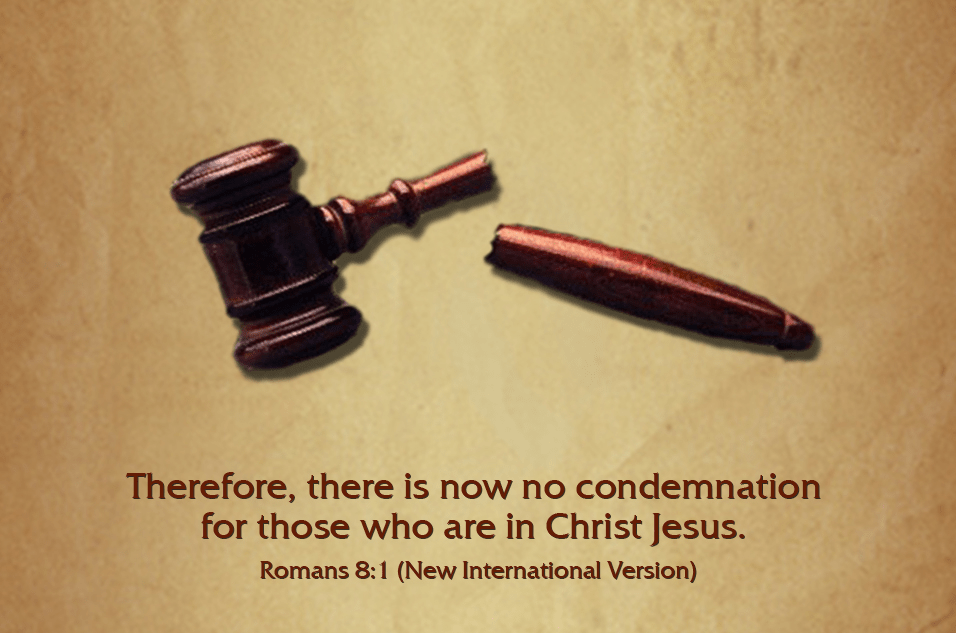
Therefore, there is now no condemnation for those who are in Christ Jesus, because through Christ Jesus the law of the Spirit who gives life has set you free from the law of sin and death. For what the law was powerless to do because it was weakened by the flesh [sinful nature] God did by sending his own Son in the likeness of sinful flesh to be a sin offering. And so he condemned sin in the flesh, in order that the righteous requirement of the law might be fully met in us, who do not live according to the flesh but according to the Spirit.

Those who live according to the flesh have their minds set on what the flesh desires; but those who live in accordance with the Spirit have their minds set on what the Spirit desires. The mind governed by the flesh is death, but the mind governed by the Spirit is life and peace. The mind governed by the flesh is hostile to God; it does not submit to God’s law, nor can it do so. Those who are in the realm of the flesh cannot please God.

You, however, are not in the realm of the flesh but are in the realm of the Spirit, if indeed the Spirit of God lives in you. And if anyone does not have the Spirit of Christ, they do not belong to Christ. But if Christ is in you, then even though your body is subject to death because of sin, the Spirit gives life because of righteousness. And if the Spirit of him who raised Jesus from the dead is living in you, he who raised Christ from the dead will also give life to your mortal bodies because of his Spirit who lives in you. (New International Version)

I feel tremendously privileged to be a Christian and to enjoy the very Spirit of God. The people of God are spiritual people, possessing God’s own Spirit. The Apostle Paul wanted Christians to know the privileges of life in the Spirit, as believers in Jesus.

No Condemnation

There is now no condemnation, no judgment, for us who are in Christ. God has pronounced a verdict, and that decision is final. We have been united to Christ by means of God’s Spirit. Since God condemns neither you nor I, there is no need whatsoever to condemn ourselves or other believers.

Since no condemnation is our reality as Christians, we are to believe this promise of God and swim in its wonderful privilege. Believe that the sin issue has been taken care of once for all through the life and death of Christ. And if you do not feel forgiven, then put yourself in a position to believe. 

It would be silly to go into the bathroom, turn on the shower, and then just stand in the middle of the bathroom without getting under the showerhead. It would be weird because you did not put yourself in a position to actually become clean. You may believe that a shower and using soap and shampoo will make you clean, but if you do not actually avail yourself of the privilege of actually taking the shower, but just stand there and look at it, you will not really be clean. 

We must put ourselves in a position to experience the privilege of knowing our wonderful state of cleanliness (no condemnation) by actually reading the Word of God on a regular basis; by praying in the Spirit on all occasions; by practicing the silence and solitude and other spiritual disciplines necessary to receive the cleansing work of the Holy Spirit.

Two people are declared “married” in a formal wedding ceremony. The couple then works out their shared union together over a lifetime. The minister does not pronounce condemnation at the ceremony; he declares a blessing. Yet, from that point forward, the two people must work on their marriage. They must believe their relationship is important enough to warrant putting themselves in a position to grow together. They will intentionally create date nights and conversations on the couch. They’ll seek to learn, appreciate, and participate in the other person’s interests and life. 

“Grace is not opposed to effort; it is opposed to earning. Earning is an attitude. Effort is an action. Grace, you know, does not just have to do with forgiveness of sins alone.”

Dallas Willard, The Great Omission

Just as we do not marry ourselves and pronounce ourselves a married couple, so we do not save ourselves. However, having a marriage license does not mean there is no effort to be done in the relationship. A marriage is both a legal reality, and a kind of mystical union between two married persons.

It’s a beautiful thing to be in a relationship where there is no condemnation. Because of Jesus Christ we are free to be the people God created us to be – forgiven and no longer burdened by the condemning voices of guilt and shame.

Freedom from Sin and Death

In Holy Scripture, sin is not only a personal struggle but a present ubiquitous reality in the world. The power and presence of sin is found everywhere. There is personal sin, institutional sin, and systemic sin. Because sin is everywhere, death is everywhere. Biblically, death refers to more than physical death because it is also a relational term. Death means relational separation from God. Conversely, life is relational connection with God. 

God did all the action necessary to make the union possible. God sent the Son. God became incarnate. God’s Son became a sin-offering, an atoning sacrifice for our sins. God condemned sin in sinful humanity. God met the righteous requirements of the law. God effects holiness in us by means of the Spirit. 

Rather than saving us from this terrible plight of sin, and then simply telling us to live a holy upright life, God the Father and God the Son sent God the Holy Spirit to indwell us so that we can live like Jesus. Therefore, we must put ourselves in a position to experience life through dwelling in the Scriptures and letting the Spirit and the Word work together to effect practical change in our lives (sanctification, that is, becoming holy). 

Having the Mind of Christ

A problem we all face is that we inhabit a fallen world. Our mindset can easily get screwy. If we want life and peace, we need the mind of Christ and the Spirit. Whatever our minds are occupied with is what determines whether we will have life and peace, or not. 

If the objects of our thoughts, interests, and affections are continually away from Christ and the Spirit, we will experience death, not life. If we put ourselves in a position to indulge the sinful nature (the “flesh”) we will miss real life. An undisciplined mind only leads to relational separation.

The addict knows there are two choices: either life or death. The first of the twelve steps of Alcoholics Anonymous is to admit that I am powerless over alcohol and that my life has become unmanageable.  The second step is to believe that a Power greater than myself can restore me to sanity. The third step is to turn my life and my will over to that Power. So, it is the same for us. 

We are powerless over sin, which will, if left unchecked, lead to death. But in the Spirit (not the alcoholic spirits!) we have life. Sin, like alcohol, is a daily possibility, even after giving my life and my will to God. Yet, there is also the possibility of life. And that hope of life comes with possessing the mind of Christ and the Spirit. 

We have hope that through the Spirit’s power we will overcome the power of choices that lead to death; and instead, embrace choices that lead to life. So, whatever we put into our minds is vitally important. 

The Spirit Indwelling Us

The Spirit is the distinguishing mark of the believer in Jesus. The Spirit opposes the sinful nature and expects us to do the same. There’s no need to try and live the Christian life on our own power when we possess spiritual power. There exists an internal struggle within us that desires to do right but has a compulsion to do otherwise. Yet, the indwelling Spirit gives us victory. Jesus lived the life for us that we could not live. His life, as much as his death, achieved salvation from sin for us. The very same Spirit that helped Jesus live his life, and raised him from death, is the same Spirit whom we possess.

When I was a kid, I remember my grandmother canning preserves. I would sit on a stool in the kitchen and watch her, looking forward to having some grape preserves on my next piece of toast. I once asked her, “Why are you always melting that wax over the fruit?” I didn’t understand how wax could make my toast taste any better. Grandma answered, “The wax seals the jar tightly so the fruit can’t be contaminated. If I didn’t seal it, the fruit would eventually rot.” As an amateur in the canning business, I could see the importance of picking grapes, boiling them, and canning them. But I now know how important sealing and preserving are.

You and I are God’s preserves. God not only chose us, redeemed us, and called us to life in the Son – God also had a plan for preserving us as heirs of eternal life. God gave us the indwelling Spirit so that we can live as we ought, free from sin and doing the will of God through spiritual power working within us. 

I hope today that you have a deep appreciation for the privileges of no condemnation, freedom from sin, possessing the mind of Christ and the power of the indwelling Spirit. And more than that, that you will avail yourselves of this tremendous gift of the Spirit and experience life and peace.

Gracious God, fill us with the knowledge of your will through all spiritual wisdom and understanding. May we live lives worthy of the Lord Jesus and please him in every way; bearing fruit in every good work, growing in the knowledge of God; being strengthened with all power according to your glorious might so that we may have great endurance and patience, joyfully giving thanks to you. For you have rescued us from the dominion of darkness and have brought us into the kingdom of the Son you love, in whom we have redemption, the forgiveness of sins. Amen.