

Immortal God and Mortal Humanity (Psalm 90)

Digital artwork by Bruce Butler

Lord, you have been our dwelling place
    in all generations.
Before the mountains were brought forth
    or ever you had formed the earth and the world,
    from everlasting to everlasting you are God.

You turn us back to dust
    and say, “Turn back, you mortals.”
For a thousand years in your sight
    are like yesterday when it is past
    or like a watch in the night.

You sweep them away; they are like a dream,
    like grass that is renewed in the morning;
in the morning it flourishes and is renewed;
    in the evening it fades and withers.

For we are consumed by your anger;
    by your wrath we are overwhelmed.
You have set our iniquities before you,
    our secret sins in the light of your countenance.

For all our days pass away under your wrath;
    our years come to an end like a sigh.
The days of our life are seventy years
    or perhaps eighty, if we are strong;
even then their span is only toil and trouble;
    they are soon gone, and we fly away.

Who considers the power of your anger?
    Your wrath is as great as the fear that is due you.
So teach us to count our days
    that we may gain a wise heart.

Turn, O Lord! How long?
    Have compassion on your servants!
Satisfy us in the morning with your steadfast love,
    so that we may rejoice and be glad all our days.
Make us glad as many days as you have afflicted us
    and as many years as we have seen evil.
Let your work be manifest to your servants
    and your glorious power to their children.
Let the favor of the Lord our God be upon us
    and prosper for us the work of our hands—
    O prosper the work of our hands! (New Revised Standard Version)

All of the psalms are prayers. Most of them are prayers of David. Today’s psalm is a prayer of Moses.

Moses acknowledged and affirmed that God is eternal, and we humans are not. We are frail and in need of God. We are dependent upon God for health, hope, and happiness in life.

There are observations to notice in today’s Psalm lesson, that are then followed by prayerful petitions which arise from those observations.

First Observation: God Is Eternal

God is immortal. God has always been, and will always be. Therefore, the Lord’s rule and reign existed way before this world was ever created, and shall extend way beyond the lifespan of creation. God’s dwelling place is without beginning or end – which means that God isn’t going anywhere. That is a great comfort to me.

Second Observation: Humans Are Finite

Whereas God is immortal, we humans are mortal beings. We are creatures with limited time on this earth. We all eventually die. Everyone returns to the dust from which they came – which isn’t even a blink of an eye when compared to God’s eternal existence.

This isn’t meant to be a downer for us, but rather to help us. It is necessary to work within our limitations while living in this world. To live as if we are immortal has grave consequences (pun intended).

Third Observation: The World Is Broken

Our world is fundamentally messed up. Another way of saying this is that everything in creation is under a curse. Things are not as they should be. And that’s on us, not God. Because of our own human proclivity to sin, our world is beset with a great deal of suffering and toil.

Hopefully, in the best scenario, people learn to understand the brevity of life, and gain wisdom on how to live a humble, just, and good life with one another, and with their God.

Now notice the petitions which Moses offered to God, based upon the observations of God’s nature, human nature, and the world’s situation.

First Petition: Turn, O Lord!

Moses was pleading with God to turn away from divine judgment and wrath, which was more than deserved for a group of people who were chronically complaining and disobedient. Moses was well aware of all Israel’s sins, and was counting on the Lord’s mercy for God’s covenant people.

Second Petition: How long, O Lord?

Moses was asking one of those questions that we ask, knowing that he wasn’t really going to get an answer. Yet, in the asking, there is an understanding that human misery won’t go on forever. Our suffering is temporary.

In this petition of Moses, he was also calling for a change, for God to deal with the people in a different way. Moses wanted gladness to replace affliction, and the sufferings of this life to give way to the joy of living in a good world.

Third Petition: Prosper the work of our hands

This wasn’t a petition for God to simply make everyone healthy and wealthy. It was a focused prayer that God’s work and our human work would be one seamless activity. That is, this is a prayerful longing for what we do in our lives to completely synchronize with God’s law in this world we all inhabit together.

Whenever we sin, we cause damage, not prosperity. Yet, with a divine/human cooperative in which we acknowledge and affirm God’s sovereignty over our lives, and take up our own human responsibility, then humanity thrives and flourishes in the goodness we were meant to enjoy as God’s creatures.

Christian Observations

In Christianity, the immortal and invisible God comes to us in the mortal and visible life of Jesus. In Christ, the sovereignty of God and the responsibility of humanity is not only synchronized; it is perfectly united and harmonized so that there is deliverance from the power of evil and from God’s judgment.

God’s steadfast love is brought to us with skin on.

For the Christian, Jesus is the answer to the prayers and petitions of Moses. Christ is the prophet foretold by Moses who was to come:

I [Yahweh]will raise up for them [the Israelites] a prophet like you [Moses] from among their own people; I will put my words in the mouth of the prophet, who shall speak to them everything that I command. (Deuteronomy 18:18, NRSV)

The incarnation, life, ministry, crucifixion, death, resurrection, ascension, and glorification of Jesus Christ has dealt with the weeds and overgrowth of guilt and shame that has taken over the garden of this world.

In Christ, we can begin to hack through all the stuff, in order to see the beauty underneath all of the spiritual neglect which has occurred for so long.

May the grace of the Lord Jesus Christ, the steadfast love of God the Father, and the encouragement of the Holy Spirit be with you, now and forever. Amen.

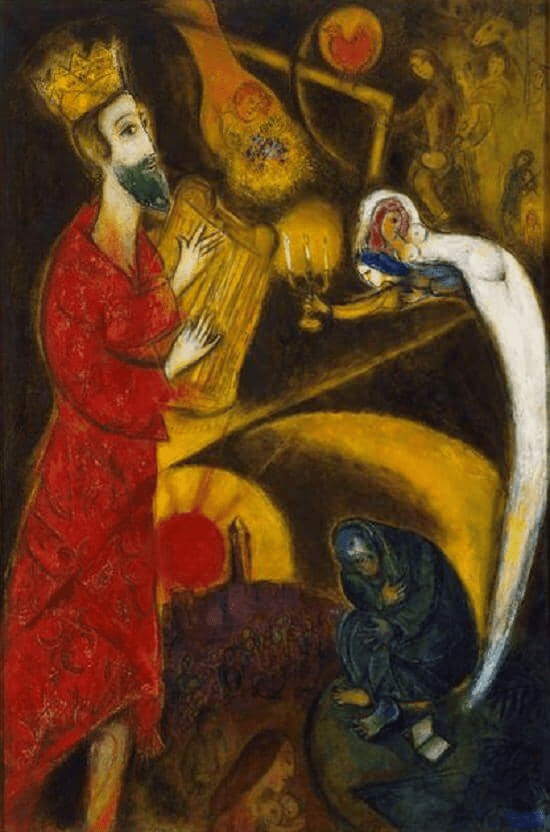
Pillow Thoughts (Psalm 132:1-12)

King David, by Marc Chagall, 1962

O Lord, remember in David’s favor
    all the hardships he endured;
how he swore to the Lord
    and vowed to the Mighty One of Jacob,
“I will not enter my house
    or get into my bed;
I will not give sleep to my eyes
    or slumber to my eyelids,
until I find a place for the Lord,
    a dwelling place for the Mighty One of Jacob.”

We heard of it in Ephrathah;
    we found it in the fields of Jaar.
“Let us go to his dwelling place;
    let us worship at his footstool.”

Rise up, O Lord, and go to your resting place,
    you and the ark of your might.
Let your priests be clothed with righteousness,
    and let your faithful shout for joy.
For your servant David’s sake
    do not turn away the face of your anointed one.

The Lord swore to David a sure oath
    from which he will not turn back:
“One of the sons of your body
    I will set on your throne.
If your sons keep my covenant
    and my decrees that I shall teach them,
their sons also, forevermore,
    shall sit on your throne.” (New Revised Standard Version)

King David took great pains in providing for the house of the Lord; and was very concerned about the worship of Yahweh. He went well out of his way to ensure that a temple would be built for his God.

David made as many preparations as he possibly could before his death, so that his son Solomon could follow through and build the temple. The editor of the Book of Chronicles commented on this:

David gave orders to gather together the aliens who were residing in the land of Israel, and he set stonecutters to prepare dressed stones for building the house of God. David also provided great stores of iron for nails for the doors of the gates and for clamps, as well as bronze in quantities beyond weighing, and cedar logs without number—for the Sidonians and Tyrians brought great quantities of cedar to David. 

For David said, “My son Solomon is young and inexperienced, and the house that is to be built for the Lord must be exceedingly magnificent, famous and glorified throughout all lands; I will therefore make preparation for it.” So David provided materials in great quantity before his death. (1 Chronicles 22:2-5, NRSV)

The king did all of this because God came to David and let him know that he would not be the one to build the temple; that job would fall to his son Solomon. (2 Samuel 7:4-13)

David’s final instruction to Solomon and the people had to do with the construction of a house for the Lord his God:

“Now set your mind and heart to seek the Lord your God. Go and build the sanctuary of the Lord God so that the ark of the covenant of the Lord and the holy vessels of God may be brought into the house built for the name of the Lord.” (1 Chronicles 22:19, NRSV)

The worship of God, for David, was to be the central feature of the Jewish people. All Israel and Judah were to encourage one another in worship at God’s house, the Lord’s Temple, in Jerusalem.

The priests of God wore special clothing, and handled the holy implements and the Ark of the Covenant of God. Yet, they were to be also clothed with righteousness, making sure that their outward ceremonial rituals reflected an inner moral purity and holiness before God.

David was bound and determined to not only worship the Lord himself, but to see that the entire nation of Israel had the opportunity to worship together in a central place.

Maybe a question arises for you about why David was so driven to construct a house for God. What is it that motivated King David to spend so much of his planning and energy on making sure that a temple would be constructed for the Lord?

Now when the king was settled in his house and the Lord had given him rest from all his enemies around him, the king said to the prophet Nathan, “See now, I am living in a house of cedar, but the ark of God stays in a tent.” Nathan said to the king, “Go, do all that you have in mind, for the Lord is with you.” (2 Samuel 7:1-3, NRSV)

A lot of events had transpired for David to be in the position of king, with peace all around him. The Lord had been with David, and brought him through the sort of adversities most of us will never know.

Once King David was at the pinnacle of peace and success, his thought were not about how to hold onto power, or to get more of it. He would lay his head on his pillow at night and wonder how he could give back to God for being so faithful.

And considering all that God had accomplished for him and for Israel, it seemed a travesty that he was luxuriating in a fine house, while the Ark of the Covenant – the objective presence of God among the people – was sitting in an old tent. So, David became determined to change that situation, because he could.

I wonder if when you and I are at a place in our lives where we feel safe and secure, prosperous and happy, our thoughts and dreams turn toward how we might give back to God in a worshipful way which will honor the Lord, as well as bless all the people of God.

I am curious what sort of things occupy your mind at night while your head is on your pillow, when you are feeling good about how your life is going.

Many, if not most, people will think about themselves, and what to do with what they have gained and/or accomplished. But what about you?

How will you respond to God’s grace, goodness, deliverance, and protection in your own life? What sort of ideas arise in your mind? What is in your heart to do for God and God’s people?

What are your pillow thoughts at night?

Presence itself is a great gift. The presence of God is incredibly gracious, good, and miraculous. And human presence, with each individual stamped with the image and likeness of God upon them, is also a wonderful gift from the Creator. And very much needed.

David enjoyed the presence of God, and longed for all the people to experience that divine presence. Although the Lord needed no temple to live in, David had in mind to provide one.

I imagine that King David understood that each person is a luminous icon of presence, reflecting God’s image, and needing the presence of God and others in order to have a nation who worships God as commanded in the Mosaic law.

Through communal worship at a designated site in Jerusalem, the Israelites could enjoy the beauty of God’s presence together, as well as the encouragement of one another.

Wherever there is presence and the acknowledgement of God and each other, there is freedom to offer affection, understanding, and respect.

It seems to me that these were the sort of thoughts that ran through King David’s mind, which made him determined to build a house for the Lord his God.

So, what will you do with your thoughts and your life?

Almighty God of all hope, of our thoughts and dreams: In humility, we give you thanks for all of creation; and for everything you give us. We praise you for forgiving us of our guilt and shame, even before we ask. You raise us from our broken state and make us whole. You give us the peace we yearn for.

Blessed God, fill us, your people, with your divine Spirit. Be our light in the darkness. Envelop us with your presence. Orient our hearts toward your justice; and help us always praise you. Let us ever be mindful of your power and grace in the world. Let us live as one with you in grace and in truth. Amen.

There Is a Larger Perspective (Psalm 73:1-20)

Psalm 73, by Keli Hogsett. The artist states, “This piece is made entirely of wood ‘ends.’ The wood colored ends represent nearness to God, where the darker pieces represent the opposite. The darker ends can attract and manipulate the wooden ends, but the darker they get, they turn downward and are swallowed by the wooden ends.

God is indeed good to Israel,
    to those who have pure hearts.
But I had nearly lost confidence;
    my faith was almost gone
because I was jealous of the proud
    when I saw that things go well for the wicked.

They do not suffer pain;
    they are strong and healthy.
They do not suffer as other people do;
    they do not have the troubles that others have.
And so they wear pride like a necklace
    and violence like a robe;
their hearts pour out evil,
    and their minds are busy with wicked schemes.
They laugh at other people and speak of evil things;
    they are proud and make plans to oppress others.
They speak evil of God in heaven
    and give arrogant orders to everyone on earth,
so that even God’s people turn to them
    and eagerly believe whatever they say.
They say, “God will not know;
    the Most High will not find out.”
That is what the wicked are like.
    They have plenty and are always getting more.

Is it for nothing, then, that I have kept myself pure
    and have not committed sin?
O God, you have made me suffer all day long;
    every morning you have punished me.

If I had said such things,
    I would not be acting as one of your people.
I tried to think this problem through,
    but it was too difficult for me
    until I went into your Temple.
Then I understood what will happen to the wicked.

You will put them in slippery places
    and make them fall to destruction!
They are instantly destroyed;
    they go down to a horrible end.
They are like a dream that goes away in the morning;
    when you rouse yourself, O Lord, they disappear. (Good News Translation)

The psalmist Asaph communicated his own experience, which is really the experience of all Israel, and of all who genuinely seek to follow God.

Everyone who is truly pure in heart will struggle, at times, to make sense of all the impurity and injustice in the world. Even a cursory observation of this old world clearly sees that it is a broken messed up place.

Those observations challenge the faithful with questions such as, “Is God really good?” and “Is maintaining my purity and faithfulness worth it?”

Most often, the response to those questions is “Yes, but…”

Arrogant people prosper. They get away with being jerks. And it isn’t fair. Good people continually face adversity and hardship. Nothing comes easy. And it doesn’t make sense.

Contemplating this reality for too long can lead to a spiritual crisis of faith. It can produce doubt. It is likely to either morph into anger and bitterness, or a passive “meh” to most things in life.

However, observational appearances can be deceiving. There is much more to seeing than with our two physical eyes. There is the kind of sight which God has:

“I do not judge as people judge. They look at the outward appearance, but I look at the heart.”

1 Samuel 16:7

In truth, the real and actual power of arrogantly wicked people is their ability to create envy and jealousy in the righteous persons.

We need a different way of seeing, a reorientation of our limited understanding of life. Look at the world, containing both the wicked and the righteous, from an angle you haven’t seen before.

For Asaph, this breakthrough perspective happened in the sanctuary of his God. The psalmist began to see that the seeming wealth, health, and invincibility of the arrogant is merely a façade. Their true future is anything but prosperous.

Asaph also had a reorientation of himself. He began to understand and accept that his own heart had the shadows of bitterness and ignorance. He himself had too much vice hiding in his heart.

With the spiritual eyes of the heart, we can focus in on the presence of God. The Lord’s guidance is constant, even when it doesn’t seem like it. God’s handle on the future is secure.

The arrogant and the wicked will not last. There is a day coming when they will not rule over anything. Their end is a sure thing.

The wise heart discerns that not everything I see today will be the same tomorrow. Therefore, I can plan wisely for the future, and be patient that the goodness of God will ultimately prevail over it all. This orientation to life brings confidence and hope.

Wisdom also directs us to discern that our hope and confidence can wax and wane. Just because we may be full of faith, hope, and love today, does not mean that from here-on-out we will never have to struggle with these feelings of jealousy, envy, disappointment, and anger.

Far too often we think emotions can be easily replaced, the negative ones for the positive, envy for happiness, or jealousy for satisfaction.

However, we are more complex creatures than that, having the capacity to hold multiple emotions at the same time. Sometimes, the best thing is to recognize that I can be happy, even though I am sad, without ignoring or stuffing the sadness.

Consider this: At the same time, all the time, God is both terribly sad, as well as quite exuberant. The Lord both grieves and celebrates continually. That’s because God sees it all.

And if I were to see the entire scope of your life, I am sure there are aspects of that life which are joyous, and elements which are despondent, with great longing for change.

Asaph got a much fuller picture of how things actually are in this world. And with that more expansive perspective he discovered a sense of settled hope, despite the fact that nothing in his world had changed at all.

Indeed, I myself am to be the change that I long for in this world. And it starts with gaining a perspective of wisdom, and seeing the angle of immateriality.

Arrogant pride, hoarding of wealth, and injustice will not last forever. They are temporary. But there are permanent things in this universe, and none of them have to do with money or stuff.

When all is said and done, Love survives and thrives. God hasn’t gone anywhere. Jesus Christ is the same yesterday, today, and forever. The Spirit is still alongside us.

And the wicked are no more.

So, may righteousness, justice, and peace surround you today and everyday like a warm security blanket of hope. And may you know that you are seen and loved by a God who cares. Amen.

For the Sake of Beauty (1 Kings 7:1-12)

King Solomon’s throne room, by Edward Poynter, 1890

Solomon’s palace took 13 years to build.

Forest Hall was the largest room in the palace. It was 44 meters long, 22 meters wide, and 13.5 meters high, and was lined with cedar from Lebanon. It had 4 rows of cedar pillars, 15 in a row, and they held up 45 cedar beams. The ceiling was covered with cedar. Three rows of windows on each side faced each other, and there were three doors on each side near the front of the hall.

Pillar Hall was 22 meters long and 13.5 meters wide. A covered porch supported by pillars went all the way across the front of the hall.

Solomon’s throne was in Justice Hall, where he judged cases. This hall was completely lined with cedar.

The section of the palace where Solomon lived was behind Justice Hall and looked exactly like it. He had a similar place built for his wife, the daughter of the king of Egypt.

From the foundation all the way to the top, these buildings and the courtyard were made out of the best stones carefully cut to size, then smoothed on every side with saws. The foundation stones were huge, good stones—some of them four and a half meters long and others three and a half meters long. The cedar beams and other stones that had been cut to size were on top of these foundation stones. The walls around the palace courtyard were made out of three layers of cut stones with one layer of cedar beams, just like the front porch and the inner courtyard of the temple. (Contemporary English Version)

By Bible Art

Having secured the throne after his father’s death, King Solomon set himself to the task of following his father David’s ardent desire to build a temple for the Lord. The work took seven years to complete. (1 Kings 5-6)

Then, Solomon turned to building a royal palace with a complex of buildings (or halls). It seems these had the purpose of being both residences and government structures. This architectural achievement took nearly twice as long as constructing the temple of God.

Some commentators are rather hard on Solomon about this fact of taking so much time to build himself a palace. They interpret him as being distracted, almost self-absorbed – that somehow his heart was more into his own buildings than God’s temple.

I don’t really buy into that line of thinking. It seems to me this reads more into the text than what’s there. They could be right. However, it appears such commentary does an anachronistic reading of the text. Taking a standpoint of Solomon’s later devotion to his many wives, and hence their many other gods, a lack of commitment is then superimposed upon the construction projects. It’s as if Solomon finished the temple stuff in order to get his real architectural passions.

I think there’s a more plausible explanation for King Solomon’s dedication to erecting buildings in addition to the temple. The editor of 1 Kings includes the detail and dedication that went into the temple.

Let’s keep in mind that King David had been stockpiling and preparing materials, and planning for the temple, well before he died. Just because the Lord told David that he would not be the one to build it, that Solomon would, did not mean that David kept his thoughts and his hands off of getting as much ready as he could for his son.

What’s more, once Solomon put together such a marvelous and intricate building as the temple, the experience gave him a desire to work on other projects, as well. Solomon had an expansive vision of his kingdom.

As the wisest person on earth, he put his money where his mouth was, by constructing beautiful structures given to justice, and reflecting the abundance of a goodness and justice which comes through living by God’s covenant code.

Did Solomon go overboard? Yes, and no. It depends on the project, and with whom you talk to. The issue of Solomon’s building projects, as I would frame it, has much more to do with demonstrating a particular theology.

The theology I believe Solomon was trying to reflect was that Israel serves a God who is given to beauty, justice, and abundance. And those qualities are also seen in the New Testament. I think of the story when Mary came to Jesus with her expensive and beautiful perfume:

Mary took a very expensive bottle of perfume and poured it on Jesus’ feet. She wiped them with her hair, and the sweet smell of the perfume filled the house.

A disciple named Judas Iscariot was there. He was the one who was going to betray Jesus, and he asked, “Why wasn’t this perfume sold for 300 silver coins and the money given to the poor?” Judas did not really care about the poor. He asked this because he carried the moneybag and sometimes would steal from it.

Jesus replied, “Leave her alone! She has kept this perfume for the day of my burial. You will always have the poor with you, but you won’t always have me.” (John 12:3-7, CEV)

I would argue that Judas Iscariot was the one distracted – and not Mary. Thus, returning to the story of Solomon’s building the palace complex, I would also argue that perhaps some of the commentators, with an eerily familiar criticism, are actually the ones distracted – and not Solomon.

Anyway, I like my positive reading of today’s Old Testament lesson, rather than the others’ negative reading. What about you?…

O heavenly God, who has filled the world with beauty: Open my eyes to see what is beautiful, to behold your gracious hand in all your works. Open my mind to know what is true. Open my heart to love what is good. May I learn to serve you with gladness, justice, and righteousness. Amen.