Psalm 82 – Help Others, Without Prejudice

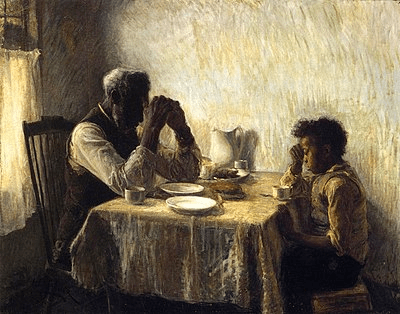
“The Thankful Poor” by Henry Ossawa Tanner, 1894

God takes his place in his own assembly.
He pronounces judgment among the gods:
“How long are you going to judge unfairly?
How long are you going to side with wicked people?”

Defend weak people and orphans.
Protect the rights of the oppressed and the poor.
Rescue weak and needy people.
Help them escape the power of wicked people.

Wicked people do not know or understand anything.
As they walk around in the dark,
all the foundations of the earth shake.
I said, “You are gods.
You are all sons of the Most High.
You will certainly die like humans
and fall like any prince.”

Arise, O God!
Judge the earth, because all the nations belong to you. (God’s Word Translation)

“My dear friends, pay attention. God has given a lot of faith to the poor people in this world. He has also promised them a share in his kingdom that he will give to everyone who loves him.”

James 2:5, CEV

God’s mercy and grace is what makes the world go round. God’s attention to people who possess little to nothing is what upholds the earth from being consumed with judgment.

An absence of grace in people is offensive to God. An uncharitable spirit, indifferent to those in need, will eventually face the crushing weight of God’s glory upon them.

The psalmist is uncompromisingly clear on divine imperatives for humanity: defend the weak; protect the rights of the poor; rescue the needy; and deliver them from unjust power. That’s what God does. And that is what we are to do, without prejudice.

When I was growing up, our family dog was named “Sam.” Sam loved being on the farm. One time he tussled with a skunk. I could barely get close enough to clean him up because he stunk so badly. 

Favoritism toward those with means over those who don’t, stinks, and God has a hard time getting close to us when we show partiality to others. And the Lord is going to clean us up when he smells the stench of discrimination on us. 

Showing favoritism to some over others is evidence that the dog is running away from the bath of grace. In order to develop relationships and interact with people the way God wants us to, we must be free from prejudice.

No matter how you slice the Bible, God cares about persons trapped in poverty. The poor are important to the Lord. 

When Jesus began his earthly ministry, he pointed people to the words of the prophet Isaiah.

“The Spirit of the Lord is upon me, because he has chosen me to bring good news to the poor.” (Isaiah 61:1; Luke 4:18) 

In the Old Testament, there are seven different words for the “poor” because poverty was such a pervasive reality (and still is across the world!). The range of meanings includes those who are poor because of laziness; those born into poverty; being poor because of inhuman oppression or slavery; simple beggars; and the pious humble poor. 

These spiritual poor persons are the Hebrew “anawim.” (pronounced “on-a-wheem”) The anawim are humble persons caught in grinding poverty, having no choice but to put their trust in God.

God has a lot to say about such persons because they are near and dear to the divine heart. Old Testament law was quite clear about how to treat the poor. 

Poor persons will never disappear from the earth. That’s why I’m giving you this command: you must open your hand generously to your fellow Israelites, to the needy among you, and to the poor who live with you in your land. (Deuteronomy 15:11, CEB)

Do not cheat poor and needy hired servants, whether they are Israelites or foreigners living in one of your towns. Each day before sunset pay them for that day’s work; they need the money and have counted on getting it. If you do not pay them, they will cry out against you to the Lord, and you will be guilty of sin. (Deuteronomy 24:14-15, GNT) 

The mistreatment, exploitation, and inattention to the poor, the anawim, was the chief reason God sent prophets to Israel. 

Listen to this, you who rob the poor
    and trample down the needy!
You can’t wait for the Sabbath day to be over
    and the religious festivals to end
    so you can get back to cheating the helpless.
You measure out grain with dishonest measures
    and cheat the buyer with dishonest scales.
And you mix the grain you sell
    with chaff swept from the floor.
Then you enslave poor people
    for one piece of silver or a pair of sandals.

Now the Lord has sworn this oath
    by his own name, the Pride of Israel:
“I will never forget
    the wicked things you have done! (Amos 8:4-7, NLT)

Instead of being generous to the poor and allowing them to forage for grain at harvest behind the harvesters, they kept “those people” away from the fields so that they could turn a profit at every little bit they could. And God thought it all stunk to high heaven.

Bear in mind, only the poor in spirit will enter the kingdom of heaven. The real issue is humility that demonstrates grace to people who cannot offer you something in return. 

It’s easy to be merciful to people who will turn around later and scratch your back. It’s altogether a different thing to be humble, gracious, and generous to those you know cannot give anything back to you.

God cares about the condition of our souls and not the balance of our bank accounts. 

Inattention to the needy only betrays a heart far from the Lord. God does not judge people on face value and the state of their finances, and neither should we.

The only way to rid ourselves of the stench of showing favoritism is to receive the cleansing bath of God’s mercy in Jesus Christ. The shampoo of grace is available, that is, if we will let God apply it. God is the expert in:

  • Turning people from only associating with those they are comfortable with, to lovingly reaching out to people very different from themselves
  • Changing people from the stinking thinking about what they can continually obtain and consume, to people who are loving and generous with their words and their physical resources
  • Putting to death a proud spirit that looks to get ahead and accomplish an agenda by any means possible, to giving new life through humble repentance.

Ministry to the poor is a non-negotiable for the Christian and Christ’s Church. 

Beyond mere dispensing of benevolent funds, the poor also need relationships, connections, resources, and a chance to give back in ways they can contribute. That’s just part of being attentive to them and extending basic human respect and dignity. 

How do you or your church show their concern for the poor in your city and/or region?

Almighty and most merciful God, we remember before you all the poor and neglected persons whom it would be easy for us to forget: the homeless and the destitute, the old and the sick, and all who have none to care for them. Help us to heal those who are broken in body or spirit, and to turn their sorrow into joy. Grant this, gracious Father, for the love of your Son, who for our sake became poor, Jesus Christ our Lord. Amen.

1 John 2:7-11 – Love, Not Hate

Dear friends, I am not writing you a new command but an old one, which you have had since the beginning. This old command is the message you have heard. Yet I am writing you a new command; its truth is seen in him and in you, because the darkness is passing, and the true light is already shining.

Anyone who claims to be in the light but hates a brother or sister is still in the darkness. Anyone who loves their brother and sister lives in the light, and there is nothing in them to make them stumble. But anyone who hates a brother or sister is in the darkness and walks around in the darkness. They do not know where they are going, because the darkness has blinded them. (New International Version)

It ought to be abundantly clear that hate has absolutely no place in the Christian’s life. Hate is never justified for any individual or group of people. There are no exceptions.

Love, however, is the consummate Christian virtue. The highest of all truth in Christianity is the grace that is bestowed on us through the love of God in Christ. We, in turn, reflect our Lord’s grace by loving others, no matter their gender, race, creed, or ethnicity.

Yet, we are all familiar with hate. Everyone has hated another, and others have hated us. Unfortunately, hate is ubiquitous throughout the world.

Let’s face it: You and I have people we just don’t like. And maybe for good reason. After all, if you are being gaslighted by someone, or have been abused, mistreated, or oppressed by a person or group, then it takes no effort in disliking them, even to the point of despising them in your heart.

As much as other people need to change, the Apostle John places the burden of change to fall on us who claim the name of Christ. Love must begin somewhere. Let it begin with me.

The bald fact of the matter is that we cannot change another person. We can only control ourselves, and a lot of us don’t do a very good job with that. Christians are to learn to speak and act in the loving ways passed on to us through the gospel. We are to become skilled in the ways of Jesus, which is the way of love.

I fully understand this is not easy. In fact, it is downright hard. Forgiving another, even ourselves, can be a long painful process. Making the choice to love again, or love my enemy, is no small thing. Love must always be our default and de facto response to everyone. Otherwise, our hearts will grow cold and hard. And we will become the very people we despise.

There is a shadow self, dwelling within us all. There are murky places in our hearts where darkness resides. We cannot afford to ignore those places. If we pretend there is no shadow self and keep up appearances, then we actually give the darkness power to come out of us through hateful speech and actions.

The “shadow” is a concept first coined by the Swiss psychiatrist, Carl Jung (1875-1961). Jung describes the shadow self as those aspects of our personality we choose to reject and/or repress. In other words, we all have parts of ourselves we don’t like—or that we think others won’t like—so we stuff those parts down into our unconscious psyche.

So then, the shadow self is a collection of things we toss into the closet of our hearts, lock the door, and forget about them. But they’re still there. And they still exert a great deal of influence from inside that dark closet.

We must be willing to face the shadowy parts of ourselves, to face the dark thoughts and feelings of secretly harming another (or ourselves), nursing a grudge, harboring bitterness, or holding onto an offense, as if it were a security blanket.

Whereas some may believe all our unwanted emotions, thoughts, feelings, and experiences are tightly hidden, they are not. Instead, the telltale sign of the darkness slipping out sideways into the world is hate. And that insidious hate typically takes the following forms:

  • Harshly judging or criticizing others by taking a superior posture over another. The critic, however, doesn’t know they are really castigating themselves.
  • Rebuking others as a common practice. Pointing out another’s “sins” is only a projection of one’s inner darkness onto the other.
  • Having a quick temper. Getting angry and belittling those who cannot fight back or respond is really self-loathing slathered onto someone else.
  • Being the victim in every bad situation. Victimization is a terrible thing. And when someone who isn’t really a victim claims to be one, it diminishes and invalidates the help that true victims need. This is the shadow self’s insecurity coming out – needing attention so that the incessant pounding from the inside of the heart is silenced.
  • Doing whatever is needed to get what you want. If that entails being mean, nasty, and hateful to achieve a desire outcome, then that is what is done.
  • Expressing implicit biases and prejudices. Anyone different is a threat to the shadow self. That other person might expose what’s inside me. So, the other gets treated with subtle digs, demeaning behaviors, and discouraging speech to keep them from getting close.

We need healing from this awful malady of hate.

The good news is that light is also available, and within us. Even in the blackest of hearts, there still remains the little spark of God’s image, way down in there. And it only takes a small Bic lighter to penetrate the darkness.

God’s glory is brighter than the brightest sun. A mere glimpse of such glory is more than enough to lay any heart bare and dispel the darkness.

The love of God in Christ is meant to be received, and then given to others. Fortunately, God has an inexhaustible storehouse of grace, mercy, and love – which means we can keep receiving and keep giving. We’ll never run out.

The shadow self sees only scarcity, so it holds onto resources in the belief there may not be enough. The true self, however, living into the grace and mercy of Christ, rightly discerns that God’s kingdom is a place of abundance. We are enhanced, not diminished, whenever we do the opposite behaviors of the shadow’s propensity to hate:

  • Encouraging and helping others. Pointing out another’s strengths and affirming their good behavior is a liberal practice in God’s kingdom.
  • Showing empathy. Being able to put oneself in another’s shoes, along with the willingness to sit with another’s pain, are common practices of the loving Christian person.
  • Doing whatever is needed to build up the community for the common good of all persons.
  • Including others, especially those who are different than me, by making room for them at the Table and giving them a voice.
  • Forgiving others, just as Christ forgave us.

The believer need not be blinded by hate but can love from a place of healthy self-awareness.

Loving heavenly Father, I thank you for looking beyond my faults and loving me unconditionally. Forgive me when I fail to love others in the same way. Give me eyes to see the needs of the difficult people in my life and show me how to meet those needs in a way that pleases you and glorifies the name of Jesus Christ. Amen. 

Romans 5:1-5 – Maybe There Can Be Peace…

Therefore, since we have been justified through faith, we have peace with God through our Lord Jesus Christ, through whom we have gained access by faith into this grace in which we now stand. And we boast in the hope of the glory of God. Not only so, but we also glory in our sufferings, because we know that suffering produces perseverance; perseverance, character; and character, hope. And hope does not put us to shame, because God’s love has been poured out into our hearts through the Holy Spirit, who has been given to us. (New International Version)

Today, there are millions, perhaps billions, of people without peace in this world.

Maybe…

Maybe there isn’t much peace in your life. Because of that unsettled icky sense of agitation, your mind is somewhere else. It could be that you are upset about something that has happened or are worried about something that is going to happen. 

Maybe the lack of peace has to do with another person. They did or said something, and it’s been grinding on you. So, you are having conversations with that person in your head for which you will probably never say aloud. 

Maybe you have to deal with someone else who doesn’t have peace, and it’s creating stress for you. And you are wondering when things will settle down.

Maybe the lack of peace runs much deeper than your immediate circumstances and plans. 

Maybe every day, day-in-and-day-out, you are not quite sure about where you stand with a person or a group of people.

Maybe you aren’t sure about how you stand with God. You wonder whether God is really pleased with you, or not. 

Maybe you aren’t even in touch with your lack of peace because you are an expert at pushing whatever feelings you have so far down that you think you’re fine. But you really aren’t.

Maybe you are a perfectionist…

Perfectionists are never at peace. The specter of perfectionism always hangs in the air. There’s a steady stream of “should have’s,” and “could have’s” making noise in your head. Your work, no matter how good, is never good enough. “I should have done better.”  “I ought to do better.”  “I must be better.” 

Instead of viewing life’s opportunities as challenges to be welcomed, the perfectionist sees life as one unending mountain to climb, never quite reaching the top. 

The constant companions of perfectionistic people are disappointment, condemnation, frustration, and perceived failure. There is, for them, an internal world of self-loathing based on the lie that I am not enough – I have to be perfect. Peace, for the perfectionist, is a pipe dream.

Maybe we could focus a bit on God…

The Christian God is a triune God, existing in three persons – Father, Son, and Spirit – the great Three-in-One. The Trinity is the basis for all we are and all we do.

All of life is grounded in the triune God. God exists in perfect unity and harmony. God is God’s own community of glorious love. God’s glory is primarily seen on this earth through creation, through us, God’s creatures.

Glory is revealed as we reflect the image of God stamped on us in creation. Since God is love, God’s people are to be characterized by love – loving God, loving one another, and loving neighbor. God’s people are meant to exist together in unity and harmony, reflecting the very nature of the Holy Trinity. 

Yet, after the creation of the world and humanity, man and woman fell into guilt and shame through bucking God’s design for people. Ever since, God has been on a mission to reclaim the lost glory.

Maybe we need to focus on the Son… 

The ultimate expression of God’s mission was the sending of the Son to this earth. It is through Christ’s life, death, resurrection, and ascension that the way has been opened to a renewed relationship with our triune God.

The way is now clear for us to experience real practical peace. It has been achieved through the cross of Jesus Christ.

Therefore, since God has initiated a rescue mission for us by sending the Son, since we have been justified through faith, we have peace with God. 

To be justified means God made us righteous – has made things right between us. God has also provided access for us to be right with each other and the rest of creation. To put this in a contemporary vernacular, we ask God, “Are we good?” and God responds, “We’re good.”

Since then, we’re good with God, we have peace with God. 

Since then, that is true, we cannot try and get peace by another way.

Peace does not come through doing the right things, and by being a good person. 

Peace does not come through trying to obtain feelings of peace.

Peace is not merely the absence of conflict – of just keeping people from strangling each other and harming one another. 

Peace cannot be achieved by trying to relieve anxiety through better effort. 

Maybe grace is the answer…

The antidote to perfectionism, the resolution to feeling a lack of peace is unconditional approval from God. 

Grace is the elixir of life. 

Grace is the thing a perfectionist cannot work to obtain, and the thing that truly helps. 

Grace is freely given; it is a gift.   

Grace (God’s loving unconditional acceptance of us) is the true way of peace.

Some folks have so tied themselves to impossible performances and conditional love that the gift of grace is hard to accept. 

Change won’t happen overnight, and that’s okay – because God deals with us according to grace, not by earning spiritual merit badges. 

The renewal that brings transformation is a process, not an event. In Scripture it’s called “sanctification.” So, it’s important to enjoy the process. 

When you’ve caught yourself going back to the pigsty of perfectionism, instead of beating yourself up, go ahead and laugh at yourself and your own fallibility. Perfectionists take themselves way too serious. Anytime they can lighten up, it lights up the face of God (in a non-performance sort of way!).

Maybe peace is possible…

Peace delivers us from our brokenness.  Again, let’s return to the triune God. There is perfect peace within Father, Son, and Spirit. God is perfect unity, harmony, and love.

Peace means living, working, and playing together. 

Peace means experiencing wholeness, integrity, and contentment, even in the midst of hard circumstances. 

Peace means being a peacemaker.

The late Fred Rogers, from Mister Rogers’ Neighborhood, got into television because he didn’t like TV. During spring break of his senior year in seminary he encountered television for the first time. What he saw repulsed him because he saw people demeaning each other and not having peace.  

Fred Rogers worried that TV programming would create a generation of emotionally-bankrupt children. Faced with the decision to either sour on television itself or work to restore the medium, he chose the latter. He dropped out of seminary and began pursuing a career in broadcasting. Fourteen years later, he created a television show that shaped entire generations of children, running on PBS from 1968-2001.

Mr. Rogers was a devout Christian who rarely talked about his faith on the air. Yet, his show infused our society with beauty and grace. “You’ve made this day a special day by just your being you,” he’d famously sign off. “There is no person in the whole world like you, and I like you just the way you are.” 

In many ways, the lasting legacy of Mr. Rogers will not only be the greater emotional stability of generations of children, but also his wonderful example of peace and how to restore the world through basic human kindness.

Maybe the path of peace is different than I believed…

Having all our circumstances like we want them is not the basis of experiencing peace. That’s being delusional. Peace doesn’t happen whenever everything goes our way.

Instead, we are to rejoice in all our circumstances, even the ones which cause suffering – because they the Holy Spirit’s means of teaching us to experience the peace we long for.

Suffering is our triune God’s way of weaning us off all that divides and antagonizes so that we can attach ourselves to God’s peace. 

One of the most read Christian books of all time was written in the 1500’s by a French woman known as Madame Guyon. She saw the disunity of the world and the lack of peace in our individual lives as stemming from our lack of practicing God’s ways. 

Much of the world doesn’t know what to do with suffering, and does not accept it, because people want their own way with everything.

War and Peace by U.S. Air Force Staff Sgt. Jamal D. Sutter

To know God’s peace, we must practice just the opposite – by refusing all personal desires we have, whether good or bad. Why? Because the practice of refusing our own will breaks it free so it can attach to God’s will.  

We need our brains to be rewired in saying “no” to ourselves.

The other part of Madame Guyon’s practice is to accept every circumstance, even difficulty and suffering, with joy and thanksgiving. 

We can learn to say “yes, thank you” for each hard circumstance, whether good or bad. As in the case of Mr. Rogers, the evil we observe can spur us toward making peace in this world. We detach from personal desires so we can attach to what God wants to do.

Peace, on the practical level, comes from persevering under suffering and rejoicing in it. Why rejoice? Because suffering produces character and character hope. There cannot be hope without suffering. 

God the Father called God the Son to suffer; and God the Spirit leads us into suffering so that we might know peace and hope on a daily basis.

Conclusion

Abandon everything to God. Let it go – every dream, every personal desire, everything you have so that you are free to know God’s will for your life. 

Accept each circumstance you face with joy and thanksgiving. The Trinitarian love of God is poured into our hearts through every circumstance of life, even if it is difficult and hard. 

When we practice abandonment of our wills and acceptance of our circumstances, the result gives us hope, the confident expectation that nothing in our lives happens in vain. 

Every situation can lead us to know God and experience peace. This is very different from simply believing in the Trinity; it is to daily experience the Trinity. 

Glorious God, make your presence known through our worship, our prayer, and our reading of your Word. Father, Son, and Holy Spirit, within you lies unity, love, justice, peace, and power.

Fill our outstretched hearts with your Spirit and encircle us with your love. Make yourself known to us in new and challenging ways. Empower us to forsake every will but your own.  Inspire us toward your peace. Do with us what you will, through Christ our Lord in the power of the Holy Spirit. Amen.

John 1:14-18 – This Is the One

The Word became flesh and blood,
    and moved into the neighborhood.
We saw the glory with our own eyes,
    the one-of-a-kind glory,
    like Father, like Son,
Generous inside and out,
    true from start to finish.

John pointed him out and called, “This is the One! The One I told you was coming after me but in fact was ahead of me. He has always been ahead of me, has always had the first word.”

We all live off his generous abundance,
    gift after gift after gift.
We got the basics from Moses,
    and then this exuberant giving and receiving,
This endless knowing and understanding—
    all this came through Jesus, the Messiah.
No one has ever seen God,
    not so much as a glimpse.
This one-of-a-kind God-Expression,
    who exists at the very heart of the Father,
    has made him plain as day. (The Message)

This is an astounding passage of Holy Scripture! These are verses to savor and not quickly read through. The Apostle John’s opening comments to his Gospel are theologically rich, lovingly beautiful, and missionally sensitive. 

The high and holy God has chosen to come and show himself to us in the person of Jesus. We know God through Christ. We learn about what God is like through Jesus. God has condescended to us, bent down and communicated to us through means we can understand and discern, through the Lord Jesus. 

In the biggest cities of the world, like Mexico City, Mexico and Manilla, Philippines, there are huge garbage dumps that cover several square miles. On top of these heaps of waste there live thousands of families who have made this their home. 

Each day they send their kids out to forage for scraps so they can have something to eat and survive. Few others tread where these families are. Yet, there are believers who make the journey and try to bring the love of God to such a place.

As incredible and sad a situation this is, the journey from heaven to earth that Jesus made has no comparison.  Christ came to the sin-soaked dump of this world, to us who were living on a heap of garbage and entered into our lives to save us from our wretched condition.

“The Self-revealing of the Word is in every dimension – above, in creation; below, in the Incarnation; in the depth, in Hades; in the breadth, throughout the world. All things have been filled with the knowledge of God.”

St. Athanasius, On the Incarnation

Jesus did not just appear to be human. He actually became one of us. Christ, the rightful King of the universe, chose to live with all the same things we face from day to day.  He “tabernacled” with us, using the imagery of God’s presence with the ancient Israelites through their desert journey.

John and the other Gospel writers were evangelists; they wrote so that people might believe in Jesus and clearly see what God is doing for them amidst the grinding spiritual and physical poverty of this fallen world.

The Apostle John saw and experienced first-hand Jesus interacting with families in the dump. John knew what was happening; God was coming to save the people. 

The way to reach people, who are so concerned for scurrying about their business and trying to survive apart from God, is through the incarnation. Christ’s descent to this earth – his earthly ministry, his crucifixion, death, resurrection and subsequent ascension back to heaven – demonstrated how we, as his followers, are to live our lives.

Believers in Jesus testify to what God has done in Christ. They do so through being little incarnations, entering fully into people’s lives with the grace and compassion given them by their Lord. Christians are to be like the moon, not we ourselves producing light, but in the middle of darkness, reflecting the light of the sun (Son) so that the earth may know that Jesus cares and can deliver them.

The sort of God that Christians worship and serve is an over-the-top gracious and generous God who has gone to the most incredible lengths possible to restore lost humanity. 

Since God has bridged the great chasm between heaven and earth, the very least we can do is walk across the street, or across the room, and develop a new relationship with someone who needs the sort of deliverance Jesus can expertly provide. 

This is the One, Jesus, who shows us the glory of God.

God’s loving initiative can become our own motivation. Sit and soak with this wonderful passage of the New Testament today. Let it seep deep into your soul. Allow it to shape how you live your life.

Almighty God, whose blessed Son, our Savior Jesus Christ, ascended far above all heavens that he might fill all things: Mercifully give us faith to perceive that, according to his promise, he abides with his Church on earth, even to the end of the ages; through Jesus Christ our Lord, who lives and reigns with you and the Holy Spirit, one God, in glory everlasting. Amen.