Christ the King Sunday (Luke 23:33-43)

The 118 feet high Christ the King statue in Świebodzin, Poland

When they came to the place that is called The Skull, they crucified Jesus there with the criminals, one on his right and one on his left. Then Jesus said, “Father, forgive them, for they do not know what they are doing.” And they cast lots to divide his clothing. And the people stood by watching, but the leaders scoffed at him, saying, “He saved others; let him save himself if he is the Messiah of God, his chosen one!” The soldiers also mocked him, coming up and offering him sour wine and saying, “If you are the King of the Jews, save yourself!” There was also an inscription over him, “This is the King of the Jews.”

One of the criminals who were hanged there kept deriding him and saying, “Are you not the Messiah? Save yourself and us!” But the other rebuked him, saying, “Do you not fear God, since you are under the same sentence of condemnation? And we indeed have been condemned justly, for we are getting what we deserve for our deeds, but this man has done nothing wrong.” Then he said, “Jesus, remember me when you come in your kingdom.” He replied, “Truly I tell you, today you will be with me in paradise.” (New Revised Standard Version)

I’m glad that the Gospel text on this Christ the King Sunday is the story of Christ on the cross with the two criminals on each side also crucified. Why?

Because our cultural contexts tend to associate power and authority with high level earthly positions. But, in reality, Christianity is a paradoxical religion full of truths which seem antithetical to each other; yet they are not.

Many people (including many Christians) believe that, in order to influence the culture, Christians must have prominent positions in society. This leaves the majority of Christians feeling as if they have nothing to offer the world. After all, they have no important title at their job, in the government, or within the church.

But nothing could be further from the truth. Christ, in the lowest earthly position possible by being nailed to a cross, was a king who had the highest heavenly position in the universe. One will never come to grips with Jesus apart from understanding that Christianity is an inherently paradoxical religion.

The Sanctuary of Christ the King in Almada, Portugal

One of the criminals crucified with Christ discerned this reality well; the other criminal did not understand at all. One demonstrated the reality that humility is the powerful key to all things, whereas the other criminal remained full of himself.

The scene portrayed for us on Golgotha’s hill shows us what the kingly reign of Jesus Christ truly looks like: It is characterized by the power of humility and sacrifice. It highlights Christ’s authority by giving mercy to those hanging on a cross alongside himself.

True power is not found in the halls of earthly political power, but rather in the elevating power of God’s grace and Christ’s self-sacrifice. Therefore, Christians can best demonstrate their own power and authority by extending grace and mercy toward others, even when it’s hard to do.

It can be difficult to wrap both our heads and our hearts around this reality of possessing power without actually having positions and titles of authority in the world and the church.

Many a church pastor bemoans the fact that a number of their parishioners fail to be active servants in the wrongheaded notion that the clergy are supposed to do all the work. The laity may believe that the clergy are the ones with the educational, experiential, and positional power to influence culture and society.

What’s more, it can be even harder for those who once had positions of power to believe they themselves can no longer effectively work for the good, because they are now nobodies. They may ask, “Who would listen to me?”

The answer is: A lot of people. God uses all sorts of persons in all sorts of places and situations. What we all need, whether clergy or laity, is the willingness to be humble and to sacrifice one’s time or talent in showing mercy to another.

Christians must take their cues from the Lord Jesus. In the setting of the interaction between Christ and the other two crucified men in today’s story, Jesus is the innocent one sandwiched between two guilty persons. Christ’s humiliation is on full public display. The crowd of onlookers mock him, along with one of the criminals. Because of the apparent incongruence between being ‘King of the Jews’ yet not freeing himself from his awful situation.

Whereas most of us might avoid being humiliated in public at any cost, Jesus embraced the rejection and the suffering, knowing that he was offering a sacrifice for the benefit of the whole world.

Even though Jesus was extremely vulnerable, and in emotional, spiritual, and physical pain which we can only imagine, he nonetheless chose to use his kingly power and authority on behalf of others – including those who blatantly rejected and mocked him.

Grace and mercy were demonstrated by submitting to an ignominious death, and by willingly acting to be the bridge connecting others to God. Relationship is at the very heart of the divine will; God would do anything to restore broken relations with his fallen people. No one is beyond the reach of grace.

In a contemporary culture of polarized relations and angry vitriol toward one another, the ordinary Christian without earthly title or authority is in the best position to provide basic human kindness by extending mercy to “enemies” and demonstrating humility in all things.

Christ embodied love and forgiveness. He used his power for mercy, not judgment;  and for grace, not revenge.

Jesus demonstrated for us how grace is the greatest operative force in the universe.

To love and forgive another is the best demonstration of power and authority that anyone could ever show.

God’s action in Christ through the cross is what can move us to true acts of love and selflessness. We participate in Christ by giving grace through acts of mercy in comforting, encouraging, and helping others.

The only way we can give grace is to receive grace. It is God’s action in Christ through the Spirit that moves us to true acts of love and selflessness.

Personally, I am encouraged with the image of Christ as King – the One who is both sovereign over all creation, and yet is with me and knows my every need, giving grace and mercy and unconditional love.

For me, the idea of both God’s transcendence and God’s immanence is the perfect lead-in for the Advent season.

Earthly leaders can be capricious, petty, enamored with earthly power, and wield authority only in ways that serve themselves and not the common good of all. No wonder there is so much corruption and injustice in this old fallen world of ours.

Such hateful leadership has no problem leaving us beaten, bruised, and hanging on a cross. In our pain and our suffering, what will we do?

Hopefully, we will let Jesus transform our understanding of power and authority.

Ideally, in our worst situations of suffering and confusion, we will remember Jesus lifted-up on the cross, lifted-up as sovereign over all things. We will find our own true power in self-giving-love to a world which appears it has given itself to hate and selfish judgment of people they don’t like.

A participation in Christ’s rule and reign over all things means that his crucified power has given us grace and forgiveness, so that we might pass it on, pay it forward, and work for that which is just, right, and good.

May it be so, to the glory of God.

Almighty God, you rescue us from our enemies, so that we may serve you without fear. Strengthen us, that we might share in the inheritance of the saints in your kingdom of light. Amen.

A Prayer of Confession and Contrition (Nehemiah 9:16-25)

But they—our own ancestors—acted arrogantly.
They became stubborn and wouldn’t obey your commands.
They refused to listen.
They forgot the miracles you performed for them.
They became stubborn and appointed a leader
to take them back to slavery in Egypt.
But you are a forgiving God,
one who is compassionate, merciful, patient,
and always ready to forgive.
You never abandoned them,
even when they made a metal statue of a calf for themselves
and said, ‘This is your god who took you out of Egypt.’
They committed outrageous sins.
But because of your endless compassion,
you didn’t abandon them in the desert.
The column of smoke didn’t leave them during the day,
but it led them on their way.
The column of fire didn’t leave them during the night,
but it gave them light to see the way they should go.
You gave them your good Spirit to teach them.
You didn’t keep your manna to yourself.
You gave them water to quench their thirst.
You provided for them in the desert for 40 years,
and they had everything they needed.
Their clothes didn’t wear out, and their feet didn’t swell.

You gave kingdoms and nations to the Israelites
and assigned them their boundaries.
So they took possession of the land of Sihon,
the land of the king of Heshbon,
and the land of King Og of Bashan.
You made their children as numerous as the stars in the sky.
You brought them into the land you told their parents to enter and possess.
Their children took possession of the land.
You defeated for them the Canaanites, who lived in the land.
You handed the Canaanite kings and their people over to them
to do whatever they wanted with the Canaanites.
The Israelites captured fortified cities and a rich land.
They took possession of houses filled with all sorts of good things,
cisterns, vineyards, olive trees,
and plenty of fruit trees.
So they ate and were satisfied and grew fat.
They enjoyed the vast supply of good things you gave them. (God’s Word Translation)

The Jewish people had experienced the Babylonian Captivity. The walls of Jerusalem had been torn down, and the Temple was ransacked and destroyed.

Years later, the Persians overthrew the Babylonians, and many of the Jewish captives were allowed to return to Judea. One of the returning groups was led by Nehemiah, who was a cupbearer to the king.

Nehemiah engaged in an ambitious project of rebuilding Jerusalem’s wall and securing the city. It was a large undertaking. Yet, even more daunting was restoring the Jewish people’s worship of Yahweh, and following the Torah, God’s law.

Today’s Old Testament lesson takes place in the fifth century B.C.E. Nehemiah, along with the religious leader Ezra the scribe, organized a public assembly. The people listened to the Torah being read, and were fasting, confessing, and repenting of the ways they had neglected God’s law.

A group of Levites (the priests) stood up and said a long prayer of confession. Our verses for today are a part of that extended time of confession of sin and profession of faith. The people’s past history was very much a part of their present circumstances.

The Levities emphasized that it is God’s nature to be full of faithfulness and steadfast love. So, the Lord preserved the Israelites and rescued them out of Egyptian slavery through a series of miraculous wonders.

While their ancestors were out in a desert sojourn, anticipating entry into the Promised Land, God was faithful to provide for the Israelites both physical and spiritual food – Torah and manna.

And yet, despite the incredible rescue from Egypt, and miraculously escaping through the Red Sea, the people were rebellious. Their disobedience to God in the golden calf experience prevented that generation from entering into the promised rest. (Hebrews 3:16-19)

Every generation has its “sinners,” those who seem to have a bent toward selfish behavior, and refuse to see the needs of the entire group. They only serve God if it serves their own self-centered purposes. And they stubbornly refuse to bend to anyone’s wishes, including God’s.

Unfortunately, that sin of pride and arrogance gets passed down to the next generations. It’s not only, in some ways, taught; this sort of stubbornness also appears to have a genetic component, as well. Whenever our minds and hearts are rewired with injustice toward others and disobedience toward God, that wacky wiring gets passed down to the next generations.

It is quite likely that past trauma has a lot to do with skewed minds and hearts.

Epigenetics is a scientific field which investigates how environment influences our genes. Trauma does not alter our actual DNA sequence; but it does impact how that sequence is read and utilized in our body.

When an individual experiences trauma, their body may adapt by adjusting gene expression, and some of these changes can be passed on to their children. It’s like passing on genetic notes to our progeny – which means that these notes can be rewritten (and rewired) by our own life experiences and actions.

I am not a genetic scientist, yet this may be something akin to the divine warning about generational sin, arising from a generation’s trauma experience, after being enslaved and mistreated for 400 years in Egypt. In giving the Law to Moses, God then said:

“The Lord, the Lord, the compassionate and gracious God, slow to anger, abounding in love and faithfulness, maintaining love to thousands, and forgiving wickedness, rebellion and sin. Yet he does not leave the guilty unpunished; he punishes the children and their children for the sin of the parents to the third and fourth generation.” (Exodus 34:6-7, NIV)

Whether any of us knows anything about genetics and epigenetics, or not, there yet remains the need for a prayer of confession. It is necessary to acknowledge our own sins, as well as the sins of our ancestors.

In their prayer of confession, the Levites in Nehemiah’s time acknowledged and confessed their own guilt, and the guilt of their ancestors, of being the following:

  1. Obstinate. They stubbornly presumed God would be with them, then obstinately did whatever the heck they wanted.
  2. Stubborn. They were “stiff-necked” and refused to obey God when they didn’t want to.
  3. Forgetful. Not an accidental forgetting, but a purposeful neglect to remember what God had done for the people.
  4. Idolatrous. It was the people’s impatience with waiting for Moses on Mount Sinai that led to the golden calf idol disaster. Failing to accept God’s timetable will always lead to a bevy of bad behavior.
  5. Disobedient. The most sinister form of this is obeying halfway, and believing that you have completely done your duty for God, i.e. the sin of one person, Achan, affecting the entire community. (Joshua 7:1, 10-12, 20-26)
  6. Complaining. Murmuring and grumbling is the dissatisfying attitude and speech of ingrates. When directed at God, it is a failure of faith, replaced with a belief that God is mean and/or capricious.

Confession and repentance are the remedies to both individual and communal guilt. And that is exactly what Ezra and Nehemiah organized the post-exilic Israelites to do, publicly.

Not only did they offer a prayer of confession and repentance, but they also acknowledged and believed God’s faithfulness and mercy to forgive, renew, and restore.

Indeed, God’s grace is greater than all of our sin.

The Levites were not simply offering a mechanical liturgical formula for corporate confession. They were crying out with heartfelt confession to the God they believed was listening and would respond.

As the Levites led the people in confession and repentance, they pointed to the following attributes and activities of God which they put all of their trust in:

God forgives.

He made known his ways to Moses,
    his deeds to the people of Israel:
The Lord is compassionate and gracious,
    slow to anger, abounding in love.
He will not always accuse,
    nor will he harbor his anger forever;
he does not treat us as our sins deserve
    or repay us according to our iniquities.
For as high as the heavens are above the earth,
    so great is his love for those who fear him;
as far as the east is from the west,
    so far has he removed our transgressions from us. (Psalm 103:7-12, NIV)

God guides.

He guides me along the right paths
    for his name’s sake. (Psalm 23:3, NIV)

God provides.

He has caused his wonders to be remembered;
    the Lord is gracious and compassionate.
He provides food for those who fear him;
    he remembers his covenant forever. (Psalm 111:4-5, NIV)

God sustains.

I lie down and sleep;
    I wake again, because the Lord sustains me. (Psalm 3:5, NIV)

When all is said and done, the centrality of God is humanity’s ballast. As we orient all of life around the Lord, this is what makes all the difference in coming to grips with our past, present, and future.

May it be so, to the glory of God.

Divine Goodness, Despite Human Ingratitude (Psalm 78:23-29)

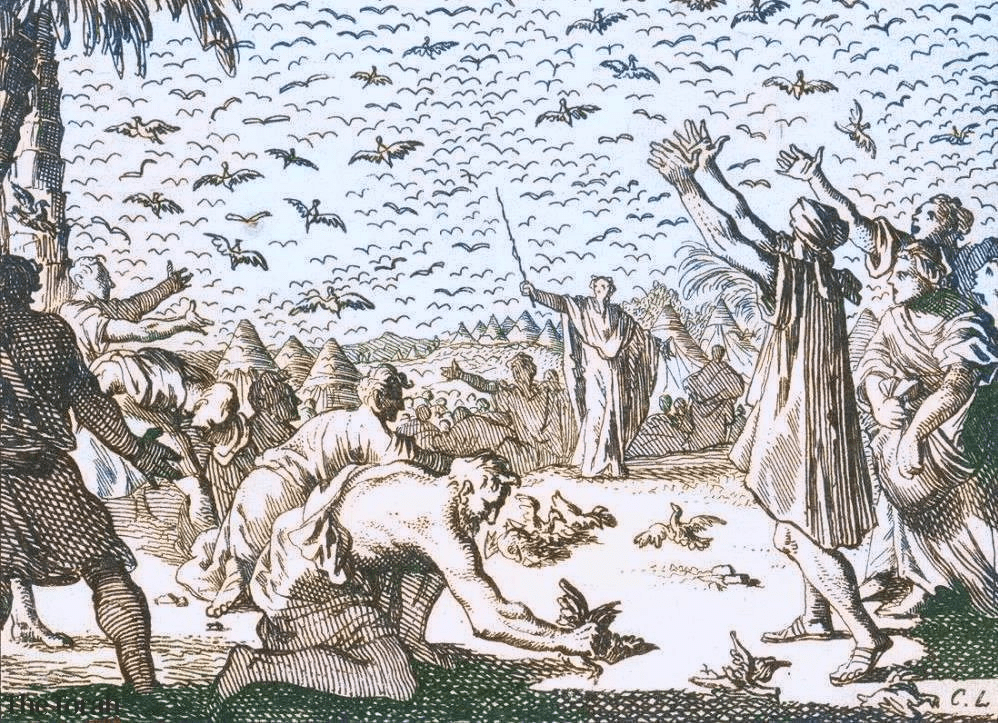
Quail in the Wilderness, by Caspar Luyken, 1698

Yet he commanded the skies above
    and opened the doors of heaven;
he rained down on them manna to eat
    and gave them the grain of heaven.
Mortals ate of the bread of angels;
    he sent them food in abundance.
He caused the east wind to blow in the heavens,
    and by his power he led out the south wind;
he rained flesh upon them like dust,
    winged birds like the sand of the seas;
he let them fall within their camp,
    all around their dwellings.
And they ate and were well filled,
    for he gave them what they craved. (New Revised Standard Version)

Today’s psalm is the second longest in the psalter (72 verses, with Psalm 119 the longest at a hefty 176 verses). Along with Psalms 105-106, Psalm 78 remembers and rehearses the history of Israel. This is a psalm which is meant for teaching and passing on important lessons.

The upshot of this psalm’s historical recollection is that the people’s ancestors were faithless; therefore, those reading the psalm now should live differently in a positive life of goodness, having observed how the past actors serve as a negative example of ingrates.

The psalmist, Asaph, viewed past events as highly informative for present circumstances. His purpose for crafting the psalm was explicit. He wanted the people:

 to put their hope in God—
        never forgetting God’s deeds,
        but keeping God’s commandments—
    and so that they won’t become like their ancestors:
    a rebellious, stubborn generation,
        a generation whose heart wasn’t set firm
        and whose spirit wasn’t faithful to God. (Psalm 78:7-8, CEB)

The verses for today’s lectionary reading have a unique place within the psalmist’s rehearsal of the past. They connect to the previous section (verses 9-22) which recounts the Lord’s angry response concerning Israel’s unbelief and rebellion.

In many ways, Psalm 78 has a consistent theme of human stubbornness, lack of faith, and wanting to do their own thing apart from God. Bucking God’s covenant code and moral law was ever-present in Israel’s history. And yet…

The Lord remained the same: Faithful and true. Furthermore, God stubbornly showed steadfast divine love and covenant loyalty to the people, despite their herky-jerky commitment and fickle faith.

Manna from heaven

Although the theme of human failure runs throughout the psalm, the dominant idea points to God’s gracious mercy, eternal faithfulness, and steadfast love. Most of all, the psalmist wanted his readers to remember the goodness and grace of God.

The people’s unbelief in no way stymied the promises of God. That’s because salvation and deliverance, faith and hope, do not originate and are not sustained by humans, but by the Lord God almighty who created heaven and earth.

Even though the people were faithless, and thus, had no trust in God’s power; nevertheless, the Lord opened the doors of heaven in order to meet the needs of people who did not deserve divine help.

The verses for today remember the story of God’s provision of manna and quail in the desert (Exodus 16). The Lord was gracious, merciful, and kind to the Israelites, despite their incessant grumbling. God responded to them because of their sheer need, and not because of any righteousness coming from them.

God not only provided food, but gave the manna in abundance, and the quail in superabundance. The contrast could not be any more glaring: Israel murmured, grumbled, complained, and demonstrated a lack of faith; God granted the Israelites a ridiculous amount of food, and evidenced steadfast faithfulness to the covenant.

The supreme goodness of God brings out, in stark relief, the incredible foolishness of Israel’s attitude. In the Exodus account, while the meat was still in their mouths, God’s anger flared because of the people’s recalcitrance.

On the surface, the divine response of judgment may appear out of sorts to the divine grace shown to Israel. Yet, the Lord cares about the holistic needs of people, and not only in giving sustenance.

God wants faithful and obedient people. The Lord desires goodness, righteousness, and justice to be the hallmark of the community.

To have your belly full and your spirit empty is an affront to God – because the Lord is good, right, and just, and does not tolerate impertinence, impudence, and impetuousness. Vice and ingratitude only makes a person an imbecile who is worthless to their fellow humanity.

Divine punishment – anywhere you find it in Holy Scripture – is meant to draw people back into relationship with God. Another way of phrasing this, is that God delivers people and grants them freedom, so that they will have no obstacles toward living a good, right, and just life.

No matter the response of God – whether it is by miraculous provision or by divine punishment – it’s always a response of grace; the Lord consistently acts from a place of compassion and commitment to doing what is best for the community.

Whereas the Israelites repeatedly cycled themselves through spirals of faith and unbelief, gratitude and grumbling, obedience and disobedience; God, however, constantly demonstrated the presence of grace and mercy, righteousness and justice, holiness and love.

The only reason the Israelites (and the entire human race, for that matter) are not wiped out is because God forgave their iniquity and did not destroy them. What’s more, the Lord didn’t even let them destroy themselves, unwittingly by their own unawareness and foolishness. (Psalm 78:36-39)

I am profoundly glad that God is the bigger person in the relationship with humanity. The Lord is continually mindful of who we are, as well as God’s own divine essence and power.

Yet he, being compassionate,
    forgave their iniquity
    and did not destroy them;
often he restrained his anger
    and did not stir up all his wrath.
He remembered that they were but flesh,
    a wind that passes and does not come again. (Psalm 78:38-39, NRSV)

As people created in the image and likeness of God, we find our highest joy and greatest fulfillment in receiving the good things from God with gratitude; and of giving goodness to others in a spirit of love – no matter what.

Gracious and almighty God: Open wide the eyes of my soul that I may see the good in all things. Grant me today a new vision of your truth. Inspire me with the spirit of joy and gladness. Make me a cup of strength to suffering souls. Amen.

Developing the Skill of Wisdom (Colossians 1:9-14)

Colossians 1:9-10, by Bible Art

For this reason, since the day we heard about you, we have not stopped praying for you. We continually ask God to fill you with the knowledge of his will through all the wisdom and understanding that the Spirit gives, so that you may live a life worthy of the Lord and please him in every way: bearing fruit in every good work, growing in the knowledge of God, being strengthened with all power according to his glorious might so that you may have great endurance and patience, and giving joyful thanks to the Father, who has qualified you to share in the inheritance of his holy people in the kingdom of light. 

For he has rescued us from the dominion of darkness and brought us into the kingdom of the Son he loves, in whom we have redemption, the forgiveness of sins. (New International Version)

When I was younger, I played a lot of ping-pong. And I got good at it. In fact, during a several months stretch, back-in-the-day, I had a record of 156-2. Not bad.

That kind of record was only possible because of the two reasons that make any skill an accomplishment:

  1. Knowledge. I learned the game of ping-pong and eventually knew it inside and out.
  2. Experience. I practiced for hundreds, if not thousands, of hours in developing my technique.

The sort of knowledge that Paul was talking about was more than information and intellectual understanding; he used a specific word (in the Greek language – ἐπιγινώσκω, pronounced “EPee-gi-NOS-ko) which refers to knowledge gained by experience.

In English, we need to put two words together in order to communicate Paul’s concept: experiential knowledge – an understanding which is gained by continual repetition and practice until there is proficiency.

There are just some things that can only be learned and integrated into life through constant use and development over time. And this is precisely how a person becomes mature in life:

Growth + Time = Maturity.

And with maturity comes the wisdom to live life as it meant to be lived. This means that wisdom doesn’t come overnight or quickly; to be wise requires a great deal of learning, effort, experience, and time.

The wisdom and understanding Paul refers to is not some sort of secret information which has to be accessed through careful initiation into a group of people who have the inside knowledge. No, this is wisdom which can be gained by anyone who embraces a life of faith and spiritual discipline.

The highest form of knowledge for the Apostle Paul is knowing God in Christ.

This sort of knowledge is an understanding of salvation, and experiencing deliverance from guilt, shame, and the false self. Such knowledge is evidenced by the fruit of the Spirit in living a life of love, joy, peace, patience, kindness, goodness, faithfulness, gentleness, and self-control. (Galatians 5:22-23)

Colossians 1:11, by Bible Art

From the outside of Christianity looking in, it may appear that this is all a grand achievement of the human will. But it isn’t. On the inside, the Christian life is thoroughly a work of God’s glorious power, bringing new life, and effecting spiritual growth and maturity into a wise and good way of life.

We did not deliver ourselves. God did. The Lord transferred our membership from the realm of darkness to the empire of light. Christians are simply people who have been redeemed by God in Christ. Our liberation is because of God’s gracious forgiveness of sins.

Forgiveness, however, is not the end game. Forgiveness frees us to pursue the spiritual life without guilt and shame hindering us and weighing us down all the time. Forgiveness opens us to the possibilities of positive and life-giving relational connections with God and other people.

In our relationship with God, prayer becomes the conduit of divine/human conversation. That connection, in the past, had blockage because of our unhealthy lifestyles. But it is now unobstructed because of God’s gracious intervention by Jesus, in the Spirit.

So, when it comes to our interactions in prayer, there’s no need to invent a new game; we just need to learn the one we’ve got, and put in the hours of work necessary to become accomplished at it. 

Today’s New Testament lesson is a prayer from the Apostle Paul to the Colossian Church. His prayer for them was singular: To have wise minds and spirits, that is, to have knowledge of God – an understanding of who God is and how God operates.

To learn divine ways is to acquire the skill of wisdom.

Paul prayed for a reason: so that we might live our lives in a way which pleases God and enables us to sustain a lifetime of spiritual growth. 

As people created in God’s image and likeness, we are hard-wired with a spirit which needs strengthening and exercise. That happens as we put in the constant repetitions of connecting with the divine and putting in the time on our knees – praying daily for ourselves and others to mature in faith so that we might all together act wisely and justly in this world, for the life of the world.

A good place to start is to use Paul’s prayer as our own. Never has there been such a need than now for us to know how to apply wisdom in the places and in the circumstances we’ve never been in before. 

For wisdom to happen, we must grow in our knowledge by putting in the hours of prayer.

The skill of wisdom doesn’t magically happen. Wisdom is the culmination of acquired understanding; a lot of practice exercising love in the places where love is not; and engaging in a lifetime project of becoming knowledgeable through constant learning, struggling, and growing.

Direct me, O Lord, in all my doings with your most gracious will and wisdom. Further in me your continual help – that in all my work and in all I do and say, I may glorify your holy name; and, by your mercy, obtain the life that is truly life; through Jesus Christ, my Lord.  Amen.