Hosea 6:1-10 – “I Want Mercy, Not Sacrifice”

“Come, let us return to the Lord.
He has torn us to pieces
    but he will heal us;
he has injured us
    but he will bind up our wounds.
After two days he will revive us;
    on the third day he will restore us,
    that we may live in his presence.
Let us acknowledge the Lord;
    let us press on to acknowledge him.
As surely as the sun rises,
    he will appear;
he will come to us like the winter rains,
    like the spring rains that water the earth.”

“What can I do with you, Ephraim?
    What can I do with you, Judah?
Your love is like the morning mist,
    like the early dew that disappears.
Therefore I cut you in pieces with my prophets,
    I killed you with the words of my mouth—
    then my judgments go forth like the sun.
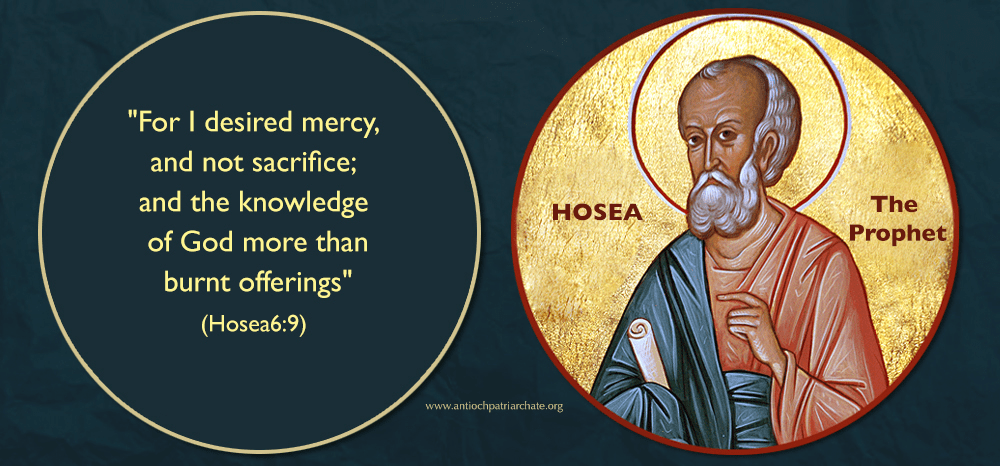
For I desire mercy, not sacrifice,
    and acknowledgment of God rather than burnt offerings.
As at Adam, they have broken the covenant;
    they were unfaithful to me there.
Gilead is a city of evildoers,
    stained with footprints of blood.
As marauders lie in ambush for a victim,
    so do bands of priests;
they murder on the road to Shechem,
    carrying out their wicked schemes.
I have seen a horrible thing in Israel:
    There Ephraim is given to prostitution,
    Israel is defiled. (New International Version)

My favorite word in all of Holy Scripture is the Hebrew word חסד (“chesed” pronounced in English “kes-ed).  It is such a rich word that no one English word can capture its depth and import. 

So, chesed is translated in various ways across English translations of the Bible as:

  • Goodness (American Standard Version)
  • Faithful love (Common English Bible)
  • Loyalty (God’s Word Translation)
  • Constant love (Good News Translation)
  • Mercy (King James Version)
  • Love that lasts (The Message)
  • Faithfulness (New English Translation)
  • Loving-kindness (New Life Version)
  • Steadfast love (New Revised Standard Version)

Chesed is God’s committed, gracious, and loving covenant loyalty to people. The Lord’s very attributes are sheer Love.

Since chesed marks the character and activity of God, the Lord very much desires people to reflect this same stance toward one another. In other words, because God is merciful and kind, we, as people created in God’s image, are to be marked with this same character in all we do. 

In today’s Old Testament lesson, God is calling and wooing wayward people to return to a life of closeness with the Lord. God demonstrated chesed by not sending the people away, like a spouse outright divorcing an unfaithful partner. Instead, the Lord is committed to loving the Israelites even when they were unlovely.

At all times, the response God wants from people is not simply to go through the motions of outward worship. Ritual practices mean little if there is no heart behind them. The Lord longs for people to demonstrate both fidelity and fealty through mercy and a steadfast love to God and neighbor.

Both our work and our worship are to be infused with divine mercy. 

God deeply desires a close relationship with humanity. The Lord is deeply grieved when people whore after other gods to meet their needs for love and belonging. Hosea’s prophecy is an impassioned plea for all persons to find their true fulfillment and enjoyment in a committed loving divine/human union, like a marriage.

In Christian readings of Hosea’s prophecy, repentance means accepting God’s chesed through Jesus Christ.

The believer is to allow the character of God to rule and reign in their heart so that love and commitment come flowing out in words, actions, thoughts, and dispositions.

Mercy, in Christianity, finds its highest expression in the person and work of Jesus.

It is no wonder, then, that Jesus lifted Hosea’s prophecy as a treasured principle of operation when asked why he deliberately made connections with “questionable” people:

As Jesus continued on from there, he saw a man named Matthew sitting at a kiosk for collecting taxes. He said to him, “Follow me,” and he got up and followed him. As Jesus sat down to eat in Matthew’s house, many tax collectors and sinners joined Jesus and his disciples at the table.

But when the Pharisees saw this, they said to his disciples, “Why does your teacher eat with tax collectors and sinners?”

When Jesus heard it, he said, “Healthy people don’t need a doctor, but sick people do. Go and learn what this means: I want mercy and not sacrifice. I didn’t come to call righteous people, but sinners.” (Matthew 9:9-13, CEB)

And when confronted about “questionable” activities, Jesus appealed to the same source of Hosea’s prophecy:

“Look! Your disciples are doing something that is not right to do on the day of rest—a holy day.”

Jesus asked them, “Haven’t you read what David did when he and his men were hungry? Haven’t you read how he went into the house of God and ate  the bread of the presence? He and his men had no right to eat those loaves. Only the priests have that right. Or haven’t you read in Moses’ Teachings that on the day of rest—a holy day, the priests in the temple do things they shouldn’t on the day of rest yet remain innocent? I can guarantee that something  greater than the temple is here. If you had known what ‘I want mercy, not sacrifices’ means, you would not have condemned innocent people. (Matthew 12:2-7, GW)

One can never go wrong with mercy and grace. If in doubt between whether to judge another or show mercy, the Christian’s choice is clear.

Grace and love reconnects the disconnected. The heart of true Christian spirituality is a deep kinship with the divine. Whenever that relation is broken or severed, it is vital to restore it. The means of doing so is not judgment; it’s mercy.

Chesed is more than a word; it is a way of life.

God wants mercy. Grace is the Lord’s divine will. So, let us today receive the forgiveness of Jesus and devote ourselves to prayer and works of love which come from a heart profoundly touched by grace. 

May the result of our return to the Lord be healing of that which has been broken, and reconciled relationships with others.

Merciful and loving God, the One who shows amazing grace, forgive us for our wanderings away from the divine life. Return us, again, to the grace of Jesus Christ our Savior so that our hearts will be renewed and aflame with love for others. In the Name of the Father, Son, and Spirit, the Great Three in One. Amen.

Psalm 100 – Know That the Lord is God

Shout for Joy by Lucy Adams

Shout for joy to the Lord, all the earth.
    Worship the Lord with gladness;
    come before him with joyful songs.
Know that the Lord is God.
    It is he who made us, and we are his;
    we are his people, the sheep of his pasture.

Enter his gates with thanksgiving
    and his courts with praise;
    give thanks to him and praise his name.
For the Lord is good and his love endures forever;
    his faithfulness continues through all generations. (New International Version)

The worship of God cannot be contained with one dimension of a person – their spirit. Worshiping God requires the body, mind, and emotions, as well. Anything less, is withholding praise. We are to worship with our entire being.

The original use of today’s psalm was for the ancient Israelites approaching the temple to worship God.  Before worshipers ever came into the presence of the Lord, they were preparing themselves to encounter God through giving thanks, using this very psalm.

When King David and other Hebrew writers penned their poetic songs, they centered what they most wanted to draw attention to in the middle, so that what came before it and after it pointed to that central message. The center of the psalm is:

Know that the Lord is God. Knowing God is to experience the divine through a close relationship. It means we have a place and a purpose. It is a knowing and belonging which exists deep down in our gut.

We get to know God by how he has worked in people’s lives, as well as our own. So, gatherings of believers (whether physical or virtual) are an opportunity to reinforce collective values, strengthen faith, and encourage the discouraged.

Faithful worshipers deeply desire to focus on who God is and what God has done, remembering and rehearsing divine qualities and deeds. Through this activity, we help one another know the Lord. And knowing God is what real life is all about. The Lord is worthy of all the praise, adoration, and worship we can give.

There are three imperatives (commands) that come before the middle phrase to know that the Lord is God; and three imperatives coming after it.  All six imperatives are meant to help us know God better, to give our proper praise to the Lord.

Shout for joy to the Lord, all the earth. Declaring loudly of God’s gracious and loving character, expressed through right, just, and fair actions.

Worship the Lord with gladness. Kneeling and prostrating before God in humble reverence, awe, and adoration.

Come before the Lord with joyful songs. Approaching God’s throne with confidence and boldness.

Those are the three imperatives which lead us to know the Lord. 

The following three imperatives point back to know that the Lord is God:

Enter the Lord’s gates with thanksgiving. Immersing oneself in the presence of God.

Give thanks to the Lord. Giving voice in gratitude to God

Praise the name of the Lord. Declaring God’s holy name with heartfelt expression.

We belong to God. God’s people celebrate this tremendous experience of belonging with deliberate actions that put us in a position to know God better.

I keep asking that the God of our Lord Jesus Christ, the glorious Father, may give you the Spirit of wisdom and revelation, so that you may know him better. (Ephesians 1:17, NIV)

One of my all-time favorite verses in the Bible has to do with knowing God:

I want to know Christ—yes, to know the power of his resurrection and participation in his sufferings, becoming like him in his death.

Philippians 3:10, NIV

Everything in our lives, whether good or bad, is designed to help us know God better. Shared experiences with each other encourage Christians to keep living for Jesus. All of life, from a Christian perspective, points us to the mid-point of history, Jesus Christ, and him crucified, risen, and coming again.

And this is eternal life, that they may know you, the only true God, and Jesus Christ whom you have sent. (John 17:3, NRSV)

So, let us express gratitude today for all the gracious ways of God’s self-revealing and reaching out to save such ones as us.

I pray that out of his glorious riches he may strengthen you with power through his Spirit in your inner being, so that Christ may dwell in your hearts through faith. And I pray that you, being rooted and established in love, may have power, together with all the Lord’s holy people, to grasp how wide and long and high and deep is the love of Christ, and to know this love that surpasses knowledge—that you may be filled to the measure of all the fullness of God.

Now to him who is able to do immeasurably more than all we ask or imagine, according to his power that is at work within us, to him be glory in the church and in Christ Jesus throughout all generations, for ever and ever! Amen. (Ephesians 3:16-21, NIV)

Gracious and almighty God, the One who works on my behalf, give me grace to put away the rootless existence of someone who has no place; and help me to experientially know your radical acceptance and inclusion into the dance of the Trinity – Father, Son, and Spirit – one God, now and forever. Amen.

Grace and peace be yours in abundance through the knowledge of God and of Jesus our Lord. (2 Peter 1:2, NIV)

Amen. Soli Deo Gloria.

Hosea 3:1-5 – Reconcile the Past

Then the Lord said to me, “Go and love your wife again, even though she commits adultery with another lover. This will illustrate that the Lord still loves Israel, even though the people have turned to other gods and love to worship them.”

So, I bought her back for fifteen pieces of silver and five bushels of barley and a measure of wine. Then I said to her, “You must live in my house for many days and stop your prostitution. During this time, you will not have sexual relations with anyone, not even with me.”

This shows that Israel will go a long time without a king or prince, and without sacrifices, sacred pillars, priests, or even idols! But afterward the people will return and devote themselves to the Lord their God and to David’s descendant, their king. In the last days, they will tremble in awe of the Lord and of his goodness. (New Living Translation)

Sometimes you have to get your behind in the past before you can put your past behind you.

The ancient nation of Israel was in a spiritual pickle. Gradually, over hundreds of years, they made small decisions of compromised religion which added up to a severe breach of faith with their historic God.

The relationship between God and God’s people, throughout the prophetic books of the Old Testament, is many times likened to a marriage of two spouses – God, the faithful spouse, and Israel, the unfaithful spouse who adulterated themselves by seeking the love of other gods.

This situation evoked feelings of sadness and anger within God. To help restore the broken marriage, the Lord used the prophet Hosea as an earthly illustration of the divine/human dilemma.

Just as Hosea graciously took a wife of dubious repute, so God mercifully took Israel. Just as Hosea’s wife, Gomer, slept with other men, so Israel went to bed with other gods. And just as Hosea remained faithful and actively sought to reconcile the past with his wife, so God tenaciously and dramatically honored the covenant relationship with Israel by showing steadfast love, despite her sordid past.

Israel needed to do her part by reconciling the past – returning to the Lord through acknowledging the truth of the situation and owning their responsibility to make things right.

Holy Scripture exhorts the believer to live according to truth. Whenever we fail to do so, we suffer spiritual loss. We are told to confess and reject unfaithful patterns of past behavior and not allow them to influence us today (Titus 2:12; 1 Peter 1:14, 18). 

Neglecting our responsibility inevitably causes emotional, mental and physical repercussions, as well as spiritual. In the New Testament, when the Apostle Paul said he was forgetting what is behind and straining toward what is ahead, he could say that because he had come to terms with and reconciled his own terrible unfaithful past with God. (Philippians 3:4-13)

It is both helpful and necessary to go back into one’s life and deal with the past on the basis of truth. In doing so, we honor our relationship with God. We must ask the Lord to turn the searchlight of truth on us and our past. 

Trust God to help you remember all the times in which you need to reconcile what has happened (or failed to happen). Make the choice before God to be as honest as you possibly can. 

The following are some suggestions from a former professor and mentor, the late Dr. Victor Matthews, (put in my own words) to carefully follow:

  1. Write out every time you were unfaithful or were hurt by another’s unfaithfulness (reject the temptation to just think and/or talk about it). Be complete, name the people involved, state what happened, do not try and protect yourself or other people and do not fantasize and let your thoughts run amok.
  2. Evaluate each past event on the basis of truth. If you were unfaithful, then confess it to God truthfully and receive forgiveness and cleansing (1 John 1:9). If you were hurt by someone, and it was their fault, then state out loud that “_______ should not have done that to me.” When you have finished writing out the event(s) deliberately stop and completely forgive the person(s) (Mark 11:25-26).  If you were at fault in some way, then confess that to God, as well.
  3. Resist the temptation to hurry with this process! Do not generalize by putting many events into one. Be specific and take the time necessary to get in touch with what God is trying to help you connect with.  This practice of reconciling the past is not introspection, so do not indulge in self-pity, self-criticism, or develop a martyr syndrome.
  4. Affirm that your inner critic, others, and any dark force may no longer use your past against you. “In the Name of the Lord Jesus Christ I take this event away from Satan and declare that he may not use it against me anymore!” (Ephesians 4:27; 5:11; 6:14).
  5. Receive the healing provided for those who believe and live according to God’s words and ways (Isaiah 53:5). “Now that I have made this right with you, O Lord, I receive the healing you have provided for me through the cross of Jesus Christ.” (Galatians 2:19-20)

When you have finished your work, then count it finished. When Jesus said, “It is finished!” he meant what he said. (John 19:30)

Reconciling the past means leaning into the finished work of Jesus for our complete healing. If and when we think of our unfaithful past, then firmly state: “I have dealt with that truthfully. It is settled, once and for all.” 

Whenever unfaithful, from this point forward, confess it, receive forgiveness, and make the affirmations of truth. In doing so, we are living by faith in the Son of God who loved us and gave himself for us. Amen.

1 Chronicles 10:1-14 – Faithfulness Matters

The Philistines fought against Israel in a battle at Mount Gilboa. Israel’s soldiers ran from the Philistines, and many of them were killed. The Philistines closed in on Saul and his sons and killed three of them: Jonathan, Abinadab, and Malchishua. The fighting was fierce around Saul, and he was gravely wounded by enemy arrows.

Saul told the soldier who carried his weapons, “Kill me with your sword! I don’t want those godless Philistines to torture and make fun of me.”

But the soldier was afraid to kill him. Then Saul stuck himself in the stomach with his own sword and fell on the blade. When the soldier realized that Saul was dead, he killed himself in the same way.

Saul, three of his sons, and all his male relatives were dead. The Israelites who lived in Jezreel Valley learned that their army had run away, and that Saul and his sons were dead. They ran away too, and the Philistines moved into the towns the Israelites left behind.

The next day the Philistines came back to the battlefield to carry away the weapons of the dead Israelite soldiers. When they found the bodies of Saul and his sons on Mount Gilboa, they took Saul’s weapons, pulled off his armor, and cut off his head. Then they sent messengers everywhere in Philistia to spread the news among their people and to thank the idols of their gods. They put Saul’s armor in the temple of their gods and hung his head in the temple of their god Dagon.

When the people who lived in Jabesh in Gilead heard what the Philistines had done to Saul, some brave men went to get his body and the bodies of his three sons. The men brought the bodies back to Jabesh, where they buried them under an oak tree. Then for seven days, they went without eating to show their sorrow.

Saul died because he was unfaithful and disobeyed the Lord. He even asked advice from a woman who talked to spirits of the dead, instead of asking the Lord. So, the Lord had Saul killed and gave his kingdom to David, the son of Jesse. (Contemporary English Version)

The books of Samuel and Chronicles contain similar content and material concerning the kings of Israel and Judah. Yet, whereas 1 & 2 Samuel gives a more straightforward narrative, 1 & 2 Chronicles often provides the narrative with explanatory comments. 

We have such a story in today’s Old Testament lesson. The last chapter of 1 Samuel gives an account of King Saul’s death, along with his sons. However, in 1 Chronicles 10, we get the narration of their deaths along with a clear concise note on why King Saul perished in battle:

Saul died because he was unfaithful to the Lord and hadn’t followed the Lord’s word. He even consulted a medium for guidance. He didn’t consult the Lord, so the Lord killed him and gave the kingdom to David, Jesse’s son. (1 Chronicles 10:14, CEB)

The original compiler of Chronicles did so for the Jewish exiles who were returning to Palestine. He did not want to simply recount the important stories of the kings of Israel; he wanted the exiles to know exactly why they went into exile to begin with, and how in the future they could keep it from happening again. So, Saul served as Exhibit A of the kind of person that erodes the true worship of God and lives against the grain of faithfulness to the Lord.

The true measure of a godly person is not in titles, positions, or membership. The real test of a faithful person is obedience to, and observance of, the revealed will of God contained in Holy Scripture. Thus, to read it, know it, and live it is one of the highest callings as God’s people.

Faith in the Bible is a complete trust in who God is and what God has done. The Lord shows faithfulness through steadfast love, gifting people with faith to obey, and remaining true to divine promises for humanity.

In the New Testament, the height of faith is to place one’s life completely in God’s hands, believing in the person and work of Jesus Christ. Faith involves both information and action.

For example, the Mackinac Bridge, connecting the upper and lower regions of Michigan, is an imposing structure. It’s the longest suspension bridge in the Western hemisphere at 26,372 feet. At its mid-point, the bridge’s roadway towers 200 feet above the Mackinac Straight.

The wind on the bridge can be punishing. In 1989, a woman died when her small car flew over the 3-foot-high railing and plunged into the water due to an excessively high gust of wind. I have crossed the bridge many times. Sometimes the bridge is open to road traffic, and sometimes not, due to the wind conditions. The bridge authorities even have a protocol about how to cross the bridge when it is windy but not excessively so (driving beside a truck).

This is all important and necessary information for crossing the Mackinac Bridge. Yet, knowledge alone is not enough. At some point, one needs to actually drive across the bridge. Information must lead to action. I couldn’t just cross the Straight between the two regions of Michigan at any point along the land with a blind faith that believes I’ll make it to the other side. I needed some knowledge. Then, I needed the courage to act on that knowledge.

The person who is scared crossing the bridge, and the person who thinks nothing of it, both make it to the other side. It isn’t the amount of faith that is important; it’s in what (or who) that faith is placed. Faith in the Bible is having some important and useful information about God, then putting that knowledge into action with a trust and commitment that you’ll make it to the other side.

Saul tried to cross over on his own terms. It didn’t go so well for him. His car was picked up and thrown into the Straight.

We need to be careful what and whom we consult when we are stressed. Not collaborating with God isn’t going to end well. Being faithful matters.

Who are you faithful to? Where is your trust placed? Because the answer to those questions determines which actions we will take.

Eternal God, you remain the same throughout the ages of time. Help me to be faithful to your standard of righteousness and live faithfully into the ways of Jesus, my Lord. Amen.