Micah 6:1-8 – What Does the Lord Require of Us?

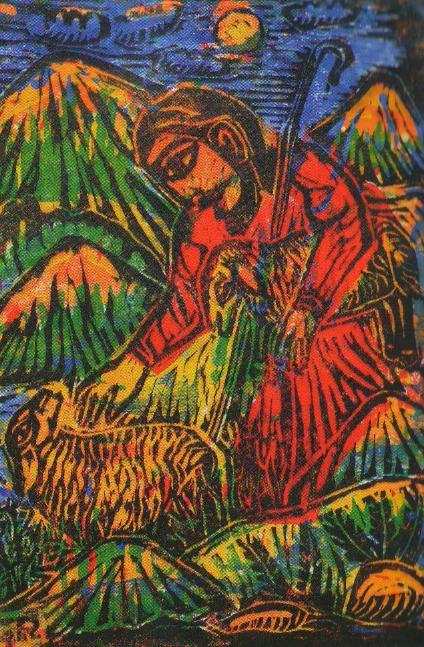
Jesus the Good Shepherd by Solomon Raj

Listen to what the Lord says:

“Stand up, plead my case before the mountains;
    let the hills hear what you have to say.

“Hear, you mountains, the Lord’s accusation;
    listen, you everlasting foundations of the earth.
For the Lord has a case against his people;
    he is lodging a charge against Israel.

“My people, what have I done to you?
    How have I burdened you? Answer me.
I brought you up out of Egypt
    and redeemed you from the land of slavery.
I sent Moses to lead you,
    also Aaron and Miriam.
My people, remember
    what Balak king of Moab plotted
    and what Balaam son of Beor answered.
Remember your journey from Shittim to Gilgal,
    that you may know the righteous acts of the Lord.”

With what shall I come before the Lord
    and bow down before the exalted God?
Shall I come before him with burnt offerings,
    with calves a year old?
Will the Lord be pleased with thousands of rams,
    with ten thousand rivers of olive oil?
Shall I offer my firstborn for my transgression,
    the fruit of my body for the sin of my soul?
He has shown you, O mortal, what is good.
    And what does the Lord require of you?
To act justly and to love mercy
    and to walk humbly with your God. (New International Version)

We are the people of God, the Church, the Body of Christ, the army of God, a holy temple. Those biblical labels are a picture of who we are and what we are to do. These metaphors all describe a people set apart for service, working in concert together toward a shared purpose.

In the prophet Micah’s day, the Israelites lost sight of the purpose and meaning of being God’s people. They needed to remember that the Lord acts in and through them for the redemption of the world. The kind of sacrifice and service which God wants is not so much a largess of tangible offerings we give. Rather, it is neatly summarized this way: Act justly. Love mercy. Walk humbly with your God.

This Old Testament passage has the feel of a courtroom scene. The defense lawyer is Micah, representing God. The people of Israel are the plaintiffs. The world is the judge. All of creation is the jury.

Israel was complaining about God. It’s an age old complaint from many people through the millennia: Blame God for anything that goes sideways in my life. The reasoning goes something like this: After all, God is powerful and in control. God should fix everything.

In their small-minded and short-sighted ways, the people seem unable to discern that easy fixes rarely help anyone. Like yanking up a big weed next to a small plant, it destroys both of them.

The defendant, Micah, speaks on behalf of God. What have I done to you? How have I burdened you? In fact, God has done just the opposite of failing to act or wronging the people in some way. The Lord actively delivered the Israelites:

  • When the people groaned and grumbled under Egyptian slavery, God delivered them with a series of miraculous deeds.
  • When the Israelites were heading to the Promised Land and vulnerable to their enemies, God protected them from the Moabites. The Lord even used a talking donkey to work on their behalf. God miraculously turned the efforts of Balak to curse the people into a blessing.
  • When the people entered the land, they did so by the powerful act of God to stop the Jordan River from flowing so the Israelites could cross over.

These saving acts of God are the motivation for living a life pleasing to God. Micah sarcastically pressed his argument, essentially asking if there’s anything that can be done to keep the people happy? What extremes need to happen to meet such excessive demands? The response by God is this: Do justice. Love mercy. Walk humbly with God.

Walk Humbly with God

Faith and action are meant to work seamlessly together. Doing justice and loving mercy are possible as we walk with God. Walking everyday with Jesus gives us the power and passion to invest in the healing of the world. God desires that we journey with Jesus and follow his words and ways. Throughout the New Testament, the Christian life is described as a road or a way we walk. In fact, the earliest believers were known as “The Way.” (Acts 9:1-19)

Jesus is the way (John 14:6). Jesus is the way to deal with our current concerns and anticipated anxieties. He himself is the way. The way is not through a program of self-improvement. The way is not through a fake-it-till-you-make-it approach. The way is not through an ability to articulate well-crafted words or through being able to answer with certainty every question of faith. The way is not through finding just the right plan or system.

Jesus is our way – he is the way of rescue, the road to a life of harmonious peace and settled rest even when the world is going to hell around us. Jesus is the way for the church everywhere – fellowship, encouragement, acts of loving service, teaching, and strengthening of faith all center around Jesus because he is love incarnate.

Jesus is the way for the world – serving neighbors and nations, advocating for those who are mistreated and facing injustice, tackling the dozens of world problems which oppress humanity – come through the continuing presence of Jesus here on this earth, that is, through the Holy Spirit and God’s people.

Love Mercy

This phrase (in the NIV) is translated various ways in other Bible versions:

  • “Embrace faithful love” (CEB)
  • “Let mercy be your first concern” (CEV)
  • “Show constant love” (GNT)
  • “Be compassionate and loyal in your love” (MSG)
  • “Love being kind to others” (NCV)
  • “Love kindness” (NRSV).

The reason for the variations is that the phrase in Hebrew carries a lot of meaning – and it’s difficult to capture that meaning in just one or two English words. It has to do with God’s steadfast loyalty to people based in a committed love and determination to do what is good and kind on their behalf – no matter whether they deserve such a grace, or not.

To love mercy comes from a large heart. The Grinch had a small heart. It caused him to be a nasty green curmudgeon who could steal gifts from a sweet little Who-girl. Only when his heart was enlarged did he mercifully return the gifts and then participate with the Whoville folks in their grand celebration.

God was merciful! We were dead because of our sins, but God loved us so much that he made us alive with Christ, and God’s wonderful kindness is what saves you. (Ephesians 2:4-5, CEV)

Love one another as if your lives depended on it.

1 Peter 1:22, MSG

Act Justly

Because many people define justice as a punitive act toward a wrongdoer, they struggle with this admonition to “do justice.” Giving people what they deserve doesn’t primarily mean someone is supposed to go to prison. Some people deserve that. Most don’t.

Instead, to act justly means to create a world in which everyone has what they need to live, thrive, and develop the gifts God has placed within them. Everyone deserves their basic human needs met – to have an equal opportunity in realizing the meeting of their needs. And that is what the heart of biblical justice is. Therefore, justice includes practical things like:

  • Providing tutors so that kids in urban schools have the same opportunities to read and as suburban kids.
  • Supporting an overwhelmed single parent who is struggling to find the time and resources to give adequate time to his or her children.
  • Taking in a foster child who needs the environment of a loving family.
  • Employing a person coming out of prison so that the terrible rates of recidivism don’t keep going.
  • Advocating for an underprivileged person who needs adequate healthcare or good housing.

Doing justice is more than giving away money or resources. It’s helping people to help themselves. It’s providing others the dignity and respect of putting them in a position so that they can take pride in their own efforts, just like we do. It’s not only giving someone a fish but taking the time and effort in teaching them how to fish.

Speak up for people who cannot speak for themselves. Help people who are in trouble. Stand up for what you know is right and judge all people fairly. Protect the rights of the poor and those who need help. (Proverbs 31:8-9, ERV)

Conclusion

What does the Lord require or desire of you?

What gifts and abilities has God given to you to act justly, love mercy, and walk humbly?

How can you and I step outside our comfort zones to other areas the Lord might be desiring for us?

The answers to those questions will determine whether we sink or swim as the people of God.

Father God, you have made all people in your image. It’s your desire and requirement that they be gathered together as one family in yourself. Fill the hearts of humanity with the fire of your love and the desire to ensure justice for all. By sharing the good things, you give us, may we secure equality for all our brothers and sisters throughout the world. May there be a truly human society built on love and peace, through Jesus Christ our Lord. Amen.


Psalm 113 – There Is a Deliverer

Shout praises to the Lord!
Everyone who serves him,
    come and praise his name.

Let the name of the Lord
    be praised now and forever.
From dawn until sunset
    the name of the Lord
    deserves to be praised.
The Lord is far above
    all of the nations;
    he is more glorious
    than the heavens.

No one can compare
    with the Lord our God.
His throne is high above,
    and he looks down to see
    the heavens and the earth.
God lifts the poor and needy
    from dust and ashes,
    and he lets them take part
    in ruling his people.
When a wife has no children,
    he blesses her with some,
and she is happy.
    Shout praises to the Lord! (Contemporary English Version)

It is appropriate, as we approach the Nativity of our Lord in just a few days, that we acknowledge and celebrate Christ’s incarnation by using today’s psalm.

Believers everywhere serve a God who is attentive to humanity. Although high and transcendent above all creation, the Lord carefully observes the plight of people. And God determines to do something about it. God breaks into the human experience by becoming human.

In the New Testament, the Apostle John frames this movement from heaven to earth in this way:

The Word became flesh and blood,
    and moved into the neighborhood.
We saw the glory with our own eyes,
    the one-of-a-kind glory,
    like Father, like Son,
Generous inside and out,
    true from start to finish. (John 1:14, The Message)

This grand descending to earth plumbed the very depths and despair of humanity.

In the largest cities of the world, like Mexico City, Mexico and Manilla, Philippines, there are huge garbage dumps that cover several square miles. On top of these heaps of waste there live hundreds of families who have made this their home. 

Each day they send their kids out to forage for scraps so they can have something to eat and survive.  Few others tread where these families are.  Yet, there are Christian believers who make the journey and try to bring the good news of Jesus Christ to such a place.

As incredible and sad a situation that this is, it doesn’t compare to the journey from heaven to earth that Jesus made. God became flesh, Christ descended to earth and came to the sin-soaked dump of this world – to us who were living on a heap of garbage – and entered our lives to save us from our wretched and pitiable condition.

God’s generosity in sending the Son was a gracious and cataclysmic entry to this earth on our behalf. It’s as if Jesus moved into the garbage dump and was born on the heap of waste so that God might be present with us.

Jesus did not just appear to be human, but actually became like us and lived with all the same things we face from day to day. He “tabernacled” with us, using the imagery of God’s presence with the ancient Israelites.  God is with us!

Jesus interacted with the families in the dump. God was coming to save the people.  he way to reach people, who are so concerned for scurrying about their business and trying to survive apart from God, is through the incarnation – both through testifying to what God has done in Christ, and through being sent, we ourselves, as little incarnations of entering into people’s lives. 

We are like the moon, not producing light ourselves, but in the middle of darkness, reflecting the light of the sun so that the earth may know that Jesus is coming.

The mystery of the incarnation is that Jesus became human and lived among us. 

May we believe.

May we know there is a Deliverer.

May we rejoice and be glad in this reality, and may it move us to be used of God to save those on the sin heap of this world.

May the poor and needy be lifted up.

May you have a blessed Christmas and enjoy peace with God and others in this next year.

O God, you make us glad by the yearly festival of the birth of your only Son Jesus Christ: Grant that we, who joyfully receive him as our Redeemer, may with sure confidence behold him when he comes to be our Judge, who lives and reigns with you and the Holy Spirit, one God, now and forever. Amen.

2 Samuel 7:18-29 – A Model Prayer

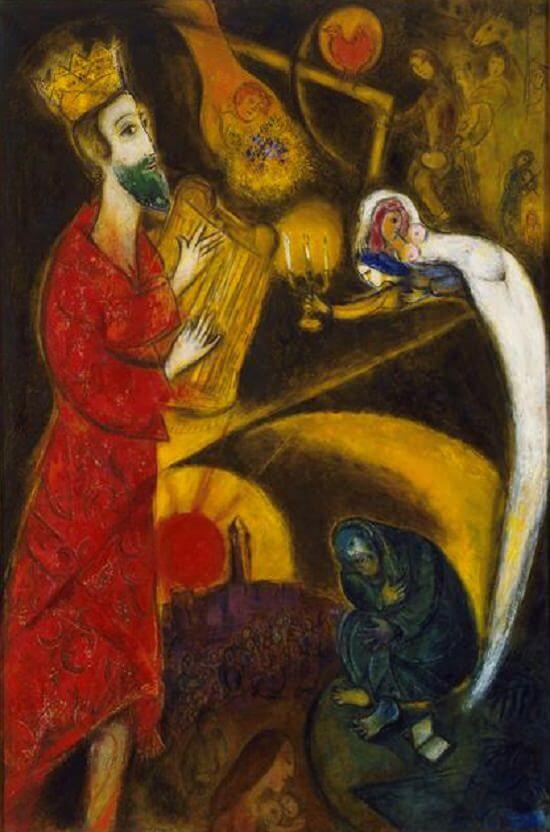
King David by Marc Chagall, 1962

Then King David went in and sat before the Lord, and he said:

“Who am I, Sovereign Lord, and what is my family, that you have brought me this far? And as if this were not enough in your sight, Sovereign Lord, you have also spoken about the future of the house of your servant—and this decree, Sovereign Lord, is for a mere human!

“What more can David say to you? For you know your servant, Sovereign Lord. For the sake of your word and according to your will, you have done this great thing and made it known to your servant.

“How great you are, Sovereign Lord! There is no one like you, and there is no God but you, as we have heard with our own ears. And who is like your people Israel—the one nation on earth that God went out to redeem as a people for himself, and to make a name for himself, and to perform great and awesome wonders by driving out nations and their gods from before your people, whom you redeemed from Egypt? You have established your people Israel as your very own forever, and you, Lord, have become their God.

“And now, Lord God, keep forever the promise you have made concerning your servant and his house. Do as you promised, so that your name will be great forever. Then people will say, ‘The Lord Almighty is God over Israel!’ And the house of your servant David will be established in your sight.

“Lord Almighty, God of Israel, you have revealed this to your servant, saying, ‘I will build a house for you.’ So, your servant has found courage to pray this prayer to you. Sovereign Lord, you are God! Your covenant is trustworthy, and you have promised these good things to your servant. Now be pleased to bless the house of your servant, that it may continue forever in your sight; for you, Sovereign Lord, have spoken, and with your blessing the house of your servant will be blessed forever.” (New International Version)

“The whole reason why we pray is to be united into the vision and contemplation of God to whom we pray.”

Julian of Norwich (1343-1416)

Perhaps you wish you had a better prayer life. To pray, as with most things in life, requires both motivation and how to do it. So, it’s appropriate to find answers about prayer by observing the biblical models of prayer contained in Holy Scripture.

Today’s Old Testament lesson is King David’s prayer in response to God’s revelation to him about fulfilling covenant promises. Looking at David’s prayer, there is a three-fold division which models for us a good way to approach God.

The Present: Gratitude for God’s Grace

David began his prayer with an attitude, posture, and words of humility, recognizing and affirming the relationship between himself and God. Although David is the king over all Israel and Judah, he repeatedly refers to himself as a servant (10 times).

God didn’t have to communicate anything to David about the future. Yet, the Lord graciously made known that it would be through David’s descendants that all of God’s good promises will be fulfilled. And David is overwhelmed with such gracious words. It comes tumbling out of him in a heartfelt prayer of gratitude and thanksgiving.

It is good for us to think about the spiritual blessings we have received from God. Not only can prayers of thanksgiving be uttered at any time to the Lord, but we can also write our gratitude in a journal as a prayer offering to God.

It’s also good to be specific about the circumstances and the praises. In the future, whenever there are discouraging situations, we can look back to what we wrote and remember the ways in which God showed up and encouraged us with very great and precious promises.

The Past: Praise for God’s Actions

David affirms there is no one and no god which can compare to Yahweh, the great I Am. It is the Lord God almighty who displayed divine power and presence in redeeming the Israelites out of Egyptian slavery and into the Promised Land.

Any greatness which arises from humans is the direct result of God’s greatness. Apart from God, there is no distinctive way of living. God’s presence makes all the difference:

Then Moses said to him [Yahweh], “If your Presence does not go with us, do not send us up from here. How will anyone know that you are pleased with me and with your people unless you go with us? What else will distinguish me and your people from all the other people on the face of the earth?” (Exodus 33:15-16, NIV)

The Lord specializes in bending hopeless situations to divine purposes, transforming people to new life, and turning systemic evil on its head so that the humble, meek, and penitent will be first, not last.

The Future: Prayer for God to Fulfill Divine Promises

King David already knew God’s promises to the Israelites. Now, however, David understands how he personally fits into the Lord’s plan.

Courage arises whenever God’s people know God’s promises and then discern how to fit into God’s plan. Confident assurance and settled peace cannot simply be ginned-up through positive thinking; bold faith needs a foundation of truth – a rock solid base which cannot be moved and is always there.

King David found his ultimate motivation in life in God’s revelation. His basis of prayer was God’s Word. Biblical prayers, like David’s, are there for us to model our own prayers.

Accept, O Lord, our thanks and praise for all that you have done for us. We thank you for the splendor of the whole creation, for the beauty of this world, for the wonder of life, and for the mystery of love. We thank you for the blessing of family and friends, and for the loving care which surrounds us on every side. We thank you for setting us at tasks that demand our best efforts, and for leading us to accomplishments that satisfy and delight us. We thank you also for those disappointments and failures that lead us to acknowledge our dependence on you alone.

Above all, we thank you for your Son Jesus Christ; for the truth of his Word and the example of his life; for his steadfast obedience, by which he overcame temptation; for his dying, through which he conquered death; and for his rising to life again, in which we are raised to the life of your kingdom. Grant us the gift of your Spirit, that we may know Christ and make him known; and through him, at all times and in all places, may give thanks to you in all things. Amen.

Psalm 18:20-30 – Vault the Highest Fence

God made my life complete
    when I placed all the pieces before him.
When I got my act together,
    he gave me a fresh start.
Now I’m alert to God’s ways;
    I don’t take God for granted.
Every day I review the ways he works;
    I try not to miss a trick.
I feel put back together,
    and I’m watching my step.
God rewrote the text of my life
    when I opened the book of my heart to his eyes.

The good people taste your goodness,
The whole people taste your health,
The true people taste your truth,
The bad ones can’t figure you out.
You take the side of the down-and-out,
But the stuck-up you take down a notch.

Suddenly, God, you floodlight my life;
    I’m blazing with glory, God’s glory!
I smash the bands of marauders,
    I vault the highest fences.

What a God! His road
    stretches straight and smooth.
Every God-direction is road-tested.
    Everyone who runs toward him
Makes it. (The Message)

I confess I’m tired a lot. Maybe it’s the rigors of pastoral ministry and hospital chaplaincy. It might be from the daily grind of household chores and family responsibilities. It could be because my mind is always a beehive of activity and doesn’t shut down easily at night. Perhaps it’s due to not enough self-care. More than likely, it is a bit of all that. 

I perked up, though, when I read today’s psalm and heard David say that by means of God he can vault the highest fences. Back in the day, I certainly did my share of hopping over high fences. But it’s been a long while since I’ve leapt over a fence. I’m old enough to know better than try something like leaping over anything. I can clearly imagine pulled hamstrings and a messed-up back doing a feat like that.

David was really no spring chicken himself when he wrote this. Psalm 18 is a psalm of praise to God for rescuing David from Saul and all his enemies. This deliverance did not happen overnight; it came over years of David running from the king and being pursued by others. Yet the day finally came, and David was not shy in proclaiming his praise to God.

If God’s deliverance from earthly enemies can energize David so much, how much more can I be invigorated by the reality that I’m delivered from sin, death, and hell through the blood of Jesus Christ? 

Maybe you, like me sometimes, think too much about adverse circumstances and ornery people – which makes the biblical Psalms a great place to go when fixating on personal injustice. They help give voice to our contemporary situations. 

So, today, I’m taking my own advice by reading and meditating on this psalm and getting a leg up on letting gratitude set the tone for my life and ministry. I probably won’t go out and vault myself over a fence, but I suspect my soul will be renewed and energized by contemplating the goodness and guidance of a loving God who always has my back.

Accept, O Lord, our thanks and praise for all that you have done for us. We thank you for the splendor of the whole creation, for the beauty of this world, for the wonder of life, and for the mystery of love. We thank you for the blessing of family and friends, and for the loving care which surrounds us on every side. We thank you for setting us at tasks that demand our best efforts, and for leading us to accomplishments that satisfy and delight us. We thank you also for those disappointments and failures that lead us to acknowledge our dependence on you alone.

Above all, we thank you for your Son Jesus Christ; for the truth of his Word and the example of his life; for his steadfast obedience, by which he overcame temptation; for his dying, through which he conquered death; and for his rising to life again, in which we are raised to the life of your kingdom. Grant us the gift of your Spirit, that we may know Christ and make him known; and through him, at all times and in all places, may give thanks to you in all things. Amen.