Be Renewed (Joshua 24:25-33)

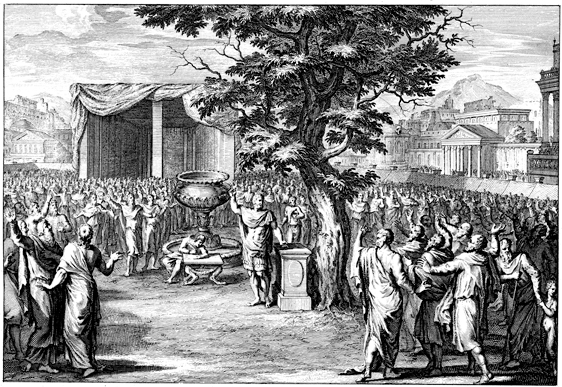
Joshua renews the covenant with the people of Israel, by David Martin (1639-1721)

On that day Joshua made a covenant for the people, and there at Shechem he reaffirmed for them decrees and laws. And Joshua recorded these things in the Book of the Law of God. Then he took a large stone and set it up there under the oak near the holy place of the Lord.

“See!” he said to all the people. “This stone will be a witness against us. It has heard all the words the Lord has said to us. It will be a witness against you if you are untrue to your God.”

Then Joshua dismissed the people, each to their own inheritance.

After these things, Joshua son of Nun, the servant of the Lord, died at the age of a hundred and ten. And they buried him in the land of his inheritance, at Timnath Serah in the hill country of Ephraim, north of Mount Gaash.

Israel served the Lord throughout the lifetime of Joshua and of the elders who outlived him and who had experienced everything the Lord had done for Israel.

And Joseph’s bones, which the Israelites had brought up from Egypt, were buried at Shechem in the tract of land that Jacob bought for a hundred pieces of silver from the sons of Hamor, the father of Shechem. This became the inheritance of Joseph’s descendants.

And Eleazar son of Aaron died and was buried at Gibeah, which had been allotted to his son Phinehas in the hill country of Ephraim. (New International Version)

All things, if they exist for any length of time, require renewal. This is especially true of relationships, and in particular, our relationship with God.

The book of Joshua is closely connected to the book of Exodus. God’s special relationship with Israel was confirmed with a covenant. God’s gave the Law to Moses as the leader of the people. And God brought a mighty deliverance to the Israelites from Egyptian bondage. These are all themes that linger with importance into the leadership and life of Joshua and the Israelites as they entered and inhabited the Promised Land.

Joshua was a faithful attendant to Moses, a model soldier, and an effective spy. After the death of Moses, Joshua was the appointed successor to bring Israel into Canaan and capture it. He was just as faithful to God and the people as Moses had been. In taking the land, Joshua made sure to do the following with the people:

  • Reminded all the Israelite tribes of their covenantal relationship and obligations to God
  • Allocated the land to each of the tribes, as specified by God’s command
  • Circumcised all the males that had been born during the forty years in the desert
  • Established cities of refuge, and cities for the Levites (because they had no land inheritance)
  • Admonished the people to be steadfast in observing the laws given to Moses by God 
  • Made it clear what the consequences are for any break or breach in the covenant agreement

Joshua did all of this by facilitating a covenant renewal ceremony. There were still some Canaanites in the land, and so, the Israelites were at risk of worshipping foreign deities and engaging in intermarriage. The people needed to have a collective memory of God’s deliverance, covenant, and law.

The covenant renewal emphasized obedience to the law and fealty to God because the Israelites are a holy nation, set apart for the Lord’s purposes. They were to serve the Lord with faithfulness and sincerity. There were to be no foreign gods whatsoever. Obedience would bring blessings, whereas disobedience would lead to the land being cursed.

As the mediator between God and Israel, Joshua commanded Israel to make a firm choice about what they were going to do. He was holding them accountable and ensuring they actively participate in the covenantal agreement.

The people declared that they would not forsake the Lord to serve other gods. And Joshua pledged to hold them accountable to their words and commitments.

Just as Israel was to be renewed in loyalty to their God, so we, too, in each generation of believers, must experience a renewal of our relationship to the Lord. We do so through reaffirmation, recording our response, and setting up a remembrance of the renewal.

Reaffirm

To reaffirm is to make a renewed commitment to something, usually verbally. In affirming God as the Lord, we are saying, “I believe!” So reaffirming repeats the belief, and makes it clear that you still feel that way. We make promises and make plans to keep them. We vow to be faithful and restate our love for God and God’s Word.

Joshua repeated, restated, and reaffirmed God’s Law for the people, so that they would know exactly what their responsibilities are, and pledge to keep them always.

Record

To record something is to establish a written record of what was said. Joshua made sure that everything was written down so that nobody in the future could say something contrary, or forget what was said.

One of the most powerful ways we can engage in personal renewal is by actually recording our promises and commitments to the Lord in a journal. The act of writing, in-and-of itself, is a transforming practice. And when we couple the practice with important and impactful words of intention and desire, then we are doubling our chances of actually following through and doing what we say we will do.

Remember

Memory is more than the mind. Remembering is activated with tangible things that we can see, touch, or smell. With the Israelites, Joshua set up a huge stone as a remembrance of what was said and promised. And he engaged the imagination by stating that the stone heard it all – and would hold them all accountable.

Physical objects, such as the cup and the bread in Christian communion, press the remembrance much better and deeper into both our minds and our hearts. Anything in life that is vital to remember ought to have a tangible item which symbolizes the importance of the memory.

Experiencing renewal in life doesn’t simply happen, but is an intentional process of reaffirming, recording, and remembering. Concerning God’s Word, Holy Scripture is something worth putting the effort into in order to realize new life and a renewed relationship with the Lord.

O God, King eternal, your light divides the day from the night and turns the shadow of death into the morning: Drive from us all wrong desires; incline our hearts to keep your law; and guide our feet into the way of peace; so that, having done your will with cheerfulness during the day, we may, when night comes, rejoice to give you thanks, through Jesus Christ our Lord. Amen.

The Radiant Face of Moses (Exodus 32:29-35)

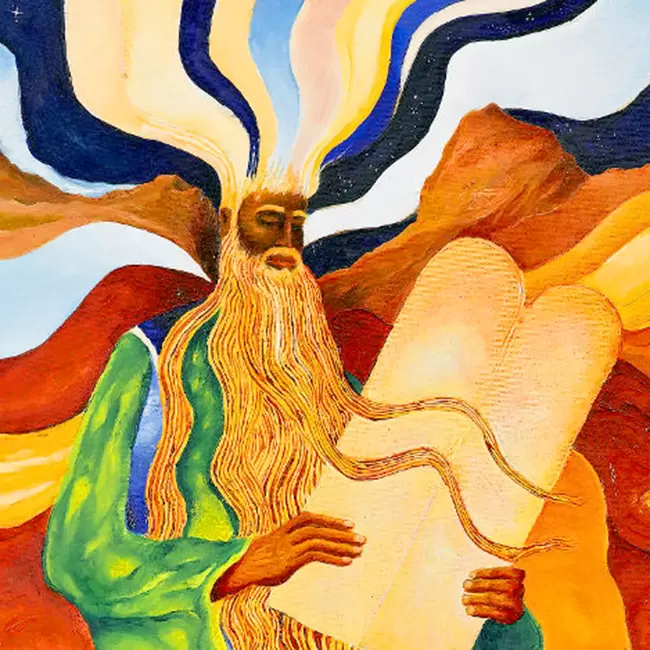
Moses and the Fire of Sinai, by Darius Gilmont

When Moses came down from Mount Sinai with the two tablets of the covenant law in his hands, he was not aware that his face was radiant because he had spoken with the Lord. When Aaron and all the Israelites saw Moses, his face was radiant, and they were afraid to come near him. But Moses called to them; so Aaron and all the leaders of the community came back to him, and he spoke to them. Afterward all the Israelites came near him, and he gave them all the commands the Lord had given him on Mount Sinai.

When Moses finished speaking to them, he put a veil over his face. But whenever he entered the Lord’s presence to speak with him, he removed the veil until he came out. And when he came out and told the Israelites what he had been commanded, they saw that his face was radiant. Then Moses would put the veil back over his face until he went in to speak with the Lord. (New International Version)

I’ve never seen anyone on Halloween dressed like Moses, complete with a shiny glowing face – even though the sight of Moses as he came down the mountain made the Israelites afraid to come near him. The face of Moses had been transformed in a way that made him appear haunted house scary to them.

Moses had actual face-to-face time with God on the mountain. And this seems to have changed his visage. Yet, Moses had stood before God previously without any change to his face. Moses had even interceded with God on other occasions with no special Halloween effect.

God made the new covenant and gave the new tablets because Moses smashed the old ones at the golden calf experience (see Exodus 32, especially verse 19). It could be that, with the radiant face of Moses, God was displaying before the people a tangible sign of God’s presence.

After all, the people had doubted God’s presence again and again during their time in the desert. So, when God’s seemingly ghostly presence was offered this time around, they were too afraid to be that closely connected to the divine.

Just as the loincloth that God made for the disobedient Adam and Eve in the Garden of Eden; and just as the sign of the rainbow God put in the sky after the world wide flood, so the Lord was making a new way for the people, a visible sign and demonstration of God’s presence – which was both reassuring and frightening.

It seems God wanted to show that Moses was still the leader, still God’s man, and that the people needed to not give him a hard time or rebel against God’s commands. At the same time, the Lord was assuring the Israelites that they were not abandoned, that Yahweh remains their God, full of mercy and grace, slow to anger, and abounding in steadfast love.

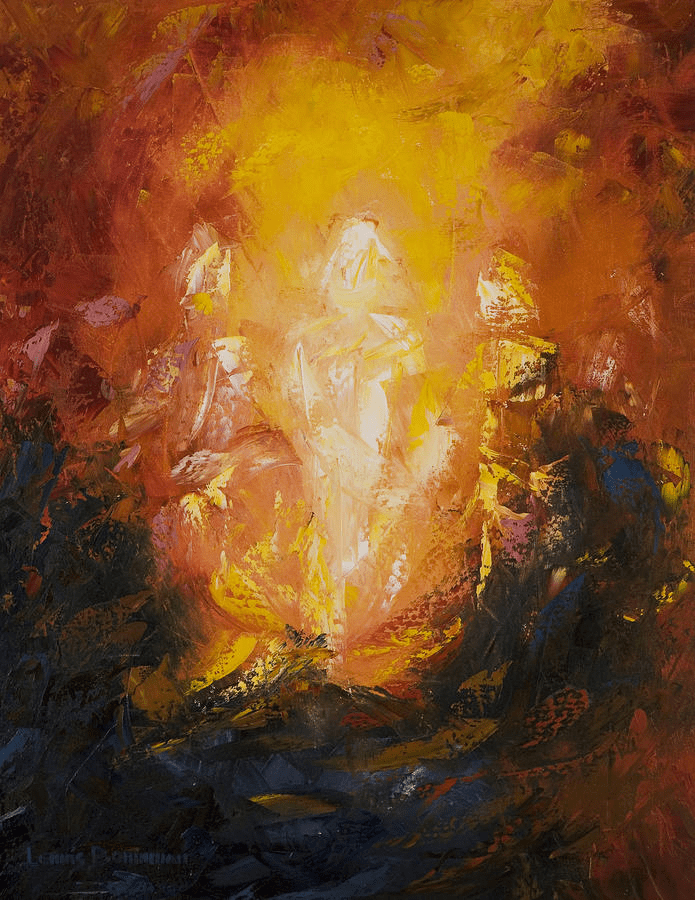
Transfiguration, by Lewis Bowman

In a similar way, the Transfiguration of Jesus in the New Testament Gospels does the same. The disciples were frightened on the mountain, seeing Jesus changed and probably much brighter than the face of Moses. And yet, they were also reassured that God was present with them in the person of Jesus Christ.

Just like the doubting people in Exodus, the disciples caught a glimpse of the great and awesome God, up close and personal. And like the people in the wilderness, the disciples did not understand everything that was going on. Both the ancient Israelites, and Christ’s disciples, did not fully comprehend what God was showing them. Each showed the fear of humanity, while God demonstrated God’s own character of love, faithfulness, and patience with frail humanity.

Certainly, when the face of Moses shone, it was an affirmation of the covenant’s renewal by God. The shiny face is also an indicator of the sort of relationship Moses had with God – and of his openness and vulnerability before God and before the community. It was a sign that Moses trusted God and that Israel, in turn, could trust God and Moses as their leader.

Whether veiled or unveiled, the face of Moses is a reminder of his unique relationship with God and with Israel. It’s a sign of God’s care and continual presence, and that God’s grace prevailed, even in the midst of Israel’s sin.

Another way of putting it, is that the radiant face of Moses represents a reversal of outcome concerning the golden calf idolatrous episode. It represents hope in the midst of a disaster in which all seemed hopeless.

In our own contemporary day and time of national upheavals and national disasters, it’s no wonder that many people would question whether there is any hope for our world, or not. Yet, no matter how dismal it may look; and no matter how unpromising the times we presently live in, today’s story about ancient Israel is a reminder to all of us to keep persevering and hold onto our confident hope that God is with us. There are better days ahead.

It might be Halloween, but the Advent of Christ is just around the corner.

Lord Jesus, Son of Man, Son of God, you encouraged us to come to you, all of us who labor and are heavy laden, and that you will give us rest. So, I now take your yoke upon myself, and learn from you because you are gentle and lowly in heart, and I know I will find rest for my soul. For your yoke is easy, and your burden is light. Help me to refocus from all that’s wrong in this old fallen world, and trust in you, through the enablement of the Holy Spirit. Amen.

Use Your Freedom For Good (Exodus 33:1-6)

Then the Lord said to Moses, “You and the people you brought out of Egypt must leave this place. Go to the land I promised to Abraham, Isaac, and Jacob with an oath, saying, ‘I will give it to your descendants.’ I will send a Messenger ahead of you, and I will force out the Canaanites, Amorites, Hittites, Perizzites, Hivites, and Jebusites. Go to that land flowing with milk and honey. But I will not be with you, because you are impossible to deal with, and I would destroy you on the way.”

When the people heard this bad news, they acted as if someone had died. No one wore any jewelry. The Lord had said to Moses, “Tell the Israelites, ‘You are impossible to deal with. If I were with you, I might destroy you at any time. Now take off your jewelry, and I’ll decide what to do with you.’” After they left Mount Horeb, the Israelites no longer wore their jewelry. (God’s Word Translation)

It took little time for the covenant between God and the Israelites to be violated. The relationship between the Lord and the people was meant to be cemented through a special covenant in which Yahweh makes promises to them and gives them instructions and commandments; and the Israelites pledge their fealty and promise to obey.

But the people quickly reneged on the relationship. While Moses was up on Mount Sinai, receiving the Law from God, the Israelite grumbles and complaints came to full flower. They went their own way and made a calf idol out of gold.

So, the Lord’s judgment broke out amongst them. The Levites, to their credit, rallied around Moses and the Lord, and took out the rabble rousers in the camp. What’s more, God sent a plague that killed many.

In the aftermath of the rebellion against Moses and the Lord, God ordered the people to leave Mount Sinai – the place where everyone was to have a positive experience of Yahweh’s presence. God’s anger and wrath were so aroused that it became impossible for the divine presence to go with the people. Only Moses, as God’s emissary, would be able to guide the Israelites so that they are not completely eradicated.

Mount Sinai, by Sefira Lightstone

Yet, even after all the bad attitudes, rebellious actions, and an idolatrous spirit among the Israelites, Yahweh will still keep the divine promise to Abraham, Isaac, and Jacob to deliver them and bring them to the Promised Land.

Today’s story has the feel of a chastened child sitting in the corner, having to think about what they just did to raise the ire of the parent. The Israelites moved from Sinai in a somber mood, realizing more clearly than ever how much their lives are tied and linked to God’s divine presence.

At God’s command, the people removed their jewelry and took off their party clothes from the celebration that got them into so much trouble. It began to sink in, that the Lord departed from them because of their great sin. They started to realize, albeit too late, that they really screwed up their relationship with God.

The Israelites didn’t know how good they had it with the divine pillar of cloud by day and fire by night to lead them – and how much they actually depended on the God-given manna for their sustenance and existence.

It’s all too typical for us humans that we fail to realize what we have, until it’s gone. The ancient Israelites were freed from a cruel slavery in Egypt. They clearly did not handle their freedom well, at all. Perhaps the people were so used to being in bondage that, when they go their freedom, they just adopted a different sort of slavery – to their sinful passions.

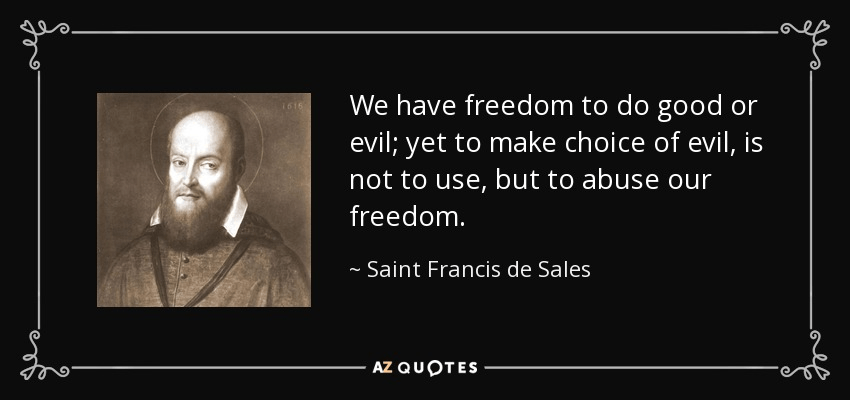
Let’s handle our freedom with some responsibility and accountability, so that we do not go down the same rebellious path as the ancient people of God. You and I are free to choose what we do, what we think, and how we spend our time. It’s easy to blame outside forces when circumstances are hard; and to grumble whenever we don’t like something.

Freedom is a spiritual discipline; we must learn how to intentionally practice it and use it for good. The following are four areas to purposefully work on with our freedom by making good choices:

Choose your words carefully. What comes out of your own mouth is up to you. Let those words reflect who you truly are; and let your speech impact others around you for good, and not evil.

Choose your attitude with some self-awareness. With awareness comes choices. For example, if we are not aware of our own anger, it will eventually come out sideways on another person. Our sullen attitude and jaded perspective will color our relational interactions. But if we are aware of our emotions, we can choose to effectively work through them, and then decide what sort of attitude we’re going to have.

Choose your actions before you do them. Seemingly insignificant choices turn into small actions. The small actions become habits. And habits shape character and create a life. We make choices every day about what we’ll do and not do. In every sort of situation we have choices to act, such as: Will I let go, or will I try and control others? Will I walk, or drive? Will I spend, or save? Shall I prepare, or procrastinate? Be fit, or be fat? Talk or listen?… and a thousand other choices of action.

Choose your beliefs with care. Our beliefs and our faith determines how we act and behave. If we believe in a good God who has our best interests at heart, we will freely trust such a God. But if we believe God to be a capricious Being who is aloof from my concerns, then we will make choices to watch out for number one and view others with suspect.

If you are behaving in ways that aren’t working for you, examine what belief is causing that behavior. Then decide whether that’s a belief you really need to have, or not, then change it, if necessary.

Every choice we make, contributes to the person we want to become, and sets us on the path to where we want to be in life. Maybe if the ancient Israelites had more awareness of this, they might have chosen very differently.

Gracious God, grant me clarity and awareness to make wise decisions. Enlighten my heart and mind, as I seek to follow your divine guidance. In the face of uncertainty, give me the courage to trust your promises. Help me embrace the path set before me, with a spirit of love and grace. Amen.

Remember God, for God Has Remembered Us (Psalm 105:1-11, 45b)

Give thanks to the Lord;
    call upon his name;
    make his deeds known to all people!
Sing to God;
    sing praises to the Lord;
    dwell on all his wondrous works!
Give praise to God’s holy name!
    Let the hearts rejoice of all those seeking the Lord!
Pursue the Lord and his strength;
    seek his face always!
Remember the wondrous works he has done,
    all his marvelous works, and the justice he declared—
    you who are the offspring of Abraham, his servant,
        and the children of Jacob, his chosen ones.

The Lord—he is our God.
    His justice is everywhere throughout the whole world.
God remembers his covenant forever,
    the word he commanded to a thousand generations,
        which he made with Abraham,
        the solemn pledge he swore to Isaac.
God set it up as binding law for Jacob,
    as an eternal covenant for Israel,
    promising, “I hereby give you the land of Canaan
    as your allotted inheritance….”

Praise the Lord! (New Revised Standard Version)

Human thoughts and actions respond to divine thoughts and actions. We remember because God remembers. We act because God acts in history. We give because the Lord first gave to us.

The psalmist calls us to act and to think – and it’s all a response to God’s merciful attention to God’s people. Notice the imperative verbs which call us to use our words, emotions, and actions, so that we press spiritual truth into our minds and hearts, and do not forget our experiences. They all, from a Christian perspective, have their fulfillment in the person and work of Jesus.

Give thanks to the Lord

Give thanks in all circumstances; for this is God’s will for you in Christ Jesus. (1 Thessalonians 5:18, NIV)

Make known God’s deeds

“Righteous Father, though the world does not know you, I know you, and they know that you have sent me. I have made you known to them, and will continue to make you known in order that the love you have for me may be in them and that I myself may be in them.” (John 17:25-26, NIV)

Sing praises to the Lord

For I tell you that Christ has become a servant of the Jews on behalf of God’s truth, so that the promises made to the patriarchs might be confirmedand, moreover, that the Gentiles might glorify God for his mercy. As it is written:

“Therefore I will praise you among the Gentiles;
    I will sing the praises of your name.”

Again, it says,

“Rejoice, you Gentiles, with his people.” (Romans 15:8-10, NIV)

Dwell on God’s works

Let the message of Christ dwell among you richly as you teach and admonish one another with all wisdom through psalms, hymns, and songs from the Spirit, singing to God with gratitude in your hearts. (Colossians 3:16, NIV)

Give praise to God’s holy name

Now on his way to Jerusalem, Jesus traveled along the border between Samaria and Galilee. As he was going into a village, ten men who had leprosy met him. They stood at a distance and called out in a loud voice, “Jesus, Master, have pity on us!”

When he saw them, he said, “Go, show yourselves to the priests.” And as they went, they were cleansed.

One of them, when he saw he was healed, came back, praising God in a loud voice. He threw himself at Jesus’ feet and thanked him—and he was a Samaritan.

Jesus asked, “Were not all ten cleansed? Where are the other nine? Has no one returned to give praise to God except this foreigner?” Then he said to him, “Rise and go; your faith has made you well.” (Luke 17:11-19, NIV)

Pursue the Lord

Flee the evil desires of youth and pursue righteousness, faith, love and peace, along with those who call on the Lord out of a pure heart. (2 Timothy 2:22, NIV)

Seek God’s face

And without faith it is impossible to please God because anyone who comes to him must believe that he exists and that he rewards those who earnestly seek him. (Hebrews 11:6, NIV)

Remember God’s works and God’s justice

“Why do you look for the living among the dead? He is not here; he has risen! Remember how he told you, while he was still with you in Galilee: ‘The Son of Man must be delivered over to the hands of sinners, be crucified and on the third day be raised again.’” (Luke 24:5-7, NIV)

We are to remember because God remembers. The Lord has an ongoing reminder in the divine day timer: Fulfill the promises I made. Keep the covenant I initiated with the people, even when they are stinkers and forget who I am.

God does not forget. The Lord keeps divine promises.

For the Christian, all God’s promises are remembered and fulfilled in the person and work of Jesus Christ.  Deliverance from sin, death, and hell; the gift of the Holy Spirit; and, ongoing divine presence and provision are given to us graciously and freely by the God who loves and cares for people. 

For Christians everywhere, remembering means coming to the Lord’s Table, entering into the once for all loving sacrifice of Christ on our behalf. It is here that we remember to give thanks and praise, seek and sing. In doing so, we make invisible realities visible, and the divine character of God known to amongst the nations.

God and Father of all, and of Jesus Christ our Lord, as you remember your dear Son, remember us. Grant us peace in our time and a longing for the day when people of every language, race, and nation will be brought into the unity of Christ’s kingdom, where there shall be endless praise, singing, thanksgiving, and joy in the Holy Spirit. This we ask in your holy Name, because of your great glory, and for the sake of Christ’s rule and reign over the earth, now and forever. Amen.