Living Without Answers (Job 41:12-34)

“I will not keep silent concerning its limbs
    or its mighty strength or its splendid frame.
Who can strip off its outer garment?
    Who can penetrate its double coat of mail?
Who can open the doors of its face?
    There is terror all around its teeth.
Its back is made of shields in rows,
    shut up closely as with a seal.
One is so near to another
    that no air can come between them.
They are joined one to another;
    they clasp each other and cannot be separated.
Its sneezes flash forth light,
    and its eyes are like the eyelids of the dawn.
From its mouth go flaming torches;
    sparks of fire leap out.
Out of its nostrils comes smoke,
    as from a boiling pot and burning rushes.
Its breath kindles coals,
    and a flame comes out of its mouth.
In its neck abides strength,
    and terror dances before it.
The folds of its flesh cling together;
    it is firmly cast and immovable.
Its heart is as hard as stone,
    as hard as the lower millstone.
When it raises itself up the gods are afraid;
    at the crashing they are beside themselves.
Though the sword reaches it, it does not avail,
    nor does the spear, the dart, or the javelin.
It counts iron as straw
    and bronze as rotten wood.
The arrow cannot make it flee;
    slingstones, for it, are turned to chaff.
Clubs are counted as chaff;
    it laughs at the rattle of javelins.
Its underparts are like sharp potsherds;
    it spreads itself like a threshing sledge on the mire.
It makes the deep boil like a pot;
    it makes the sea like a pot of ointment.
It leaves a shining wake behind it;
    one would think the deep to be white-haired.
On earth it has no equal,
    a creature without fear.
It surveys everything that is lofty;
    it is king over all that are proud.” (New Revised Standard Version)

In a long anticipated response, God finally spoke to Job with his companions present. And it was nothing like anyone expected.

Today’s Old Testament lesson continues God’s questioning of Job, and talking of the great Leviathan – a large and uncontrollable creature.

Trying to figure out exactly what Leviathan is or was (e.g. a dragon, a dinosaur, or some dang demon) is not the point of having this chapter in Holy Scripture.

We can become obsessed with having our questions answered, everything neatly categorized and understood, every problem and mystery solved to our satisfaction.

If the Book of Job teaches us anything, it is that there are questions for which there are no answers this side of heaven. There are problems which we humans cannot logically and scientifically solve.

Ironically, we discover the presence of God through God’s absence; and hear the voice of God through God’s silence.

Any encounter we may have with God will typically shatter any preconceived notions about divinity. Any experience with God shall prevent us from packaging up an answer with some nice pretty paper and bows, as if we were enjoying a delightful Christmas at home.

Facing God is much more like coming face to face with who you really are, and what motivations and intentions are really in your heart. It’s more like Halloween than Christmas. It’s staring at a scary monstrous Leviathan, and not a bright jolly Santa Claus.

Coming to grips with our fears and anxieties, struggles and weaknesses, mortality and vulnerability, is the real sort of encounter people have with God. It’s not so much that God is scary; it’s we who are scary.

It’s scary what people will sometimes do in order to try and get answers to their questions. And it is equally scary what we will do to avoid the questions asked of us.

We don’t like hearing there are some things which are unanswerable. Yet, the mystery of God is real, which means that we are never going to know about everything we want to understand.

And we also don’t like being questioned. But what can you do, whenever you cannot move, and God begins peppering you with his own questions?

We would like to justify and vindicate ourselves – even rationalize our words and actions, if that’s what it takes. Yet, it is God alone who has the power to absolve and exonerate, to bring justice while in the teeth of injustice.

Furthermore, such justification comes in God’s own timing, not ours. Again, this is one of those realities which is far above us, for which we have only a very limited perspective on.

As we move ever closer to the end of the Book of Job, Job’s quest for answers and vindication hasn’t come, at least yet. We, along with Job, must handover the entire affair thoroughly to God in complete trust – without insisting that God say or do what I want God to say or do.

Living by faith is the only real option we have. All other options leave us in an existential angst, sliding toward nihilism.

Anyone who believes they can govern the world better than God, better brace themselves for some serious questioning.

There is not a person on this earth, including myself, that I would trust to run it for ten minutes. Because within ten seconds the world would be burning.

I don’t want that world.

I want a world with God – because I wholeheartedly believe that grace is the real and true operative force on this earth.

The grace of God allows us to see the divine without having to have our puny questions answered. Grace reassures us that we are not lost, that God sees and knows what is happening, and will do something about it.

So therefore, I can rest assured that everything is held in the sinewy strong arms of God. And no person, no monster, no Leviathan, is outside of God’s ability to effect justice and righteousness in the world.

It may take some time to realize complete and total justice, but God has given me enough faith to rest in mystery, and to live with uncertainty.

May it be so, to the glory of God.

Creator of the world, we pray

That you, with steadfast love, would keep

Your watch around us while we sleep.

From evil dreams defend our sight,

From fears and terrors of the night;

Tread underfoot our deadly foe

That we no sinful thought may know.

O Father, we ask your will to be done

Through Jesus Christ, your only Son;

And Holy Spirit, by whose breath

Our souls are raised to life from death. Amen.

Who Is In Control? (Psalm 47)

Ascension, by Angela Taylor Perry

Clap your hands, all you peoples;
    shout to God with loud songs of joy.
For the Lord, the Most High, is awesome,
    a great king over all the earth.
He subdued peoples under us
    and nations under our feet.
He chose our heritage for us,
    the pride of Jacob whom he loves.

God has gone up with a shout,
    the Lord with the sound of a trumpet.
Sing praises to God, sing praises;
    sing praises to our King, sing praises.
For God is the king of all the earth;
    sing praises with a psalm.

God is king over the nations;
    God sits on his holy throne.
The princes of the peoples gather
    as the people of the God of Abraham.
For the shields of the earth belong to God;
    he is highly exalted. (New Revised Standard Version)

Who is in control? This is really a big question. We humans seem almost obsessed with the issue of control.

Some people want to be in charge of regulating everything. Others want to exert force over nothing at all. And there are those who continually want to know the clear lines of authority and who is in control, at all times.

Control, in and of itself, is not a bad thing. In fact, it’s a good thing. Taking charge of a situation – and especially of oneself – is often needed. Leadership that is informed, decisive, humble, true, and right, is a must.

The problem comes whenever we try to exert domination over another person, or attempt to command an organization when it isn’t our responsibility to do so.

Ultimate control of all things belongs to God, and not to you or me. The psalmist is insistent that God is the Ruler of the universe; and that all things belong to the Lord. God’s commands are good.

The Lord’s dominion is known as the kingdom of God. Whenever people are in sync with this reality, then they are able to be joyful and celebrate the good, right, and just Being who is in control.

Yet, if people have problems trusting another; desire to always call the shots on everything; and command everyone; there you will find a host of miserable people – with the one trying to exert control as the most miserable of all.

People, instead, are called to self-control. We are to have charge over our own thoughts and actions. It’s important to have sobriety in our lives in which we can use proper restraint, as well as needed initiative.

Be alert and be of sober mind. Your enemy the devil prowls around like a roaring lion looking for someone to devour. (1 Peter 5:8, NIV)

In order to get our lines of authority in the proper places, and to participate in the established rhythms of control in the universe, we are commanded to clap, shout, and sing. Because God has ultimate control, divine initiatives are grounded in goodness, justice, righteousness, and deliverance from evil. The Lord has mercifully acted on behalf of people.

The Lord only asks of us to do things that he himself has done. The psalm states that “God has gone up with a shout.” We shout because God shouts. God rules over the nations, and was not simply some local deity that the ancient Israelites served and worshiped. The divine presence is with those who acknowledge God; they will hear the Lord’s shout.

“No misfortune is seen in Jacob,
    no misery observed in Israel.
The Lord their God is with them;
    the shout of the King is among them.
God brought them out of Egypt;
    they have the strength of a wild ox.” (Numbers 23:20-22, NIV)

We are also told to sing. The reason we do so is because the Lord is high above all people, and is king over the nations. This is something we need to say out loud and to sing, and to not only read silently in our heads. Our ears need to listen to the psalm, to hear the praises of God reverberating on our ear drums.

My people, hear my teaching;
    listen to the words of my mouth. (Psalm 78:1, NIV)

It is perfectly appropriate for Christians to use today’s psalm in reflection upon Ascension Day. Jesus has been lifted up into the sky; God has gone up with a shout. The Lord has equipped us for citizenship in the kingdom of God. We have solid grounds for celebration, shouting, and singing. Jesus is our King.

God put this power to work in Christ when he raised him from the dead and seated him at his right hand in the heavenly places, far above all rule and authority and power and dominion and above every name that is named, not only in this age but also in the age to come. And he has put all things under his feet and has made him the head over all things for the church. (Ephesians 1:20-22, NRSV)

Because of Christ’s ascension, believers in Jesus have the memory of the past, the experience of the present, and a hope for the future. With Jesus in control, there is no need for fear, or for trying to gain control for oneself.

Grant, we pray, Almighty God, that as we believe your only-begotten Son our Lord Jesus Christ to have ascended into heaven, so we may also in heart and mind there ascend, and with him continually dwell; who lives and reigns with you and the Holy Spirit, one God, for ever and ever. Amen.

Contending with Forces Beyond Our Control (Mark 5:1-20)

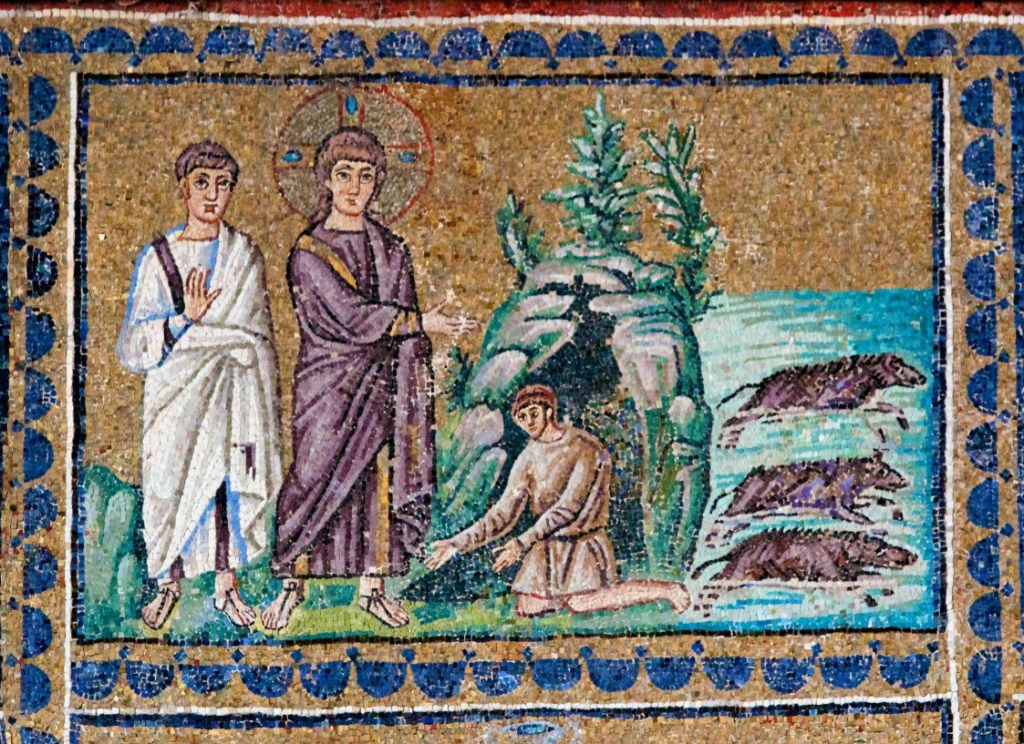
6th century mosaic of the exorcism of the Gerasene demoniac, Basilica di Sant’Apollinare Nuovo, Ravenna, Italy

They went across the lake to the region of the Gerasenes. When Jesus got out of the boat, a man with an impure spirit came from the tombs to meet him. This man lived in the tombs, and no one could bind him anymore, not even with a chain. For he had often been chained hand and foot, but he tore the chains apart and broke the irons on his feet. No one was strong enough to subdue him. Night and day among the tombs and in the hills he would cry out and cut himself with stones.

When he saw Jesus from a distance, he ran and fell on his knees in front of him. He shouted at the top of his voice, “What do you want with me, Jesus, Son of the Most High God? In God’s name don’t torture me!” For Jesus had said to him, “Come out of this man, you impure spirit!”

Then Jesus asked him, “What is your name?”

“My name is Legion,” he replied, “for we are many.” And he begged Jesus again and again not to send them out of the area.

A large herd of pigs was feeding on the nearby hillside. The demons begged Jesus, “Send us among the pigs; allow us to go into them.” He gave them permission, and the impure spirits came out and went into the pigs. The herd, about two thousand in number, rushed down the steep bank into the lake and were drowned.

Those tending the pigs ran off and reported this in the town and countryside, and the people went out to see what had happened. When they came to Jesus, they saw the man who had been possessed by the legion of demons, sitting there, dressed and in his right mind; and they were afraid. Those who had seen it told the people what had happened to the demon-possessed man—and told about the pigs as well. Then the people began to plead with Jesus to leave their region.

As Jesus was getting into the boat, the man who had been demon-possessed begged to go with him. Jesus did not let him, but said, “Go home to your own people and tell them how much the Lord has done for you, and how he has had mercy on you.” So the man went away and began to tell in the Decapolis how much Jesus had done for him. And all the people were amazed. (New International Version)

Jesus cures the Gerasene demoniac,from the Gospel Book of Otto III, Reichenau,
Germany, c.1000

The Evangelist Mark wants his readers and hearers to understand and know that Jesus is the Divine Warrior who fights against evil in the world. Many times in his earthly ministry, the Lord Jesus encountered some rather militant demons. In today’s Gospel lesson, an entire legion of them were tormenting a man who was unable to be with others and hung out in cemeteries all the time, practicing self-harm.

Much like Pharaoh’s army being drowned in the Red Sea by an act of God, so Jesus sent the legion of demons into a herd of pigs who rushed over an embankment and into the sea to drown.

The chaotic man comes to his right mind. The chaos evoked by the demonic realm is restored to order.

But, similar to an Old West movie in which the townsfolk are shortsighted to the sheriff’s heroic feat, the people in the region of the Gerasenes only see the loss of pigs, and not the loss of demons. So, the people pleaded with Jesus to leave the area.

Yet, at some point, everyone must deal with Jesus, simply because he is a force to be reckoned with. 

Eventually, we all face unseen forces that are beyond our control. It might not be today, and the sun may out, but the weather will change; everyday isn’t the same. Summer will give way to autumn, and then winter. The landscape will look very different. It’s not a question of “if” but “when.” We may console ourselves that we don’t have to deal with those forces today, but contend with them we shall.

Jesus will come. A person might not have to deal with him today, maybe not tomorrow. However, eventually, there will be a whopper of a gale force, and we will have to deal with it.

In today’s Gospel lesson, a man who was severely influenced by a strong demonic force approached Jesus. Inside of him was such a terrible inner storm that the demons shouted at Jesus.

Jesus, unfazed by the man’s inner violence and outer screams, uttered a command from a place of confidence. As fierce as the man was, Jesus had the authority to deal with the situation. As a result, the terrible force within the man subsided.

Yet, the bad weather was not over – it picked up momentum with the townsfolk. It seems they had been living their merry lives with no thought to Jesus. But he showed up. So, they had to contend with his authority right there in front of them. Unfortunately, they chose poorly. 

The Evangelist, Mark, wants us to see a connection in the story between the demons who begged Jesus, and the people of the town who begged Jesus. They did not humbly beg to follow him; they begged him to get away and leave them alone.

Jesus is an authoritative force to be reckoned with… and he is coming to your town.  Maybe not today, perhaps not tomorrow. But things will not always be the way they are right now. People will have to contend with unseen forces, and they will eventually face Jesus, one way or another.

Jesus Christ, Son of God, you are Lord over the wind, the waves, and the weather. You also command the unseen, and they obey. You are God with us. Oh, that all people would beg to follow you and not beg you to leave! I am grateful for your power and authority over all things. Amen.

Hold It Loosely (Exodus 1:1-7)

When Jacob went to Egypt, his son Joseph was already there. So Jacob took his eleven other sons and their families. They were: Reuben, Simeon, Levi, Judah, Issachar, Zebulun, Benjamin, Dan, Naphtali, Gad, and Asher. Altogether, Jacob had 70 children, grandchildren, and great-grandchildren who went with him.

After Joseph, his brothers, and everyone else in that generation had died, the people of Israel became so numerous that the whole region of Goshen was full of them. (Contemporary English Version)

Exodus is the second book of the Bible, and the second of five books known as the “Pentateuch” by Christians, and the “Torah” by Jews. The first book, Genesis, ended with the story of Joseph – who was one of the 12 patriarchs. God established a covenant with Abraham, the father of Judaism, and promised him land and descendants – even though he did not have a son. God miraculously gave Abraham and Sarah a biological son, Isaac, who grew up to be the father of Jacob, or Israel, Joseph’s father.

The stories in Genesis surrounding Abraham, Isaac, Jacob, and Joseph were filled with wonderings of whether God’s promise would ever survive, or not. Yet, it did. Joseph, in the ultimate reversal of fortunes, went from the lowest person in Egypt to it’s highest official. Through Joseph, the brothers and their families ended up relocating to Egypt because of a severe famine.

Present-day land of Goshen, Egypt

As time moved on, Joseph, his brothers, and all that generation died. In contrast to the extended family of Jacob, 70 of them, who initially went to Egypt, the opening of of Exodus relays an exponential growth in numbers of Israelites.

God was faithfully and tirelessly preserving the covenant and the promise for Israel. When the people went to Egypt, God assured them they need not be afraid. The Lord will make them a great nation, will be with them, and shall lead them back out again. (Genesis 46:1-4)

The opening of Exodus not only connects us with events in the latter part of Genesis, but also hearkens back to it’s very beginning, when God spoke to the first human couple. The Lord gave them a five-fold blessing, consisting of commands to 1) be fruitful 2) multiply 3) fill the earth 4) subdue it, and 5) have dominion over it. (Genesis 1:28)

Following the Flood, God blessed Noah, repeating the commands to be fruitful, multiply, and fill the earth (Genesis 9:1). Later, God spoke to Abraham, promisingto make him fruitful (Genesis 17:5-9). Moving into Exodus, we see a fulfillment of the commands and the promise taking shape, stating that the descendants of Israel were fruitful and multiplying, so that the land was filled with them.

It was this very blessing of progeny, and the fertile increase of descendants, which sets up the entire book of Exodus. The great and growing numbers of Israelites became a source of concern and fear amongst the Egyptians. It wasn’t long before the Jews were seen as another source of slave labor.

Sometimes, we must bear in mind and remember that great blessing also has an underbelly of great blight. Only God and relationships last forever; everything else is temporary, including our earthly blessings.

Therefore, it is wise to hold all things loosely, with open hands, and not with clenched fists that believes possessing things in this moment will be permanent. The following are some things to remember:

Remember who is in control

When things are going well, it may create the illusion that I am in charge of the blessing. But, in reality, it was given to you, and it can be taken away, as well.

The only thing you can control are your thoughts, feelings, emotions, choices, actions and the story you are telling yourself about what happened in the past, is happening now, and will happen tomorrow.

We all have our personal invisible backpacks to carry. That backpack is ours, and nobody else’s. Others have their own burdens to carry, which are individual to them. They aren’t yours to carry. Their stories aren’t yours to tell.

God is the Sovereign of the universe, and controls all things. That is God’s burden to carry. Not yours. Carrying the world on your shoulders isn’t your job. So, hold loosely whatever happens on this earth, whether for good or ill. 

Remember that life is both planning and improvisation

We have an agenda, make our plans, and put things in place. Yet, in the execution of doing it, we have to move with whatever circumstances and conditions arise – with whatever life throws our way – and then adjust our expectations.

Remember it’s both in planning and in improvising. The Israelites laid plans to go to Egypt, went there, and then had to deal with changing conditions once they were there. All planning and no improvising is unrealistic; and all improvisation with no plan is flying by the seat of your pants and living in a dream world which doesn’t exist.

What’s more, it might be your plan, or your group’s plan, but it’s not everybody’s plan. They have the freedom to say, “No thank you.” So, be careful to not marry yourself to a particular outcome. Release the urge to cling or obsess about certain expectations. Hold your plans loosely, and plan to improvise.

Remember to cooperate with God

In reality, there is a divine/human cooperative which exists on the earth. Ideally, we are to work together, me doing my part, and God handling the rest. And the both of us constantly must be in dialogue with each other.

When we align with this truth, and participate with God and integrate this cooperative into daily life, then we begin to relax, breathe, move with confidence, and speak with purpose. Head, heart, and gut are no longer disparate parts within me, but work together in a harmonious sync with the Lord.

If this is a challenge for you, set aside some time and be in nature. Look around you and observe all the life thriving right in front of you. Connecting with what is alive connects us to the universal Love which exists everywhere. And that Love can help us and heal us – if we will but let it.

I can hold things loosely because I know the internal pressure of “getting it right” isn’t mine to carry. I can cooperate with God, relax, do my best, and trust.

Blessings are wonderful and abound everywhere. Yet, adversity, acrimony, and even abuse still lurk about in this old fallen world. So, may you learn to hold all things loosely, and live as you know you can, and ought. Amen.